
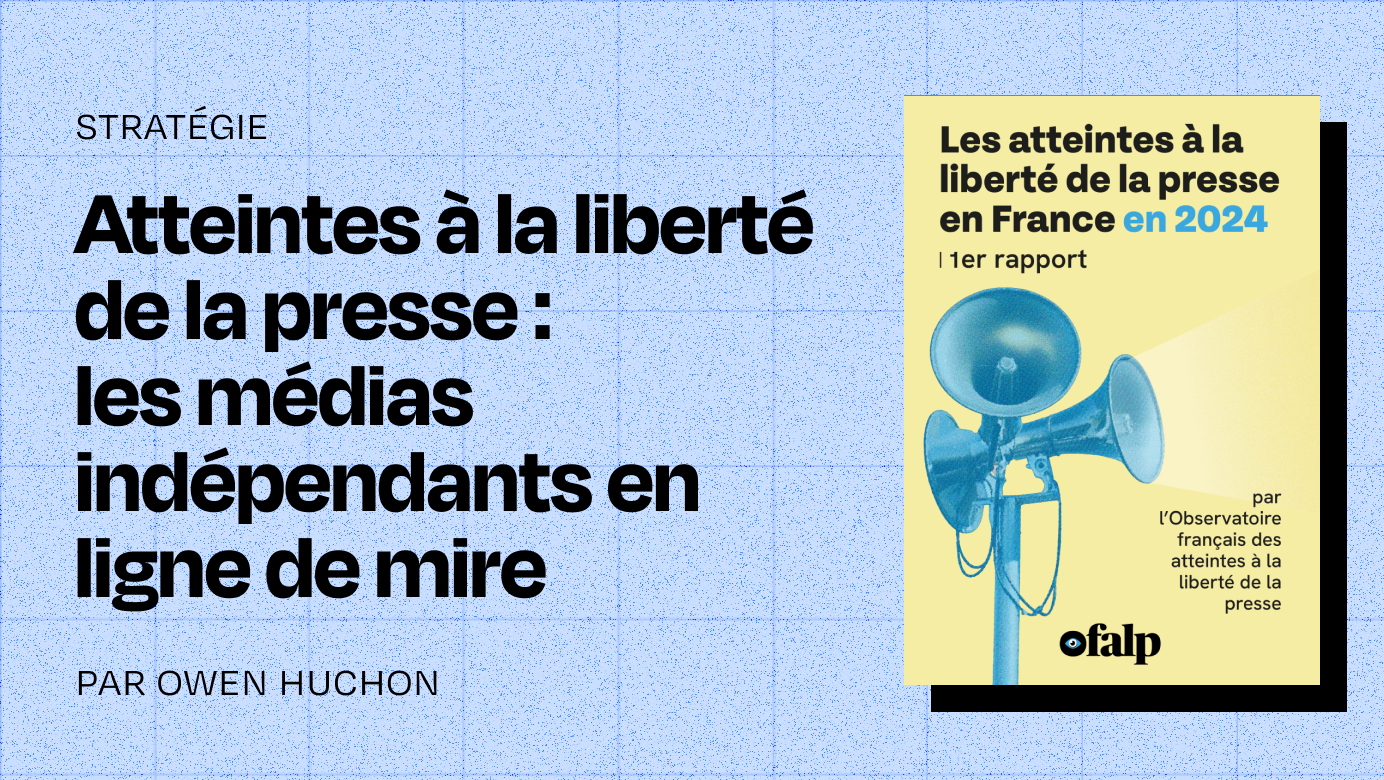
Launched in late 2023 by around twenty journalists, the French Press Freedom Violations Observatory (Ofalp) published its first report on Wednesday, February 18, bringing together reports and testimonies collected throughout 2024. In total, 91 cases of press freedom violations were documented and verified by the organization's teams.
While Ofalp acknowledges that the situation remains preliminary (lack of historical perspective, limited human resources), several emerging phenomena are evident. Among them: the repeated targeting of independent press outlets, which are particularly vulnerable due to their limited financial and human resources. Although it is not yet possible to establish a quantified trend in the absence of prior data, the recurrence and consequences of the documented attacks underline increased vulnerability.
Gag clauses to economic suffocation
Among the tactics used to hinder journalistic work, legal proceedings are a preferred instrument of intimidation strategies. Prominent among these are strategic lawsuits against journalism (in English: Strategic lawsuit against public participation, (SLAPP)), which have become a recurring pressure tool against newsrooms and journalists. "When they target small independent media outlets with already fragile finances, this directly threatens their viability, even their survival," the report notes.
For organizations with tight financial margins, these procedures are more than just a legal risk. They are a tool of economic pressure. The mere cost of defense, regardless of the court's outcome, consumes time, depletes cash reserves, and diverts teams from their core mission: producing information. "If we're ordered to pay [the other party] €15,000, we close down. We don't have the resources, let alone to pay half of what they're asking for," testifies a media professional to Ofalp. For organizations with tight margins, litigation risk becomes an existential risk.
A plurality of pressures… and affected media
Beyond these costly legal proceedings, the report documents other forms of pressure: harassment, threats, physical assault…
Examples cited include Arrêt sur images, whose journalist Nassira El Moaddem faced severe cyberstalking, Reflets, sued by the Altice group, Disclose, whose journalist Ariane Lavrilleux was monitored by the DGSI, and StreetPress, which claims to have received several hundred insulting messages daily during the 2024 electoral period. The report also mentions a list of media outlets blacklisted by LVMH, revealed by La Lettre, including notably L'Informé, Mediapart and Miss Tweed.
This exhibition examines the very structure of the independent media model, including for outlets whose economic independence is more stable. Without backing from a major corporation, without shareholders capable of absorbing this type of financial shock, these newsrooms alone bear the cost of their independence. A paradox: it is precisely because they are autonomous that they become more vulnerable.
A political context under tension
When asked about potential overexposure of independent media outlets, Ofalp takes a cautious approach.
In parallel, some newsrooms report observing a hardening of their working conditions. Last December, in an article published in Le Monde, journalist from Splann ! Faustine Stenberg spoke of progressive deterioration: "We feel a growing mistrust toward independent media".
An issue considered all the more urgent given the particularly intense electoral context in 2024, marked by the European elections followed by the dissolution of the National Assembly, which helped intensify tensions, the report notes: "The media are increasingly designated indiscriminately as enemies, even targets". A dynamic likely to recur as upcoming elections approach, one month before municipal elections and one year before the presidential election, in a political landscape marked by the rise of the far right. Of the 91 cases recorded, approximately one third can be linked more or less directly to this movement. Of the eight parliamentarians identified as authors of attacks, seven are members of parliament affiliated with or rallied to the National Rally.
What concrete tools can newsrooms use?
The association positions itself above all as a documentation tool, according to Cécile Dolman, journalist and co-president of Ofalp:
First and foremost is the transposition of the European anti-SLAPP directive, which is due to be transposed by May 2026 and should better protect journalists and public interest defenders against abusive lawsuits. Some organizations, including Reporters Without Borders and Sherpa, advocate for "over-transposition" to further strengthen the safeguards provided by the European text.
For newsrooms and journalists needing support, the report finally lists several existing programmes. Among them are the Free Press Fund and the NGO Media Defence, which jointly launched the Ripostes Fund to provide financial support to independent media facing abusive legal proceedings. Also mentioned is the French office of Reporters Without Borders, which offers assistance in case of attack (physical threats, online harassment, abusive legal proceedings).
Beyond these measures, the key also lies in anticipation and internal organization: identifying a dedicated legal advisor, formalizing an internal protocol in case of attack, and exploring forms of resource-sharing between independent media outlets to share resources and expertise. It is this capacity to anticipate and structure one's defense that constitutes, for leaders, the most strategic lever for protecting both their editorial freedom and their economic viability.