


On February 29th, the team from the feminist media outlet La Déferlante organized an evening at the third-space Césure in Paris, featuring a filmed conversation with author Annie Ernaux marking the release of their latest issue on abortion. The magazine took the opportunity to reflect on the progress made since the decriminalization of abortion fifty years ago and the stakes surrounding the issue, « at a time when the rise of the far right threatens reproductive rights in France and around the world ». The event, centered on a burning and mobilizing current issue, sold out just hours after ticketing opened — free admission.
Build and retain an audience
Like La Déferlante, adopting an event strategy centered on current news rather than a moment in your media's life cycle (release of a new issue, anniversary, launch of an offer, etc.) is a good way to showcase your team's expertise on contemporary social issues. The event becomes both a tool for building audience loyalty and an entry point for introducing your project to a wider public, who will attend the event for its programming rather than for who is organizing it, and will subscribe to La Déferlante's newsletters and social networks so they don't miss the next ones.

Whether discussing the mental health of American high school students, burnout among firefighters in the West, or the housing crisis in Los Angeles, at ProPublica, an investigative nonprofit based in New York, all events are systematically organized or streamed online. The practice began in the early days of the Covid-19 crisis, a time when the shift to remote work was still viewed as a constraint.
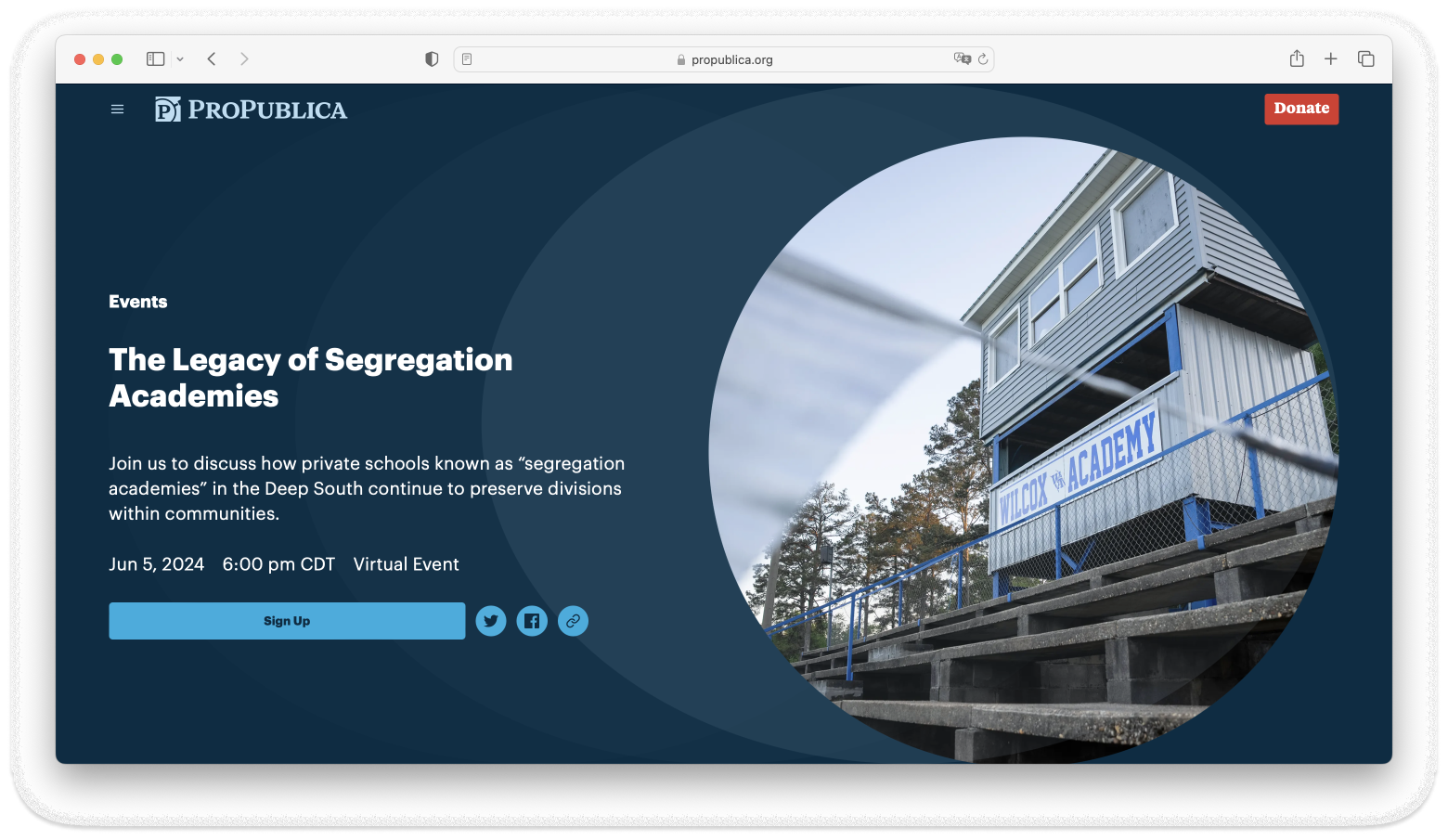
Celeste LeCompte, vice president of strategy and operations at ProPublica explains to marketing platform Marigold Engage that the media outlet has been able to capitalize on this situation by ensuring that people attending online events can be integrated into a loyalty cycle. "When you register for a webinar on ProPublica, you submit a certain amount of information on our site and you have the option to sign up for our newsletters. We then use the information provided to create personalized invitations to future events and to suggest certain content based on the person's interests." Beyond making events more accessible and thus expanding its potential audience beyond geographic constraints, this strategy makes it possible to deliver the best content to each reader at the right time. A good way to maximize visibility and impact while building an engaged community.
Anchor events in the value proposition
When news gives rise to one-off events, these can also be integrated into a media outlet's value proposition. This is the case with Grand Continent, a journal founded in 2019 devoted to European issues from a geopolitical, legal and cultural perspective. Grand Continent's event-driven approach consists of regularly organizing conferences and discussions on European political space, climate challenges, women's rights and the connections between philosophy and history.
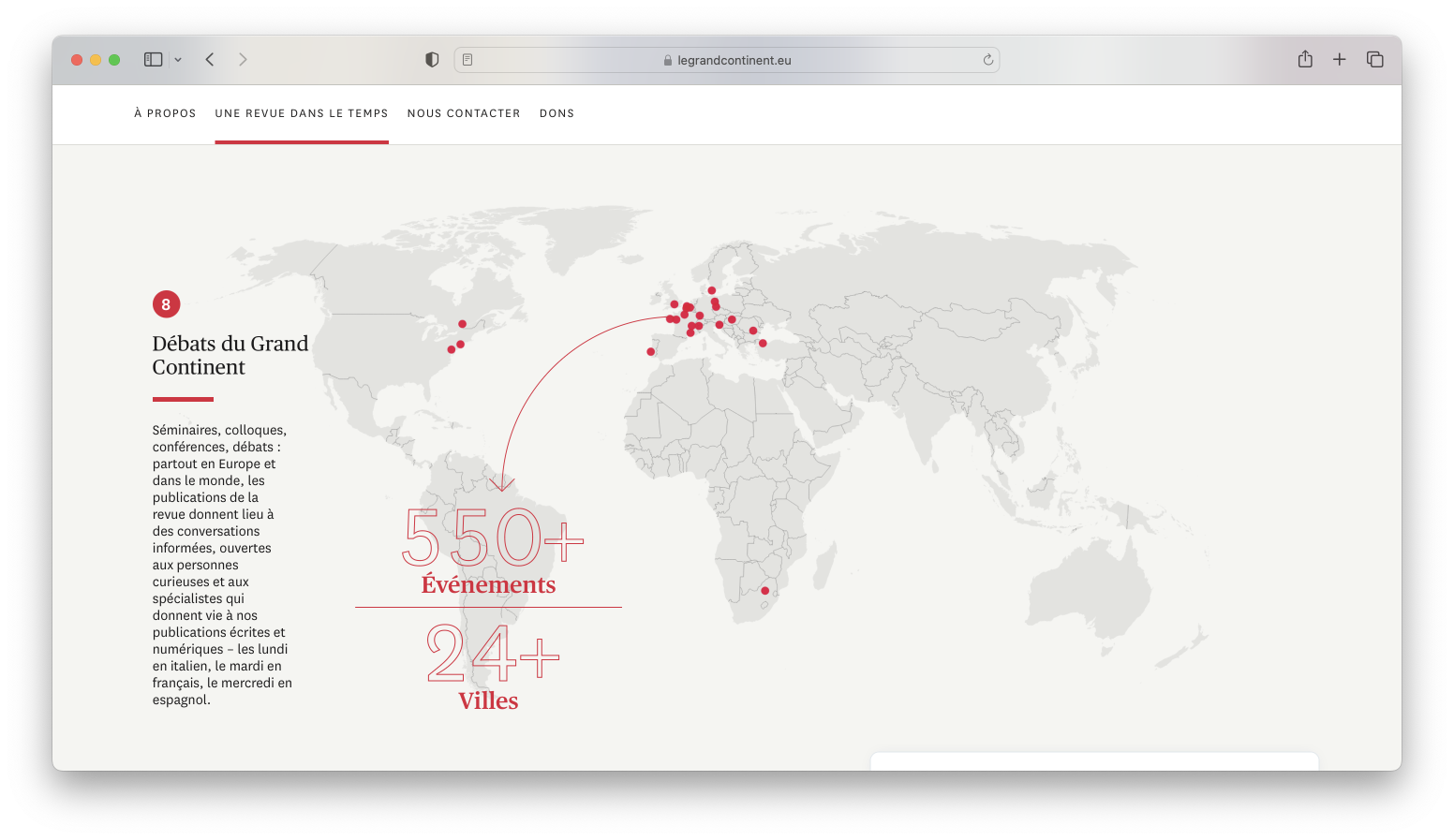
These events are an integral part of the journal's editorial strategy and aim to build reader loyalty by expanding on published articles while offering a new entry point to the journal, using current events as a starting point. This strategy thus consists of beginning with the reader's interests to help them discover the media and, why not, propose an offer that suits them.
In Marseille, the Mediavivant team also produces investigations told aloud. On stage, journalists invite their sources to testify live, in a venue open to all. A similar initiative exists in Austria, from the magazine Dossier.
For audiences turning away from traditional media, these moments make it possible to tell the news in a different way and to identify with the people reporting it. These events bring a human and lively dimension to information, stimulating empathy and reflection among viewers.
⟶ As many cases and business models detailed in our book Creating a Media.
Gather engaged media
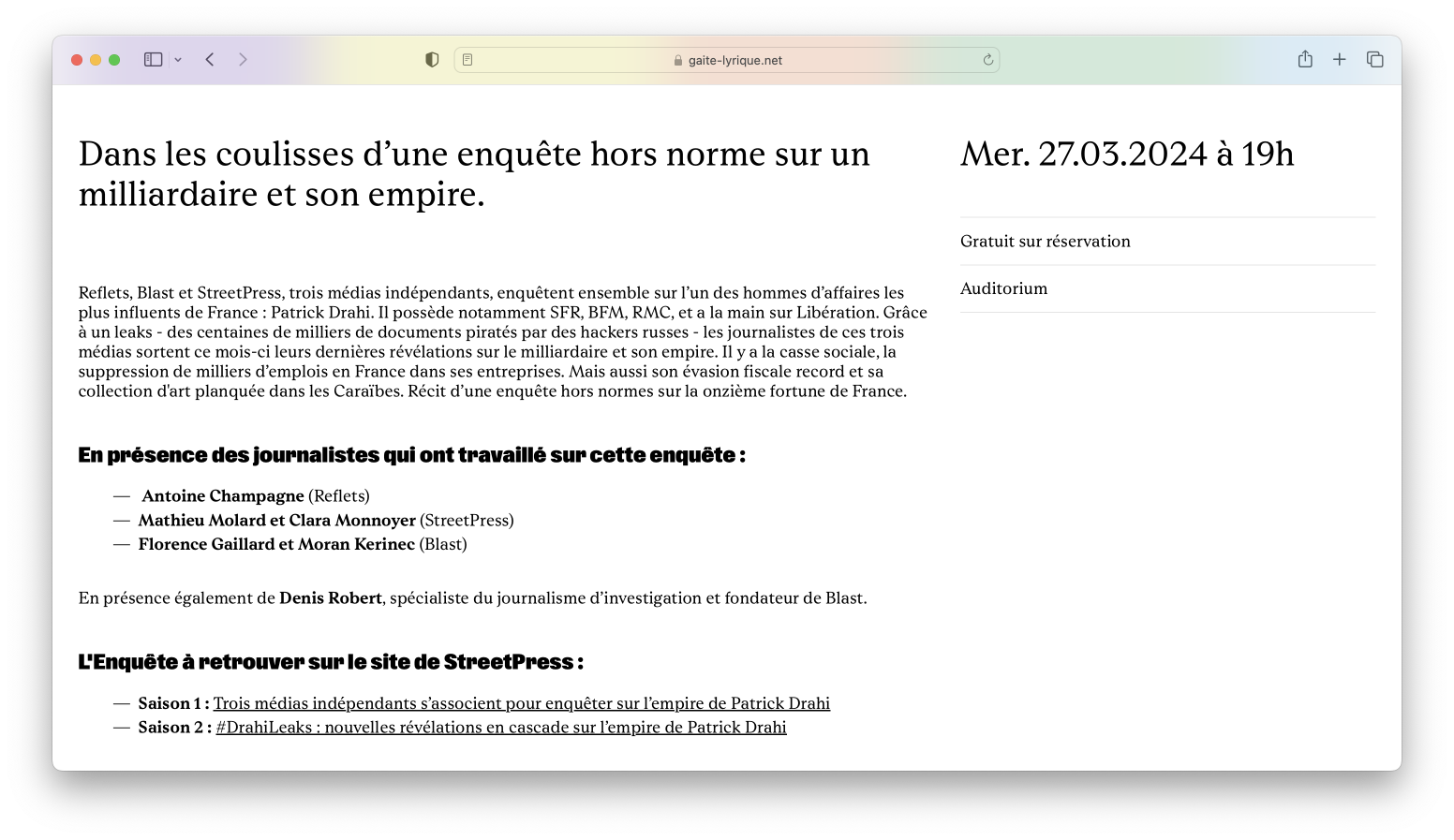
When current events serve as a pretext for organizing an event, they also become one for inviting colleagues from other media outlets covering the same themes or topics. This choice underscores the idea that independent and committed press would be better served by complementing each other rather than competing. Thus, when Reflets, Blast, and StreetPress jointly investigated Patrick Drahi's empire, they also chose to organize a free event aimed at revisiting the latest revelations about one of France's most influential business figures. By adopting this approach, these media outlets demonstrated that pooling their strengths could not only improve the quality of their investigations but also amplify their impact by combining each one's resources, expertise, and audiences.
One could equally envision these moments without pooling editorial output. For example, the fanzine Climax does not cover ecology in the same way as Mediapart. Yet these differences are their strength, and Climax illustrated this complementarity by organizing in March the anti-anniversary of TotalEnergies' 100 years, an event deliberately mocking and critical in which the fanzine invited Mickaël Correia, climate journalist at Mediapart and author of the book Le mensonge Total, enquête sur un criminel climatique. Beyond enriching discussions, inviting a journalist from an "established" media outlet — Mediapart celebrated sixteen years this year and has 220,000 subscribers — recognized for its investigations helps boost one's media in legitimacy and visibility.
Bet on iconic personalities and places
This headliner logic is also adopted by the La Déferlante team. Since the launch of its first issue, the feminist magazine's team has organized events alongside key figures in the feminist movement. This strategy includes in-store readings and evenings with filmed interviews published on the YouTube platform. « In this case, the goal is to reach a wider audience. Like in the magazine, we invite well-known figures from feminism who themselves have an impact and reach their own community », explained Perrine Daubas, Executive Director of the magazine to Médianes in 2021. These personalities thus become ambassadors for the media, helping to extend its reach and impact beyond its initial readership. They allow media outlets to reach a new community, to demonstrate their understanding of the issues they address, and therefore to strengthen trust.
The choice of venue is equally important. A concert hall, bar, or suitable community space makes it possible to reach an audience already interested in certain topics, while organically raising awareness of your media outlet. It's a way to attract regular visitors to a venue who frequently check its programming and to draw new curious people interested in the subject being covered. The media organization hosting the event is immediately associated with the values and discussions that matter to the relevant audience. An illustrative example of this strategy is the podcast Afrotopiques, recorded once a month in front of a live audience at La Gaîté Lyrique, "a cultural venue of the City of Paris, intended to respond to cultural, social, democratic and climate urgency". Enough to attract a diverse audience to the events hosted by researcher Marie-Yemta Moussanang, whose work involves exploring "the contemporary issues linking the Global North and the South."
Furthermore, the choice of such venues is directly linked to the issue of headliners, as it facilitates access to renowned figures, thereby increasing the quality and appeal of discussions, and strengthening the media's reputation with its audience.
To go further
- Editorial, marketing, funding… with our book Creating a Media, we sought to offer a practical resource to support the development of a viable and virtuous editorial and economic model. You'll find in particular an interview with Lucie Geffroy, cofounder of La Déferlante and resources to help you build your economic model.
- During major events like presidential elections, some newsrooms join forces to build editorial projects together. A behind-the-scenes look at the "alternative election night coverage" with Loopsider and StreetPress.
- Launch parties, giant karaoke nights, captivating discussions… Whether the event complements your published content or simply provides a good reason to get together, we're offering you three rooms, three atmospheres for these media that break through the screen.
- Whether it's an event, a communication campaign, or discounted subscriptions, three ideas for celebrating your media outlet's anniversary.
- Lauren Boudard is co-founder of the newsletter TechTrash and of Climax, a newsletter about climate change news launched in 2021, which became a fanzine the following year. She is the guest on the fifth episode of the second season of Chemins, Médianes' podcast.
- Often endured rather than chosen, the interactions between editorial teams and readers born from the digital transformation of media nonetheless offer unprecedented opportunities to build audience loyalty: rather than ceding ground, let's see how to restore the connection.


