


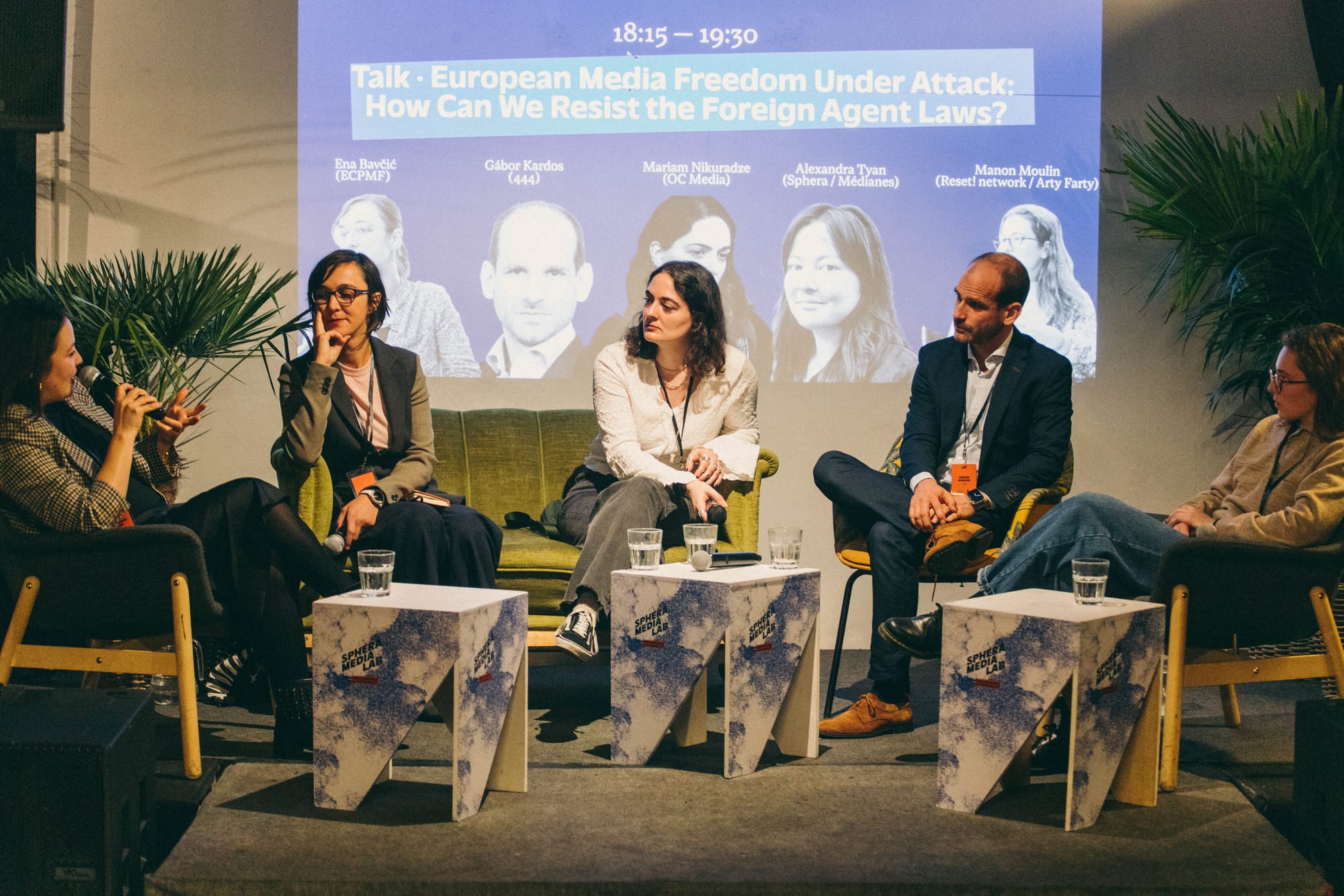
On November 6, Brussels hosted a new edition of the Sphera Media Lab, the annual gathering of the Sphera network. Coordinated by Médianes for the past year, this network brings together several independent European media outlets (444, El Salto, Popaganda, StreetPress, Krytyka Polityczna, VD News…) around editorial collaborations: investigations, podcasts, videos, and joint events.
Organized with European Lab/Arty Farty, this edition of Sphera Media Lab featured conferences, workshops, screenings and discussions around key issues such as press freedom, technological independence and the sustainability of economic models. A unique opportunity to collectively imagine new forms of cooperation between free information actors and stakeholders in Europe. Here's what happened.
Journalism in Europe facing intensifying threats
One of the strongest findings: journalists — particularly those from independent newsrooms, advocacy-focused outlets, or covering sensitive topics — are today more exposed than ever before. While the profession has always carried risks, the intensification of threats is clear: increased censorship, intimidation, assaults, imprisonment, hostage-taking, murders.
In Gaza, the Israeli government makes journalism work almost impossible; the number of journalists killed has reached an unprecedented level. In Europe, information struggles are intensifying in the face of Russian interference, with newsrooms like Lyuk Media daily exposing the mechanisms of propaganda — from blatant fake news… to the most seemingly harmless memes.
Across the continent, the political situation is deteriorating. In Hungary, Viktor Orbán continues his strategy of silencing the opposition by mobilizing laws, institutions and international norms. Alexandra Tyan, editor-in-chief of Sphera, was able to explore resistance strategies against laws on "foreign agents" with Gabor Kardos from Hungarian media 444, a member of the Sphera network, and Mariam Nikuradze from OC Media, a platform covering the Caucasus regions.

This edition of the Sphera Media Lab highlighted the fact that Europe is at a tipping point between democracies, human rights, and resurgent fascisms: a context in which collaboration and mutual support become essential levers.
How newsrooms are reclaiming their tools
In the era of platforms, algorithms and artificial intelligence, journalistic independence is also at stake on the technological front. Opaque automated moderation, algorithmic curation with bias, organized harassment, dependence on a few dominant actors: the threats are multiple. But these same technologies also offer new tools to investigate, document and tell stories, particularly in conflict zones where journalists no longer have access on the ground.
Alongside Louis Van Ginneke, journalist at Belgian media outlet Médor, our media and tech specialist journalist Owen Huchon explored existing ways for newsrooms to take back control of their tech stack, understand new distribution rules, and build strategies that preserve editorial independence. Battered by platforms, some newsrooms are already exploring new paths: printing articles like Splann!, investing in physical space like Marsactu, taking to the stage with Mediavivant, launching their own social network like Bristol Cable, creating alternative platforms like Basta, or testing the fediverse like 404 Media. The core message? Technological independence is built progressively, and above all collectively, by pooling efforts.

Not everyone can abandon these platforms overnight—platforms that have consolidated their grip for over a decade. Part of the answer thus lies in transparency (like Medicacités, which explains why they still use WhatsApp) and in education (like Reporterre, for instance, which guides its readers in understanding and adopting RSS feeds). A major challenge is convincing communities of the importance of being supported, financially or otherwise, in this effort that requires broad mobilization to succeed. These discussions also highlight the ambivalent role of technology: it can document violence, make invisible narratives visible, and support investigations, but it can also facilitate censorship, misinformation, and oppression.
The Sphera Media Lab workshops also addressed the impact of AI: automation, curation, potential manipulation, but also opportunities to document, analyze, and investigate. A solid ethical framework remains essential to ensure responsible use in service of human rights and informed public debate.
Rebuilding sustainability: cooperating to endure
Economic crisis, competition from platforms, and changing habits threaten the viability of independent media. Faced with this reality, one question arises: how can they remain independent while staying financially sustainable?
During a round table moderated by Francesca Festa, Director of Development at Médianes, Patricia Reguero Ríos (El Salto, member of the Sphera network), David Kardos (Center for Sustainable Media) and Julie Majerczak (RSF) highlighted the need for plural and cooperative models, combining public funding, citizen contributions, memberships, pooling and cooperative forms.

"Without economic independence, there can be no press freedom," Julie Majerczak reminded us, notably highlighting the massive capture of advertising revenues by platforms and the sidelining of journalistic content in favor of virality logic. A phenomenon that reflects a "structural imbalance" according to David Kardos, created by digital intermediaries that now control visibility and deprive media of their resources.
Solutions? Taxation, according to Julie Majerczak, to rebalance journalism funding as a complement to national support, not as a replacement, clarifies David Kardos. For Patricia Reguero Ríos, whose media was launched as a cooperative in 2017, the solution lies in collective forms of organization, with readers and other media to strengthen its visibility. In 2020, El Salto had for example participated with 14 other media outlets in developing a survey on the Spanish monarchy within La Plataforma de Medios Independientes (closed in 2022). Results picked up by various national media, helping to more widely disseminate the work and role of these independent newsrooms in a project whose ambition was only achievable through pooling efforts.
Media: the necessary European cooperation
Security, technology, economics: these three dividing lines structure the future of independent media in Europe today. The Sphera Media Lab 2025 showed that solutions exist — fragile, sometimes modest, but real — and that they emerge when media outlets unite their forces. This is the entire challenge of the Sphera network: to make cooperation no longer an exception, but a sustainable strategy.
Would you like to learn more about the inner workings of our network? Be informed of upcoming events? Sign up for our newsletter.


