


You've surely all received or sent this message before: « Does anyone have access to this article? » You hope that someone with a subscription can send you a link so you can read it. Beyond helping out friends from time to time, sharing articles is a perk offered by some subscription-based media outlets, regardless of the type of paywall. For media that have chosen a hard paywall, this feature can be an important factor in their discoverability. Set up and managed by the media themselves, this strategy does not depend on sharing via social networks, and therefore does not suffer from (or suffers less from) the drop in traffic from those platforms. Subscribers then become their best amplifiers. The shared article may follow a request from someone curious, but also from the desire of a subscriber to share an article they particularly enjoyed.
– Paywall: a method used on a website to limit or block access to its content for non-subscribers.
– Hard paywall: the strictest strategy that blocks all content
– Metered paywall: readers have access to a certain number of articles before being blocked.
– Freemium paywall: the site offers articles available for free and others reserved for subscribers.
– Dynamic paywall: it adapts to each reader's profile (engagement, location, etc.) and restricts their access more or less accordingly.
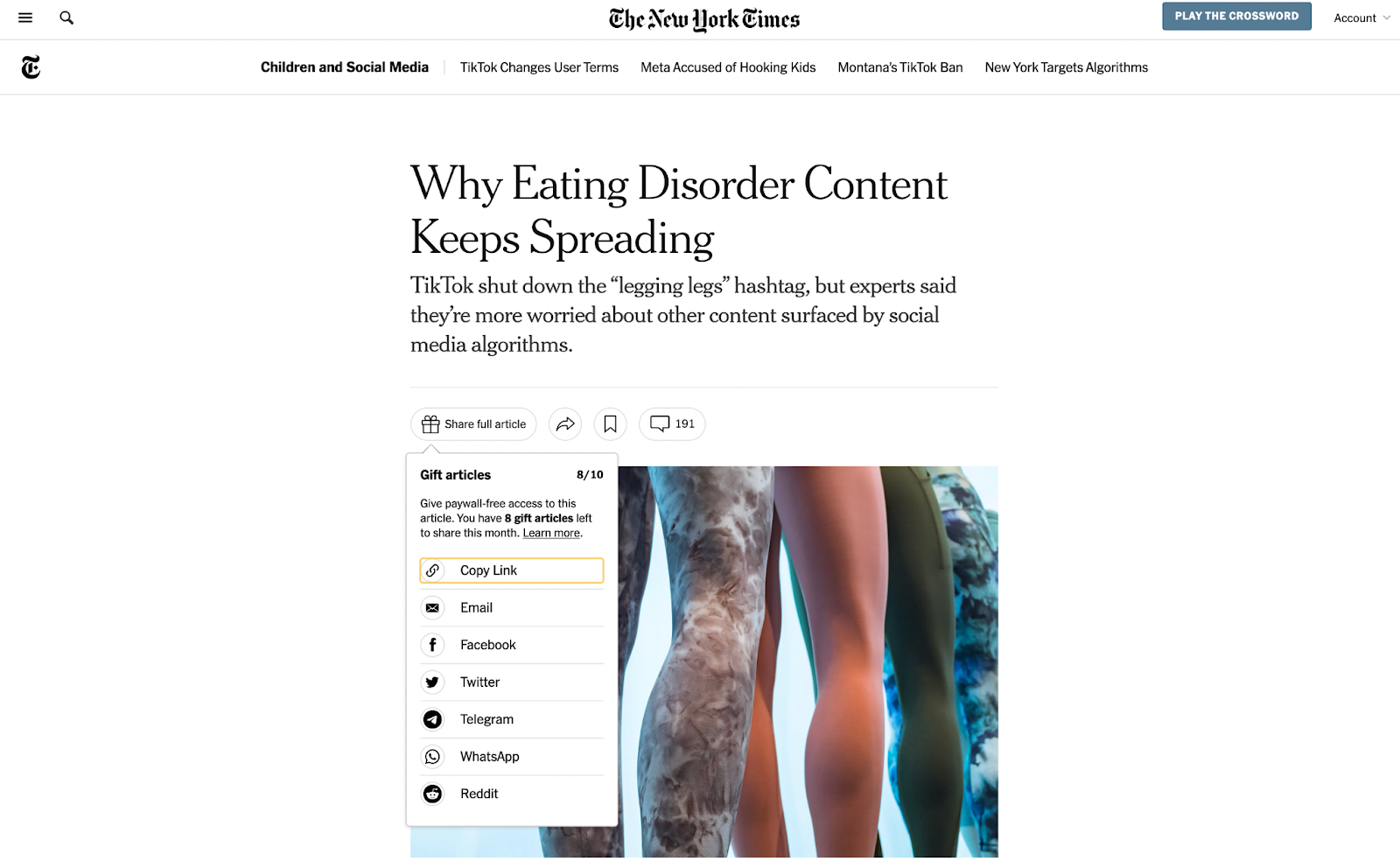
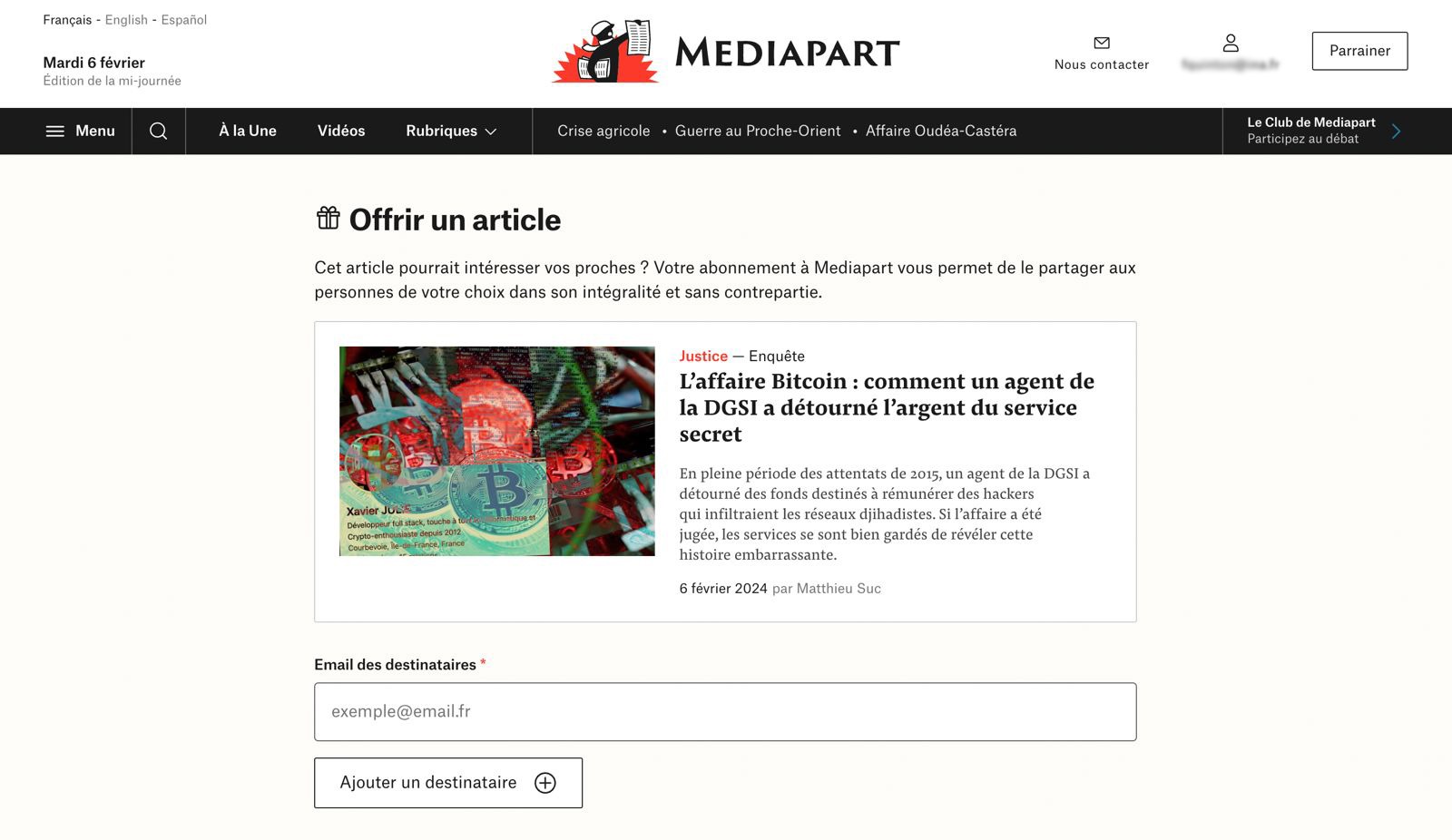
The terms for sharing media articles vary. Some, like the New York Times, allow their subscribers to send ten articles per month. For others, there's no limit on sharing for either the subscriber or the recipient. This is what Mediapart has offered since 2009. The method of distributing the article also differs from one media outlet to another. It may be accessible via a link that can be sent directly, as with the New York Times, or it is received by email for those using Mediapart. Email delivery notably allows "greater control over how content circulates to prevent screenshots and PDFs," explains Sophie Roncetto, head of marketing and communications at Arrêt sur images, which offers the same feature while limiting sharing to one article per week.
A popular and widely used feature
The ability for subscribers to gift articles is a marketing argument that media outlets are keen to highlight. « We use this argument in our communication about subscription benefits, we show subscribers that we listen to them and that they have "power" over what is made available for free », explains Sophie Roncetto. According to her, the feature is particularly appreciated by the most loyal subscribers of Arrêt sur images. This advantage is also popular with the Mediapart community. Clara Cerdan, head of the CRM department (customer relationship management) states that « among our active subscribers to date, 50% have used this feature at least once, and in 2023, an average of 60,000 articles were gifted per month ».
If this feature is an advantage for subscribers, it also allows subscription-based media to make their content known. The question of its accessibility for non-subscribers arises. « We always try to strike a balance between a strict enough paywall so that people subscribe and read us and what we broadly call the discoverability of our content, especially since it has dropped significantly in recent years via social networks », says Augustin Naepels, financial director and co-founder of Les Jours.
« To want to subscribe, you need to be familiar with the media »
Social media algorithms and their changes prevent some news outlets from reaching a wider audience. Although followed on platforms, notably by non-subscribers, the articles they share are not always seen by their community. A problem that does not encourage subscriptions since "to want to subscribe, you need to be familiar with the media outlet and have discovered it", says Augustin Naepels.
Leaders of various American platforms have made it clear in recent months, more or less explicitly, that they no longer have an interest in promoting news media on their networks. Traffic generated by media through social networks is declining, according to a study published in October by Similarweb, an American company that collects and analyzes data.
Sharing articles for free seems to be a solution for gaining visibility without depending on major platforms. In a questionnaire sent to new subscribers following their sign-up, « 12% of them say that receiving a free article – among other factors that could be selected – is what prompted them to subscribe », explains Clara Cerdan for Mediapart. A similar finding from Arrêt sur images. During their previous fundraising campaign « many donors told us they were making a donation so we could offer free content because they had discovered us through it (every week, the outlet makes two articles freely available on its site – Editor's note) », adds Sophie Roncetto.
« A complimentary article is a guarantee of quality reading »
Beyond allowing non-subscribers to read content, this feature gives them access to what the media does best according to those who pay each month for its content. "A shared article is a guarantee of quality reading and is more likely to be read from a positive angle, because we trust our loved ones to know our tastes and interests," explains Clara Cerdan, at Mediapart. "If the idea is to discuss it afterwards, we commit to reading the article so we can give feedback to the person who shared it with us," she believes. This observation is borne out by the numbers: "Half of the 60,000 articles shared each month are clicked, and visits from this type of email are of much better quality, in terms of time spent and pages viewed, than other sources of traffic," she adds.
The link between these media outlets and their subscribers is also strengthened as the latter feel they are being given a part to play. "For a while, subscribers could no longer see the 'gift an article' icon on our article pages and several wrote us panic emails," recalls Sophie Roncetto, who believes the option is appreciated even though Arrêt sur images does not, for now, have exhaustive data on the subject.
Poll your community
Since 2018, the independent media outlet specializing in media criticism has implemented a complementary strategy to allow non-subscribers to discover their content. The « free Thursdays» consist of inviting subscribers to vote each week for their favorite articles. The two that receive the most votes are then made available online for free and permanently. Today, approximately 20,000 articles are available for free on the site. A similar strategy has been implemented by Les Jours since August. Each week, on its social networks, the media invites its community (which includes subscribers but not only) to vote for an article that will be sent in full to non-subscribers. To receive the article, you just need to subscribe to the newsletter « discovery» from the media, a free newsletter designed to showcase the work produced by Les Jours.
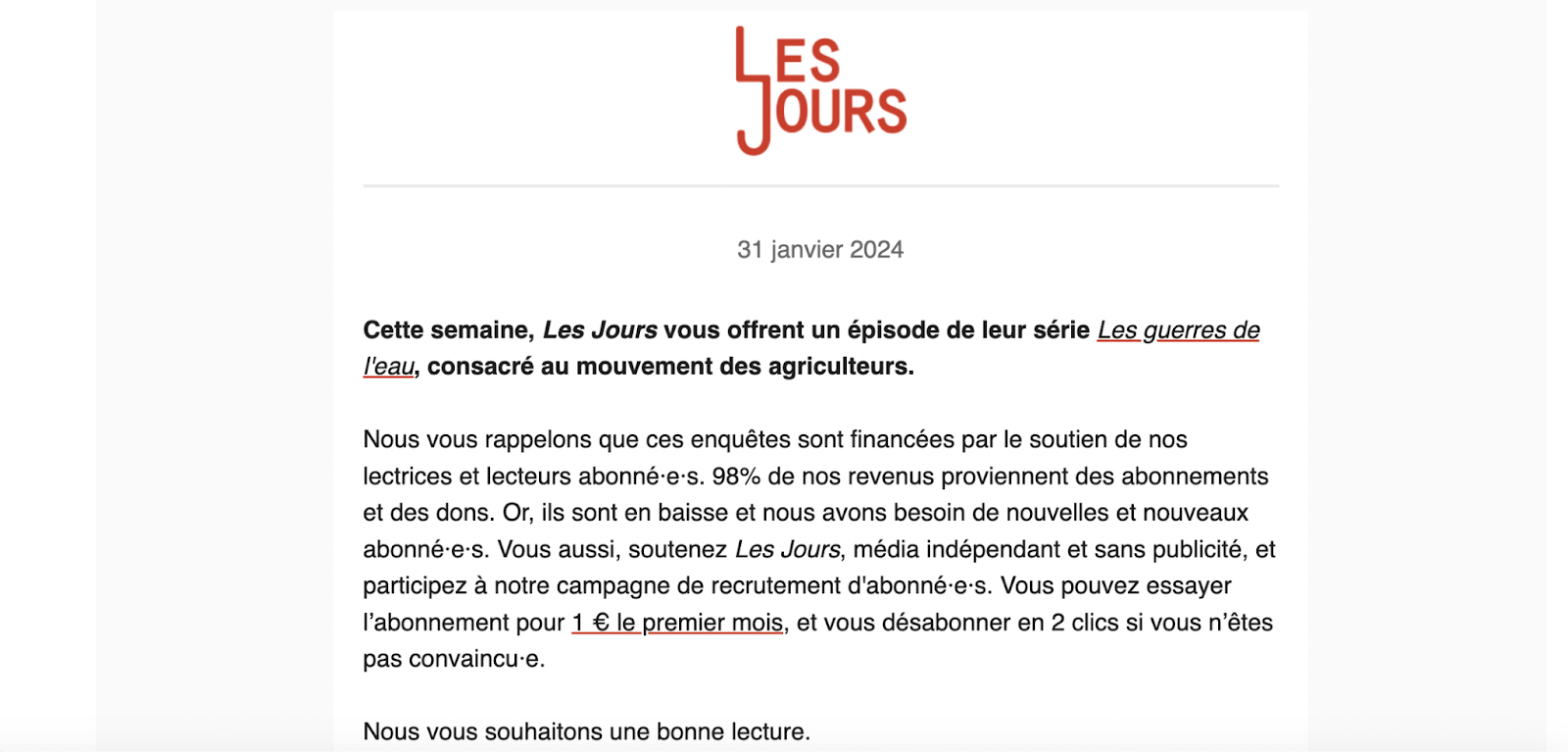
These strategies are tests and areas for exploration for Les Jours and Arrêt sur images as they seek to balance content accessibility without discouraging subscriptions. "We'll probably develop the 'discovery' newsletter to offer Les Jours as an entry point with strong editorial direction that makes people want to read us, always with the idea of showing what we can do to people who don't know us", explains Augustin Naepels (the co-founders of Les Jours announced their new newsletter in early February, editor's note).
On the Arrêt sur images side, "quite a few subscribers would like the outlet to go completely free, it's something we discuss internally, but for now we haven't taken that step because it seems risky to us", explains Sophie Roncetto, who believes that options to offer free articles are a good compromise. "There's no magic formula for this kind of setup, everyone is experimenting, trying things out, admits Augustin Naepels, free articles aren't the only way to do it and I don't know if it's the best approach but we test as much as we can."
To go further
- The independent Marseille media outlet Marsactu will make these articles accessible from several community centers and cafés.
- A practical guide that reviews existing business models centered on audiences, to help you define your own.
- Meet Robin Kwong, Head of Audience Engagement at the Wall Street Journal.
- The "Subscribe with Google" feature allows certain media outlets to grow their subscriptions, but at what cost?
- The best paywall examples in 2022 compiled by Poool, a marketing and tech tools company for media.
- The complicated relationship between major Silicon Valley tech companies and news media explained in an article from the New York Times published in October 2023.
- The evolution of relationships between platforms and media over the past decade in an article from The Atlantic published in November 2023.
This article was edited on February 19 to update the attribution of a quote.


