


Splann !, a Breton investigative media outlet, made a seemingly counterintuitive bet: asking its readers to pay for investigations even though they're already freely available online. The only difference: they're printed on paper. Behind this initiative, there was no market study or survey—just a straightforward, concrete observation that prompted the team to try the experiment: "I, like some of my colleagues, can't read on a computer. I find it incredibly tedious to read 10 to 20,000 characters, even on a phone where I think the Splann! website is very comfortable to read. I just can't do it," confides Julie Lallouët-Geffroy. The journalist, who has worked for the independent media outlet since 2022, has tried everything to improve her reading comfort, including makeshift copy-paste jobs into Word to print articles or tedious PDF transfers to her e-reader… without much success.
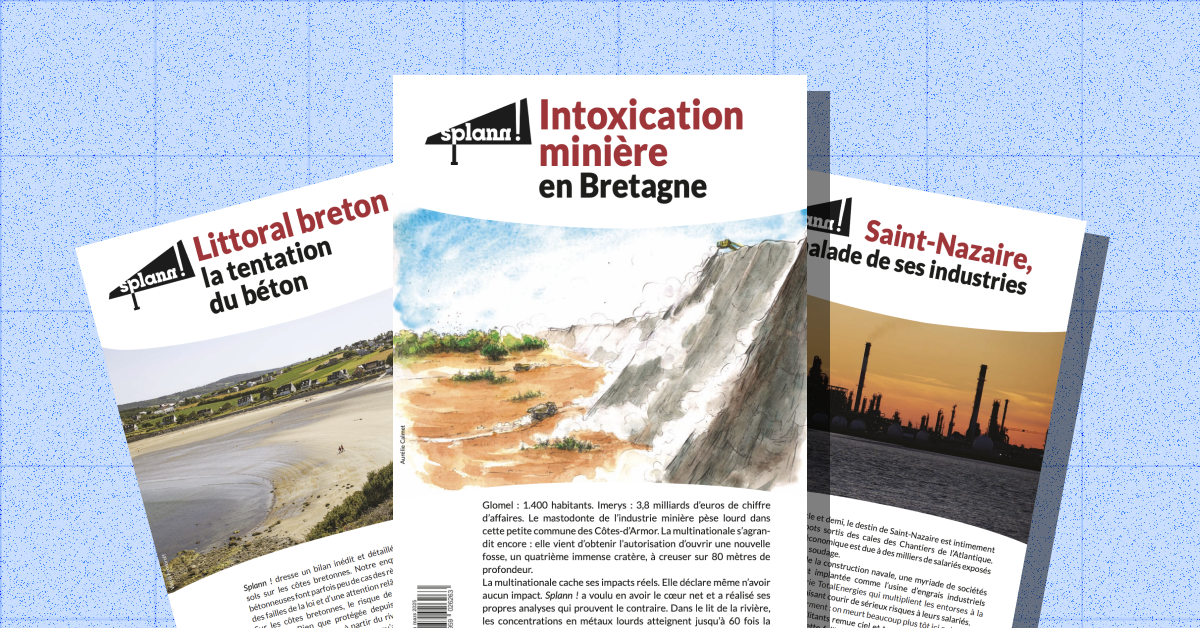
Convinced that readers, too, are looking for alternative ways to read away from screens, the team has come up with a solution: “booklets”—print versions of some of the editorial team’s notable investigations, including “The Breton Coast: The Quest for Concrete,” “Bocage: The End of a Landscape,” and “Saint-Nazaire: Sick from Its Industries.” Initially distributed in small quantities and informally at meetings or events, the initiative gained momentum, and the online media team gradually found its footing in this new realm.
Broadcast differently, beyond algorithms
While reading comfort was the genesis of the project, the format serves multiple considerations for the independent local media outlet. The first: expanding the distribution of its investigations beyond the algorithmic logic that dominates the web. The booklets notably allow reaching people less comfortable with digital and whom the media has not yet reached through its social media communication. A way to introduce Splann! to an older audience? "When I see people coming to buy at our stands for example, we have pretty much all age groups," replies Julie Lallouët-Geffroy, for whom the appeal of print is not limited to a generational question, but actually responds to digital fatigue that is very widely shared.

To do so, the media relies in particular on distribution in nearly fifty independent Breton bookstores, where the booklets are sold for 10 euros. For one euro more, readers can also purchase these paper formats by mail directly from the media's website since 2024. While the format allows Splann ! journalism to reach new readers, it also resonates strongly with its existing audience, notably newsletter subscribers. "What triggers online orders is the email we send (…) The next day, we get a bunch of orders ", observes the journalist, who now works on the layout of the booklets as well as organizing online sales campaigns. The media then relies on its audience to become, in turn, a relay by lending or giving away the booklets: "Sending a link to someone is one link among 35 billion links. A book, you give it, you leave it lying around. We also know that a paper object, a book, a magazine, isn't read just once," she confirms.
In this logic of the broadest possible dissemination, Splann ! also allows everyone to freely print investigations from its site. The media outlet has thus revived a feature that has nearly disappeared from news websites: a "Print" button, providing access to a ready-to-use PDF.
A financial contribution?
Julie Lallouët-Geffroy makes no secret of being surprised to discover certain orders worth several dozen euros despite free access to investigations on her site: "I see in orders that there are people who take a booklet of everything, who collect the whole series (…) I think it's funny anyway," she admits with a laugh. But for Splann!, this activity does not represent a lucrative financial opportunity to develop in order to maximize the profitability of its articles. The editorial team assures that it is committed above all to producing investigations and that booklets are only a secondary activity, conceived as a tool for distribution and visibility rather than as a source of revenue in its own right. The only financial condition to respect: not to incur major losses.
The media outlet, which publishes its accounts every year, states on its website that it generated €12,000 in revenue from booklets in 2024, representing 5% of its resources. But expenses are substantial: printing costs, design, a 30% commission paid to bookstores… On average, each booklet generates a profit of €4.21, the media team clarified by email after this article's publication: €2.79 in bookstores, where approximately 60% of booklets are sold, versus €5.79 for direct sales of the remainder. While exact calculation remains tricky, particularly due to occasional reprints, the average profit per topic would be around €2,000. The picture is clear: at equivalent amounts, donations, which make up the vast majority of the nonprofit media outlet's revenue (€175,000, or 72% of its resources for 2024), are financially more attractive due to lower expenses. Could booklet sales therefore cut into the overall profitability of the editorial team because readers prefer to buy investigations rather than make donations? The team asked itself this question: "That's why at the start, we didn't align the booklet sales with the year-end fundraising campaign periods," confirms Julie Lallouët-Geffroy. But doubts quickly faded and the team actually observes a slight increase in donations, despite booklet sales. For the journalist, these two forms of support ultimately stem from distinct logics that can be complementary: on one hand, the tax-deductible, intangible donation with no return, and on the other, the straightforward purchase of a product that can be given as a gift, lent out, or collected…
Limit the load
To keep workload manageable, sales aren't continuous: two major campaigns per year are prioritized. Print runs are controlled at around 1,000 copies at launch, supplemented if needed by reprints of a few hundred units. The publication can also rely on its volunteers, who are involved in various activities within the organization, to ease the financial and human burden of this approach: "Alain is the one who handles relations with bookstores. He manages inventory and restocking. That's the distributor's role," Julie Lallouët-Geffroy gives as an example. For the team, the goal is to integrate the booklets as smoothly as possible into regular tasks and their everyday routine, even if it means not implementing the most optimized distribution or communication strategy. "When we approach bookstores about selling booklets, it's because they're on our routes when we go about daily life, which sometimes explains imbalances in how we cover different departments. We don't want to overcomplicate things. When a bookstore doesn't seem motivated to stock the booklet, we just drop it, for example".
These choices, constrained but deliberate, also contribute to the "artisanal" identity of the project and strengthen a human connection between the media outlet and its community. "Taking a photo or making videos saying: 'It's me, Julie, opening the boxes, it's me handling the shipments' or writing by hand 'Thank you — The team at Splann !' is a way of saying we're really here. And when people send us checks, notes or cards, we receive them, we read them, we share them among ourselves. It feels good to restore that human touch," summarizes Julie Lallouët-Geffroy. An approach she champions as an antidote to increasing disembodiment, heightened by the omnipresence of AI.
From web to print: an accessibility challenge
Anne Caillet-Leroy explains by example. Then there is the matter of hyperlinks, omnipresent in online articles, which can present real challenges during page layout. The team prefers to use footnotes to indicate sources or direct readers to additional content.
According to her, the object's simplicity can even become an advantage. A reading experience without constant solicitations, without links or interactive formats, offers a different relationship with time and information: "In the same way that Mediapart produces comics, it makes information more accessible to the general public. It's a form of democratization. In any case, I find it more accessible than looking at a screen where you're overwhelmed by 50,000 things," says Anne Caillet-Leroy.
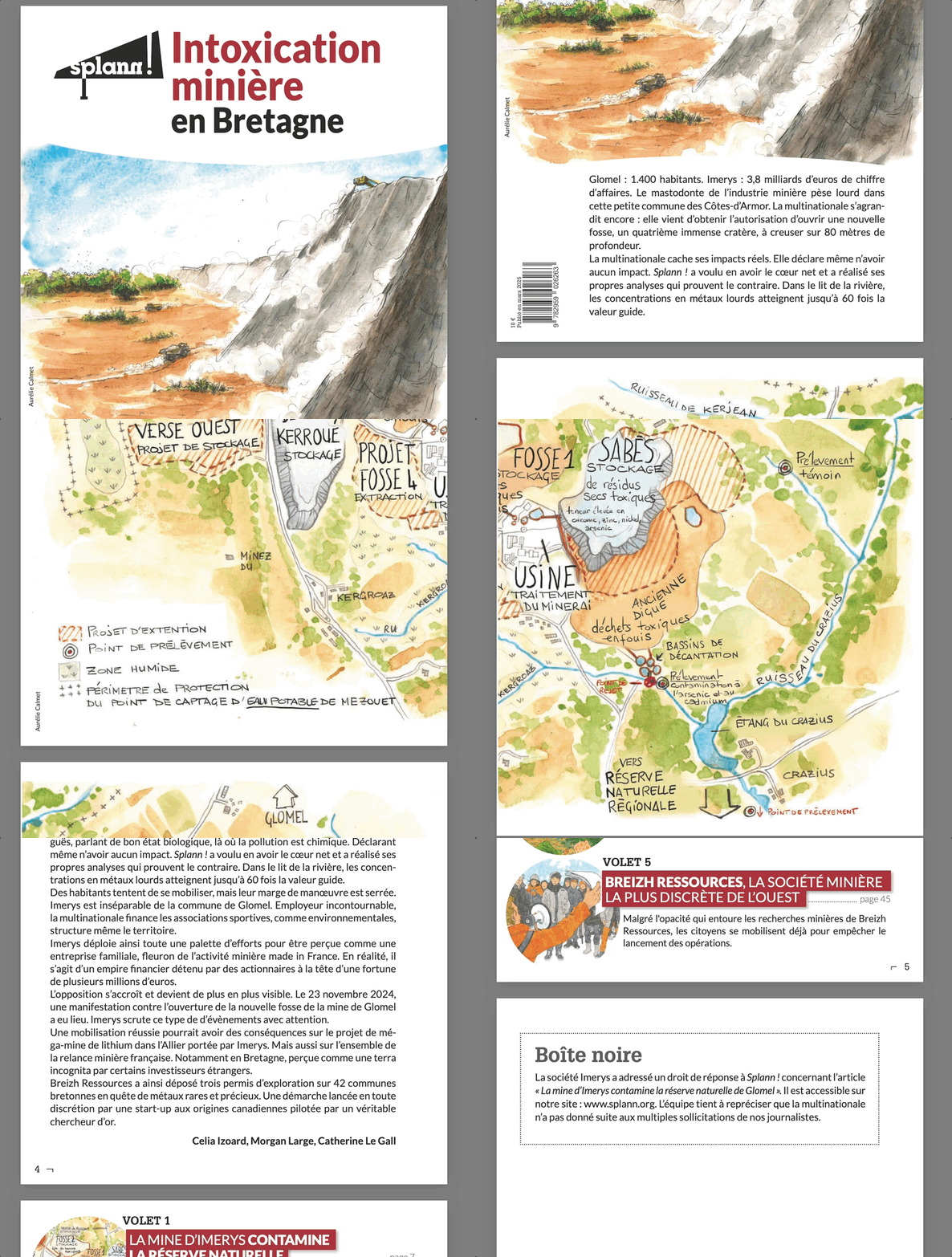
Far from being an impoverished version, paper allows other elements to shine. The watercolor illustrations in the booklet dedicated to mining intoxication, for example, gain visibility when displayed across a double-page spread. The physical format also becomes a way to embody and communicate the media's values. The Splann ! booklets are thus bilingual, just like its website: French on one side, Breton on the other, by flipping the object. A choice that reaffirms, in tangible form, the media's territorial rootedness and its commitment to the Breton language, which is also expressed through the use of a local printer based in Guingamp.


