Since the 2024 European elections, a wind of pooling resources has swept across independent media, driven by the need to strengthen their impact and resist concentration trends. This momentum is also gaining ground in publishing, where large-scale collective initiatives are emerging.
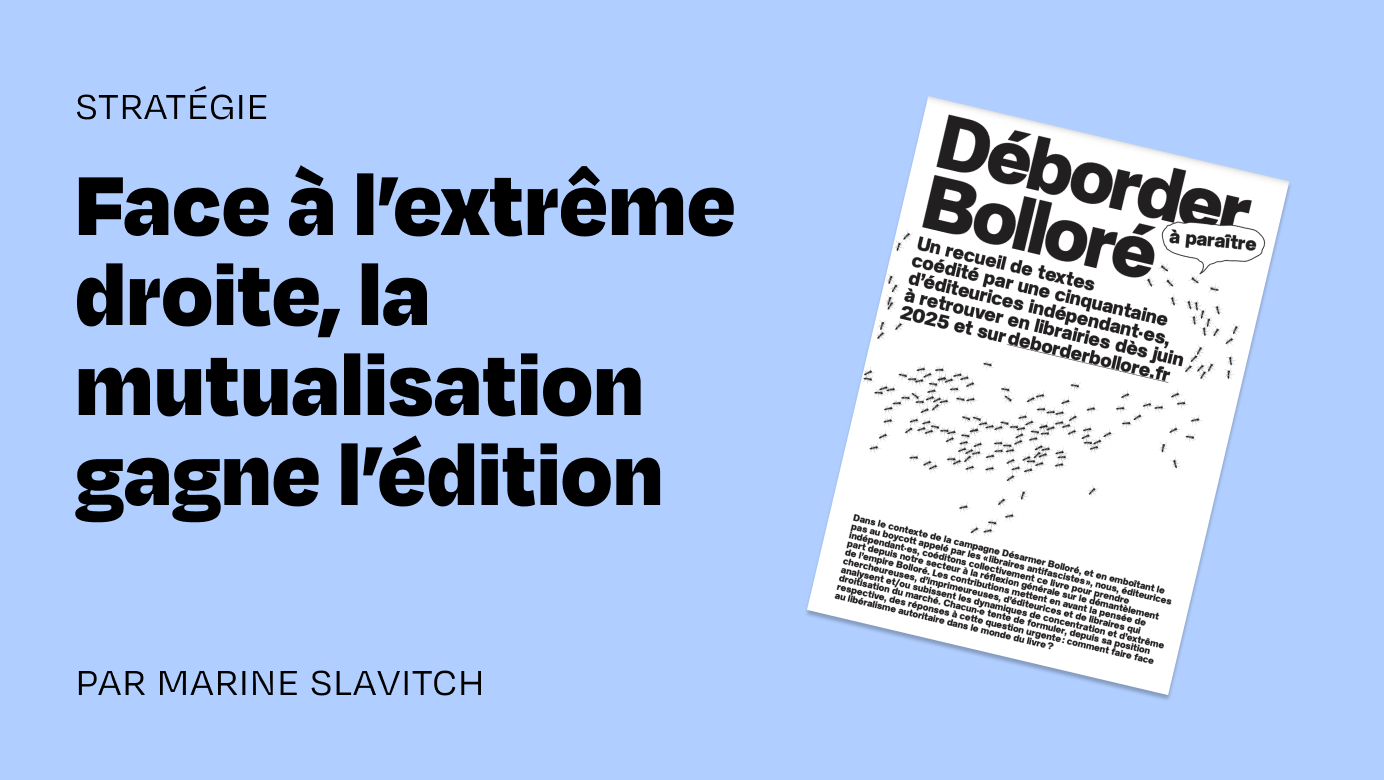
In March, around a hundred independent publishing houses came together to publish the collection « Overflowing Bolloré », a critique of the concentration of publishing and media in the hands of far-right billionaires. Beyond the book, the objective is to lay the groundwork for lasting collaboration between committed publishers. After distribution through a network of co-publishers starting in May, the work will be available in bookstores in June, marking a first step toward broader resource-sharing across the sector. Interview with two co-publishers of the project.
How to define the project « Déborder Bolloré » ?
"Overpower Bolloré" is a collective initiative bringing together several publishing houses to publish a collection examining the conservative billionaire's grip on publishing and media. Our intention is not to create a new collective or organization, but to carry out this project autonomously from within each of our structures.
The idea emerged in response to the "Disarm Bolloré" campaign. Although we have no direct connection to the groups or unions behind this initiative, we wanted to respond by questioning Bolloré's grip not only on media but also on publishing. After several discussions among publishers, we decided to bring together publishing professionals, book history researchers, journalists and activists to contribute to the project. We also wanted to build on the thinking sparked by the call from antifascist booksellers, who in November 2024 launched a boycott of books published by companies owned by Bolloré. However, we chose a somewhat different approach by questioning more broadly what a publishing world without him would look like.

⟶ Launched in 2024 by several ecological and antifascist collectives, the "Disarm Bolloré" campaign denounces Vincent Bolloré's influence over media, publishing and the economy. It aims to expose what it describes as his predatory practices and organize awareness-raising and resistance actions.
In the publishing world, this mobilization has resulted in several initiatives: activist bookmarks inserted in works published by Bollore group publishing houses, calls for boycotts relayed by 80 independent bookstores in November 2024, as well as debates and events organized to question the concentration of publishing.
What are your objectives with the publication of this collection?
This book aims to be both accessible to readers seeking to understand how the publishing world works, and to demonstrate that editorial concentration is nothing new. Since the early nineteenth century, the sector has been marked by monopolies, such as Hachette's. While Vincent Bolloré has come to occupy a prominent position in this system, he did not invent this model. Our book sheds light on these dynamics and criticizes authoritarian liberalism, embodied by this figure, but also by other less visible actors who are equally problematic. What is different with Bolloré is that he has an openly stated political agenda.
We are now around a hundred independent publishers spread across France, Belgium, Switzerland, and Canada, each with our own stories and editorial practices. This diversity takes on its full meaning in the face of one person's empire.
Why did you choose the term
We want to leverage the diversity of independent publishing against a monopoly represented by Vincent Bolloré and his policy in publishing and media. Concentration gives immense power to a single person, who, through a structure, embodies that power within the publishing and media sphere. Our approach in "Outmaneuvering Bolloré" is to create a counterweight to this concentration. We are now around a hundred independent publishers, spread across France, Belgium, Switzerland and Canada, with different histories and editorial practices. This diversity takes on its full meaning in the face of one person's empire.
The real issue here is not merely economic, but fundamentally political. Take the example of Fayard, which belongs to the Hachette group: you'll find books by committed authors whose values we share, but also those by figures like Jordan Bardella. The existence of these voices within the same publishing house creates an illusion of pluralism. In reality, this pluralism serves a much larger economic and political project, one that allows certain ideas to gain legitimacy through their coexistence with others, more progressive ones. It is this very pluralism that, ultimately, contributes to the normalization of power narratives that might otherwise remain more marginal.
Is Vincent Bolloré the only problem for you?
Other publishers have pointed out to us that it's a shame to personify the problem so much, since concentration is a global phenomenon. The real problem is the editorial system that allows a person like him to hold such power. So our project goes beyond just the Bolloré figure. But by putting the spotlight on this person, we're able to open up the debate and question these dynamics, sometimes more insidious ones, that exist elsewhere in the publishing world.
In The Publishers' Betrayal, Thierry Discepolo, author and publisher at Agone, analyzes precisely these dynamics of concentration and their political dimension. In the collection "Going Beyond Bolloré", Thierry Discepolo argues for an independent publisher status, guaranteeing financial support, tax benefits and regulation of overproduction.
What measures do you envision to carry forward this reflection beyond the collection?
In addition to publishing the collection, the goal is to make content accessible online, free of charge and in a format suited to screens. We want to create a platform that hosts not only articles from the collection, but also extensions, translations, and texts to fill gaps, much like a traditional media outlet would.
Dismantling first means understanding what needs to be dismantled, and thus, pooling knowledge and expertise about the object of the struggle.
This is about creating a space for sharing knowledge and analysis about the book sector. We are fully aligned with an idea that "Les Soulèvements de la Terre" has long championed: dismantling first requires understanding what needs to be dismantled, and thus, pooling knowledge and insights about the object of our struggle.
⟶ « Soulèvements de la Terre » is a collective founded in 2021, committed to fighting land grabs, agricultural industrialization, and ecosystem destruction.
In the collection
Beyond this knowledge-sharing dimension, we also want to strengthen the bond between publishers by consolidating the network of independent publishing houses. While we are not seeking to create some universal movement, the goal is to foster this collaboration and networking.
How was the connection between independent publishers materialized until now?
Each publisher operates within their own network. Some meet at trade shows, others are connected through unions or specific collectives. These circles function according to their own dynamics around particular scenes, which sometimes makes it difficult to achieve broader collaboration. On
That said, pooling resources among independent publishers to take a stand is not unprecedented: we were largely inspired by the La Pastèque initiative, a gathering of publishers in support of victims of the Israeli state in Gaza. It was a true model of collective work for us.
⟶ La Pastèque is a free journal available for download online and in several independent bookstores and cultural venues across France, Belgium and Switzerland. Initiated by the collective "Publishers for Palestine," this publication is supported by independent publishing houses to create a space for Palestinian voices and their allies.
The way this collective is organized, with committees where each publishing house participates according to its specific expertise, inspired us greatly. We thought this model could work perfectly for
We hope this first work will inspire other books, texts and projects, and that the site will become a platform for sharing all of them.
What does skill sharing enable within the framework of "Déborder Bolloré"?
It allows around twenty people with diverse skills to work on the same book, which is nearly impossible in independent publishing, where teams are often small. This collaboration enables us to be more efficient and to work on nearly tight scheduling for the collection.
We hope this first project will inspire other books, texts and projects, and that the site will become a platform to share all of this. The idea is to facilitate connections and enable everyone to subsequently adapt the infrastructure and working method we've put in place. Once the collection is published, the idea is to keep this dynamic open, while also finding some breathing room for our own publishing houses.
This also advances our work in accessibility: in this project, we collaborated with designers specializing in these issues, to integrate these approaches and offer greater diversity of formats. One of our members, for example, developed a converter that transforms an InDesign file into a more flexible format, such as LibreOffice or DOCX. This breakthrough makes it easier to export to different formats, such as EPUB, without having to manually redo corrections for each medium. This allows us not only to streamline content distribution, but also to significantly expand distribution possibilities.
⟶ InDesign is layout software used in publishing to prepare books for print. However, its files are poorly adaptable to other formats, such as ebooks (EPUB) or accessible documents.
The converter developed in this project makes it possible to transform these files into more flexible formats, making it easier to adapt and distribute them across different media.
What does your working method consist of?
From the outset, we agreed that if we wanted to be effective and meet our May publication deadline, we couldn't have everyone making all the decisions, but everyone needed to be informed of the decisions being made. With about twenty of us actively working on the project—some people joined along the way and many co-editors support the initiative without necessarily participating in day-to-day work—we quickly organized ourselves into several autonomous but interconnected committees: editorial, proofreading, formatting, communications, web development, press, and systems administration. Each committee makes independent decisions.
Furthermore, for a collective project like this one to work, it's not enough to have editors, proofreaders, graphic designers, and so on. You also need people in charge of coordination. They ensure in particular the project's transparency by guaranteeing constant access to information for all members: their role is not to make decisions but to relay those made in the various committees so that everyone can be informed of the status of the texts, layout, finances, and so on.
Initially, we organized one or two large monthly meetings to make major project decisions, which everyone was invited to. Then each committee started meeting independently to advance on their specific topics. After each meeting, a report was drafted and shared with all co-editors to keep everyone informed of the decisions made.
When undertaking such a complex and committed project, can one ensure unwavering independence by breaking free from major digital platforms?
An important aspect of our approach was to prioritize free tools and independence from Big Tech companies as much as possible. For example, we chose the Framasoft suite over solutions like Google Drive to manage our collaborative work. It was a way to stay true to our values and optimize the project's autonomy.
Communication wasn't straightforward to define. We decided to rely on social media and particularly Instagram, which remains an essential channel for rapid visibility. However, we also thought about other means of communication, such as creating leaflets and flyers or posters announcing the book's release. These physical materials, created by Camille de Noray, the project's graphic designer, allow us to diversify our communication channels without limiting ourselves to social media. They circulated widely in book fairs and bookstores. We sent them to all co-publishers so they could distribute them within their networks. This all stems from the culture of leaflets and fanzines and allows us to reach a broad audience while staying true to more activist and political practices.
« Returning to more artisanal methods, circulating printed documents, allowed us to build a strong bond with those who share these values. »
The book will be released in early May and we started communicating on social media on March 18th. Before that date, the project had no public visibility online. It was quite nice to know that the project existed outside of Instagram, through flyers, word of mouth and printed materials. Going back to more artisanal methods, circulating printed documents, allowed us to create a strong bond with those who share these values.
Vincent Bolloré controls both publishing houses and media outlets. Do you take this dual stranglehold into account as part of this project?
We chose to focus on publishing houses because we felt it was premature to include independent media at this stage. The goal is to structure resource-sharing within our own sectors first. That said, it's undeniable that there is a need for greater collaboration between independent publishers and independent media. After all, players like Bolloré, who dominate both the media and publishing worlds, do so with great efficiency.
Nevertheless, several independent journalists contributed to the collection Déborder Bolloré, including Antoine Pecqueur, and also Florent Massot, the editor of Blast, le souffle de l'info, a media outlet that investigates figures such as Vincent Bolloré, Daniel Kretinsky and Bernard Arnault. One of the challenges of more fluid collaboration between these two spaces, beyond
⟶ In the collection, Antoine Pecqueur, an independent journalist specializing in politics and cultural economics, analyzes Vincent Bolloré's cultural influence in Africa, notably through Canal+ and his partnerships, and how this sparks resistance, particularly a rejection of control over narratives and imaginaries.
⟶ Florent Massot — independent publisher who runs the publishing house of the same name — critiques in the collection the concentration of the French publishing sector and explores the avenues of resistance available to independent publishers.
Does addressing this issue involve boycotting content from groups affiliated with far-right billionaires?
In the collection, we included a text by Soazic Courbet, manager of the bookstore L'Affranchie, which addresses this question of boycott.

She highlights the difficulty of this approach, because for many booksellers, a large share of revenue relies on books published by major publishing groups like Hachette, even as they try to diversify their offerings. Soazic Courbet, for example, has committed to stocking less than one percent of books by cisgender heterosexual men in her bookstore. Yet even so, she still generates much of her revenue from books by these major groups… And that's significant. Independent bookstores find themselves in a complex position where they depend on major publishing houses for their economic viability, even when they attempt to prioritize other types of literature. This poses a real problem: how do you challenge the power of major publishing groups while remaining economically viable?
⟶ In the collection, Soazic Courbet, manager of the bookstore L'Affranchie and host of the podcast of the same name, examines the role of a feminist bookstore in the face of systems of domination in the book world, emphasizing that collective emancipation is essential.
We understand why the boycott was proposed and we think it opens an important discussion. But we must also acknowledge that these large corporations, by controlling broadcasters, distributors and publishing houses, hold enormous economic power, capable of tipping the balance in their favor. They can decide the fate of a bookstore. In this context, alternatives are limited. Simply stepping forward in such a campaign, even when not boycotting, could put them in an awkward position, given that large groups could very well, tomorrow, reduce the bookstore's margin.
To go further
- The criteria for becoming a co-editor of the collection are defined on the website of
- French publishing: who owns what? Click here to find the map created by Le Monde diplomatique.
- What does it really mean to be an independent publisher? Johan Badour, founder of Divergences editions, returns for Socialter to discuss the challenges of balancing economic independence, editorial freedom and radicality.
- The 2024 European elections marked a turning point for independent media. Opinion pieces, bundled offers, rallies, joint investigations, shared resources… For the first time, dozens of media outlets, emerging or established, joined forces against the far right and its flawed agenda. And saw their impact multiplied. If the momentum of 2024 demonstrated the strength of standing together, it also highlighted the need for a collective commitment anchored over time with alliances built for the long term. Here's what we found.
- This way to find our inventory of actions, practices and formats implemented by independent media outlets and publishers in June 2024 against the far right.
- At the Imprimé 2024 Festival, which Médianes co-organized last May alongside Revue Far Ouest, we devoted a discussion to the normalization of the far right in the media. A captivating exchange filled with outspoken opinions, field experiences, and solutions alongside journalists from StreetPress, Mediapart, Arrêt sur images and Rue89 Bordeaux.
⟶ Among the structures co-publishing the collection Déborder Bolloré, are editions Hors d'atteinte and trouble, two publishing houses supported by Médianes, the studio on strategic, web and marketing issues.