


Far more than a simple marketing tool, the newsletter has become a full-fledged editorial product for many media outlets. This evolution has been largely driven by the chronic instability of major digital platforms: rule changes, algorithmic adjustments, strategic reversals… all factors that are pushing media organizations to rethink their dependence on these intermediaries.
In this context, the newsletter emerges as a powerful tool for regaining control over your relationship with your audience and the distribution of your content. Its appeal also lies in the relative simplicity of its implementation, which requires neither substantial investments nor dedicated teams. Anyone with limited financial resources can launch a newsletter… though choosing the right tools is essential. Many platforms today offer turnkey solutions for designing, distributing, and managing a newsletter. The central question remains: which one to adopt? To help you with your decision, we suggest you reflect on some key questions that will already help you narrow down your options, anticipate challenges, and identify the constraints of each solution. This isn't a comparison of every existing tool, but rather a way to help you identify which aspects to examine in your choices.
What is your business model?
The answer might be simple: for now, you don't know yet. But if you already have a sense of direction, this initial reflection is an important step toward choosing the right tool. With your newsletter, are you primarily looking to sell content, articles and information, or rather products (especially print), courses or services? General-purpose marketing platforms like Brevo and Mailchimp were designed to meet that second need and include advanced features dedicated to sales, marketing and e-commerce. They offer, for example, native integrations with WooCommerce or Shopify, allowing you to sell directly from your newsletter. These tools are first and foremost designed as CRMs, customer relationship management solutions, with the ability to manage your reader and customer base, launch email, SMS or WhatsApp campaigns, and automate message sending based on different scenarios.
Conversely, platforms such as Ghost, Substack, Beehiiv or Kessel, while offering certain e-commerce and/or advertising features, are clearly geared toward editorial activity above all. This difference manifests very concretely in the text editor. Brevo and Mailchimp favour feature-rich interfaces and are useful for designing newsletters, with attractive buttons and varied functionality in the form of blocks you can drag and drop into your template, but can sometimes be less pleasant for longer-form writing. Mailchimp and Brevo also allow complete customization, with the option to bypass their editor in favour of fully custom HTML.
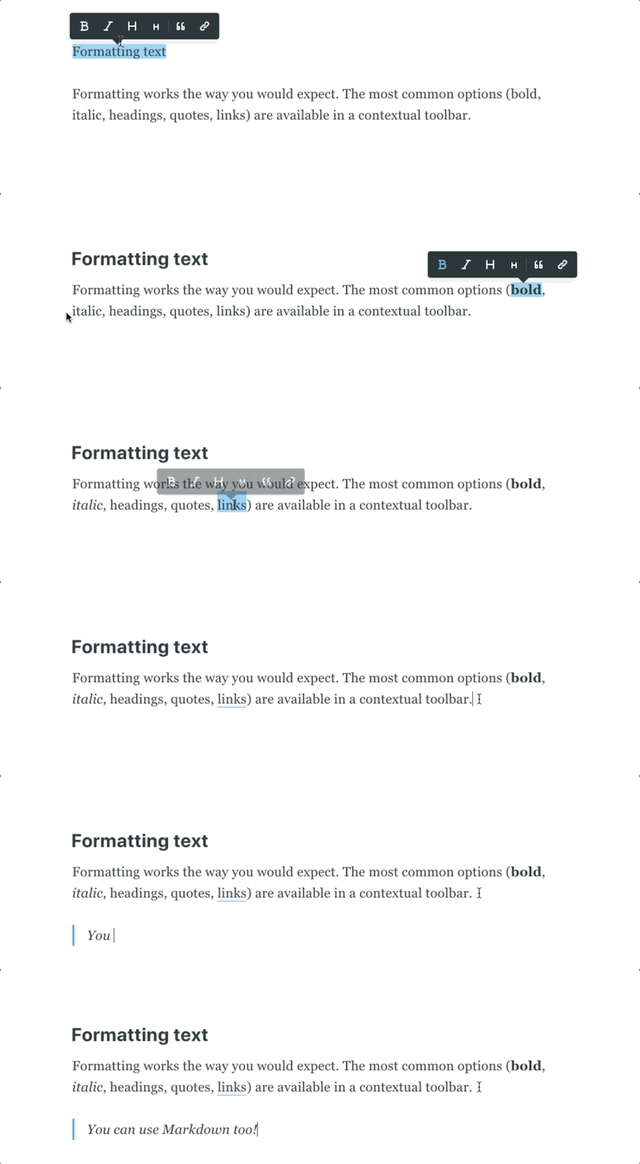
Substack, Ghost, and Beehiiv, for their part, offer editors that are similar to those found in standard writing tools and less customizable. If your project is primarily based on long texts published on a recurring basis, this criterion can make a real difference and represent a significant time savings.
It's in this spirit that we designed Socle, an offering built on open source tools like Ghost, designed for independent editorial projects that are financially accessible.
What does your community look like?
Another criterion that may guide your choice, and whose importance varies depending on your project: community. Who are your readers and what kind of relationship do you want to build with them? Is your audience relatively homogeneous, or do you instead identify different profiles, expectations, and usage patterns? These questions matter for several reasons.
First, because certain platforms allow more fine-grained management of your contact database. This is the case with e-commerce-oriented platforms mentioned earlier that let you segment your subscribers into lists based on numerous criteria. This segmentation makes it possible to send targeted content and offer a personalized experience. A need that matters more to larger organizations than to small newsrooms or independent journalists, but which can prove valuable if you distribute multiple newsletters or offer complementary services (events, training, etc).
Next comes the subject of statistics and data. Depending on the platform, access to metrics is more or less detailed: open rates, most-clicked links, click evolution over time, geographic location, or information about undelivered emails and their causes. The importance you place on this data will depend on your overall strategy. In most cases, you will have at least open rates and click rates, and can, if necessary, resort to third-party tools for more detailed analysis. The differences between platforms are more about how this data is presented and how accessible it is. It's worth noting that the relevance and reliability of these figures can vary, with some email services attempting to hide this information, like Apple with its Mail Privacy Protection. In summary: unless you've identified a significant and specific need, it seems unlikely that this will be a deciding factor in choosing one platform over another.
Finally, there's the question of growing your community, especially if you're starting from scratch. Some platforms integrate mechanisms designed to promote discovery. Beehiiv, for example, relies on cross-recommendation systems between newsletters. Ghost, for its part, allows you to appear in a directory of publications. Substack's main advantage lies in the existence of a large and active community. By integrating features similar to social networks (private messages, news feed, a "Notes" system similar to X, etc.), the platform is more than just a sending tool: it functions as a space in its own right, where you could go to find an audience. A distinctive feature that also appeals to players like the Wall Street Journal, which sees in Substack a pool of potential new readers·les rather than a technical tool.
Do I need a strong visual identity or is it secondary?
On Substack, it's deliberately limited: a few customizable colors, a restricted choice of templates, and a handful of fonts. This simplicity can be an advantage, with fewer decisions to make and faster launch times thanks to a formula tested and approved by other users. But it can become a constraint once your visual identity is an integral part of your editorial project. Ghost also offers relatively constrained customization for its newsletters, even if recent updates have expanded the possibilities. This is where a clear distinction emerges between CRM and email marketing platforms, such as Brevo or Mailchimp, and tools like Ghost, Beehiiv, or Substack: the importance given to brand visual identity. If your newsletter is primarily built on your name and personality, these limitations will likely be secondary. However, if you're developing an identified media outlet, with a name, a logo, a visual identity system, and a distinct visual universe, design becomes more important. If you have a specific and original intention for how your newsletter should look, find out whether you can modify the HTML or CSS, as is the case with ButtonDown.

This is also a good opportunity to focus on a key element: the landing page. This is where your readers will sign up for your newsletters, discover your project, and access your previous editions. Again, on Substack, customization options remain quite limited, which may be sufficient for a quick launch, but can prove frustrating for more ambitious projects in terms of branding and presentation. Ghost has the advantage of being a full CMS, like WordPress, that handles both sending your newsletter and managing a website and its content, which you'll be freer to customize. Thus, you can publish, from the same tool, articles for your site and newsletters… or both at the same time. For example, our newsletter monitoring is sent via Ghost by email and published on the Médianes website simultaneously as an article.
How much am I willing to invest?
Generally, platforms offer a monthly or annual subscription broken down into several tiers, providing more or less advanced features. Another determining factor for cost is the volume of emails sent. If your audience is still small, fees will likely remain modest at first, but it's recommended to simulate costs at different subscriber levels to anticipate how your bill will evolve as your project grows.
Starting with no budget? Substack is admittedly free to sign up for and can be a relevant solution when resources are very limited. To earn money, the platform relies on a different monetization model: it takes a commission on your paid subscriptions. Third-party integrations are limited and payment must go through Stripe, which takes around 3% of revenue, to which Substack's 10% cut is added.

Does this mean you're condemned to pay substantial sums to these platforms every month, through subscriptions or commissions? Not necessarily. By hosting your newsletter yourself, it's possible to save money and customize the services you want to use. This is one of the major advantages of open source solutions, like Buttondown or Ghost, which offer greater control. For example, with Ghost, you have two options: either you subscribe to GhostPro, an annual subscription whose price depends on the number of subscribers and which includes hosting, a turnkey site and access to all features; or you use only the software, which is free, but this means managing hosting and maintenance yourself. Be aware, however: while it may be feasible to host a newsletter on a small scale yourself without too much difficulty, technical constraints and service requirements can quickly accumulate as your activity grows and/or diversifies. The value of this approach will therefore depend on the skills available within your team (if you have one), but also on the time you can devote to maintaining and operating the tool.
What level of dependence am I willing to accept?
You may not yet have all the answers to these questions. And that's normal. If so, take the time to find out what a potential platform change would entail, whatever the reason, as the tool may ultimately prove unsuitable. Choosing a newsletter tool also means accepting a certain form of dependence. The challenge, then, is to identify the one that will pose the fewest difficulties for you in the medium and long term.
Some platforms implement mechanisms that encourage, or even force, loyalty. Substack is a prime example: you don't just launch a newsletter there, you "launch a Substack". The project becomes largely indistinguishable from the platform itself. If your initiative is still unclear or likely to evolve, this level of dependence deserves careful consideration. Other players champion a different approach. This is notably the case with Beehiiv, which positions itself more as a service provider, staying in the background.
The question is not only about whether you want to leave, but also about the longevity of the tools. Revue, acquired by Twitter in 2021, shut down two years later, forcing its users to migrate urgently.
Finally, the political and editorial choices of platforms also play a role. Substack in particular has been criticized for moderation deemed inadequate, especially regarding its refusal to ban pro-Nazi publications. For this reason, Casey Newton, journalist and founder of Platformer, chose to leave Substack for Ghost, as did many other users. This is also why projects are now turning to open source solutions, seen as offering greater freedom, control, and resilience against decisions made by proprietary platforms.
To go further
- Substack, or the mirage of independence? The newsletter platform doesn't correct the imbalances of the media system: it reproduces them. The story of a huge misconception.
- Creating and distributing an effective newsletter is an art that requires particular attention to detail, from deliverability to accessibility. What are the tech and design challenges to keep in mind?
- A newsletter can be much more than just a tool for promoting your latest articles. All our recommendations to help you create a newsletter that stands out.
- To explore the newsletter platform question even further, we recommend the practical guide created by our colleague Dan Oshinsky (in English).


