


· By reaching out to its audience, Marsactu wants to maintain control of its communications and build a relationship of trust with its readers. This allows it to bypass intermediaries that can be unpredictable, like Google or certain social networks, in distributing its content.
· Through testing phases, the team can engage constructively with its partners to refine its offering.
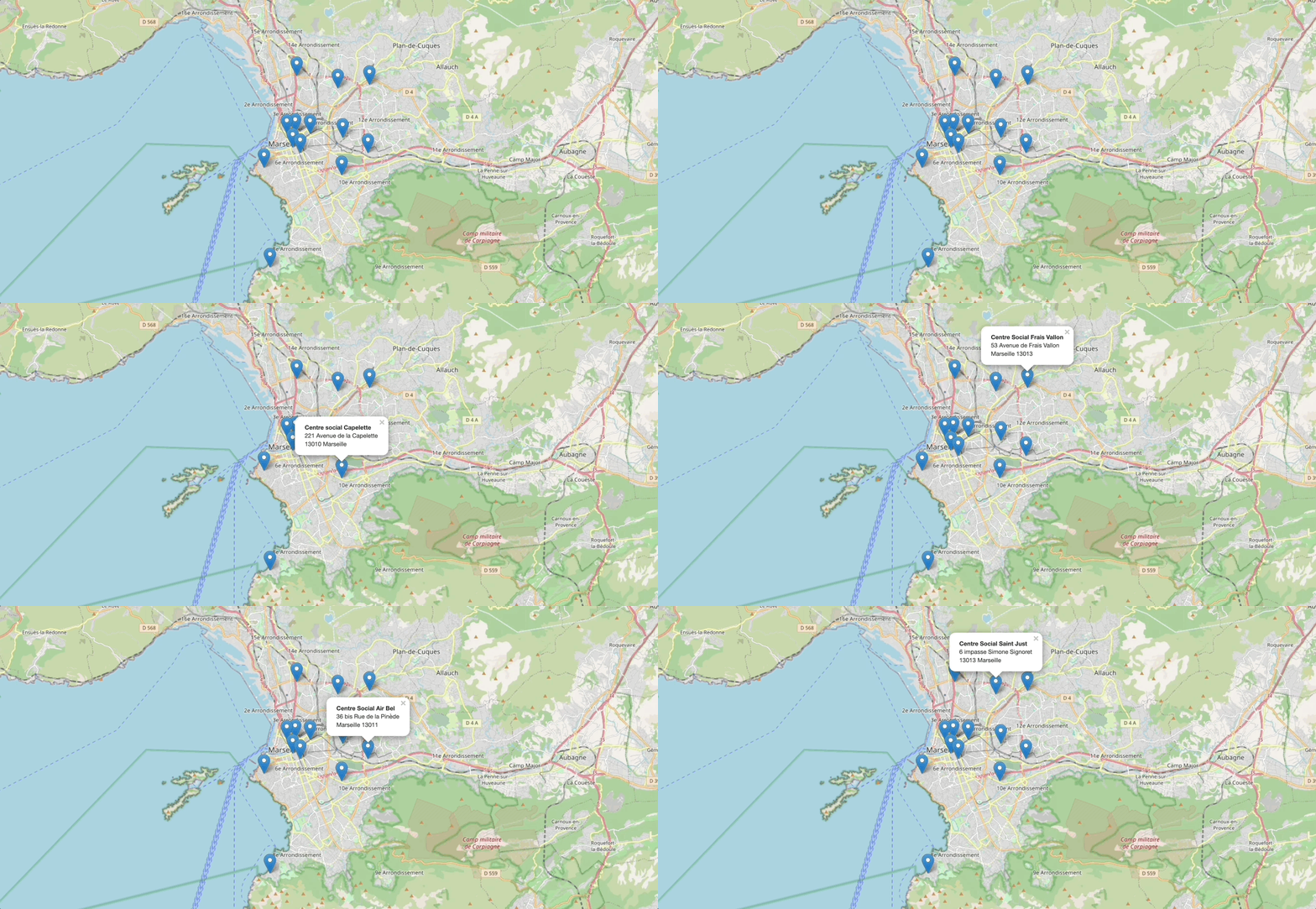
At the hair salon or in the dentist's waiting room, you've perhaps already been tempted by that pile of magazines and newspapers, stored carelessly in a corner of the room. In cafes or bars, you've perhaps already flipped through the dog-eared pages of a Télérama or the local newspaper. A common, even mundane practice, in which Marsactu, an investigative online media outlet based in Marseille, hopes to find a solution — at least part of one — to a problem that bothers it. "We have many subscribers in the city centre and the south but far fewer in the Marseille suburbs. That raises questions for us," observes Julien Vinzent, president of Marsactu. To address this, the media outlet now offers unlimited access to its content at around fifteen partner locations, mainly cafes and social centres. To do so, you simply need to connect to the Wi-Fi network, "you don't even need to have an account," notes Julien Vinzent.
With this new offer, called Marsactu Unlimited, the media aims to address barriers caused by socio-economic factors that prevent part of its target audience from accessing information. "For example, we might announce in Marsactu that a tower will be demolished or a building will be cut in half. We realize that the people most directly affected by this information are ultimately cut off from it," explains Julien Vinzent. "People living downtown or in the south of the city, more than 10 km from the affected area, receive the information before they do. We get emails from people telling us they just learned about it when we wrote about it a year ago." An initiative that complements other schemes offered by Marsactu aimed at bridging this divide but which, by Julien Vinzent's own admission, don't always achieve their primary goals, like free articles: "It circulates a lot but we still mostly stay within our subscribers' networks".
A gradual rollout
This new offer is still in its launch phase. For now, it is only available in a few cafés and social centers. In the latter, this new offer will be combined with workshops led by Marsactu on press and media topics. A first for the local media outlet. « We can reach a fairly diverse audience and perhaps, more specifically, an audience more distant from the press, particularly from paid online press » says Julien Vinzent. This presence in social centers allows Marsactu to strengthen its footprint on the outskirts of the city, unlike cafés which are located more in the city center.
It was precisely on the theme of geographic divide that Marsactu obtained funding in the summer of 2023. To implement its project, the editorial team submitted an application to the Local Media for Democracy (LM4D) program, which provided it with 35,000 euros, enough to fully finance the launch of Marsactu Illimité. This European program aims in particular to address the phenomenon of "media deserts" already observed in the United States and which the European Commission is now looking into, which funds LM4D. But the new offering cannot rely indefinitely on this type of funding and must find other revenue sources, especially since Marsactu intends to sustain and develop it, particularly in libraries. To date, partner locations do not contribute financially to this offering, at least not for now. "The goal in the long term is to build their loyalty, to convince them to stay in the program, this time by taking out a subscription" explains Julien Vinzent, adding that the price will not be "far from an annual subscription".
One of these venues, Bernie Coffee, is nestled in the 6th district of the city, at the intersection of Rue Lafon and Rue de la Palud. Nadia Friedli, one of the venue's managers, was approached by the media team on Instagram. « I was drawn to the work done by Marsactu and we said yes right away » she confirms. Through this six-month trial period, the café will be able to share feedback with the media team based on what its customers—mainly young professionals—have to say.
Make an online offer physically exist
Yet convincing partners to pay for a subscription to a fully digital news outlet is still no easy feat. "A printed newspaper, you see it right away. For us, it's a bit more complex," admits the media outlet's president. "We're an independent online newspaper so people need Wi-Fi. There's inevitably a need for some education with customers and users, which takes effort. It requires having motivated location managers and teams who are convinced this offering can be beneficial." A learning curve that can vary depending on the location and audience. At Bernie Coffee, the use of Marsactu Unlimited feels natural. "Honestly, no one asks me for anything," explains Nadia Friedli. I see customers using it. They take the flyers and simply scan the QR codes. Reading the news online this way is intuitive for my customer base."
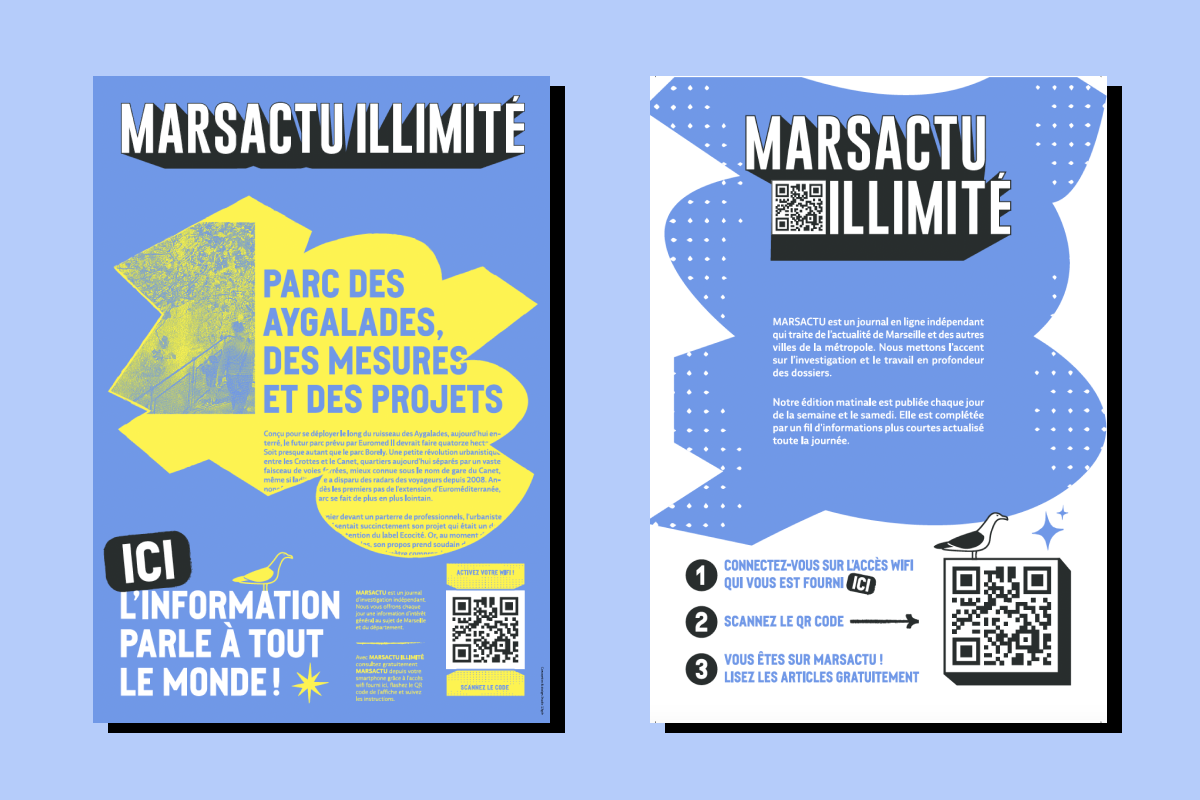
Without the simple stack of magazines and newspapers, the media outlet had to find other ways to promote its offerings and explain how it works to the users of the space. "There are flyers, posters, and stickers on the window. We're even thinking about printing articles," lists Julien Vinzent. The current trial period will help refine this communication strategy in particular. "They wanted to highlight an article about the metro closing at 9:30 p.m., but it wasn't immediately clear that reading was free because there was already a lot of information," recounts Nadia Friedli. "They were completely open to the idea of us making our own little poster," she adds. "It's constructive. We all work together thanks to the feedback we get from the field."
Beyond the single "Marsactu Unlimited" offering, the materialization of online news in physical spaces has become a genuine challenge for digital media outlets that cannot rely on newsstands or bookstores to reach new readers. Until now, social networks could play this role of "digital newsstand," but a disconnect seems to be developing between these platforms and media. While online search—and consequently the economic model of press on the internet—risks also being upended by the emergence of artificial intelligence, digital media are worried about seeing their distribution model crumble. "Previously, we had a fairly simple and free form of distribution through social networks, where we reached people's screens directly," Julien Vinzent agrees. "Now, we're seeing that it's becoming more complicated. We sometimes have to pay and make more human or technical effort to get distributed."
Given these challenges, other media outlets might be tempted to invest in physical spaces and meet their readers through events, as La Déferlante and Censored. have done
To go further:
- To stay connected with their audience, media outlets are multiplying formats that integrate citizens. A few examples from Reporters sans frontières, France Inter, Ouest-France and Centre-France.
- Collages or digital campaigns, media outlets are inventing new ways to occupy public space. Here are some recent and not-so-recent examples from Brut, Usbek & Rica and Merci Simone, which might inspire you.
- Featured articles: a marketing strategy focused on discovering your content and turning subscribers into ambassadors, beyond algorithms.


