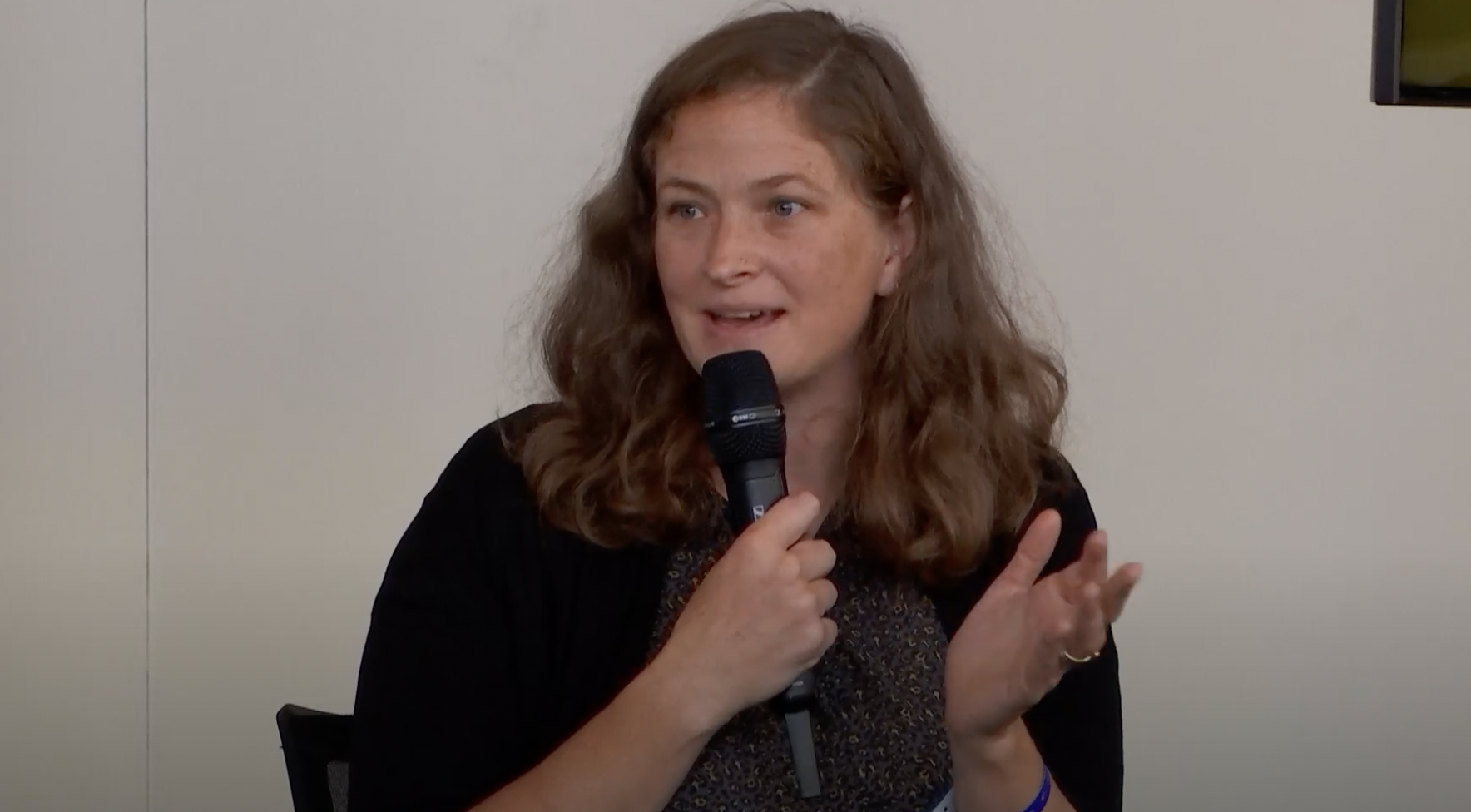
Originally a political reporter, Lénaïg Bredoux has been the editorial director for gender issues at Mediapart since 2020. Or “gender editor,” depending on how you look at it. The investigative news outlet has implemented concrete policies, and even though newsrooms are becoming aware of the changes ahead, progress remains slow.
Mediapart appointed you as gender editor in October 2020. How does your media outlet address gender issues on a day-to-day basis?
We have deliberately retained the French term because we consider the role of “editor-in-chief” to be important. Our mission is directly linked to our editorial line and the way we produce our journalistic content. My work is cross-functional; I am always fully a journalist within the newsroom, but I also liaise with other departments, such as HR. In practical terms, we operate on three levels: there’s coordination in the production of our contents, from the initial idea for an article all the way through to proofreading. Next, we pay close attention to our journalistic practices, ensuring we use inclusive language, the words we use, and gender parity in the people we quote—such as experts—or even in the photos. We also organize ourselves internally, because our work shouldn’t be limited to the articles alone.
Gender parity among journalists is a first step, but what’s it like in the newsroom?
Several years ago at Mediapart, we conducted a small internal survey to measure the distribution of speaking time during editorial meetings. Although the figure is approximate, we concluded that 80% of the time, men were the ones speaking. Today, our editorial meetings are often led by women, and we’ve appointed “monitors” tasked with ensuring that no one interrupts others, that people don’t speak too loudly, and that certain people don’t speak up just to repeat what’s already been said. The truth of the numbers isn’t enough; it’s not just about the quantitative aspects—it’s above all how you act afterward that matters.
When you arrived, what were your priorities?
It was a continuation of what had already been started at Mediapart. This role as gender editor allows us to go further and speed up the process. The newspaper has always been committed to ensuring parity, to investigating issues such as sexist and sexual violence, and to being responsive to gender issues, so we understand the importance of addressing this topic in our newsrooms and our articles. This is a long-term effort that has emerged from our discussions.
So the idea is to strive for gender parity among the people mentioned and the experts, but if a leading figure in a field is a man, how do you handle that?
The goal is to be representative, so if a highly qualified expert happens to be a man, we’re not going to rule out interviewing him. It’s not about gender parity for the sake of gender parity. However, if we take the time, we realize that the research community is predominantly female; it’s a long-term effort to refresh our network and change established habits. In research as in politics, women still feel as though they lack legitimacy. For example, the CSA study released in 2020 on the representation of women in the media during the Covid pandemic acted as a magnifying glass. We have a responsibility as a media outlet, since there are direct consequences for public opinion.
In fact, does the public really care about more inclusive policies?
I wouldn’t generalize by saying that all Mediapart readers agree with our approach. Some, for example, don’t like our use of the midpoint in our articles. As a media outlet, we have a responsibility to address all the issues facing our society—that is our duty to the public.
Are there any media outlets or practices that inspire you?
I read a lot of things that inspire me. In the United States, certain media outlets are certainly more advanced than we are when it comes to the discussions that need to take place in newsrooms, even though Americans aren’t always ahead of the curve on everything.
But it’s very stimulating to ask myself questions I’d never thought about before. In France, news is much more heavily edited; we’re constantly offering commentary. In contrast, I think of the work of AFP, which does a remarkable job of addressing these issues. Beyond the geographical aspects, there’s a generational issue. I see this in journalism schools; lately, I’ve had the impression that we’ve almost entered a whole new world—in a good way, of course. They’re tackling topics that weren’t discussed ten or fifteen years ago in lecture halls: non-binary identity and intersectionality. Male students are asking questions about gender parity and are interested in the topic. This is important because it’s essential to question our biases and our journalistic practices.
Do you feel like things are changing, or is there still a long way to go?
Bringing about change is sometimes difficult and takes time. The major media outlets have the editorial and human resources, but they aren’t doing enough; however, we’re seeing that newspapers are taking up these issues and putting them on the front page: *Libération* with PPDA, *Envoyé Spécial* on Nicolas Hulot… This is something we need to stay constantly mindful of.
For our part, we need to take action internally, particularly during the hiring process; hiring people who are well-informed about these issues is a plus. At Mediapart, we work very regularly with freelancers who are very knowledgeable about gender issues.
We can see that there is, after all, a growing awareness in the media world; for example, I’m thinking of the refusal by certain newsrooms to ultimately participate in the Journalism Conference because Nicolas Hulot was a guest. I’m also seeing Instagram accounts pop up, like “Get Ready for a Fight.”
Learn More
Lenaïg Bredoux has launched a newsletter covering the latest news on gender issues, sexist and sexual violence, feminist and LGBT+ movements, and how Mediapart covers these topics.