In this fifth episode of the second season of Chemins, we welcome Lauren Boudard, co-founder of the spicy newsletter TechTrash and of Climax, a newsletter about climate change news launched in May 2021. A year later, Climax expanded from inboxes to mailboxes with a fanzine "hotter than the climate". Is it really simpler to monetize a print product than a newsletter? How do you engage your community?
Key points
- Climax is funded by subscriptions, donations — these can be in addition to a subscription — and studio activities that sell business expertise in newsletter format.

- Climax also provides training to businesses. An economic lever that doesn't prevent the media from maintaining its committed, anti-greenwashing tone.
« We have a radicalism in the fanzine and the content we distribute in the newsletter. We keep that radicalism during our training sessions. That's what makes us different, that's what makes people follow us. »
- The media outlet has just been selected by the Fund for a Free Press — press aid whose sole resources come from donations by citizens committed to the fight for freedom and pluralism in information — which is supporting ten independent media outlets this year with amounts ranging from 12,000 to 45,000 euros.
« This funding will allow us to develop the Surveys section of Climax. Today, we have a journalist, Nicolas Beublet, who is on a work-study program and we would like to make his position permanent so he can develop reports and investigations. The argument convinced the FPL, and we are very pleased about it. »
- Climax was initially launched as a paid newsletter. A year later, the founders decided to transform this newsletter into a fanzine.
"Initially, the paid newsletter was because we believed—and still believe—enormously in the Substack model that's developing in the United States. But our editorial approach didn't fit. With paid newsletters, two paths work: either you subscribe because you know you'll get something useful for your daily life, or you subscribe to support a specific person. That's what all those American journalists do when they leave their newsrooms to build their own little solo media empire. We had a collective project that lent itself better to a free newsletter as a complement to a print format."

- When the Climax newsletter became a fanzine, it had 1000 paying subscribers. The team simply announced the transition to a print model and the existing subscribers naturally followed suit. Today Climax prints and sells 3000 fanzines.
« The idea is to grow gradually. We're going against the grain of 'scale' logic and hypergrowth. We cherish this small media because we cherish our radicalism. Since we distribute exclusively through bookstores and our website, we're constrained to a smaller reach. »
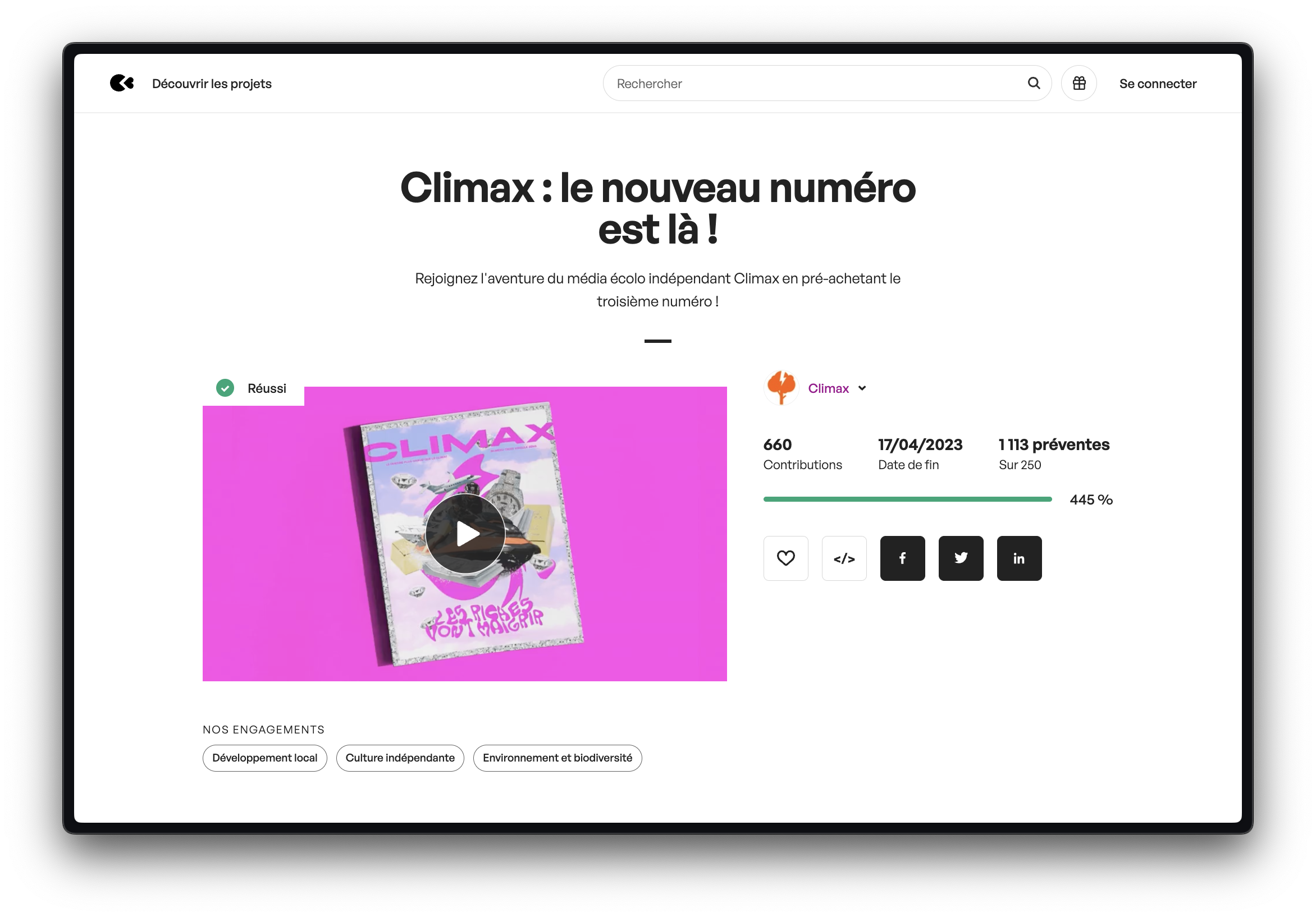
- With each new release, the team pre-sells its issue via a crowdfunding campaign. It's a matter of financial security. Today, the fanzine is barely breaking even but relies on a fragile balance given the cost of paper.
"Pre-sales allow us to both secure the necessary funds to launch printing and gauge how many copies to print. Our goal is still to have visibility on two or three issues in advance."
- The fanzine and newsletter content — now free — communicate with each other.
« We have a newsletter section called "The Bogus Argument" where we deconstruct the ready-made thinking that prevents us from taking action. In the newsletter, it's a very condensed format, but we also find this type of content in the zine with longer pieces that help readers respond to the refrains we hear every day. Connections are created between the two, but the formats remain different: the newsletter covers current events, the zine has longer formats, with archives in particular. »
- The shift from newsletter to fanzine allowed the Climax team to gain legitimacy and develop a team of freelance journalists.
« We've received a lot of feedback from our readers and fellow journalists who take us more seriously because of the print format. There's still a lot of prejudice around newsletters, with people thinking we write them in spare moments without much professionalism. So it helped us move up a level, it increased interest in what we offer, especially since there aren't many print media outlets covering ecology. »
« Besides the desire, I don't think there are any special conditions for starting a fanzine. What changed is the team's structure. We surrounded ourselves with writers beyond Climax's editorial staff. A real challenge: we developed a specific tone, how do we let other people take ownership of it? »
- Each new issue release is an opportunity to organize an evening event and develop an event-driven strategy. The team would now like to expand these events beyond Paris. This is a way to build a community around the fanzine while increasing its "discoverability".
« We want to develop eco-joyfulness. It's important for us to have a sense of accomplishment, to realize that we're not doing all this in isolation. It's an opportunity to meet the community, to organize activities like climate blind tests and oversized word games. We've also launched a series of talks on the concept of utopia to project ourselves toward desirable futures. This fits into our editorial approach. Ecology isn't just about charts and numbers. It's also about the imaginary worlds we want to project ourselves into. »
To go further
- Find all episodes of season 2 of our Chemins podcast dedicated to accelerating a media project, featuring Cécile Sourd (Mediapart), Jean-Christophe Boulanger (Contexte), Lauren Boudard (Climax), Frédéric Desiles (Alternatives Économiques), Emmanuelle Josse (La Déferlante) and Valentin Levetti (Stupid Economics).
- The fanzine, a great way to stand out from traditional publications without losing its identity.
- Beyond the Ministry of Culture, the concept of press aid encompasses many different schemes, each with its own complexities. Follow the guide.
Editor's note: Médianes, the studio, has been supporting the Climax team in its strategic developments since 2022.