


A newsletter can be far more than a simple promotional tool for your latest articles. You can think of it as an embodied product to speak directly to your community, customize it based on current events, or even structure it in finite cycles. Here are all our recommendations to help you create a newsletter that stands out from the crowd.
1. Create a genuine editorial project
Often, a newsletter is conceived as an extension of a media outlet or editorial proposition and aims to build reader loyalty through press reviews and news monitoring. It is also seen as a way to confirm the legitimacy and journalistic expertise of its authors. While the idea is commendable – recommendations help bring things to life and are always appreciated – it's also possible to view a newsletter as a media channel with a native editorial project rather than as an afterthought. And that can be real playground.
And in practice?
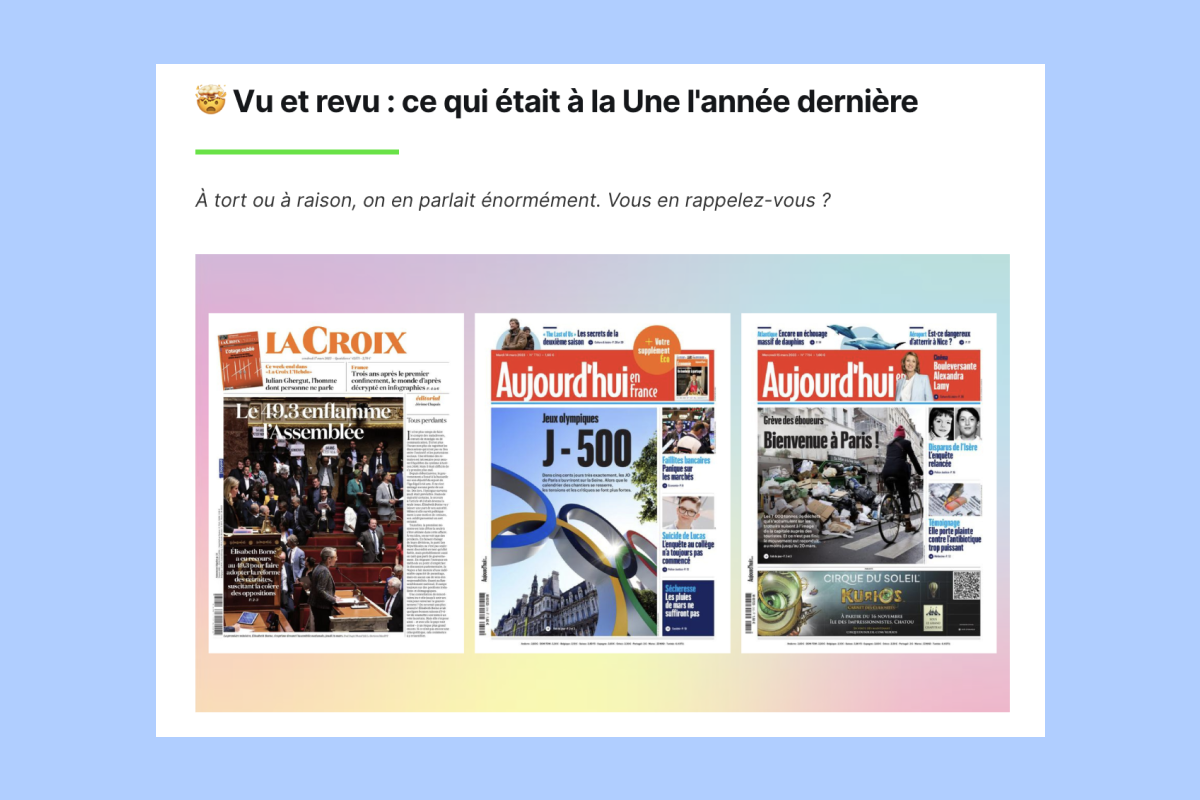
- The Rembobine newsletter, launched in 2022 by three independent journalists, offers a weekly look back at the news from the previous year. What stories made the headlines? Where do we stand on these issues today? The idea is to measure journalism's impact on society by looking back.
- Artips is a newsletter initially launched in 2013 with the goal of providing "a short and original explanation of a famous or little-known work of art". The media outlet now has four new newsletters covering science, sports, music and economics that follow the same principle. An original anecdote format that works perfectly for newsletter distribution. To monetize the project, the media outlet has developed a studio that offers to adapt its signature newsletter format to the needs of businesses and institutions.
- L'Intimiste is a media outlet "dedicated to alternative news about life events". It is a magazine published as a series of newsletters containing long-form articles, photography, art, and stories. A refreshing promise that helps us escape the flood of news in our inboxes and take time to immerse ourselves in in-depth stories.
2. Imagine cycles
Structured in episodes or sequences, a newsletter can absolutely be conceived as a finished editorial product, to be consumed like a series. The advantage then lies in its excellent value for money: the writing takes a defined amount of time and once created, the newsletter continues to live as long as registration remains open. This makes it possible to offer rich content at a relatively low production cost.
And in practice?
- To set up a welcome cycle, like Nice-Matin is doing: the group is preparing to launch a newsletter for newcomers to Nice. It will consist of eight episodes and will give new Nice residents insights into the city's history, heritage, cuisine, as well as practical advice for settling in and completing administrative procedures. "The idea is that if we've engaged a reader over roughly two months and provided them with relevant services, it will be easier to convert them into a subscriber," says Olivier Marino, deputy editorial director at Nice-Matin in this interview with Médianes.
- To create an online course system, like the Wall Street Journal : In summer 2020, The Wall Street Journal went further with "Money Challenge", a course to teach the basics of personal finance. For six weeks, participants receive a weekly email with exercises, tips, and even homework. To learn more, read our interview with Robin Kwong, head of audience retention at Wall Street Journal.
- To make the most of its archives, like Pew Research Center: using and promoting archives is a common—if not systematic—challenge for news organizations. Pew Research Center found a clever way to bring them to life through a system of mini-courses delivered by email, drawn from existing productions. Want to learn more about immigration to the United States? Interested in exploring the latest U.S. population census? You can sign up for free to receive five lessons delivered straight to your inbox.
3. Embody, embody, embody
Looking for a medium to introduce yourself and share your project on a daily basis? A newsletter is the perfect space to share your insights and recommendations, while allowing your audience to get to know the faces behind the stories. More than just a communication channel, it becomes a way to embody your editorial values and direction… and thus, build reader loyalty by creating a relationship of trust and closeness.
And in practice?
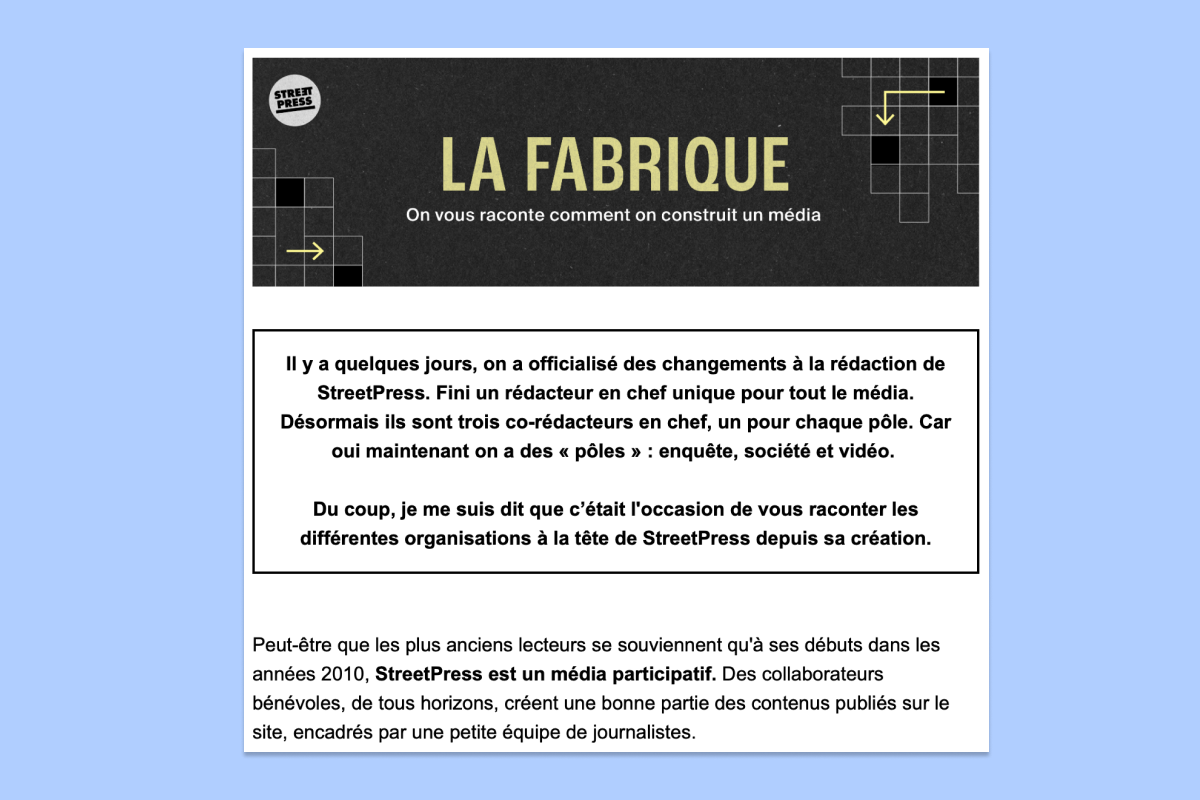
- Behind the scenes, La Fabrique de StreetPress is a newsletter that reveals how the media is made, covering everything from new team members to organizational growth. Throughout each issue, the newsletter shares anecdotes from the media's early days, including reporting mishaps and small miracles that make up the adventure of entrepreneurship. It's an excellent way to build narrative while bringing new team members up to speed. Since the media relies partly on donations for revenue, it's also a way to put a face to the organization—reminding readers who receives their money, where it goes, and why their support matters.
- On the recommendations side, let's mention Aux petits oignons, the newsletter from media criticism site Arrêt sur images led by its deputy editor-in-chief, Pauline Bock. Each week, the journalist shares her perspective on media news through an editorial before offering her favorite reads and a selection of useful articles for understanding how the media landscape developed over the past week. Readers become accustomed to the weekly presence of a journalist they trust in their inbox; they can thus benefit from personalized recommendations, as if they were coming from a close friend.
4. Make yourself known
When starting a new media project, the newsletter is often an obvious choice to introduce yourself to your readership, spark interest, and mobilize an initial community of loyal followers. The newsletter thus serves as a showcase for the content and personality of the emerging media outlet.
- The newsletter for the epistolary media La Disparition was launched before the media itself with the aim of introducing the project, sparking curiosity and building an initial base of loyal readers. "It allowed us to establish the theme of disappearances in the news cycle and prove the full interest, originality and legitimacy of our project. […] We chose to use the six months we had before launching our print letters to explain this vision within a newsletter. It let us build an initial community and avoid having to say 'hey, we're launching a print media, nobody knows us and we're going to talk about disappearances, subscribe!' That would surely have been a bit odd. At first, we were gaining nearly 400 subscribers each month. We ended up with 1,600 subscribers after four months", explains François de Monès, co-founder of La Disparition to Médianes.
5. Thematize
If your newsletter is a complementary product designed to extend your journalists' stories or promote your publication, it may be worthwhile to give it a thematic focus. The idea is then to select, from the topics covered in your publication, an article that resonates with current events at the time you send your newsletter. You can then present how you chose to cover this subject with your media and extend the discussion through reading recommendations, podcasts, or videos from other sources.
And in practice?
- The Pays newsletter, a review on territories co-founded by Médianes, presents in the form of a press review a theme addressed in one of the articles in the publication. With each new issue, its colors are adapted to the design of that volume, providing a visual alert about the imminent release of a new work. The newsletter can thus offer the opportunity to present the issue and 5 reasons to subscribe to the publication.
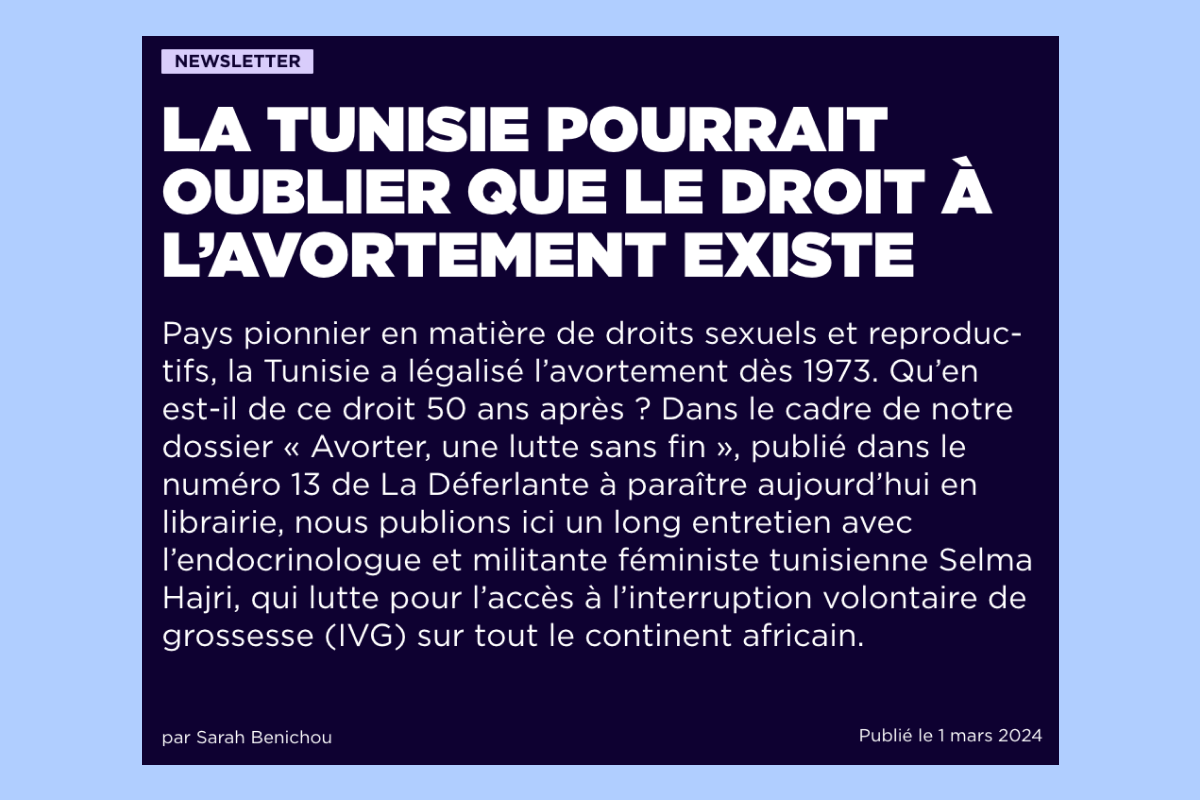
- On the feminist magazine La Déferlante's side, the newsletter responds to current events by (re)publishing interviews and content that have appeared or will appear in the magazine. Daring to use long-form content within a newsletter can be an interesting strategy for standing out among the many hot news emails. It's also an excellent lead magnet that makes people want to get the magazine by putting editorial quality at the center rather than a new marketing offer. And aside from the integration, it takes no additional time.
6. Test the LinkedIn platform
For several years now, LinkedIn has been offering its users the ability to create a newsletter directly on the social network. Today, nearly 143,000 newsletters coexist on the platform and over 500,000 people are subscribed to at least one of them. According to Keren Baruch, Product Director at LinkedIn, 150 news publishers now have their own newsletter. This phenomenon has been bolstered by the fact that LinkedIn commands greater trust among media professionals, given the troubles faced by Meta, Google, and X. It's a way to reach new audiences and gain visibility.
And in practice?
- For a year now, Le Figaro has been sharing in its LinkedIn newsletter Building Le Figaro behind-the-scenes stories of its projects and reflections on improving its products. In one issue, the Product team goes into great detail about every step in creating Figaro Cuisine, the app for everyday recipes. The newsletter's angle is clever: what better way to tell the story of how a newspaper is built than on a professional platform? Subscriptions, products, technology, user experience… Their internal organization is described with humility and transparency.
- Le magazine londonien The Economist a lancé en juillet 2022 The Economist Week Ahead, leur première newsletter envoyée via LinkedIn. Le magazine compte 13 millions d’abonné·es sur LinkedIn, d’où l’intérêt d’exploiter cette communauté en profitant de la fonctionnalité proposée par la plateforme. Dans cette newsletter, le rédacteur en chef du numérique Adam Roberts explique le processus de décision interne à The Economist, la façon dont le média prépare les grands sujets à venir ainsi que son expertise et ses conseils sur l’actualité. La seconde partie présente des chroniques sur la culture du travail et des conseils de lecture. Les abonné·es de The Economist sont presque trois fois plus susceptibles de partager du contenu que l’utilisateur moyen de LinkedIn. Le titre a également vu ses abonnements augmenter depuis le lancement de cette newsletter.
- On LinkedIn, the BBC runs a newsletter about the world of work: Worklife101. It was designed specifically for LinkedIn. Nearly 2 million people subscribe to it and, more importantly for the BBC, many comment on and react to the content published there. "We always pay attention to conversations in the comments or shares. Articles that get people talking – whether they agree or not – are considered successes for us," says Meredith Turtis in this interview. "One of LinkedIn's most unique features is that people want to talk, and they will talk – its interface makes this easier and encourages it."
7. Extend the experience for power users
Do you always get lots of responses every time you send your newsletter? That might be a sign it's time to think about creating a space where your subscribers can exchange ideas, debate, and share their own recommendations. Beyond building engagement, this space could become a goldmine for finding ideas for future editions and sparking new projects.
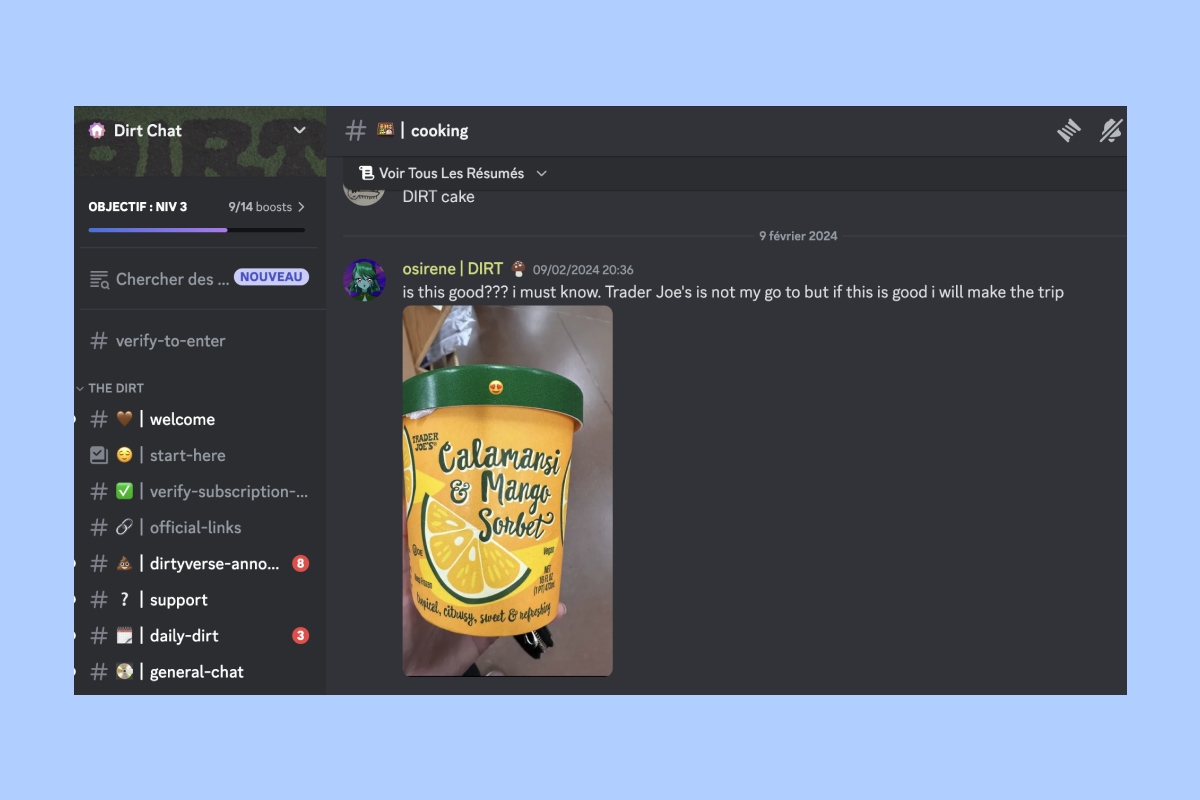
- The web culture newsletter Dirt has a Discord where subscribers can sign up and share their reading recommendations, tips and reactions to the newsletter. The community is so close-knit that it has started creating channels where discussions go well beyond the newsletter's theme: gardening, tennis and interior design are all fair game.
- Not really into Discord? There are still plenty of things to explore on the professional platform Slack, via WhatsApp and Instagram channels, or even on Twitch, by hosting Q&A sessions with your readers. To help you get started, we invite you to draw inspiration from the experience shared by the rap magazine Mosaïque or Arrêt sur images.
8. Ensure accessibility
Today, 12 million French people—roughly less than 20% of the population—live with a disability. This figure rises to 40% when including temporary disabilities. Content accessibility is therefore not a minor concern, especially since the inbox is one of the most visited digital spaces. It's also worth noting that the average attention span for newsletters is just over 13 seconds. This underscores the importance of carefully crafting both content and presentation to make them digestible and easy to navigate.
And in practice?
- For accessible content, write short sentences divided into small paragraphs with key points highlighted throughout the text. Avoid jargon by using commonly used words to make the text understandable for those who don't have your experience or expertise. Finally, sometimes no image is better than an illustration that's hard to understand or not inclusive.
- For accessible content, use a font size of at least 14 px and ensure your text has high contrast. Prefer black text on a white background, or vice versa. Also make sure to clearly indicate links, for example by using a different color or by underlining that part of the text. Finally, structure your content hierarchically to help your subscribers process information more easily.
- We recommend reading this guide, published on the Inbox Collective website and translated by us to make the design and content of your newsletters accessible to as many people as possible.
To go further
- Ready to get practical? We've translated for you the 52 tips from Dan Oshinsky, founder of InboxCollective, to grow your newsletter audience.
- To stay current with the latest news, find literary recommendations, or test new work tools, newsletters are our best allies. Here's the top 50 from the Médianes team.
- Objectives, formats, distribution… This practical guide will help you think through creating, launching, or optimizing your newsletter.
- Creating and distributing an effective newsletter is an art that requires careful attention to detail, from deliverability to accessibility. Discover our 5 tips for designing your newsletter.
- Médianes attended a series of workshops organized by the American Press Institute focused on monetization and retention strategies. Based on conversations with numerous professionals, we've compiled some tips and case studies that you can draw inspiration from.
- To (re)engage their audience, reach new targets or encourage subscriptions, editorial newsletters are a valuable tool. How can local media make the most of them?
- Rather than making it a stark registration confirmation, the welcome message deserves to be thought of as a loyalty driver. Since it's the first link between a media outlet and its community, it's worth making a good impression. Here are some ideas and best practices.
- Léry Jicquel is the founder of Concentré Vélo, a newsletter about cycling culture news. He describes to us the different funding mechanisms for his newsletter, from sponsorship to job board to a Christmas catalog. At the heart of his strategy? A
- Jean Abbiateci is the founder of Bulletin, an optimistic newsletter media outlet founded in 2020 that now includes a training studio. In 2022, he launched Le Dico des mots extraordinaires, a book compiling the best from the favorite section of his free newsletter subscribers. Click here to read our interview.
- When you launch your newsletter, you position yourself as an expert on a subject. This expertise can guide you in finding your business model. If your readers aren't ready to pay a subscription to access your resources or your updates, perhaps you could offer them personalized training. This is the formula adopted by Léa Lejeune, founder of the newsletter Plan Cash.
- Substack's newsletter service has long been presented as a promised land for independent journalists. What is the track record of using the platform?
Médianes, the studio, supports or has supported the teams behind L'Intimiste, StreetPress, Arrêt sur image, La Disparition, La Déferlante and Pay


