



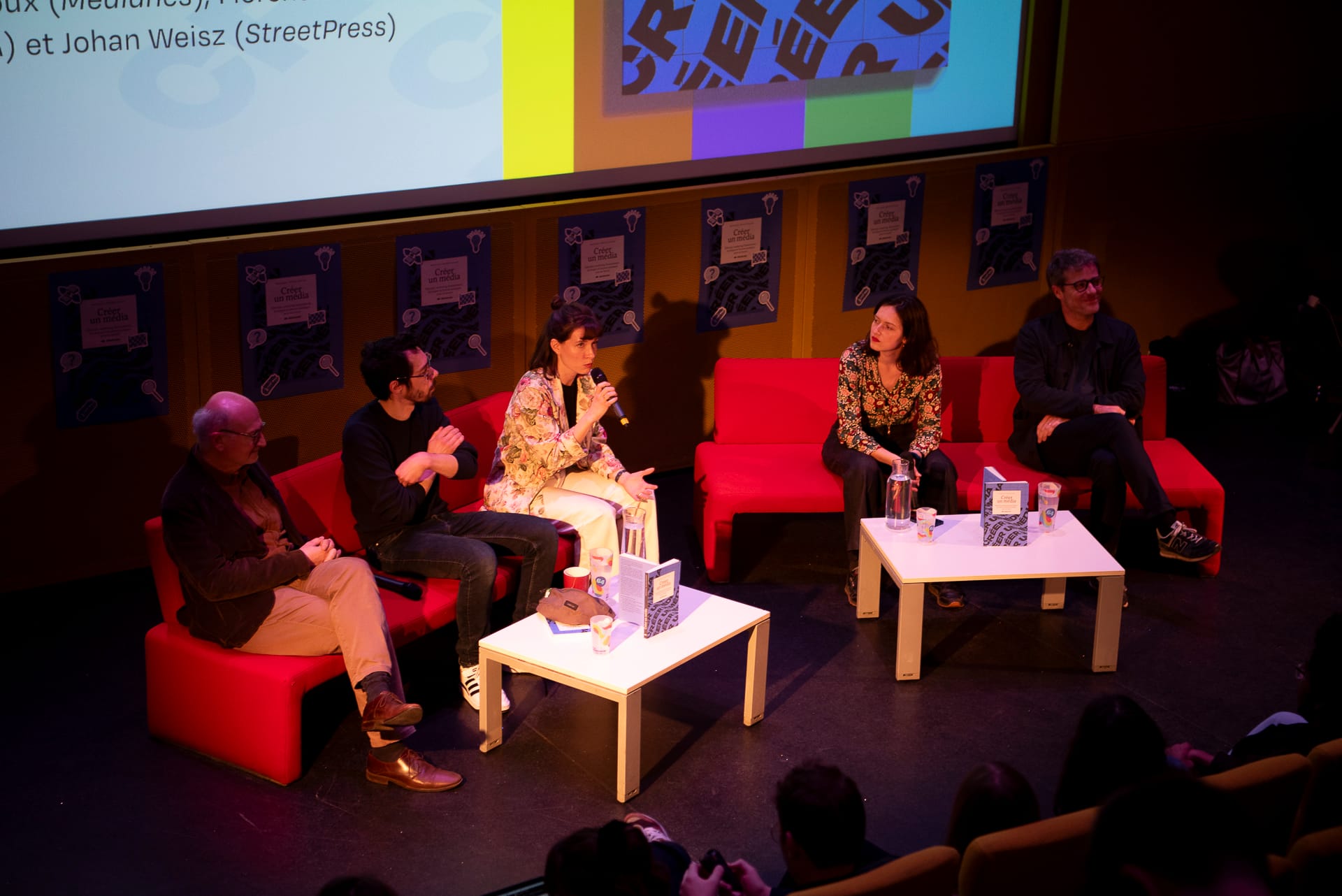
On Tuesday, April 2nd, we organised a roundtable discussion on the theme: "How to create a media outlet in 2024?", to mark our third anniversary and the release of our book Creating a Media Outlet, a practical guide to support media creation. This evening was an opportunity to discuss media creation alongside various independent French-language organisations — such as Vert with Juliette Quef, StreetPress with Johan Weisz, Le 1 with Eric Fottorino, and URBANIA France with Florent Peiffer. All the key takeaways from this roundtable discussion moderated by Marine Doux, co-founder of Médianes.
Lesson 1: Knowing how to say no
Éric Fottorino joined the newspaper Le Monde in 1986, where he spent no fewer than twenty-five years, including five as head of the daily publication and then of the group, from 2007 to 2011. A lecturer at the Institut d'études politiques de Paris, columnist and essayist, he has published around ten novels. In 2012, in Mon tour du Monde, he recounts his thirty years in journalism. He subsequently launched into media creation in April 2014 with the weekly Le 1, followed by the quarterly magazines America (2017), Zadig (2019) and Légende (2020).

The adventure of 1 began around a table: the co-founders, including Éric Fottorino, listened and folded paper. "Our designer unfolded a small sheet that became a large sheet. We thought: this is what we want!" he recalls. A creative process that gave birth to the 1 formula, which became so familiar in newsstands. The newspaper, launched in 2014, explores a new subject each week, with the intention of "creating a dialogue between the world of sensibility and knowledge through multidisciplinarity". Far from being a gimmick, the newspaper's format allows for a progressive discovery of subjects through an "unfolding of current events," both in the gesture of the reader and in the editorial treatment of the subjects.
Le 1 is not Éric Fottorino's only editorial venture since leaving Le Monde in 2010. For 4 years, the short-lived magazine America explored Donald Trump's America throughout his entire term. Zadig, meanwhile, continues to explore France, and Légende, the large-format black and white publication, offers a new perspective on a personality through text, but above all, through images. Different formats and subjects each time, but according to Éric Fottorino, all of these projects are true "press objects" that "all hold hands together" and commonly defend a commitment to free and independent journalism.
A multitude of titles whose publication is made possible by a team that has grown over the years, both in size and in skills and experience. « Seeing people grow around you is very important. When you create a newspaper, a business, you take young people with you and these people grow. You have to see them grow » explains Éric Fottorino, emphasizing in particular the importance of delegation. But a team, however large, cannot do everything. While the editorial team prides itself on adopting a culture of testing and experimentation, « you have to know how to do the opposite, know how to say no, he adds, out of 100 projects, reject 99. »
But his experience at Le Monde did not make Éric Fottorino immune to difficulties, or even to questioning. During his early years, Le 1 saw its flagship publication disappear following the closure of a printing facility. The newspaper was caught up, despite itself, like other press titles, in the collapse of Presstalis in 2022, a press distribution company. Today, Le 1 and its related publications face paper prices that have only continued to rise in recent years. These difficulties led management to seek alternative sources of funding, resulting in billionaire François Pinault joining the publisher of 1 at a 40% stake. A situation that does not, in his view, undermine the principles of editorial independence to which the newsroom of 1 is firmly committed. "I asked François Pinault if he could be interested in 1 on one condition," he clarifies, "that he help with projects but that he not get involved in the content."
StreetPress: Learning to question your model
Entrepreneur and journalist, Johan Weisz is the founder of StreetPress, an investigative media outlet and urban culture publication that has championed pay-what-you-wish independent journalism since 2009. StreetPress aims to offer independent journalism, stand against the far right, and remain accessible to everyone. On StreetPress, investigations and documentaries are indeed freely available.

Before launching StreetPress, Johan Weisz was a freelance journalist covering issues related to radicalism and working-class neighbourhoods. While reporting on stories, the journalist noticed the same concerns repeatedly coming from the people he interviewed: "If I agree to answer your questions, that doesn't mean I trust you to tell our story." At that time, Johan Weisz developed the habit of recording every interview to be certain he wouldn't misrepresent what was said. "Over time, I realized how eroded trust had become. I questioned my role and wondered what good a media outlet could do if people don't trust us to tell their stories," he explains. This led to the desire to launch a media platform where people could share their stories without worrying about how their words would be reported.
In 2009, Johan Weisz decided to launch StreetPress. "Since bankers were skeptical about my project, I pretended I needed money to renovate my bathroom and took out a consumer loan," the journalist recalls. At the time, crowdfunding platforms like KissKissBankBank and Ulule didn't yet exist: "it was the Stone Age and the idea of financing through readers wasn't even considered," Johan Weisz emphasizes.
The media outlet, which has been funded for five years through donations from its readership, was built organically and grew slowly, step by step. Today, StreetPress has around fifteen full-time journalists and nearly twelve thousand people have already donated to the news site. Reader-funded financing allows the media outlet to maintain its independence. That said, the transition to this model wasn't straightforward. "It's difficult to say: for years, you've been reading us for free, and now it's paid but you can continue to access our articles for free," notes Johan Weisz.
StreetPress also derives part of its revenue from its content agency. « Its teams produce, for example, magazines for Secours populaire and the National Inter-Union of Medical Interns, or videos for NGOs like the French Red Cross, institutions (Institut Français) and brands (Engie). Balancing precariously since 2013, the media draws 80 % of its revenue from this activity, the rest coming from advertising sold on its site and in its « urban guides » dedicated to neighbourhoods in Paris and its suburbs », as detailed by the newspaper Le Monde in 2019.
This model shift went through an intense period of questioning the previous year. "When the media exists, it's difficult to rethink its model. What already exists is always more complicated to work with than a project starting from scratch. We had to accept stopping and taking time to reflect," notes Johan Weisz. In these moments, it falls to the founder to champion the project so that the team can take the media where it needs to go. The key lies in the balance between horizontal management, which grants necessary trust to teams, while avoiding placing on employees' shoulders the responsibilities that belong to founders. A vision that echoes that of Valentin Levetti, founder of the online media Stupid Economics, a guest on our podcast Chemins in 2023: "The end never justifies the means. The only people who can take risks on a media must be shareholders and do so with full knowledge of the facts. On the other hand, all people in subordinate roles — journalists, technicians, editors — must be paid and benefit from collective agreements. A business rests on its human resources. We must take care of them."
Green: Ecology within the company
Juliette Quef is a journalist and co-founder of Vert, an independent media outlet that places climate and the living world at the center of its editorial policy. A former expert advising company committees, she spent five years conducting extensive investigations into employee working conditions and gender equality. With Vert, she initiated the Charter for Journalism Worthy of the Ecological Emergency, signed by more than 2,000 professionals and a hundred newsrooms, which aims to improve journalistic coverage of these issues.

The story of Vert is that of an environmental media outlet, launched without particular ambitions and with whatever resources were available, by two co-founders who had just exhausted their unemployment benefits. Noticing a gap in the media landscape on environmental topics, the project's objective was to provide monitoring of ecological news. The newsletter emerged as the ideal solution to get started, requiring minimal resources and time to launch this format. Loup Espargilière, a journalist, took charge of writing it, and Juliette Quef handled proofreading the first editions, initially sent to their close circle. "The project developed in a very organic way, there was no grand master plan," Juliette Quef explains. The duo, who had not initially envisioned this newsletter as a project that would extend over the coming years, saw their subscriber base multiply and decided to hire staff, develop other editorial formats, and build a genuine business model. A change in scale that took place over a few years, though the process wasn't always straightforward.
While Juliette Quef had prior professional experience working with works councils, the team genuinely learned to manage a media outlet as it went along. As it developed, the team confronted the submerged phase of entrepreneurial life: finances, administration, accounting… A stage in the project's life—which now employs seven people full-time—far from the most exciting, but which proved essential: "That's what makes the difference between media outlets that do well and media outlets that don't do well". But this development, Vert has no intention of pursuing at any cost and prides itself on "practising ecology within the company". In short, not counting on runaway growth and paying teams fairly. "At some point, we wondered if we were doing too many things" admits Juliette Quef nonetheless. The journalist notably mentions a series of interviews recorded and broadcast on YouTube: "we ended this format because we felt it wasn't the right time for us". A logic of responsible development that also permeates their economic model. Vert refuses advertising and instead appeals to its readers through donations. Today, the media is funded 60% this way, the rest through training and press grants.
These supporters, Vert brings them together within a group called "The Vert Club" to build their loyalty and get them actively involved in developing the media. Today 3000 people contribute a monthly donation and have a say in decisions made by the media. As an example, the editorial team surveyed its supporters through a vote before launching a partnership with Konbini. A decision supported by 80% of its donors.
URBANIA France: Don't replicate an existing model
Florent Peiffer is president of URBANIA France, producer and journalist. After several years of TV reporting (2P2L / France 3), he presents various news segments for 15 years on France 24, ITélé and BFMTV. In 2017, he creates « YouBLive », a company specializing in Live program production. In 2020, he creates URBANIA France, a digital media « cleverly entertaining » for young adults. In 2023, he launches URBANIA France group which brings together the media, a creative studio, the YouBLive agency, and an audiovisual production company.

URBANIA has been developing in France for three years, driven by journalist Florent Peiffer following his meeting with Philippe Lamarre, who founded this magazine in Quebec twenty years ago. " Philippe Lamarre wanted to develop a media outlet in France, and I was looking for a space to bring new ideas to life. We realized that we shared the same vision and the same values ", says Florent Peiffer.
The media is today structured as a group and finances itself through a production company and creative studio. For Florent Peiffer and Philippe Lamarre, the whole challenge was to figure out how to launch an existing project with different ambitions and audience. " At first, we made the mistake of copying the Canadian model in France. Instead, we needed to find a way to exist with our own DNA ", Florent Peiffer emphasizes. According to him, the media found its identity by giving its journalists free rein on the creative side and letting them express their personality, without being locked into predefined formats. The three pillars? Human, information, and creativity.
Recently, the French version of URBANIA launched a 100% digital vertical: the micromag. Already distributed by its Quebec counterpart for some time on a weekly basis, this project, quarterly for now in France, takes the form of vertical slides — similar to stories on Instagram — while adopting the codes of a traditional magazine, with a cover, photos, and interviews. While URBANIA could have distributed this format on social networks like Instagram or TikTok, the media chose to distribute it on its own site in order to maintain control over the distribution and sharing of its content. "Rather than betting on ever-larger content distribution on social networks, journalists prefer a smaller audience, but also one that is more loyal and willing to subscribe", explains L'ADN.
Although free, access to micromags requires registration, which allows URBANIA to collect email addresses from their readers. Another advantage of this format, according to Anaïs Carayon, the publication's editor-in-chief: "it lets us cover topics the way we want, without worrying about getting shadowbanned on Instagram or being unavailable for several days on our TikTok account like can sometimes happen when we cover a sensitive subject".
While the media continues to develop gradually in France, Florent Peiffer explains that he didn't immediately realize how demanding launching a media outlet could be, both as a founder and for his teams: "I wish someone had seriously explained to me that actually, this isn't a game. There are people involved, they're your teams, not a summer camp. The way you engage people in an adventure like this is crucial: everything needs to be thought through. You can't just charge ahead blindly." While Florent Peiffer and Philippe Lamarre play the roles of orchestrators, their teams remain autonomous: "today, I'm doing this project with the goal of becoming completely unnecessary to this company and achieving that as quickly as possible. I think it's healthy not to feel indispensable," concludes the journalist.

To go further
- To learn more about the project and content of our book Creating a Media Outlet, read our column. And to get a copy, it's over here.
- Got a media idea on your mind? Want to develop your existing project further? Whether you've already started or not, whether you've studied journalism or not, the Médianes team has created these practical guides to help you develop your media.
- How do you actually launch your project? What business model should you choose? What strategy should you implement? How do you transition from journalist to project creator? Through 45-minute discussions, the first season of our podcast Chemins highlights the diversity of paths for creating and developing your media.
- Establish procedures, monitor projects and employees, listen carefully… Learn all about our management practices.
- Management, transformation, scaling, audience engagement, editorial and economic innovations: in the second season of our podcast Chemins, we host six media founders and leaders sharing strategies and best practices for sustainable growth.


