



Article translated by Owen Huchon — Original version published on the Nieman Lab website on May 11, 2023.
At its annual I/O conference held on May 10, 2023, Google announced a series of "experiments" and upcoming changes in the search field.
A transition that's just beginning, but if these changes become widespread, it will be the most significant overhaul of a crucial part of the internet in some time. This change could significantly reduce the traffic Google sends to publisher sites because more people will be able to get what they need directly from Google's search page. It could also harm the affiliate revenue that publishers earn from third-party product recommendations.
On the other hand, a new search filter designed by Google to highlight human-created content could help surface journalists, columnists, and independent news outlets – perhaps.
« Search Generative Experience » (SGE)
Google will place AI-generated answers at the top of certain search pages. Here's how the company describes this approach:
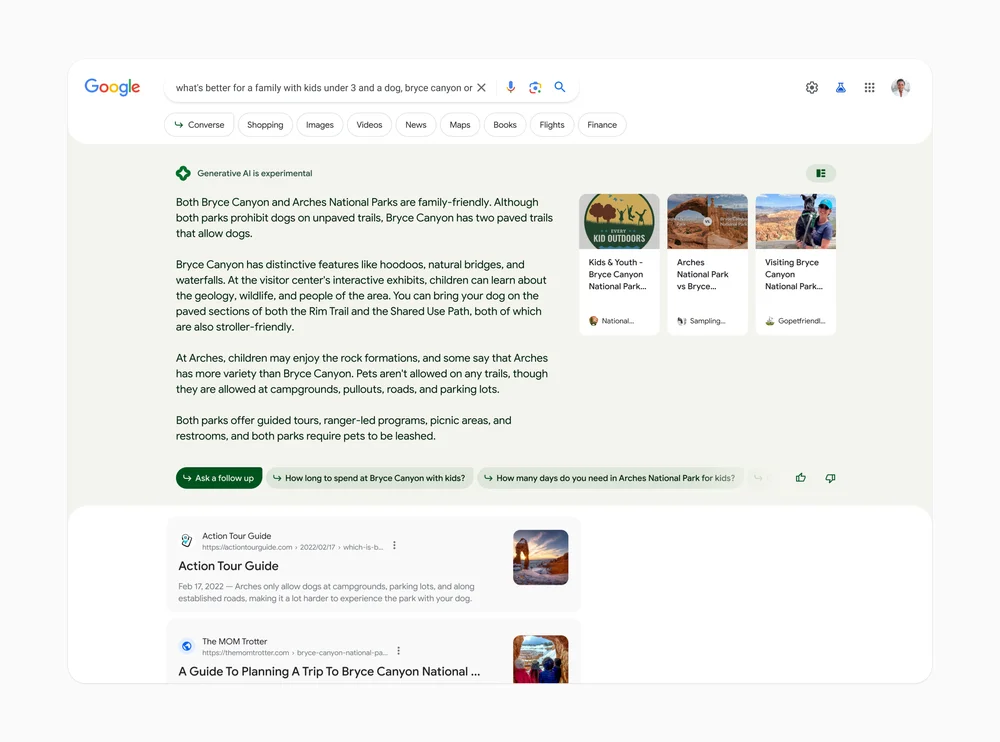
Washington Post technology journalist Geoffrey Fowler tested this feature and described how SGE cites its sources:
The first three sources display by default, but you can display additional ones.
AI-generated content will also be integrated into shopping results. If you search for something like "a Bluetooth speaker for a pool party under $100" or "a good bike for a 5-mile commute with hills," you'll get a list of recommended products curated by AI. I haven't tested this feature, but beyond preventing users from visiting publishers' pages, it seems like bad news for publishers who make money through affiliate links.
Google notes that its SGE is still in the experimental stage and not yet available at scale. (If you want to try it, you need to be in the United States and sign up for a waitlist). Beyond this limited access, The Verge's David Pierce notes that there are supposed to be limits to what Google will use to power the AI:
For example, when Will Knight of Wired asked “whether Joe Biden is a good president or for information on abortion laws in different U.S. states, it refused to answer.” Even though Google’s AI isn’t supposed to have an opinion, it seems that it sometimes slips in one. The Verge again:
so in a world where search goes fully GenAI (which is still a big if), pages of links go away and you get a handful of citations
i would imagine/guess this theoretically destroys small publisher traffic while rewarding the big outlets which may be weighted w/more authority https://t.co/7CyPj2JthQ
— rat king 🐀 (@MikeIsaac) May 10, 2023
I, for one, look forward to generating IP that helps Google generate more advertising revenue in exchange for less referral traffic. #cjpa https://t.co/6muq3S6KRT
— Matt Pearce 🦅🇺🇸 (@mattdpearce) May 11, 2023
One thing this definitely kills is the easy-click stories like "what time is the Super Bowl" — which you may hate, but because they do viral traffic every time, pay the bills in many newsrooms. https://t.co/GdNvzUVWAW
— Heidi N. Moore (@moorehn) May 10, 2023
This is what Google's answer box with new AI looks like by @geoffreyfowler
Very curious to see how people use this irl and how every website will pivot to get into the new answer box. https://t.co/FxtKANg6Fv
— Shira Ovide (@ShiraOvide) May 10, 2023
2004: Let's build our websites to make Yahoo happy!
2008: Let's build our websites to make Google happy!
2014: Actually let's focus on Facebook.
2019: Uh, actually let's go back to Google. Good ol' Google.
2023: Would you believe me if I said homepages are the new search? No? https://t.co/RPuu3Hre8a— Peter Kafka (@pkafka) May 10, 2023
It's wild how this only doesn't constitute plagiarism or copyright violation by mere technicality. Like they can copyright strike you like the day is long on YouTube, but if you write on the internet for a living, your shit is just theirs now https://t.co/FrPNssjagG
— Alex Arrelia (@AlexArrelia) May 11, 2023
Hidden "gems"
Google is also expanding the use of a search filter called "Perspectives, which incorporates user-generated content in search results, such as Reddit posts, YouTube videos, and blog articles. This change comes at a time when Americans are increasingly searching for news and information from individuals, not institutions, and when TikTok and Instagram are eating into Google's market share in search. Here's what Google says:
"We're seeing that our users, especially younger users, want to know what other people think," said Liz Reid, vice president of search at Google, in an interview with The Verge. "They don't just want to hear from institutions or big brands. So how do we make it easier to surface that information?"
As “Perspectives” rolls out, it will be interesting to see how Google defines “other people”: Are journalists or opinion columnists who work for newspapers included? Will newsletters on Substack be featured? This feature could potentially benefit major news publishers as well as freelance journalists, but uncertainty still remains.
Editor's Note
This text is not a word-for-word translation of the original article published on the Nieman Lab website. We have added contextual information, adapted certain expressions, and omitted certain passages containing specialized references intended for English-speaking or American readers. We have also chosen to apply the rules of inclusive writing to this translation, in accordance with the editorial guidelines currently in effect for all Médianes content.


