


More often imposed than chosen, the interactions between editorial teams and readers born from the digital transformation of media nevertheless offer unprecedented opportunities to build reader loyalty: rather than abandoning the field, let's see how to rebuild that connection.
In the previous column, I mentioned the need for media to reclaim their audience: by creating virtuous short circuits capable of strengthening their direct traffic, rather than increasing their dependence on indirect traffic from search engines and social networks. With this column, I hope to give you some keys to achieve this objective: by developing authentic interactions with your readership and creating a lasting community around your media.
Before we begin, I'd like to offer two subjective definitions to help distinguish between the concepts of audience and community in the context of a media outlet:
- Your audience is the public your media can reach through all its channels: its own platforms (website, apps, newsletters) as well as those where it optimizes its presence (SEO, social media accounts) on other platforms.
- Your community is the part of that audience that engages with you wherever possible: again, either directly via your media's channels (comments under articles, etc.) or by shifting the conversation to another platform (tweet exchanges, reactions under a story, etc.)
Content, readership: two investment levers
To build a loyal readership—that is, a segment of your audience whose distinctive qualities are to specifically appreciate your content and to return regularly to your platforms—you can rely on two main levers:
- Invest in your content. You can, for example, serialize your editorial output to captivate your readers over time, as with the obsessions of Quartz or Les Jours. Or develop regular touchpoints the way newsletters do so well. This lever is often the easiest to activate because it relies on existing editorial skills and user experiences proven well beyond media.
- Invest in your community: by developing spaces for exchange, interactions between your team and your readers, and among readers themselves. It's your audience's reactions that then, more than your content, prompt new reactions and create the conditions for engagement with your platforms. These interactions can be set up directly on your platforms (always preferable) or on external platforms if you want to experiment more easily.
So, how do you invest in your community by building quality relationships that are neither a financial drain (in human resources) nor a source of confusion about each person's role (between editorial and readership)?
We're tackling it with plenty of examples, optimism, and clear-eyed realism. Let's go!
To start, you can categorize the interactions that your media can implement along two axes that are fairly representative of the level of effort required:
- The timing of these interactions (asynchronous or synchronous): you can indeed seek feedback or a reaction from your audience before/after publishing your content (such as through topic selection or enabling comments) or directly during content production (such as with questions during a live video).
- Moderating these interactions: on this point you can restrict the range of reactions from your audience (with preset answers to a poll for example) or give them the ability to express themselves more freely (as with more traditional comments). This second option will almost certainly require some form of moderation, whether upfront or after the fact.
With these two axes in mind, you can divide the interactions that your media can implement into four categories.
Asynchronous and unmoderated interactions: polls, reactions, crowdfunding
These interactions are the simplest to set up and represent a first step in building a relationship with your readers:
- You can ask them in advance to choose the next topic of your newsletter (from predefined options) as the daily news outlet Brief.me or the ecology-focused media outlet Vert, does for example.
- You can offer them reactions, again predefined, after your content: like in the New York Times Telegram channel dedicated to Ukraine or even more clearly at the bottom of the newsletters dedicated to art from Artips.
- Crowdfunding, as seen here with StreetPress, can also be considered a form of unmoderated interaction.
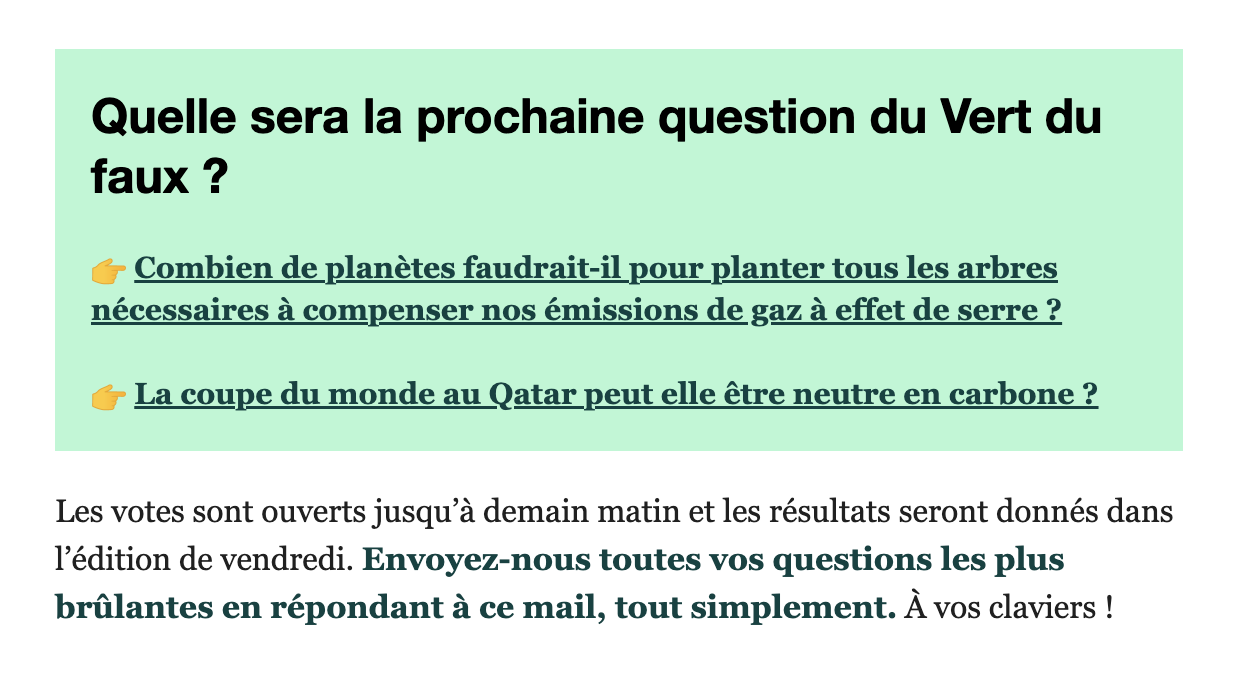
The example of Vert, which solicits its readers for input on future topics.
As you'll have gathered, asynchronous and unmoderated interactions require limited investment from your media outlet, and its risk exposure should be equally limited.
Synchronous and unmoderated interactions: live reactions, cheers, etc.
Very similar to previous interactions in terms of your risk-taking, synchronous and unmoderated interactions stand out for giving your audience the ability to react in real time. This type of interaction is particularly suited to audio or video streams. You'll find the predefined reactions for financial support on Twitch live streams, with Prime subscription triggers or sending cheers (via purchasing Bits or channel points: paid credits that, when spent, allow you to support specific creators). Outside of any financial logic, this category also includes live reactions (often emoji-based) on Instagram Live or Twitter, which has integrated them very well into its Spaces audio. I regularly follow Ukrainian Spaces where hosts often ask questions that call for using these reactions, which creates a real sense of collective listening. (Note: it's likely that Twitter will have less time and resources to develop these interactions in the coming weeks. Too bad.)
Asynchronous and moderated interactions
Slightly more complex to set up, asynchronous and moderated interactions allow your readership freer expression.
- In particular, you’ll find “comments”—that form of interaction that terrified many newsrooms during the Web 2.0 era. Comments would be opened, then closed, and finally, in many cases, left to social media platforms. When it comes to comments, it makes more sense to consider the volume and quality of the user experience rather than deciding unilaterally whether to open or close them on your platforms. What content would benefit most from open feedback and detailed testimonials from your readership? With third-party commenting solutions, such as OpenWeb, you can easily enable comments on certain articles and not on others. This also has the advantage of allowing you to gradually assess the resources you’ll need to moderate these discussions. This is because comments follow the “broken window” theory: the more negative comments (aggressive, hateful, etc.) you leave visible, the more they will attract new posters of negative comments, who will perceive this as a standard of impunity.
- Equally moderate but with less risk of rewarding trolls, questions from the chat during Le Monde's live streams are particularly clever: while they are indeed reader questions that need to be reviewed before being published, they are not public by default and only a minority will ever see the light of day. The incentive for trolls hoping to circumvent pre-moderation thus becomes virtually nil.
Synchronous and moderated interactions
Finally, the last category brings together moderated synchronous interactions: those that require the most effort but also those that will create the strongest bonds with your most loyal readers. These readers will not only visit your platforms regularly, but will also invite their own circles to do so: they are the ambassadors of your media.
- Just as unmoderated synchronous interactions are particularly well-suited to streaming content, we find the same synchronous but moderated interactions in open-format live content: Twitch chats (with sub-only, slow modes, or follow-only which set conditions/prerequisites before contributing) or Interview Club, a CNN project (disclaimer: which I had the opportunity to develop within my team) that limits contributions to questions. On Twitter, it's a chance to solicit questions from your audience during a Space to extend participation far beyond the few guests you can give audio access to. HugoDécrypte and Jean Massiet took the exercise even further by hosting editorial meetings or preparation sessions for their upcoming content directly on Twitch, with chat as a direct source of feedback from their community.
- And finally (perhaps the holy grail): free communities, where interactions are separated from the content itself. The goal is then to bring together the community of readers passionate about your media's subjects around an event, a festival, or a permanent group. This is the case with the Monde's OSINT Discord group, or that of Vortex, inspired by streamers' Discord groups.
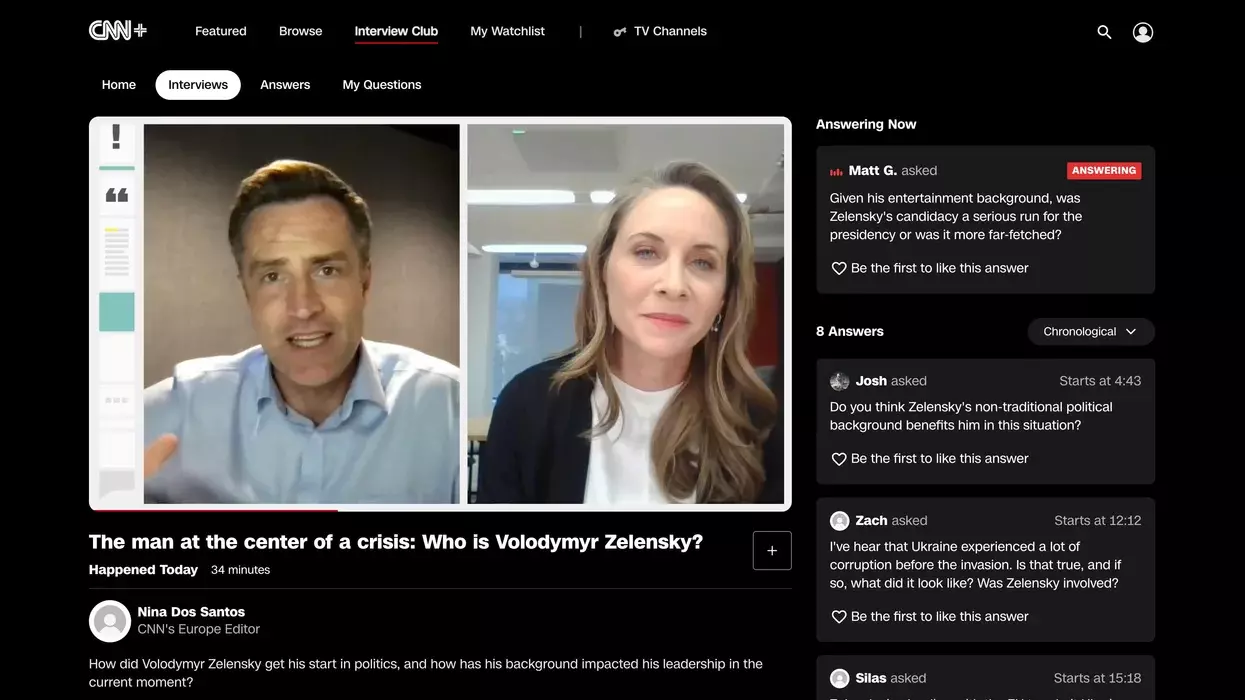
The CNN Interview Club Project
In conclusion, there are many forms of interaction available to build connections with your audience and retain them through more active experiences. It is largely through this effort that the creation of a community and a loyal readership for your media can emerge.
If you don't, rest assured that message senders (brands, politicians, institutions) have already seized this opportunity and are starting to do without your mediation. The day after the assault on the Capitol by Donald Trump supporters on January 6, 2021, it was on Instagram Live that congresswoman Alexandria Ocasio-Cortez shared her experience, with great emotion and accompanied by real-time feedback from her community. An exercise she repeated a little later on Twitch, this time on a bill about finance, even going so far as to invite experts to intervene.
The expectations and behaviors of digital audiences (particularly young ones) are shaped by the highly interactive interfaces of social networks and content platforms. Conversely, the lack of interactivity offered by too many media outlets is completely out of step, and often resembles analog formats (such as a printed newspaper or a cathode ray television) more than that of a website or app in 2022.
In short, rather than asking whether it is right or wrong for a handful of billionaires to own the majority of the media in France (a question that’s easily answered), I prefer to ask whether it is right that certain media outlets show so little interest in being influenced by the needs and feedback of their readership. This is what Jay Rosen, a professor of journalism at New York University and an outstanding critic of the media (particularly in the U.S.), explains so well through the concept of the “citizen’s agenda” in Maxime Loisel’s work.


