



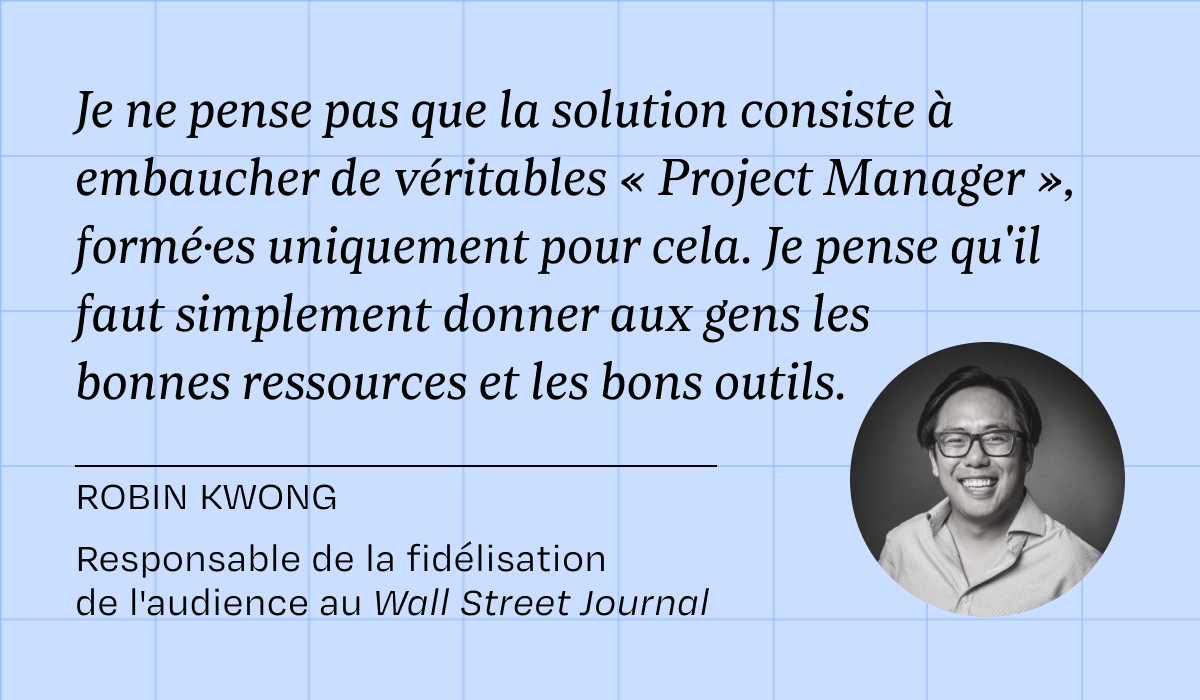
We met Robin Kwong in November 2023 at the Wall Street Journal offices in New York, a few weeks after an initial email exchange about the translation and French adaptation of his Guide to Project Management in Newsrooms.
How can you run an effective project management process within your newsroom? This guide attempts to answer that central question by using the « 6-Week Money Challenge », the first email course launched by the WSJ, as a practical case study.
Now responsible for audience loyalty at the Wall Street Journal, Robin oversees several editorial products, including the media's newsletter portfolio. He pioneered WSJ email courses and challenges and other interactive formats in his previous roles as head of innovation and editor-in-chief of new formats. Before joining the WSJ in 2019, Robin spent 13 years at the Financial Times where he held positions as journalist, editor, and manager in Asia and Europe. At the FT, he created the Uber Game, an award-winning news game that was played by more than half a million people worldwide.
Hello Robin! What inspired you to write a guide on project management in newsrooms?
Two years ago, the Association for Project Management [which brings together thousands of project management professionals around the world, editor's note], asked me if I wanted to become an honorary member. I did have my own website and I was used to writing about project management in newsrooms and in the media. I accepted, but I felt a bit guilty about receiving this title without having done anything special (laughs), and that's one of the reasons why I wrote the guide. I also had a friend who had to teach project management to a group of journalists and who asked me if I had any resources to recommend to her. So I searched online and found nothing. I sent her a few links, things I had been able to produce on the subject in the past. That's when she suggested I write something clear and comprehensive on the subject and I thought: "Why not?". At first, I was very naïve. I thought I could gather what I had written on the subject quite easily. I started writing and I realized I still had a lot to say. It turned into 15,000 words.
What was your first experience with project management?
As the tech section editor, I tried to set up a series of articles spanning 5 days on a single topic. We did this fairly regularly, two or three times a year. The coordination required to pull it off made me realize that these reporting series were truly projects. Then, when I joined the interactive news team, which was the only team at the time with developers and designers working alongside data journalists. So there was a lot of coordination involved. We had to start thinking more broadly, beyond reporting, producing and publishing the article, about how we were going to communicate on social media. That's when we realized there's a marketing team and we should probably talk to them. When we were about to launch a project, I started writing down the list of people I needed to talk to, and I came up with about thirty names. I realized that was a lot of people. These exchanges and communication between teams actually represent a lot of work and often determine whether a project succeeds or fails. But I had no training. I didn't really know what best practices were, I knew nothing about any of that. So I had to learn by trial and error, which is the case for many people I think.
Do you think it's difficult to establish a culture conducive to good project management in an editorial office that doesn't have one?
News moves quickly and everyone is very busy. This means that when you want to do something different or more ambitious, it's often hard to get a proper kickoff where everyone commits to launching a project and distributing different roles. You're left in a period of uncertainty instead. In some cases, people are too polite; they don't really want to take charge, tell others what they need to do. They don't feel they have permission to move forward and be responsible for the project. They don't feel authorized to take on the role of project manager. It's much easier if you have a culture where you have established practices and everything is clear from the start.
However, I don't know of any newsroom that has a very specific project strategy or structure in place to implement projects, with a team that only works on these issues. That's actually quite reasonable, because as a newsroom, you have to think about having a strategy for so many other different things and there's a lot of overlap between these different subjects. I don't think the solution is to hire actual Project Managers trained only for that. That's partly why I wrote this guide. We're not spending 50 million dollars over three years to build a highway network. Some of our projects are actually quite simple. I think you just need to give people the right resources and the right tools. I do think that a little bit of project management is enough to make things easier for you and that doing too much can actually slow you down. On the other hand, I think it's more of a progressive approach rather than creating a strict and precise framework from the start. You should rather try doing it once or twice, learning from your mistakes, and building a model from those experiences. That's how you gradually evolve the culture within your organization.
It's not the completion of the project that suffers most from the absence of project management practices and culture. It's the aftermath. It's the fact that you don't really end up doing a retrospective. What did you learn? How can we apply it next time? I feel like that's the most important missing step for enabling newsrooms to learn, adapt, and grow. It's obviously a good thing if you can afford to have a dedicated team devoted to innovation and experimentation that tries to move your media forward in digital transformation. But if you'd rather drive a change in practices, it's by examining and seeing what you've learned, then acting accordingly.
In the guide, you cite the 6-Week Money Challenge (a WSJ program aimed at helping people manage their personal finances better) as an example of a project. What did you learn from it specifically?
Back then, we didn't have email courses. We now have 5 or 6 of them, and we're trying to make them something different. The most recent is Liz Weber's, who took a fantastic journey through the Wall Street Journal archives to rediscover past financial crimes. Overall, "The Money Challenge" has been a good experience and I think it encouraged people to think more broadly and give themselves more permission to do something new, innovative.
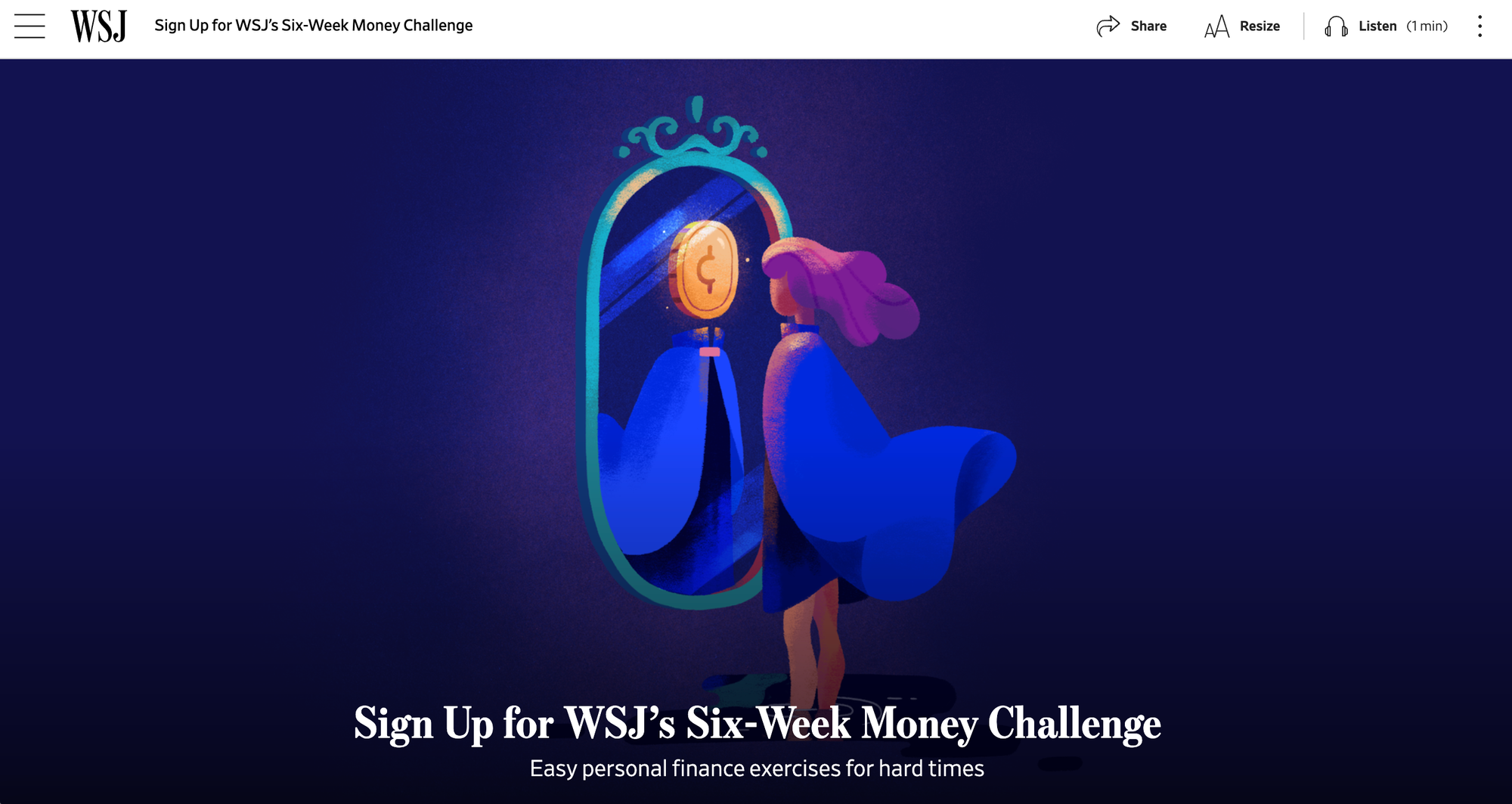
There are many ways to give yourself permission to do it, such as by building a prototype. The important thing is that you build something, present it, and learn from it.
When you launch a newsletter within the WSJ, what are the first questions you ask yourself, the first steps you take?
We already have a portfolio of newsletters. With this new newsletter, what gap can it fill? What user need does it address? Clarify from the start what this newsletter is for, who it's intended for, and how it overlaps or doesn't overlap with what we already have?
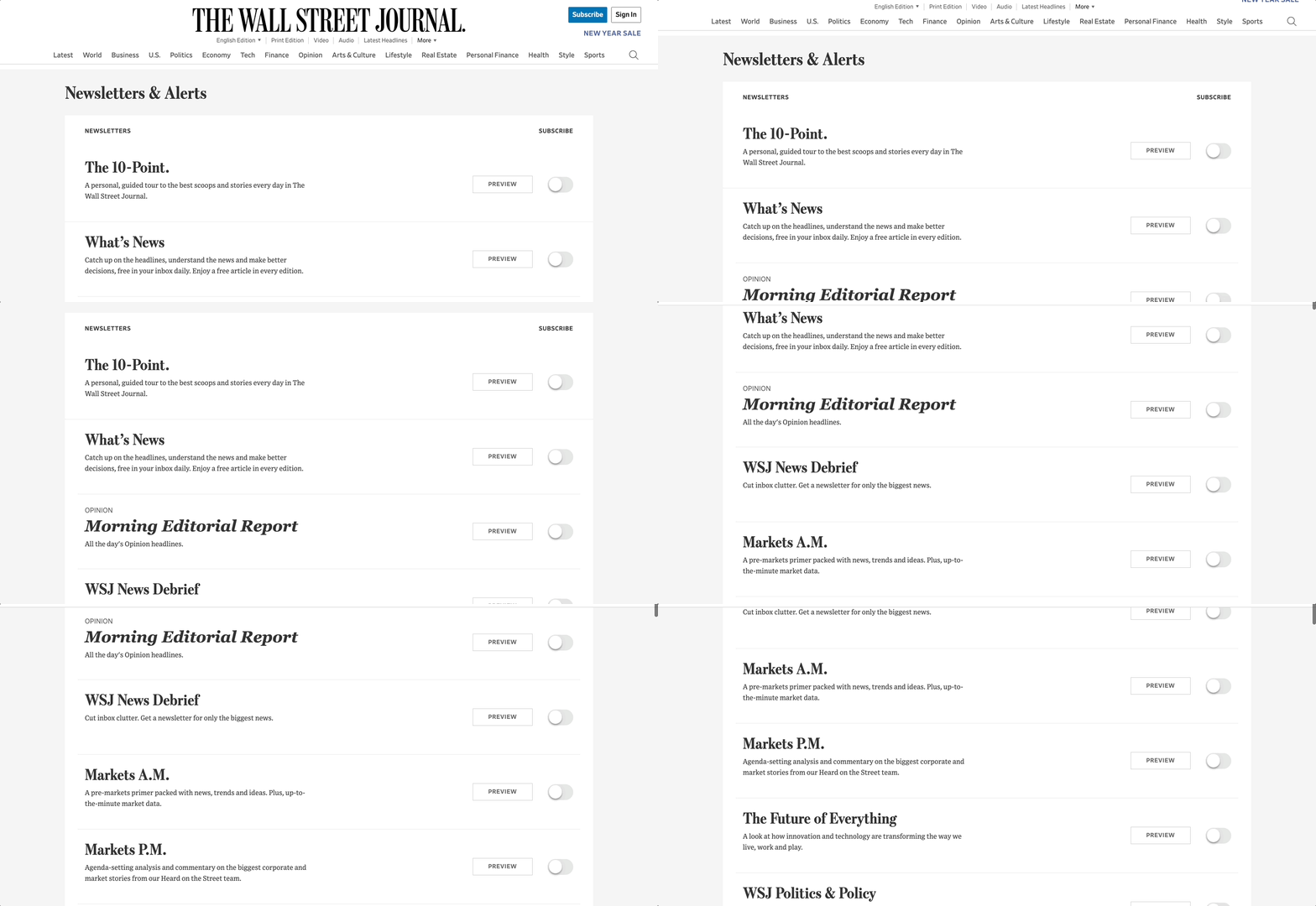
Once we're confident we have good answers to these questions, there are several possible work streams. One of the main practices we've implemented involves creating newsletter templates so we can start by selecting elements from a library that can be integrated. We then work with the copywriter on this basis and generally run a few test series. In the meantime, there's foundational technical work to set up. Next, we start notifying the marketing and promotion managers. Finally, we try to ensure that the copywriters are able to write a few "pilots". This gives us a complete overview of the final product that we can show within the editorial team to get feedback and comments. Then, you can start developing a marketing plan and calendar.
How do I create a calendar and set achievable goals?
Setting a date is more of an art than an exact science. The ideal is to set a fairly broad timeframe at the beginning. Then, as things progress, you narrow down this time period to a specific date. I think that if you set too precise a date from the start, people know it will be hard to achieve because there are still many unanswered questions.
What do these calendars look like within the WSJ?
There are two main phases. First, it's about clarifying the idea. For example, we wanted to create a newsletter about China, but it wasn't specific enough. So we refined the idea by talking more specifically about US-China relations and the tensions between these two countries. It's really complex to predict how long this kind of thinking will take and it's difficult to contain it within a short timeframe. You can find the perfect solution within a day and sometimes things fall into place within a week. There's a second part that's more about logistics and design. Today, we've managed to reduce this timeframe to a few weeks. Obviously, this efficiency will also depend on the size of the team, but it's also largely thanks to the ability to standardize these processes and make them predictable. Instead of starting with a blank page and thinking about what should go into this newsletter, you look at a shelf of components and pick from it.
At what point does thinking about the reader come into play?
It depends on what type of organization you are and what stage you're at, but for an established site like the WSJ, you should always start by having some basic understanding of your audience. When we launched the China newsletter, we didn't start from complete ignorance and zero knowledge of what people expected from us. As I said earlier, you need to think about the gaps in our portfolio. Because people don't know what they want until they see it and have it in front of them, it's actually quite difficult, especially given the timelines and pace we work at, to conduct really in-depth audience research. So we don't tend to do much audience research before launching something. However, after launching a newsletter for example, we make sure to send out a survey after some time. We encourage readers to send us emails and we use a lot of public feedback to make adjustments. Obviously, all of this assumes you haven't created a product that the public deems completely useless. To reduce that risk, you need to have a basic understanding of your audience before you start.
The WSJ has 4 million subscribers. We need to think about our different audiences and the relationships we want to maintain with them. Many of our newsletters are entirely free. You can sign up without being a subscriber to the Wall Street Journal. We don't draw direct revenue from these users' subscriptions, but do we derive any economic benefit from them? Even if they're free, they create habits. You give us your email address and we familiarize you with the publication. It's in a sense a launching pad toward subscription. Beyond that, beyond news, beyond wanting to be informed, are there other things? Can we offer you other products? The New York Times, for example, answers these questions very clearly, with games, food, and shopping. To me, it's about newsletters of all types and categories. We produce reliable sources of information, data-driven, objective, and oriented toward specific moments in your life—generally moments when you need to make an important decision.
Is it difficult to discuss project management with people who have little experience in the field?
I spent the first ten years of my career in a very traditional way in print journalism. The things that interested me and that I got involved in subsequently led me to play bridging roles for quite a long period, which forced me to be able to translate and speak different languages to people in various positions and with varied backgrounds. I think there's a sort of radical shift, by necessity, between how editorial independence was perceived 20 years ago and how it's perceived today. I think 20 years ago, structures were fairly stable and the business model was very well established. I think over the past two decades, with the massive layoffs we've seen in the industry, everyone became aware that we needed to think about things holistically. Moreover, the growing importance of technology in news organizations, both at the editorial and commercial levels, has gained momentum. Software development and work on technology have really been structured around this product model that involves having a product manager who brings together people from different disciplines to work together. This also means that, now that you can talk to each other and have contact between teams, you need principles, values, and rules. At the WSJ, we're fortunate to have an excellent team responsible for standards. We have a dedicated group of people who are responsible for ensuring a certain level of independence, making sure we uphold standards, and that our conversations respect certain ground rules that everyone subscribes to.
To go further
- Check out the Project Management Guide for Newsrooms, which we have translated and adapted for French-speaking audiences.
- Design a newsletter, build your roadmap, conduct an audience study…use our free practical guides to develop your projects.
- Email courses: what practical cases? We're sharing three examples with you, including one from the Wall Street Journal.
The interview was conducted in November 2023 by Marine Doux, edited and translated by Owen Huchon.


