


Discounted subscriptions at 50% or 70% off—this isn't a black friday promotion but rather a marketing strategy implemented by several major media outlets like L'Express and La Croix. The only condition to take advantage of these bargain prices? Subscribe using your Google account by clicking a simple button. Launched in 2018 and rolled out by French media in 2020, the "Sign in with Google" feature allows you to subscribe quickly and easily to your favorite media, according to the American company. This functionality saves subscribers from having to fill out a form and may spare them from entering their banking details if those are already linked to their account.
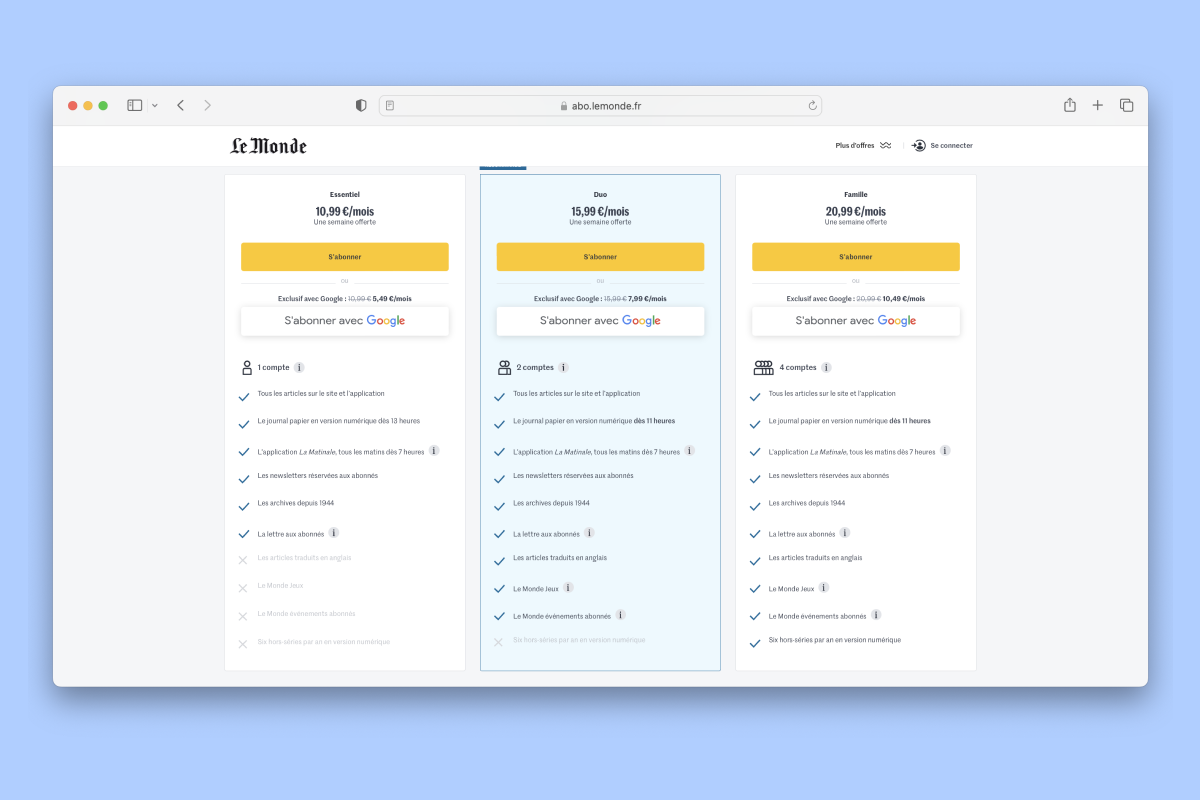
This time savings would facilitate and encourage subscriptions, Google argues. « Through this tool, publishers can increase their number of subscribers and boost the conversion rate [the number of people who subscribed after being made aware of this offer, editor's note] », acknowledges Nikos Smyrnaios, Professor of information and communication sciences at Paul Sabatier University in Toulouse. Beyond this simple feature, Google has implemented marketing strategies with certain media outlets by offering discounts to readers who subscribe via their account. Thus, for one year, Libération's digital offering drops from €119 to €36 per year and Le Monde's from €10.99 to €5.49 per month.
Bilateral agreements
Since 2020, digital subscriptions have been increasing and now account for more than half of subscriptions for some major media outlets, according to the latest report from the Alliance for General Information Press. Without costing editors more, the partnership offered by Google allows them to grow their subscriber base by simplifying the process and offering a reduced price. "Google covers the difference" between the original price and the discounted price, explains Laurent Mauriac, co-chair of the Independent Online News Press Union (Spiil) and Editor-in-Chief of the online media outlet Brief.me.
Si Google communique publiquement au sujet de l’implémentation du bouton « S’abonner avec Google », l’entreprise ne dit rien des conditions de partenariat avec certains médias qui proposent leur abonnement à prix réduit. Ces accords sont bilatéraux et les conditions requises restent opaques. Contacté à ce sujet, Google affirme auprès de Médianes avoir « mis en place des partenariats avec quelques éditeurs pour les aider à optimiser leur utilisation de l’outil dans le but de faire évoluer [notre] produit afin qu’il corresponde aux attentes des éditeurs et des lecteurs » (sic).
« This type of program concerns all publishers but they don't have the same conditions », explains Nikos Smyrnaios. Drawing on how negotiations unfolded for neighboring rights [a copyright reserved for the press, editor's note], he argues that Google's strategy is to favor the strongest media outlets by ensuring them the best conditions.
Negotiate clear terms
To prevent this competitive distortion, the Spiil, which represents 270 publishers, negotiated clear terms with Google, says Laurent Mauriac, co-president of the union. "These offers were becoming increasingly common and discounts increasingly substantial," he explains as the union begins negotiations with Google in October 2022. "They destabilize the market during a period of inflation when buyers are more price-sensitive."
After four months of negotiations, the Spiil obtained access from Google to these agreements for all publishers under a few conditions. Media outlets wishing to benefit from this must have a strategy clearly oriented toward digital subscriptions and their share of digital revenue must exceed 50%. This partnership only concerns general news media outlets with more than 4,500 subscribers. These media outlets must also have the necessary resources to support the technical costs of implementation.
As for Google's share and the partnership duration, the American company has committed to applying the same terms as those already benefiting other media outlets. However, these cannot be verified, as Google keeps the contents of its contracts confidential.
War on permanent promotions
Although he negotiated the expansion of the partnership, Laurent Mauriac views the scheme as bad for the press industry. "It distorts the value of information for the public," he explains, adding that it is difficult to reverse course and apply the usual subscription price once these offers are in place. "It's complicated, this constant promotional warfare," agrees Frédéric Desiles, Director of strategy, marketing and digital development for the media Alternatives Économiques, "it makes subscribers think that one euro is the price of quality information."
This feature is also an incentive for subscribers to use Google, as it's the only way to pay for a subscription at up to half price. It may send them a troubling signal, according to Frédéric Desiles: " as a citizen and reader who cares about personal data, when I choose to stay informed through a major national media outlet and I see Google, I have questions. " The company, which has subscriber information, effectively has an intermediary power between subscribers and publishers, observes Nikos Smyrnaios.
In this way, Google cultivates its relationships with publishers, particularly with the most significant ones: "When you're a regulated multinational, this type of agreement is always a tool of influence, they're political gains for Google", argues Nikos Smyrnaios.
"The scheme is open to criticism, but once it exists, it must be applied in the fairest and most equitable way possible while creating as little competitive distortion as possible," Laurent Mauriac believes. In negotiating with Google, he hopes the union was able to make the company understand that it "cannot do whatever it wants when it has such significant weight in the news market." "They must guarantee some form of fairness between media outlets, otherwise it creates too much disruption in the market," he adds.
In a context where Google is being judged and criticized for its anticompetitive practices, Frédéric Desiles questions how media outlets can maintain a critical discourse about the company and defend their interests against it while remaining dependent on it, "especially when it comes to subscriptions, that's where the real battle is".
To go further
- Earlier this year, Google announced upcoming changes to search that are expected to reduce the traffic Google sends to publishers' websites.
- The French competition authority accepted the commitments made by Google on neighboring rights in June 2022: read the summary of this case.
- The latest General Press Information Alliance distribution barometer in detail.
Updated December 14, 2023: the original version of this article contained a partially truncated quote. We have corrected this quote.


