




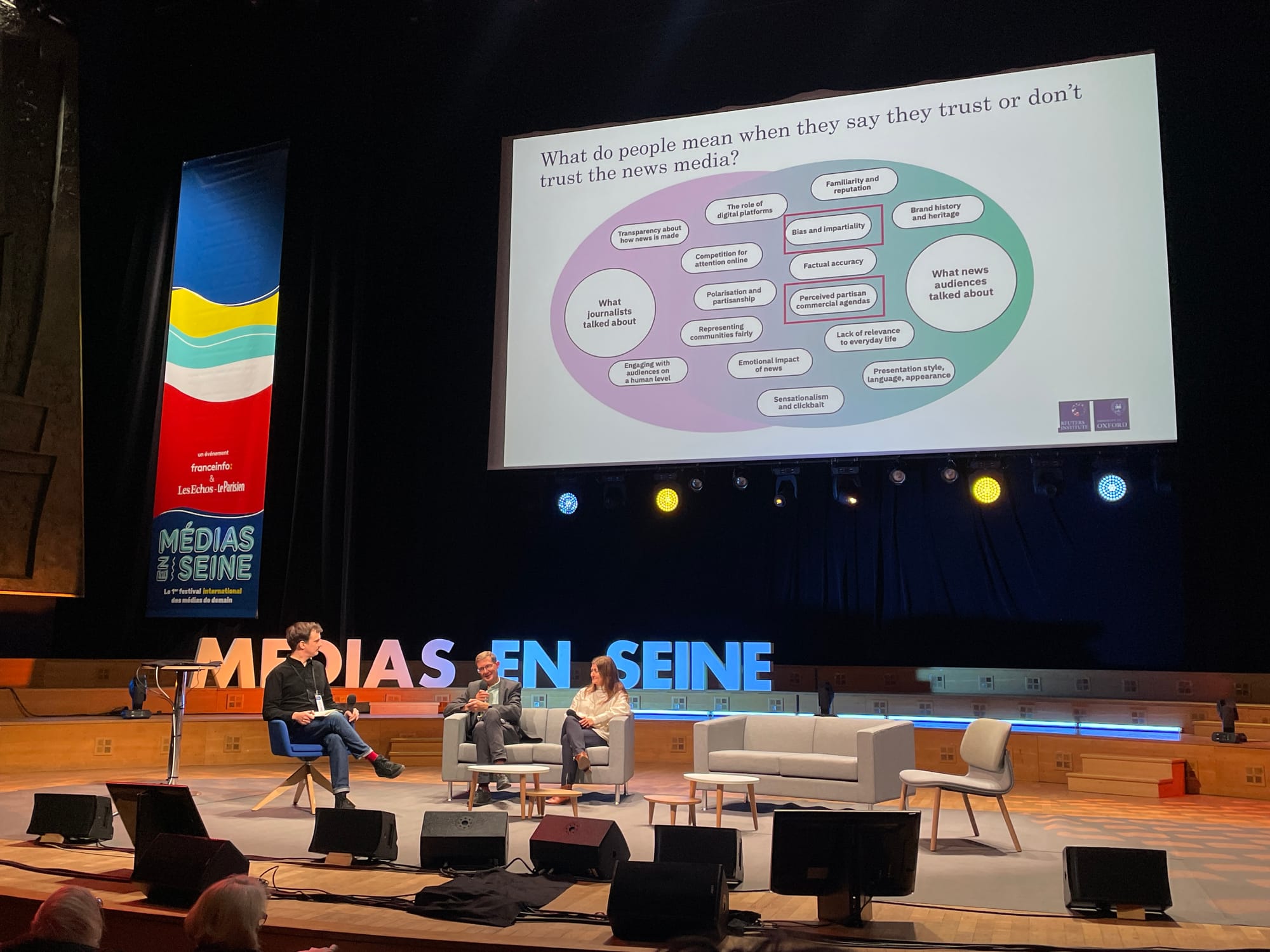
Young people's evolving information habits, the use of artificial intelligence, as well as events related to the war in Ukraine and the Middle East were at the heart of discussions at the sixth edition of the Médias en Seine festival. Here's a summary.
Results from the La Croix Barometer 'French Trust in the Media'
With contributions from Jean-Philippe Baille (Director of franceinfo and Director of Information at Radio France), Marie Boeton (Senior Reporter at La Croix L'Hebdo), Guillaume Caline (Director of Public Issues and Opinion at polling firm Kantar), Nicolas Charbonneau (Director of Editorial Staff at Le Parisien), Jean-Christophe Ploquin (Editor-in-Chief of La Croix) and Nathalie Sonnac (Professor at Panthéon-Assas University, specialist in media economics, culture and digital).
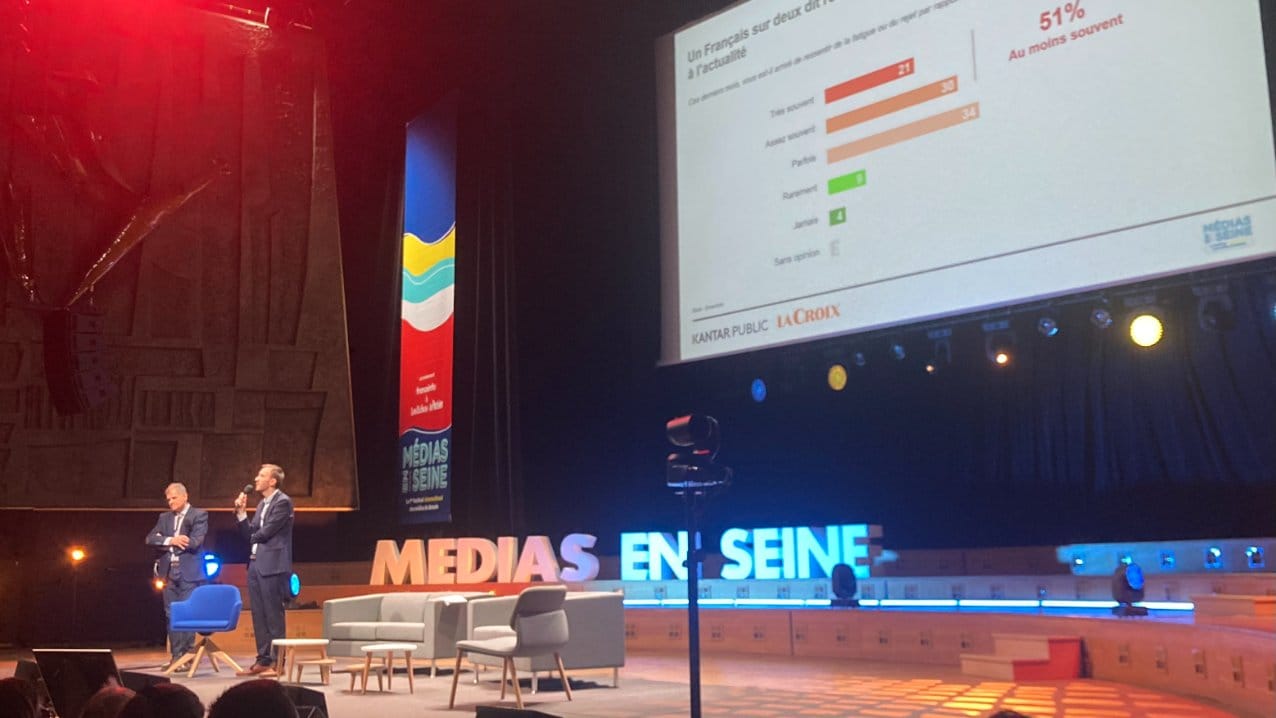
The survey behind the latest La Croix / Kantar barometer on French people's trust in the media was conducted in early October, at the time the conflict between Hamas and Israel broke out. This context may explain French people's interest in current events, which stands at 75% this year. This level is historically high compared to the 2017-2022 period when information fatigue was more pronounced, particularly due to the Covid-19 crisis.
Key takeaways
- Fatigue persists, especially among younger people and women. The reasons given? "The media always covers the same topics" (48%), "I feel anxious and helpless in the face of bad news" (38%), "I don't trust what the media says" (27%).
- French people's main sources of information remain unchanged. In order, they are: televised news programs, 24-hour news channels, social media, radio news broadcasts, regional press in digital format, current affairs and debate programs on TV, and regional press in print format.
- Only 18% of French people say they spend money to stay informed about current events. Young people are more likely to say they're ready to subscribe to access news.
- Sharing information on social media by non-journalists is overall viewed negatively despite a clear generational divide. 73% believe this contributes to the spread of misinformation and conspiracy theories.
- On artificial intelligence (AI), 30% of French people today would trust a media outlet that uses AI to choose topics to cover, select articles to feature, prepare article writing, and write articles. The overwhelming majority (84%) expresses a need for media transparency on this subject.
Key quotes
- « To regain the trust of French people, the media must question their practices to deliver three things: nuance, long-term perspective and transparency », Nathalie Sonnac, Professor at Panthéon-Assas University, specialist in media economics, culture and digital.
- « We must open up our newsrooms, explain how we work, explain the cost of a story. Perhaps we need to dare try new formats that explain to readers where journalists are coming from », Marie Boeton, Senior Reporter at La Croix L'Hebdo.
- « We forgot we had readers, we stayed in our own bubble and gradually people turned away. At Le Parisien's editorial meetings, we always ask ourselves whether a given story will really speak to our readers », Nicolas Charbonneau, Editor-in-Chief of Parisien.
⟶ To read the full live tweet from this conference, visit the X account of Médianes.
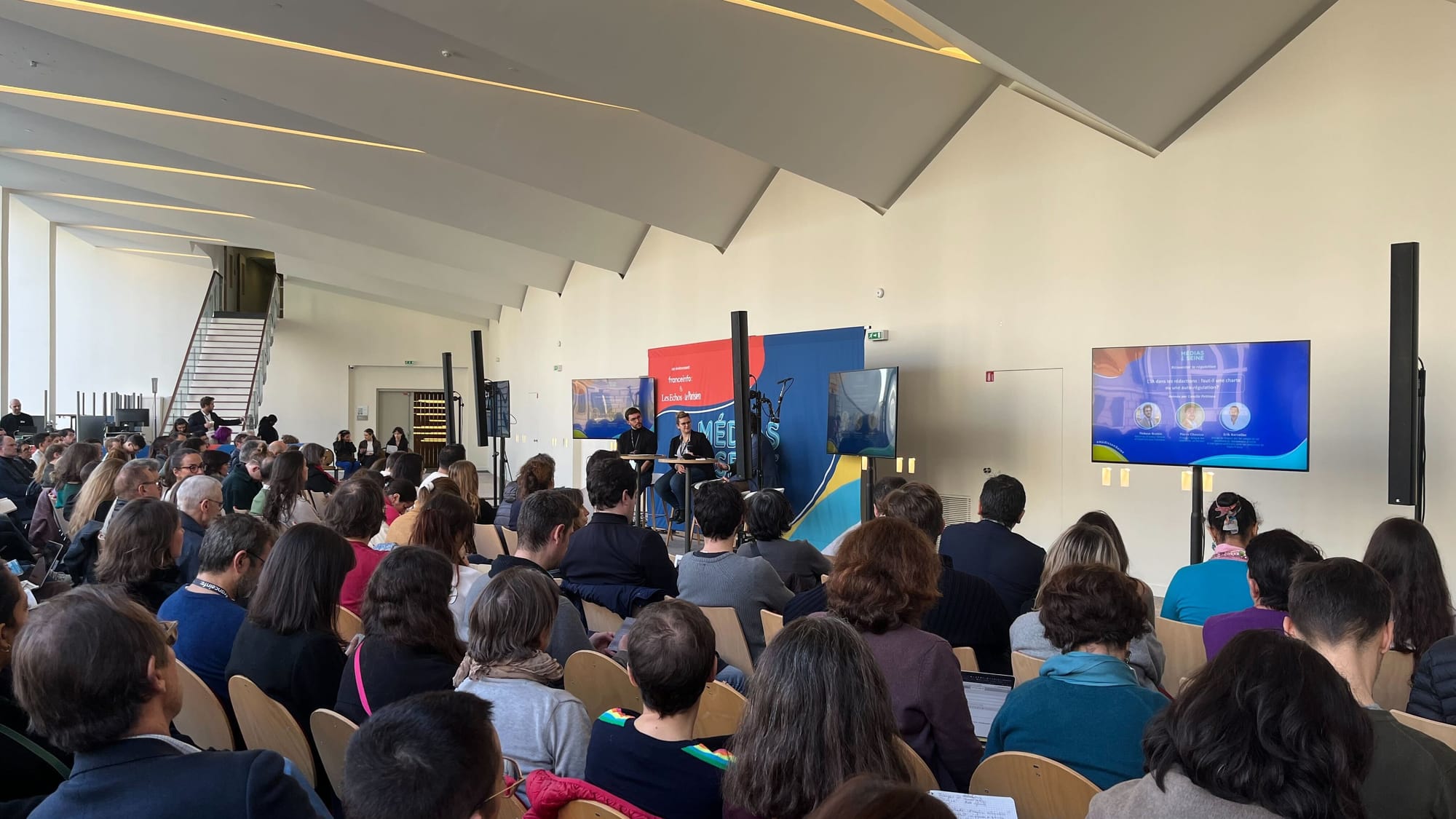
AI in newsrooms: should there be a charter or self-regulation?
Roundtable discussion moderated by Camille Pettineo (Data journalist at INA). With interventions from Thibaut Bruttin (Deputy to the Director General of Reporters Without Borders), Pierre Chausse (Deputy Director of Editorial Departments at Parisien) and Erik Kervellec (Special Advisor on the use and conditions for deploying artificial intelligence tools in Radio France newsrooms).
Key takeaways
- Last May, the Le Parisien-Les Échos group published a charter on its use of AI within its editorial team. The goal: to regulate its use and demonstrate transparency to its readers. In this AI overview, we take stock of the various charters available.
- To feed their databases, artificial intelligences use "crawlers" that "scrape" information available on the internet. Radio France group websites block AI access to their content. This is also the case for other media outlets like the New York Times and Mediapart.
- The NGO Reporters Without Borders initiated the development of a Paris Charter on AI and Journalism. The commission responsible for drafting it was chaired by Maria Ressa, recipient of the 2021 Nobel Peace Prize.
- Radio France organizes "forums" to enable its entire team, from journalists to members of the Philharmonic Orchestra, to familiarize themselves with artificial intelligence-based tools.
Key quotations
- Facing AI, "journalism can gain greater value in a world where truth will be an even greater challenge," according to Pierre Chausse, Deputy Editor-in-Chief of Parisien.
- Can we engage in dialogue with major AI companies? « We can't manage to have a normal dialogue with these companies », laments Erik Kervellec, Deputy Editor-in-Chief of Radio France.
- « We're blocking crawlers (data scrapers used by AI). It's a way to bring Big Tech to the negotiating table. We're in a power struggle and it gives us leverage », Érik Kervellec, Special Advisor on the use and implementation of artificial intelligence tools in Radio France newsrooms.
- « It's crucial to navigate these technological shifts. We can't just stand by and watch. We need to engage and try », Thibaut Brutin, Deputy Director General of Reporters Without Borders.
- In the context of AI negotiations, it is important to "resist the temptation to want to bring everyone to the table" in the face of reluctant players like large companies, according to Thibaut Brutin.
⟶ To read the full live tweet from this conference, visit the X account of Médianes.
New AI and data tools in service of information
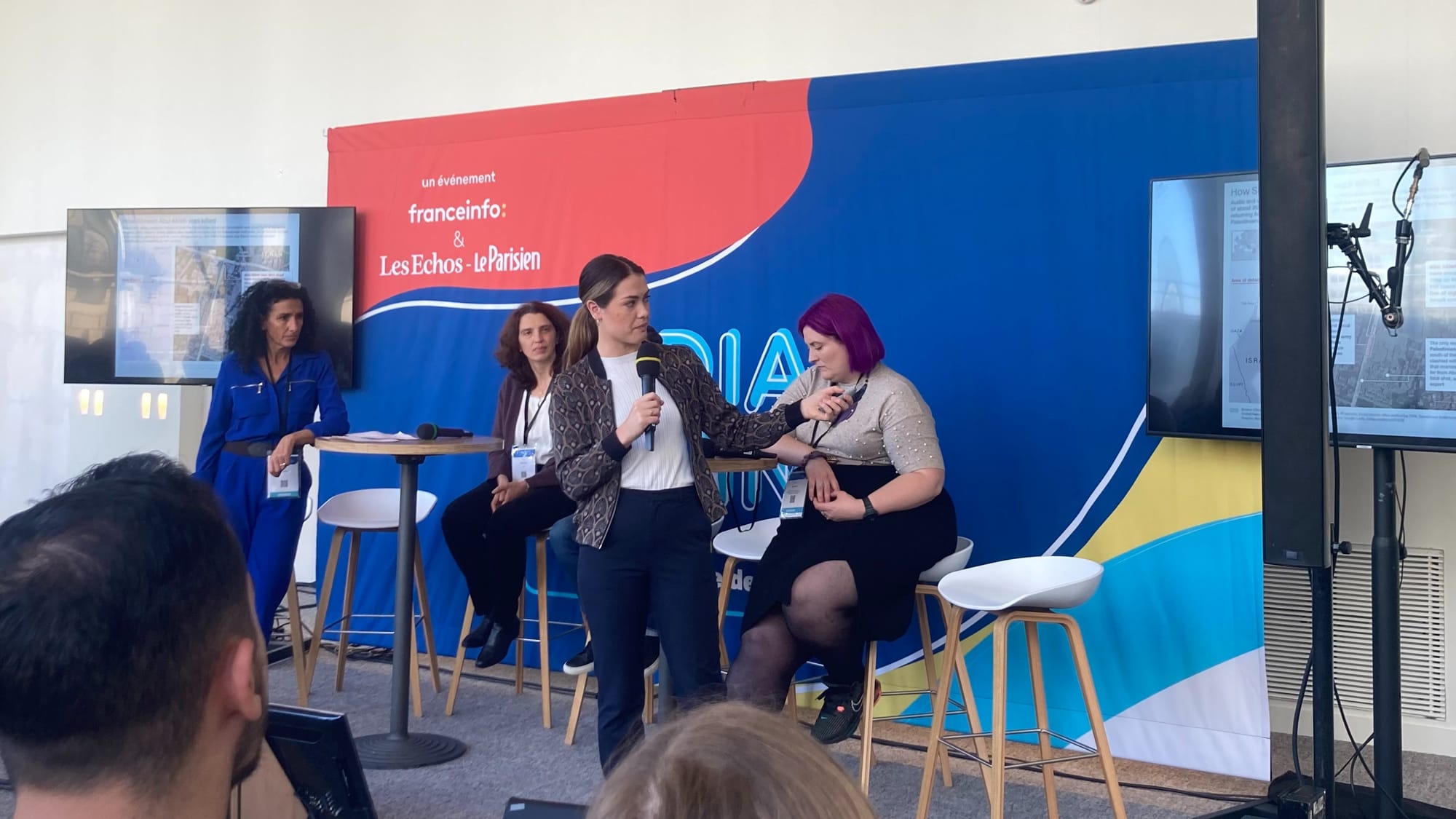
Roundtable moderated by Cécilia Gabizon (Vice President of ETX Majelan). With contributions from Alexandre Barlot (Head of Social Media at franceinfo), Marianne Bouchart (Founder and Director of the HEI-DA association for the development of media and data journalism), Ioana Manolescu (Research Director at Inria, Lecturer at École polytechnique) and Katie Polglase (Investigative Producer at CNN).
Key takeaways
- Katie Polglase, investigative journalist at CNN, explains that she strengthened the use of open-source intelligence (OSINT) tools upon joining the newsroom. She emphasizes the central role of geolocation tools in verifying information in the context of the war in Ukraine and the Israel/Hamas conflict, and in finding original stories to tell.
- Ioana Manolescu, Research Director at Inria, presented StatCheck, a tool specially designed for the Radio France group that verifies public figures' posts on social media using data from INSEE and Eurostat. The tool saves journalists time and helps them with their fact-checking work.

Key quotations
- « Practice allows you to approach perfection. I don't believe OSINT is reserved for journalists: internet users investigate using open sources in their spare time every day », Katie Polglase, investigative journalist at CNN.
- « The international community of non-English-speaking journalists lacks accessible tools in their geographic region, offline functionality, and the ability to handle audio content in different dialects », Marianne Bouchart, Founder and Director of the HEI-DA association for media and data journalism development.
⟶ To read the full live tweet from this conference, visit the X account of Médianes.
New formats, new themes, new narratives: How to reinvent the print press?
Conference moderated by François Quinton (Editor-in-Chief of La Revue des médias at INA) with a contribution from Éric Fottorino (Co-founder of the weekly Le 1 and of the quarterly publications Zadig and Légende).
Key takeaways
- Le 1 claims between 19,000 and 20,000 subscribers and 10,000 to 12,000 newsstand sales.
- To choose its paper, the team at Le 1 took the time to listen to several options. We spoke about this a few days ago with Natalie Thiriez, Art Director of the journal, in this interview.
- The successive increase in paper prices has led to a rise in the newspaper's selling price. The Ministry of Culture, which decided to establish an emergency fund for newspapers, decided not to grant aid to the newspaper.
Key quotations
- « Since the launch of Le 1, 800 to 1,000 points of sale have disappeared (…) We can see that with this reduction, we're being pushed even more toward screens », Éric Fottorino, co-founder of Le 1 and of the quarterly publications America, Zadig and Légende.
- « When you read something in Le 1, you remember that you read it in Le 1. On the internet, you read snippets from different newspapers », Éric Fottorino.
- Defending print is not nostalgia, Éric Fottorino stresses. « I think it's very modern. Today it's necessary to be able to read a text without any other dimension like advertising interfering with reading »
⟶ To read the full live tweet from this conference, visit the X account of Médianes.
Should you speak like young people to reach young people?
Panel moderated by Cyril Destracque (Cross-media Editor-in-Chief at franceinfo). With contributions from Carole Bélingard (Social media Editor-in-Chief at franceinfo and Editor-in-Chief of the video format « C quoi l'info ? ») and Estelle Cognacq, (Deputy Director of franceinfo and originator of the podcast « Ça dit quoi ? »).
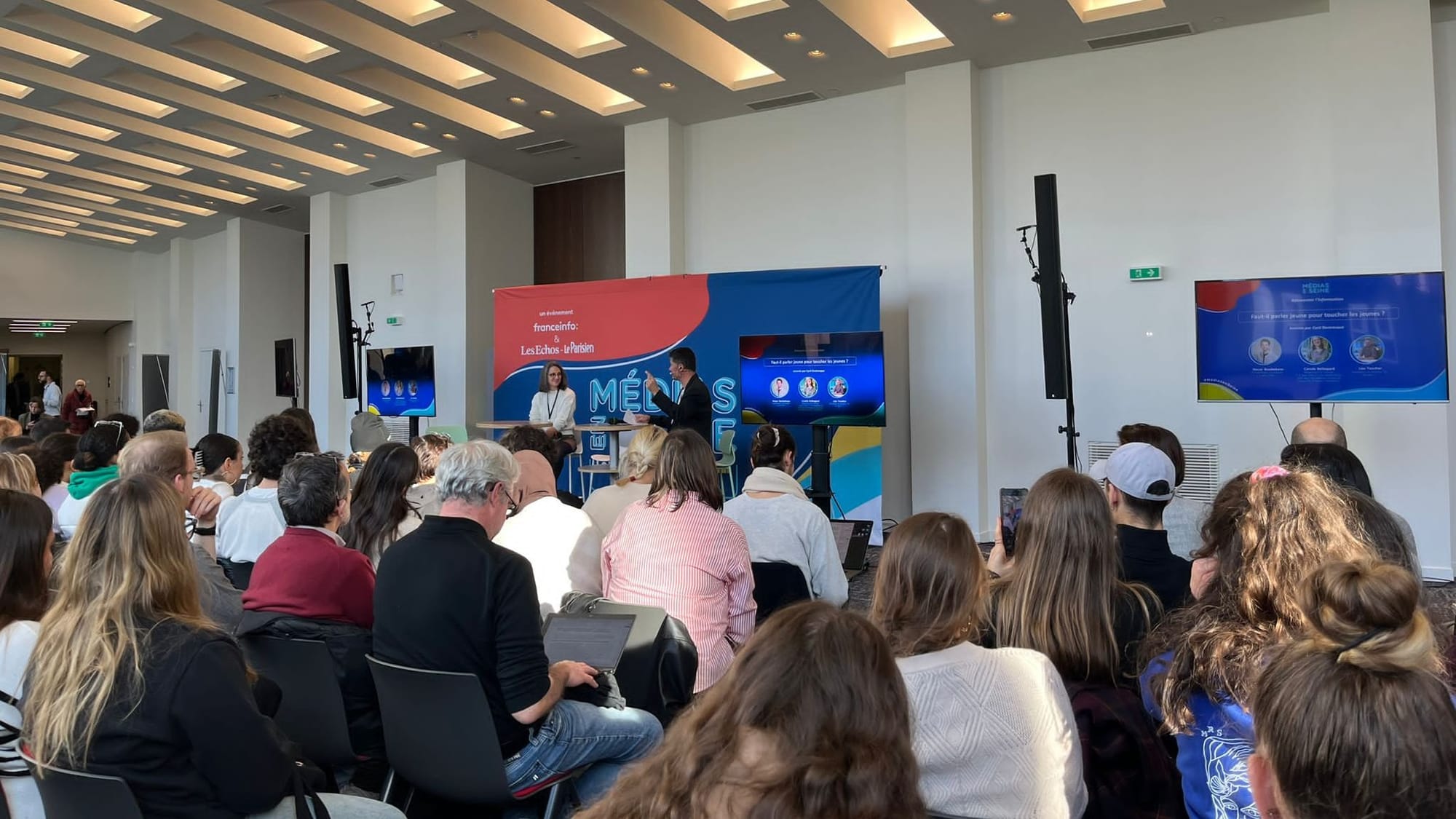
Key takeaways
- Last September, franceinfo launched « Ça dit quoi ? » a radio programme broadcast Monday to Friday for 15-25 year-olds. In parallel, a newspaper for 12-18 year-olds, « C quoi l'info », has been broadcast on channel 27 and social networks since early October.
- The team behind « Ça dit quoi ? » is pleased with a strong start, claiming 290,000 listens in October. As for « C quoi l'info », franceinfo is recording an increase in its cumulative audiences (TV, TikTok, Youtube, Snapchat …) over the weeks, partly driven by the production of short-form content distributed on social networks.
- « C quoi l'info » eventually refined its target audience over the weeks. Rather than addressing an audience of 12-18 year-olds, it now produces content with the aim of reaching an audience of 12-15 year-olds.
- « Ça dit quoi ? » has partnered with Spotify. The programme appears in the « Mon Daily » playlist, mixing music and podcasts.
Key quotations
- « We wanted to fill a gap. Today, given the place social networks occupy in teenagers' lives, it seemed essential to reach them there », Carole Bélingard (Social media Editor-in-Chief of franceinfo, and Editor-in-Chief of the video format « C quoi l'info ? »).
- «We wanted to use franceinfo's expertise with a different approach from the radio », Estelle Cognacq, Deputy Director of franceinfo, about the programme « Ça dit quoi ? ».
- « We try to strike a balance between heavier news and lighter news, without falling into trivia », Carole Bélingard.
- « We try not to use too much journalistic jargon but rather create something accessible to everyone. We shouldn't create something that sounds false, or adopt codes that aren't ours », Estelle Cognacq.
⟶ To read the full live tweet from this conference, visit the X account of Médianes.
What is media literacy for?
Roundtable moderated by Emilie Gautreau (Head of the “Le Vrai du Faux” unit at franceinfo), with presentations by Serge Barbet (Director of CLEMI), Manon Berriche (Ph.D. candidate at Sciences Po’s Médialab, research assistant for the European De Facto project, and associate expert at the Reboot Foundation), Séverine Erhel (Assistant Professor of Cognitive Psychology and Ergonomics at the University of Rennes II), and Antoine Deiana (Journalist at franceinfo as part of the “Vrai ou faux junior” unit).
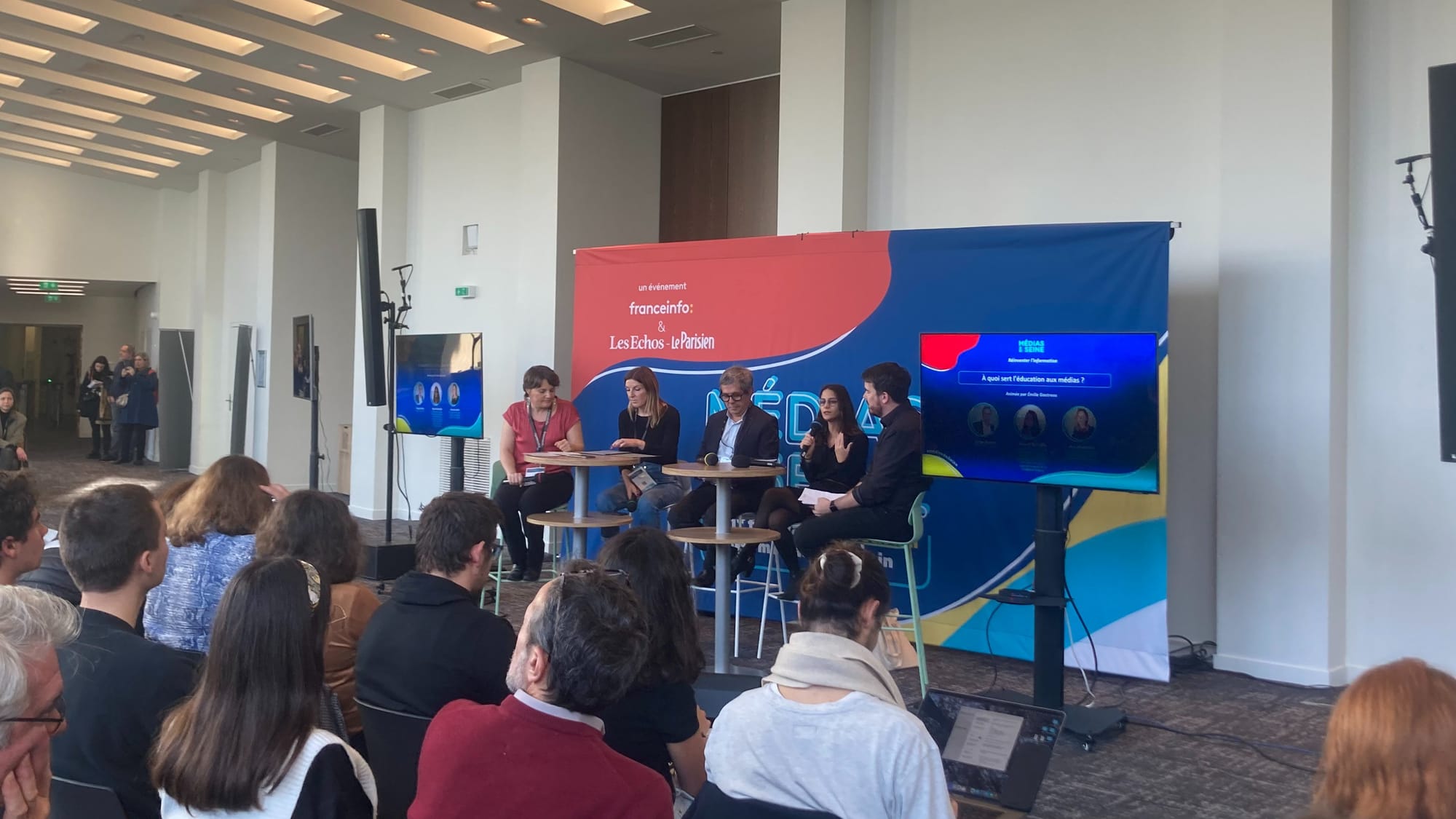
Key takeaways
- Media literacy is a cross-curricular subject that encompasses both humanities and geography, scientific subjects, digital studies, economics and social sciences. With social media, its scope now extends to other issues such as mental health.
- Media literacy isn't just for children. Many parents struggle to understand how social networks work. Regulation alone won't be enough: today it's necessary to provide everyone with the tools to protect themselves against social networks.
- For young people, social networks are a place for socializing with peers and gaining independence from the family sphere. It's also a place where they develop their own identity, their digital identity, and where they try to show that they exist.
Key quotations
- « What young people lack are the tools and reflexes to determine what is reliable information and what isn't. Some teens follow influencers on social media and wonder how to know if they can trust them. » Antoine Deiana, journalist at franceinfo within the « True or False Junior » unit.
- « Rather than talking about the effects of screens, we should talk about the effects of bad practices. A screen is a display device, and screen time is a poor indicator. We should focus on what constitutes beneficial practices (for example, building one's identity by identifying with LGBTQIA+ communities or feminist communities) and harmful practices (cyberbullying, multitasking, watching multiple screens simultaneously) », Séverine Erhel, Lecturer in cognitive psychology and ergonomics at the University of Rennes II.
- « The idea behind dark patterns, or predatory designs, is to capitalize on your time and data and push you into making transactions. This raises questions about regulation—we won't solve this with media literacy alone », Séverine Erhel.
⟶ To read the full live tweet from this conference, visit the X account of Médianes.
Ukraine, Middle East: How to Cover War?
Round table led by Éric Valmir (Secretary General of Information at Radio France) with the Bayeux Calvados-Normandy Prize. With contributions from Yashar Fazylov (Fixer for Radio France), Angelina Kariakina (Advisor to the Chair of the Board of Directors of Suspilne — Ukraine's national broadcasting company — and co-founder of the Public Interest Lab), Robin Korda (Reporter at Parisien Stories), Maurine Mercier (permanent correspondent in Ukraine for RTS, Radio France and RTBF) and Omar Ouahmane (Senior Reporter at Radio France's International Newsroom).
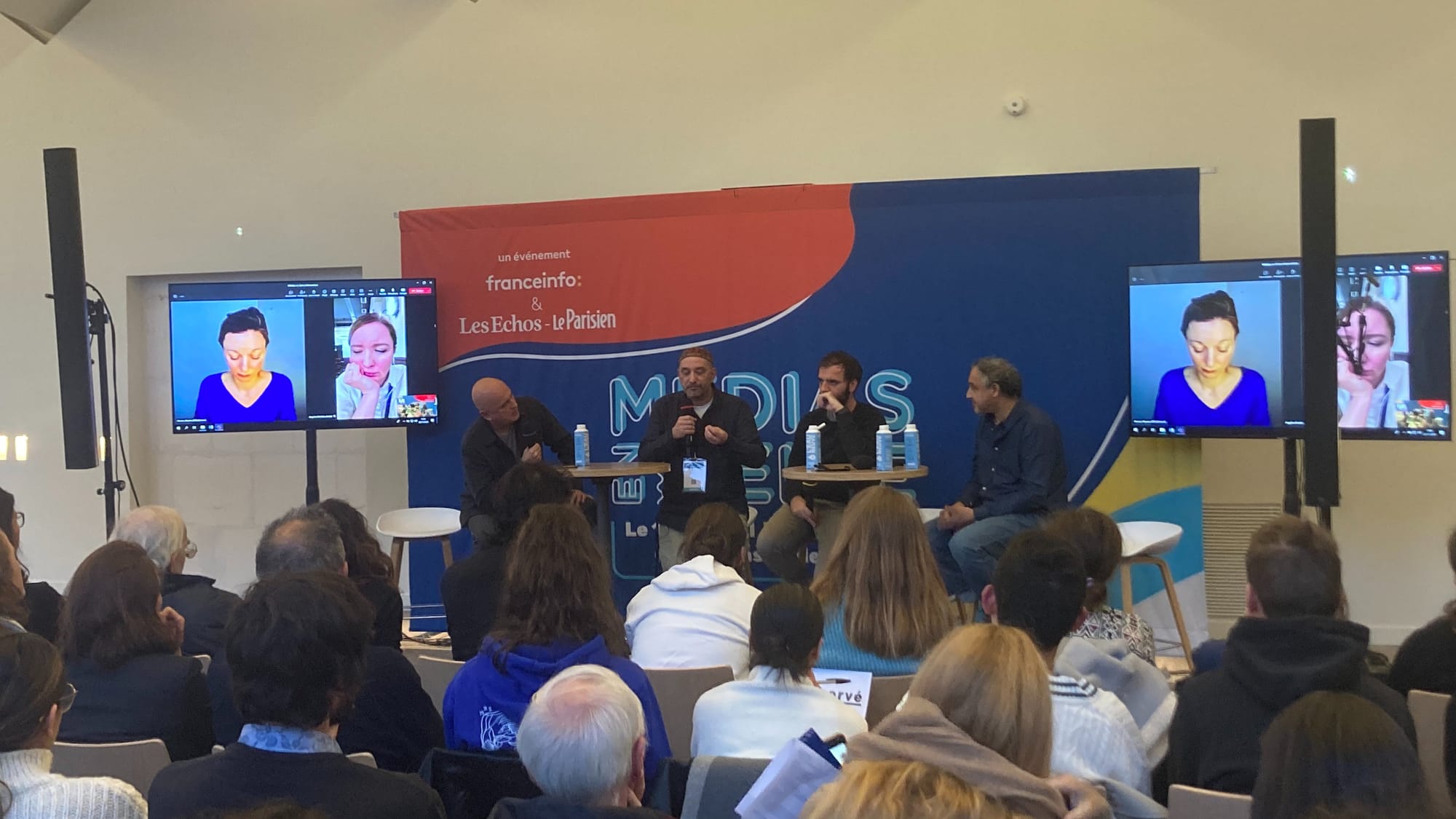
Key takeaways
- It is particularly difficult for war correspondents to cover the conflict between Israel and Hamas because the Gaza Strip is off-limits to them. "We only see what we're allowed to see and it's very frustrating", says Omar Ouahmane, Senior International Correspondent at Radio France's International Desk.
- The fixer is the eyes and ears of the journalist. Their role is not to try to influence them or lead them down paths that would be favorable to the fixer. The journalist bears the responsibility for the information and thus has the final say.
- Format, approach, tone, working conditions, tools…to cover news in wartime, discover our overview of best practices.
Key Quotes
- "I'm frustrated that we're talking less about the war in Ukraine. We need to be consistent with our audience. We can't talk so much about one conflict and then suddenly stop talking about it to our listeners. I think the public needs to hear about twenty-five wars if there are twenty-five wars ongoing. That's our responsibility—we owe it to people," Maurine Mercier, permanent correspondent in Ukraine for RTS, Radio France and RTBF.
- « You can tell the story of war by telling the story of life. It's not all blood and gloom. There's enormous energy in these countries that are fighting. My job is to find angles that don't get everyone down first thing in the morning », Maurine Mercier.
- How does one become a fixer? "I felt the need to be useful in my country," explains Yashar Fazylov, fixer for Radio France in Ukraine. "I saw a post on social media where journalists explained they were looking for someone who speaks French in Ukraine to help them cover the war."
⟶ To read the full live tweet from this conference, visit the X account of Médianes.
How to reinvent information?
Interview hosted by Didier Si Ammour (Journalist at Radio France) and Benjamin Fontaine (Journalist presenter at franceinfo). With contributions from Hugo Travers (Journalist and content creator, founder of the YouTube channel HugoDécrypte).
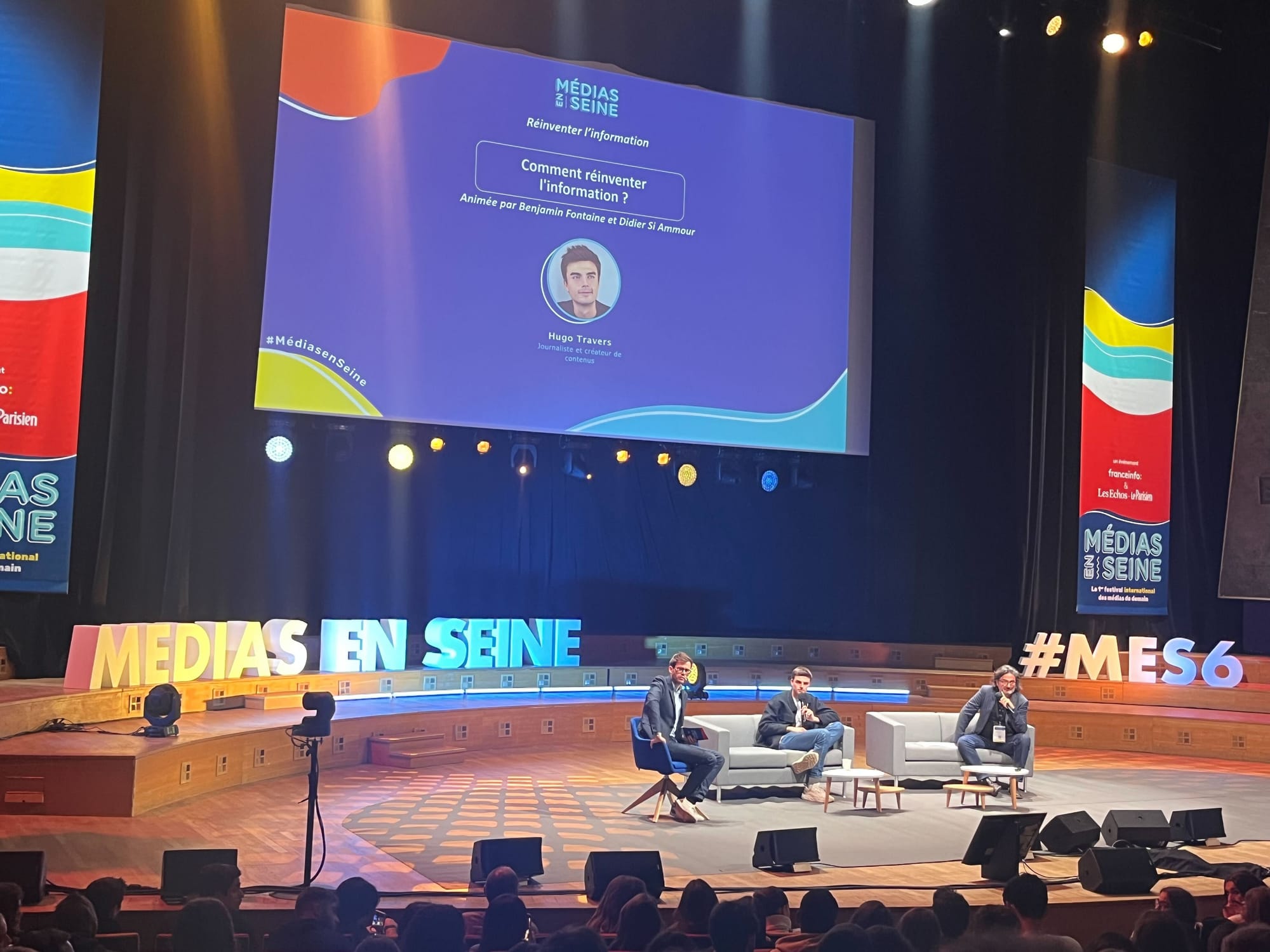
Key takeaways
- To choose their subjects, the HugoDécrypte team uses three criteria: they must be important, interesting, and relevant.
- The HugoDécrypte team has several tricks up its sleeve to outsmart algorithms. If certain topics are deemed sensitive, a platform may decide to give them less visibility. The editorial team thus chooses to use asterisks to mask certain letters, so that the algorithm's eye doesn't detect the sensitive words.
- On TikTok, the audience is much younger than on other platforms. By going there, the media outlet HugoDécrypte has made its audience even younger.
Key Quotes
- « Each social network can be used to create and share information. It is essential to let go of your preconceptions. »
- « Our team's main specialty is in formats rather than topics. You might be really good at creating content for TikTok but less so on YouTube. »
- « We didn't raise funds or receive external financing. That's due to the specific nature of how the channel developed. When I started out, I was alone. I never had the drive to raise funds to build an economy. I hired my first journalist after 3 or 4 years, once I had enough revenue from YouTube ads. It's the platforms that finance us. »
To go further
- Overview and key findings from the Digital News Report 2023 by Nic Newman, Senior Research Associate at the Reuters Institute for the Study of Journalism.
- The democratization of artificial intelligence through tools like ChatGPT has prompted the press to react. How can we harness this new array of tools without compromising the quality of information? Formats, approaches, debates, tools: an overview of uses.
- While in France the Ebra group announced it wanted to experiment with artificial intelligence before backing down, similar initiatives are multiplying across local news outlets in America.
- On TikTok, Kelsey Russell has been sharing her new passion for several weeks: reading the print edition of the New York Times. Through her videos, she aims to bring the younger generation back to print journalism. An initiative that's not going unnoticed, especially among media outlets.
- Love at first sight, breakups and compromises. Natalie Thiriez tells us the story of a symbiotic but tumultuous relationship between Le 1 and its print edition.
- Violence, misinformation… the very nature of war calls on media to take a differentiated approach, whether to better serve their audiences or to ensure the wellbeing of their teams. Format, approach, tone, working conditions, tools: an overview of best practices.
- War has broken out in Europe, intensifying the battle over information. Media outlets are acutely aware and are committing themselves both to their investigations and to the words they use. More than ever, access to factual, verified information is a necessity. Three ways to take action at any level.


