



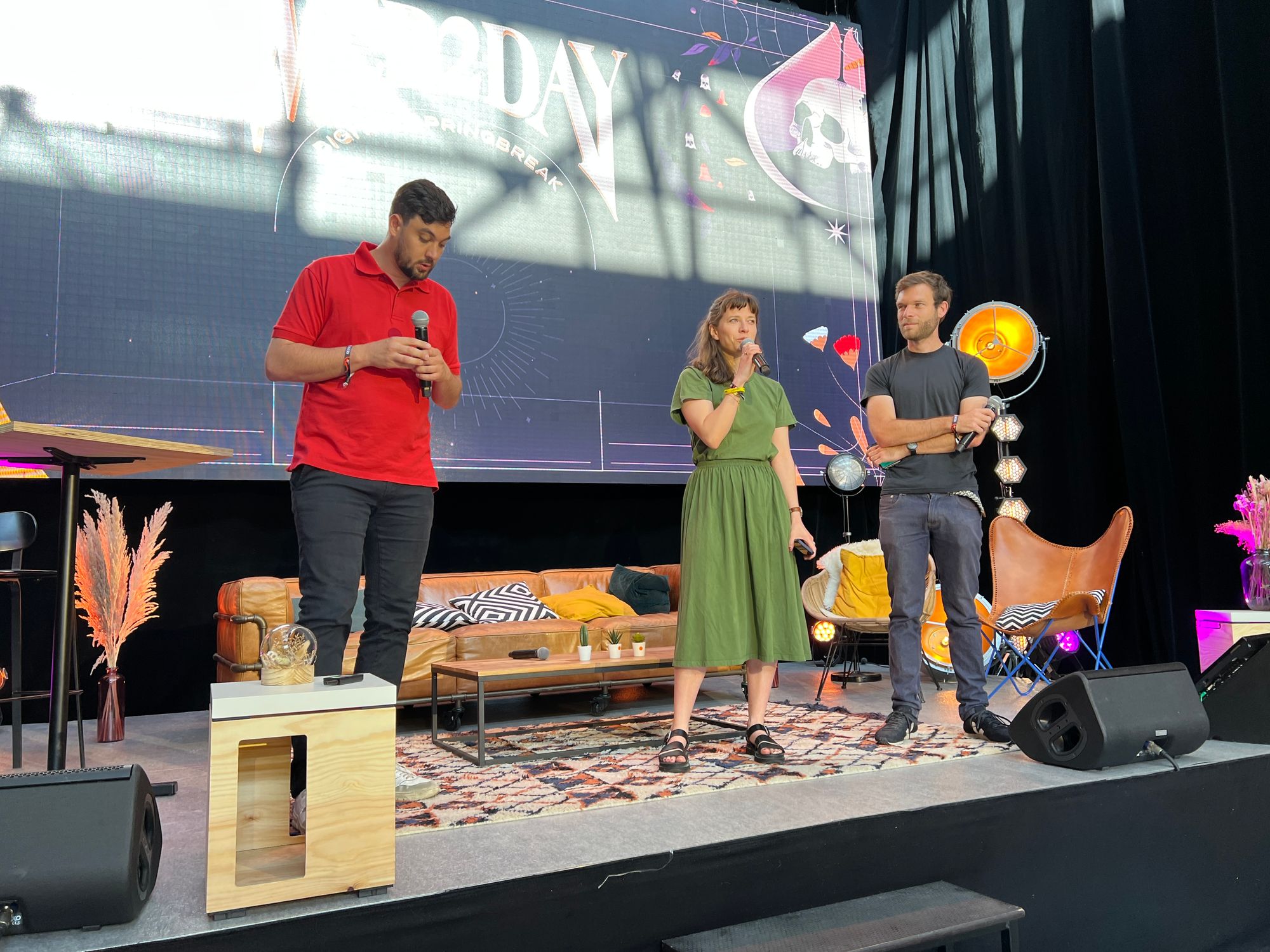
The Médianes team was in Nantes on Friday, June 2, 2023 for Web2day, an innovation festival where we helped create and lead a special media day. Information processing on TikTok, audience loyalty, challenges of engaged media communities… Here are some key takeaways from that day.
Innovation in news: beyond the article
With Alix de Crécy (Co-founder of Mediavivant), Marie-Laure Gardaz (Head of Marketing and Communications Projects at Alternatives Économiques) and Grégory Rozières (Web Editor-in-Chief of Kometa), moderated by Marine Doux (Co-founder of Médianes)
Given the changing ways people consume media, the evolving platforms, and shifting attitudes toward information, how can media organizations engage and retain their audience? Whether online or offline, both emerging and established media outlets are innovating in the production and distribution of information, offering new approaches to news coverage. Alternatives Économiques, for example, decided to launch on TikTok in January 2022 after recognizing the platform’s success, particularly among young people. According to Marie-Laure Gardaz, the outlet’s communications and marketing manager: “We hear a lot of clichés about TikTok, but media outlets like ARTE, Le Parisien, and Le Monde are already there. We’ve had our biggest hits with videos on pension reform: there’s a demand for information.”
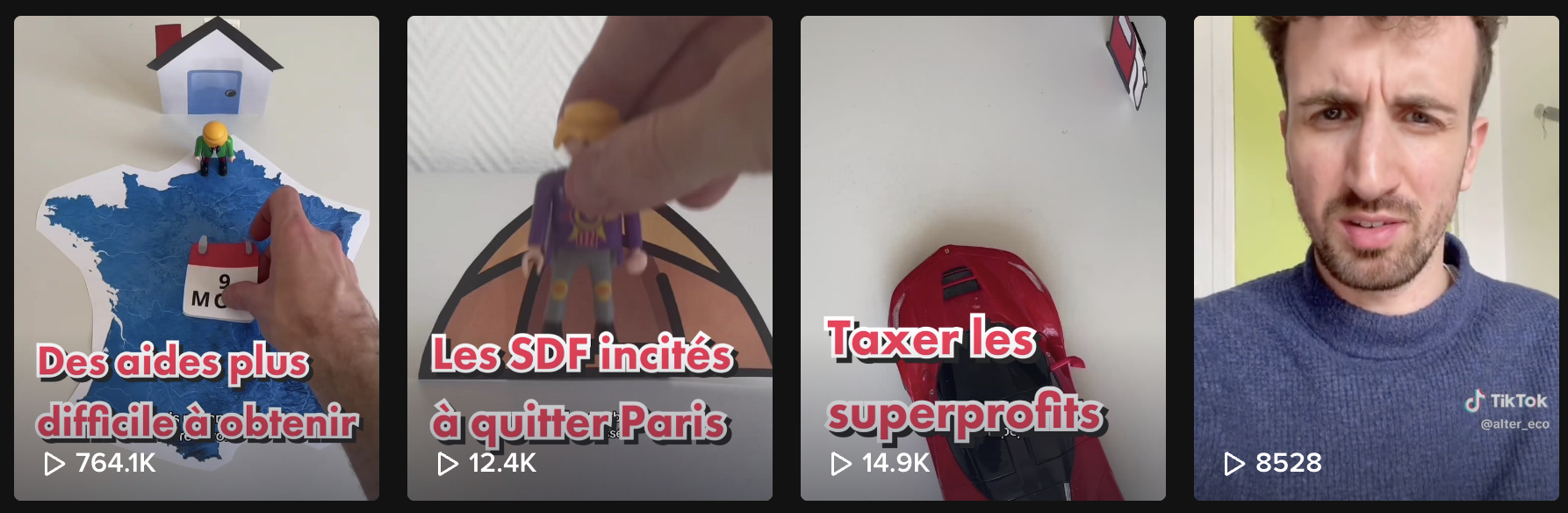
More than a year and a half after launch, the account now has 100,000 subscribers, and the videos featuring journalist Rudy Pupin get between 10,000 and 1 million views.
It is with this same desire to reach new audiences that Mediavivant, co-founded by Alix de Crécy and Jean-Baptiste Mouttet, decided to present its work before a live audience, bringing its journalists on stage so they could tell their investigative stories. A way to connect with its audience and to make information more accessible.
The young media outlet, based in Marseille, now hopes to reach other audiences in France: the team launched in May a fundraising campaign on Ulule to finance its second season.
For Kometa, whose aim is to tell the world's story by placing Eastern European countries at the center of the map, the choice to work with print media is no accident. The new outlet, co-founded by Grégory Rozières, is betting on slow journalism – or long-form journalism: another way to practice journalism with more perspective, while avoiding information overload. To achieve this, Kometa will launch a quarterly magazine next fall, and is already offering a newsletter to tell the story of its launch and build its project with future readers.
⟶ To view the full live tweet feed from this conference, visit Médianes' Twitter account.
War in Ukraine: how to amplify Ukrainian voices?
With Maksym Eristavi and Valeriia Voshchevska, co-founders of the Ukrainian Spaces podcast, moderated by Maxime Leroy (Vice President of Product at POLITICO Europe and columnist at Médianes)
During this day dedicated to engaged media, Web2day hosted in videoconference Maksym Eristavi and Valeriia Voshchevska from Ukrainian Spaces, a podcast created during Russia's invasion of the country.
The show initially began broadcasting on Twitter to provide a space where victims of the conflict could express themselves in a calm setting, which the group even describes as a group therapy.
The team wants to regain control of how their situation is covered in the media, and this also requires funding that guarantees complete independence.
⟶ To view the full live tweet feed from this conference, visit Médianes' Twitter account.
Media business models: beyond advertising
With Marion Wyss (Marketing Director at Poool), Adrien Labastire (CEO of Kessel), Lou Grasser (Director of Marketing and Products at Monde), Freddie Martyn (Director of Marketing and Communications at POLITICO Europe), moderated by Benoît Zante (Founder of the TLDR newsletter).
Subscriptions, donations, services, events… Advertising is no longer the only way to monetize online media. What strategies are working and what can we learn from the pioneers of media innovation?
In the World, in 2012, 40% of revenue came from single-copy sales while 30% came from subscriptions. By 2022, the daily newspaper had shifted to single-copy sales representing 20% of revenue, while advertising remained around 25%.
Le Monde thus chose a diversification strategy, explains Lou Grasser, Marketing and Product Director for the daily newspaper.
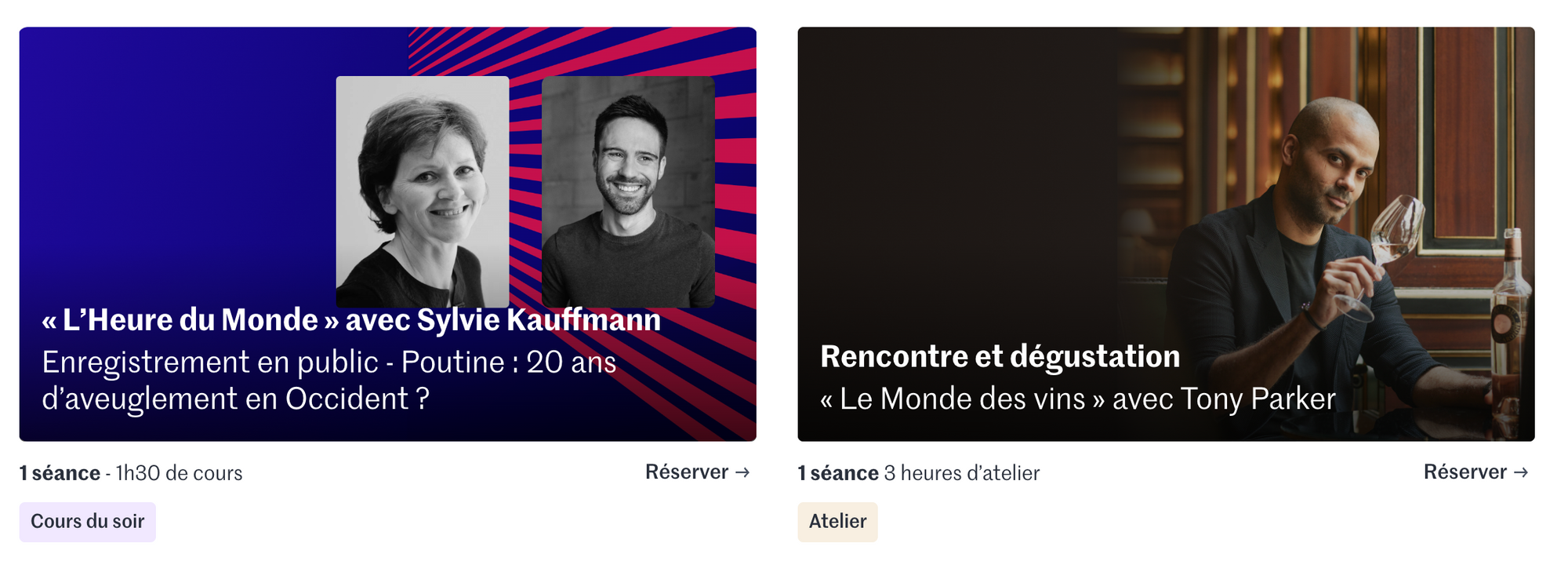
The newspaper also set out to conquer new audiences, notably targeting younger people through social media, as well as readers internationally.
On the POLITICO Europe side, which generates 80% of its revenue from its business activity serving professionals, Freddie Martyn, Marketing and Communications Director, reports that "the free site and free newsletters act as a net to catch audiences interested in politics. Playbook Paris has 45,000 subscribers. Within it, targeted public affairs advertising. "
According to Adrien Labastire, cofounder of newsletter hosting service Kessel, the newsletter offers a number of advantages for a media outlet looking to distribute announcements to a specific audience.
« There's been a newsletter revival over the past three to four years with @axios, @MorningBrew, @semafor… It's a format that costs little, has great deliverability, great precision in audience targeting, and allows for advertising. » — @labastire @kesselfr pic.twitter.com/wGfZNIkDUx
— Médianes (@medianes_org) June 2, 2023
Another potential revenue source: subscriptions. But this option is far from a magic bullet, cautions Marion Wyss, Marketing Director at Poool, a dynamic paywall tool: "You can't convert your entire audience to subscriptions, so you need to find other monetization sources".
The full recording of this roundtable is available on the Web2day YouTube channel.
⟶ To view the full live tweet feed from this conference, visit Médianes' Twitter account.
What future for content in the age of AI?
With Benoît Zante (Founder of the TLDR newsletter) and Quentin Franque (Marketing Director at Morfo and Poool)
On stage at Web2Day, Benoît Zante and Quentin Franque presented the initial findings of their report—co-authored with Marie Dollé, founder of the newsletter *In Bed With Tech*—on the future of content production.
The document highlights several trends, particularly regarding the use of artificial intelligence to write articles. On this topic, the report’s authors recommend several best practices to be implemented within newsrooms: “It will be important to specify the extent to which AI was used in the content and to demonstrate transparency in the media on this issue. BuzzFeed and Wired use AI and state this very clearly for content with low added value.”
⟶ To view the full live tweet feed from this conference, visit Médianes' Twitter account.
Socially Conscious Media: Beyond the Audience
Featuring Mathieu Molard (Editor-in-Chief of StreetPress), Marie Barbier (Co-founder of La Déferlante), Dan Geiselhart (Co-founder of TechTrash and Climax) and Antoine Patinet (Chief Digital Officer at I/O Media), moderated by Marine Doux (Co-founder of Médianes) and Maxime Leroy (Vice President of Product at POLITICO Europe and columnist at Médianes).
Environmental, feminist, LGBTQIA+, anti-racist, and social justice issues: More and more media outlets are making the editorial and economic choice to promote a more inclusive and sustainable society, alongside their communities. Why and how should we champion socially conscious journalism? How can we transition from an audience to a community? And what editorial and business model should we adopt?
Mathieu Molard, editor-in-chief at StreetPress, an investigative and urban culture media outlet, says: “Commitment has been in StreetPress’s DNA since its founding in 2010. ” This commitment is reflected in the choice of topics covered as well as the perspectives and personal accounts that the investigative media outlet seeks to highlight.
Commitment is also at the heart of the creation of *La Déferlante*, a quarterly magazine and newsletter dedicated to feminism and gender issues. “Four of us women created this publication; we’re united by feminism, and so are our readers,” says Marie Barbier, co-founder and co-editor-in-chief of the publication.

A collective endeavor that also involves readers in the development of their media outlet. Through its first crowdfunding campaign, La Déferlante invites anyone interested to become a shareholder in the media outlet.
Dan Geiselhart is the co-founder, along with Lauren Boudard, of the TechTrash newsletter as well as Climax—a newsletter and fanzine focused on climate change and its consequences. He explains that creating a new media outlet focused on environmental issues addressed a specific need: “There’s a lot of greenwashing in the communications of companies that claim to be all-green. That’s what we wanted to expose with Climax.”
Antoine Patinet, Chief Digital Officer at I/O Media—a media group that includes têtu·, Ideat, The Good Life, Dim Dam Don, Opéra Magazine, and Lyrik—also highlights the desire to fill a gap at the time of têtu·’s launch.
A media outlet that is no longer in its prime and must now bring together several generations of readers within its community—while feeling the need to reinvent itself—as Antoine Patinet confirms: “I’ve been in the media business for ten years, and it feels like we’ve been reinventing the industry every single day for the past ten years: business models, diversification, and how to engage the community.”
This diversification strategy is now being adopted by a number of independent media outlets. At StreetPress, video plays a major role in their content production, with a YouTube channel that now has more than 300,000 subscribers.
In keeping with its commitment to collaborative creation, La Déferlante is committed to regularly engaging with its readership through events, conferences, and meetups at bookstores.
The full recording of this roundtable is available on the Web2day YouTube channel.
⟶ To view the full live tweet feed from this conference, visit Médianes' Twitter account.
Editor’s Note: The Médianes team co-organized the media program for Web2day at the initiative of Maxime Leroy (Vice President of Product at POLITICO Europe) and Benoît Zante (Founder of the TLDR newsletter). To view the full live-tweet feed from the event, visit Médianes’ Twitter profile.
June 27, 2023: Added a link to the recording of the roundtable discussion “Engaged Media: Beyond the Audience.”
Médianes, the studio, supports the teams at Mediavivant, Kometa, POLITICO Europe, StreetPress, Climax, and La Déferlante.


