



The use of artificial intelligence (AI) in newsrooms is nothing new. Since 2016, for example, Washington Post has used Heliograph to write short articles about sports or election results. However, it is clear that its use has intensified significantly over the past few months. Many media outlets have experimented, tentatively or somewhat abruptly, with these new tools at their disposal. While some have chosen to regulate its use and educate the public about it, others have for example chosen to replace part of their newsroom with machines, convinced they have found a solution to their financial difficulties.
Trade unions and journalist organizations are concerned about its impact on employment and the quality of information, calling for regulation or even a ban on its use. Others argue that artificial intelligence will finally free journalists from time-consuming tasks and allow them to devote more time to their primary mission: investigation and reporting.
To help clarify this, we've selected below a non-exhaustive overview of formats, debates and practices identified in the media.
(Last updated on 23/11/2023)
- Work optimization and task automation
To date, the use of artificial intelligence is mainly limited to short, repetitive tasks. In more advanced applications, such as drafting a newsletter or translating an article, its use is generally conditioned by human action.
- For its new English-language service, Le Monde in English, the French daily is using artificial intelligence to produce an initial translation of its articles. Several members of the editorial staff then review the translations. “When an article appears on the English-language site’s homepage, it has already been reviewed by four pairs of eyes and an artificial intelligence program,” explains Elvire Camus (editor-in-chief). For its translations, Le Monde uses external service providers, one of which primarily uses the DeepL translation tool.

- Danish media outlet Zetland developed an automatic transcription tool called GoodTape for journalists. The application, which guarantees data protection and encryption for its users, was designed using the "Whisper" API developed by OpenAI, the company behind ChatGPT.

- Local online news outlet Nottinghamshire Live uses artificial intelligence to automatically summarize its articles as a bulleted list. However, an editorial staff member reviews the summaries before publication.
- For its international development, the online media Brut. is betting on artificial intelligence, particularly HeyGen, a paid service capable of automatically dubbing its journalists by mimicking the rhythm and timbre of their voices. You only need to browse the media's TikTok accounts to see the results. Here,the original French version,here in English. Spotify has also taken an interest in this technology.The company recently unveiled a few demosof its new translation tool. It should allow content creators to translate their audio content into multiple languages.
- Regulate
While AIs may seem to be in their infancy, their consequences are already significant. Having failed to anticipate this technological leap, governments around the world are attempting to catch up by drafting their respective legislation, as in the United States. Many unions and collectives from various industries have mobilized in favor of regulation, or even a ban on its use.
- In the United States, a number of unions want to negotiate with management about the matter. They are particularly concerned about the risks posed by artificial intelligence use in newsrooms. At the Financial Times, discussions have reportedly already led to a number of agreements, but at other media outlets, negotiations are currently at a "standstill" according to some union representatives.
- In France, the Council for Journalism Ethics and Mediation (CDJM) has suggested a number of "best practices" in its guide on journalism and artificial intelligence. An initiative praised by French unions, including the CFDT: Journalists and the SNJ.
- Through an op-ed published in Libération, the translators' collective "In the Flesh" calls for banning the use of artificial intelligence in several cultural fields. "We, translators, creators in the fields of literature, film, audiovisual, video games and journalism, are raising awareness about the use of these linguistic transcoding programs in our professions and, more broadly, in the generation of so-called cultural and intellectual works". They have urged in particular news organizations to refuse "recourse to AI as a tool of alleged translation and creation of artworks and texts".
- Get trained
- Samsa, a training center specializing in content production, offers a program for media professionals seeking to, for example,
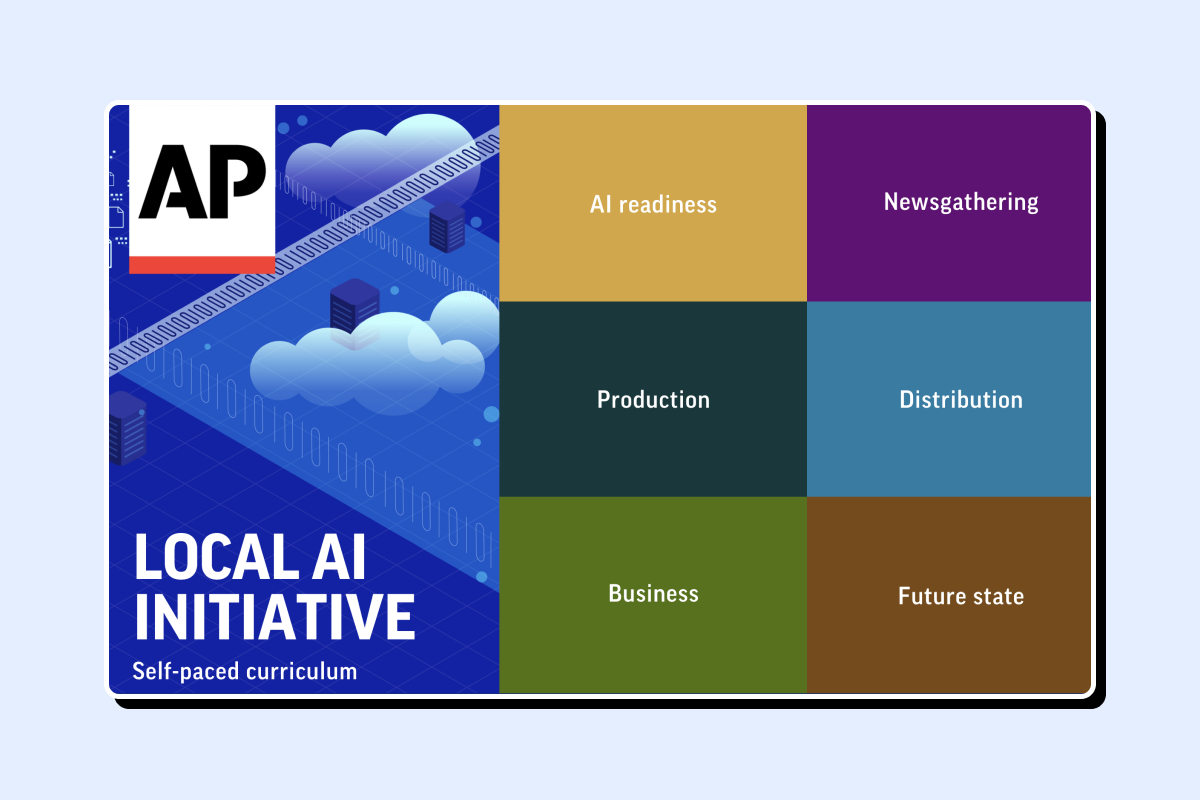
- The American news agency Associated Press, which partnered with OpenAI last July, is offering training for local media outlets so they can use artificial intelligence in their own local news coverage. Several speakers share their expertise on newsletter automation and interview transcription.
- Could you define a "Neural Network" or explain how "Deep Learning" works? The sudden emergence of artificial intelligence in the news has been accompanied by a torrent of technical terms flooding articles and columns. The New York Times and the CNIL offer glossaries of key terms to know.
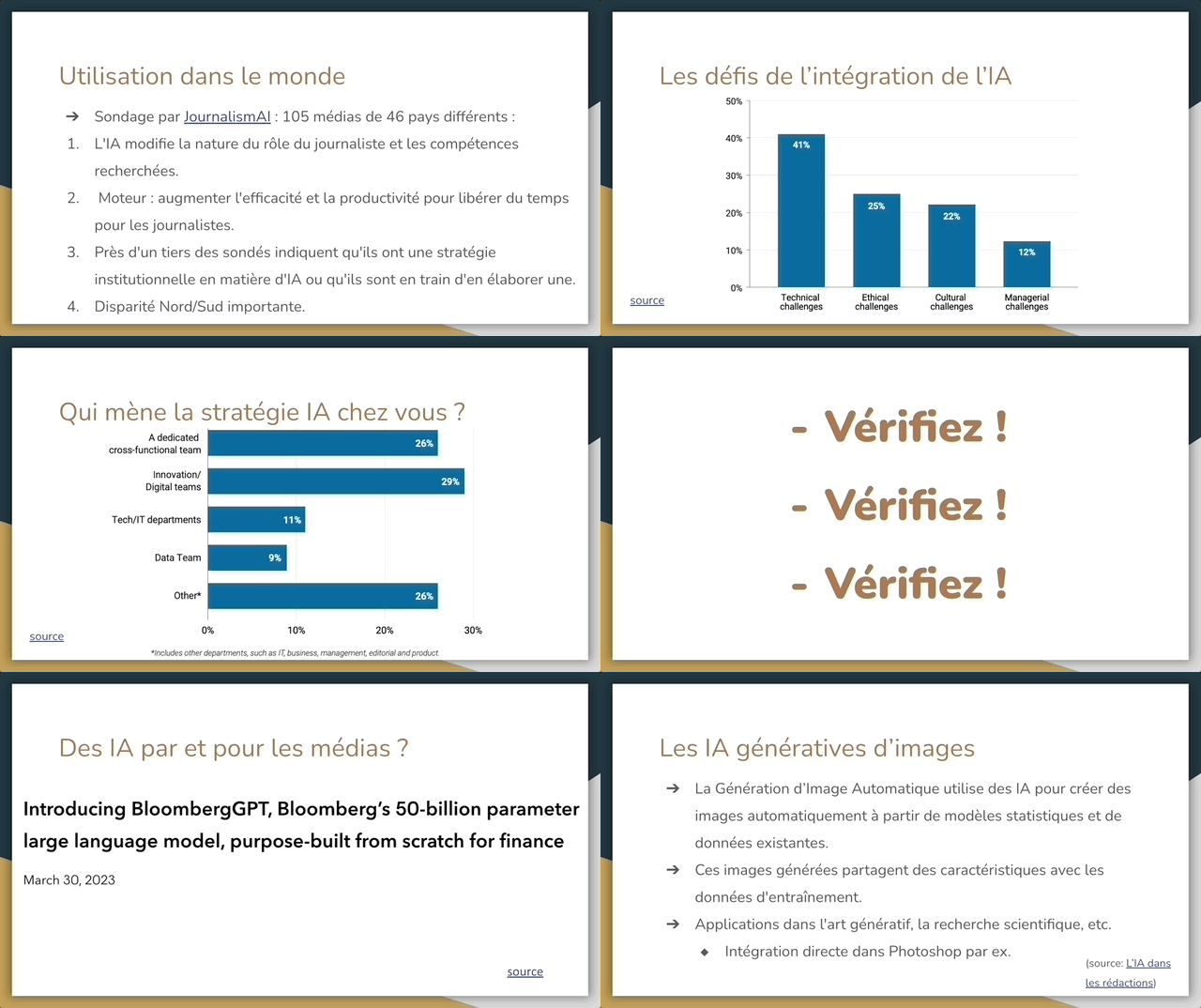
- Thomas Seymat, head of editorial projects and development at Euronews, is leading a course on generative AI in media for the CJF this year. See his presentation materials, used as part of his training, containing a series of articles, data and tools on the subject.
Ouest Médialab, a training center and laboratory for local media, offers a one-day training course: " Integrating artificial intelligence into journalism practice". While participants will be able to learn how to use these new tools, the program also covers legal and ethical issues related to AI use in the media.
- Regulating through charters
At their initiative, media organizations have written their own charters aimed at regulating the unexpected arrival of these new tools in their newsrooms. While comprehensive, these documents focus primarily on the use of AI in editorial practice, such as the production of illustrations or articles. Above all, they are an exercise in transparency toward their audiences.
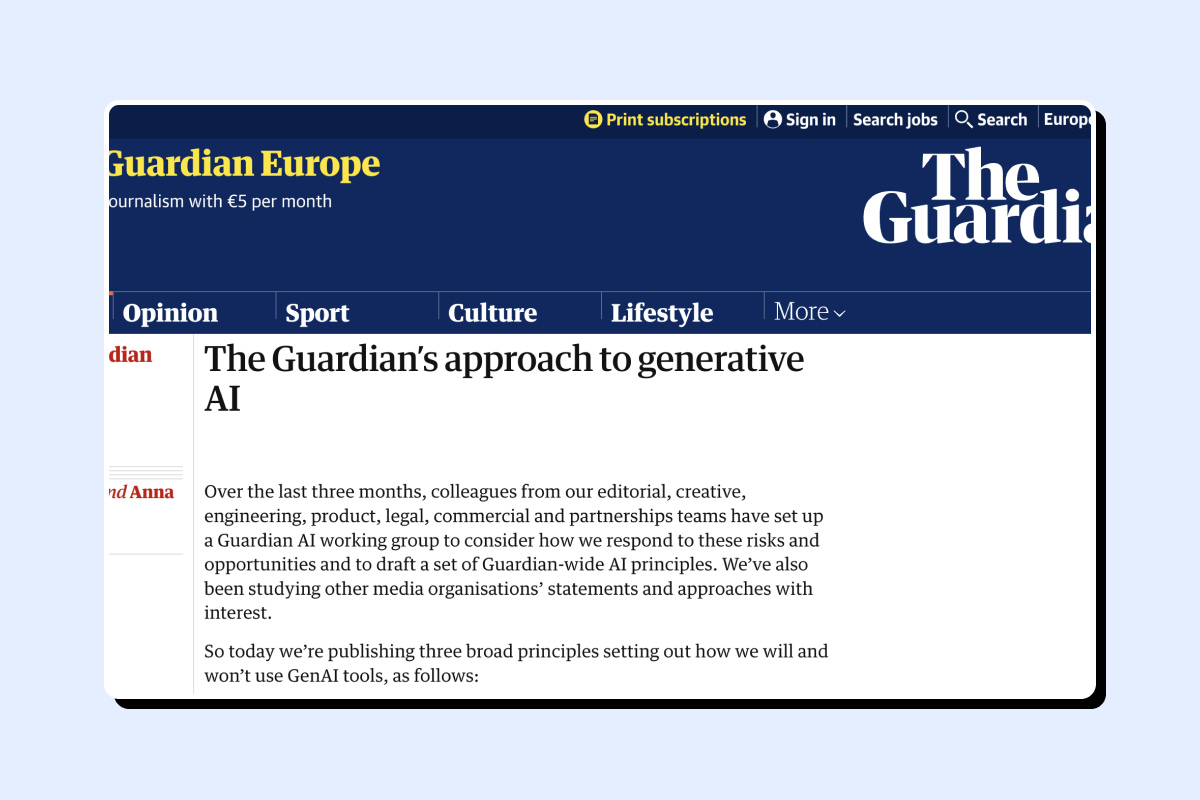
- The Guardian published an ethical charter on their use of artificial intelligence. This document, drafted by a team tasked with identifying the risks and opportunities that AI could represent, puts forward a number of recommendations. While The Guardian does not rule out its use in "situations where it can improve the quality of our work", it does mention a duty of transparency toward its readers in its use of these new technologies.
- In May, the Le Parisien – Les Échos group published its own charter on the subject. It notably rules out any publication of an article generated by artificial intelligence "without editorial and human supervision". However, AI can be used for monitoring work carried out by journalists in the newsroom, as long as they can guarantee the accuracy of the information found.
- The NGO Reporters Without Borders and 16 partner organizations designed the "Paris Charter on AI and Journalism". The committee responsible for drafting it, composed of "32 personalities from 20 different countries, specialists in journalism or AI", was chaired by Maria Ressa, winner of the Nobel Peace Prize in 2021.
- Are you interested in the subject and would like to consult other charters? Are you considering writing a set of usage rules for your own media outlet? This article from the Nieman Lab, translated by us, offers a selection of "protocols", "principles" and "ethical charters" written by media organizations around the world.
- This guide published by Journalism.design offers a series of leads and recommendations that can be used to draft an editorial and ethical charter regulating the use of artificial intelligence within a media organization. The guide's author, Gerald Holubowicz, also compiled a list of charters.
- Data use
In order to learn how to interact like humans, AIs such as ChatGPT or Bard have used a large amount of texts made available to them on the internet. Among this content: news articles. But media outlets and journalists are far from convinced about seeing their work used for the development of artificial intelligence whose contours they do not control.
- The New York Times specified in its legal notices that "the use of content without prior written consent from The New York Times Company" was prohibited in the context of artificial intelligence development. In an effort to protect its intellectual property, the American newspaper also mentioned possible legal action against OpenAI. Today, the New York Times has blocked ChatGPT's access to its content.
- Conversely, the American news agency Associated Press allows OpenAI to use its archives to feed its database and improve its algorithms as Axios reports. An agreement finalized under a 2-year contract signed between the two parties in July.
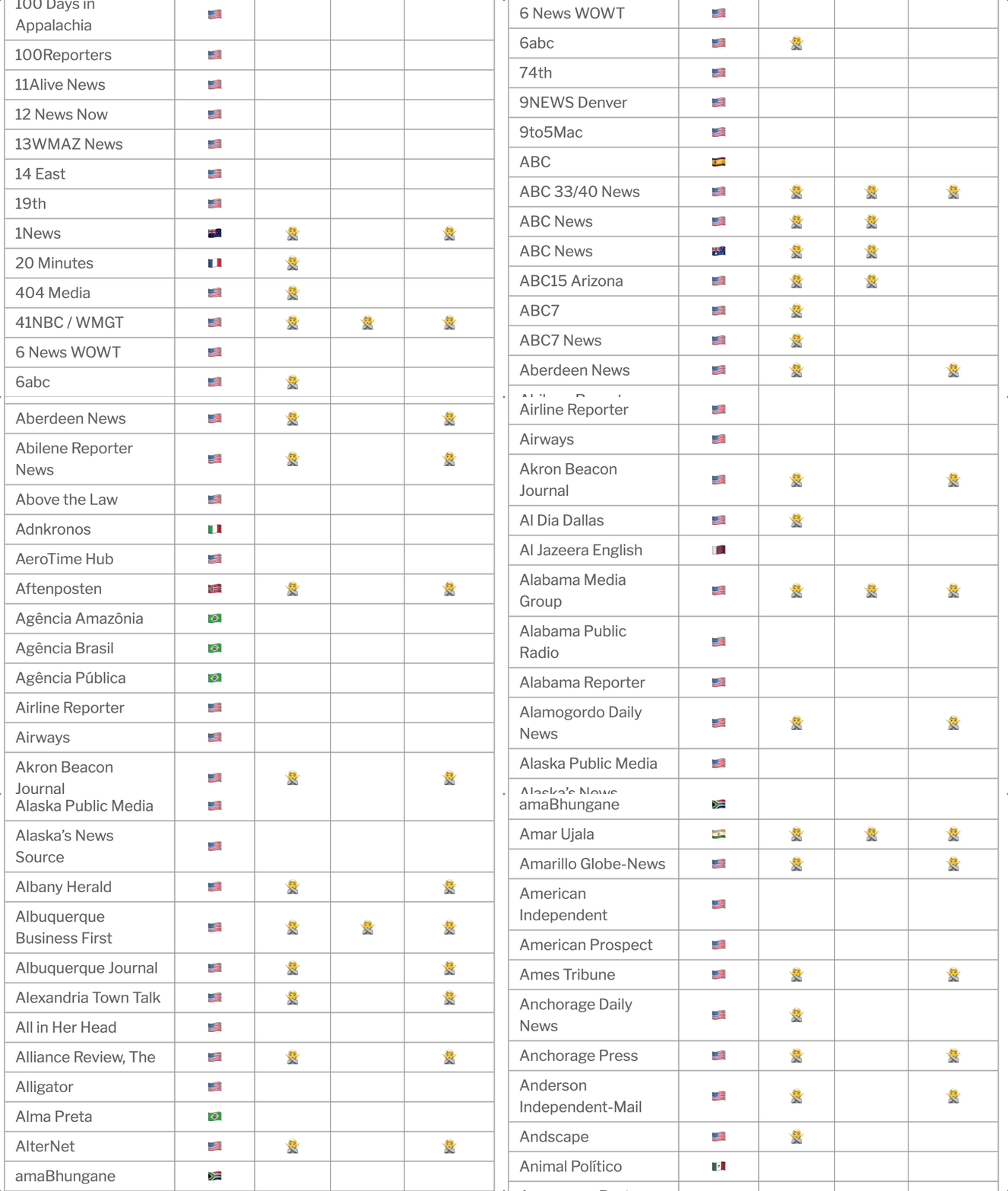
- This site lists the media outlets that have decided to prevent or allow certain AIs to access their content. For example, we learn that Mediapart has decided to completely restrict access to its site for OpenAI, Google AI and Common Crawl. This is not the case, however, for the Huffington Post.
To go further:
- Google intends to change our search habits through AI. But these new uses could reduce traffic to news sites.
- In the United States, local media outlets are using artificial intelligence in their news coverage. But this practice faces certain limitations and skepticism from their teams.
- AI was the subject of a number of roundtable discussions at the 2023 edition of Médias en Seine, "the festival of tomorrow's media". Read our report on the day.


