


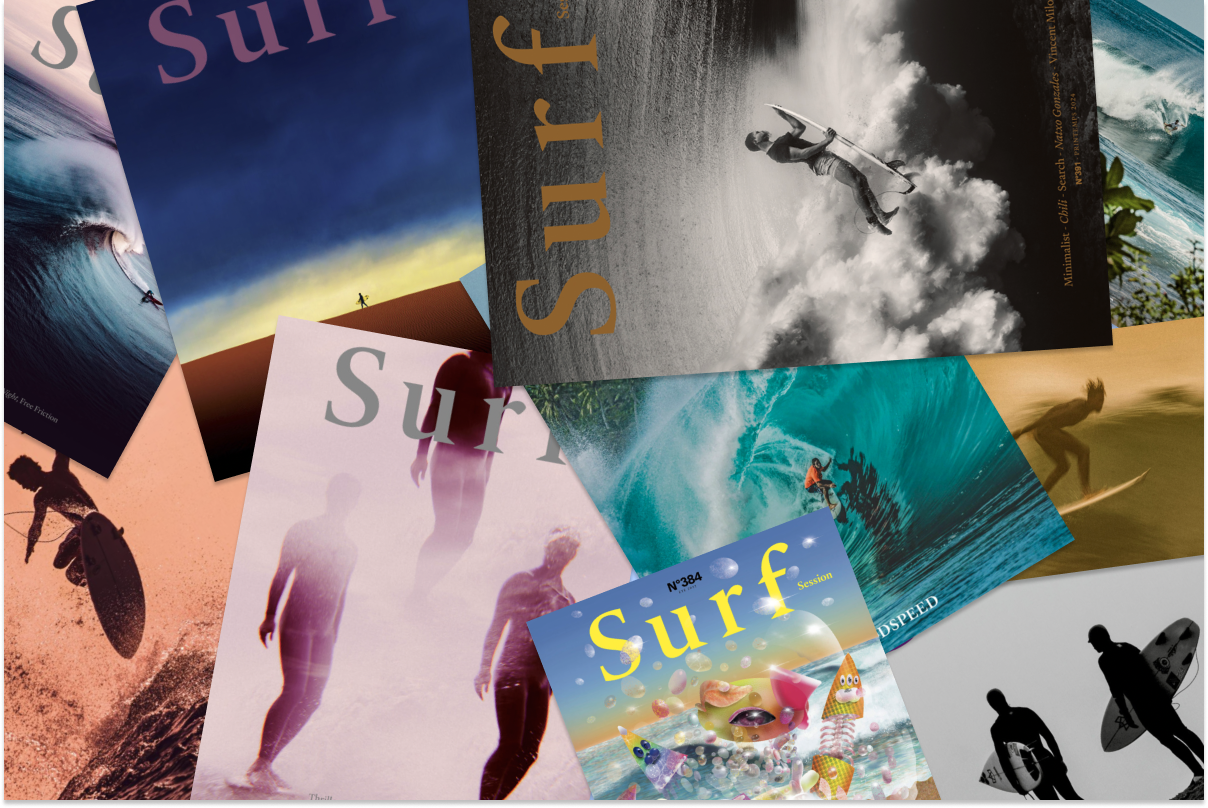
Name: Surf Session
Nationality: French
Founded: 1986
Founders: Gibus de Soultrait, Pierre-Bernard Gascogne
Business model: newsstand sales, subscriptions, advertising, shop
Platforms: website, Youtube, print
Media type: specialized surf media
Publication language: French
When I discovered surfing, what surfing actually was, I realized it was much more than just a sport or pastime. It was a world opening up to me. With its international history, rooted in Hawaii, shaped by colonialism, cultural appropriation and globalization, surfing follows its own timeline, its own technological revolutions, governed by its codes, its myths, its founding and iconic figures. From this postcolonial and marginal counterculture to mainstream culture exported to every corner of the globe in a uniform light, I was hungry to grasp this universe.
Instagram and Internet Wanderings.
Surf. Surf culture. Beach culture. Perfect bodies. Bleached blond. Big wave surfing. Green waves. Shape. Shaper. Shapeuse? Nose dive. Take off. Duck dive. Impact zone. Shore break. Bells Beach. Sponsors. Quicksilver. Rip Curl. Wetsuits. 4/3. 5/4. 3/2. Springsuits. Tubes. West coast. Pacific coast. Teahupo'o. Tahiti. Réunion. Australia. Sharks. Johanne Defay. Justine Dupont. Marco Mignot. Ramzi Boukhiam. Kelly Slater. Bethany Hamilton. Free Surf.
And then I discovered Surf Session, a providential print magazine with an approach to the surf world that was at once aesthetic, literary, anthropological, and technical (coupled with well-targeted advertising). Born in 1986 in Biarritz, the magazine has watched the years pass and the world transform. It is a kind of witness to History—the history of surfing and that of a global world—through its editorial movements, through the evolution of its form.
A publication bearing witness to a world in motion
What immediately appealed to me about Surf Session was its editorial stance and cultural thematic features. Its portraits too. All this content forms a renewed manifesto of the magazine's commitment to a particular vision of surfing and surf culture.
Back to basics. The opening pages of Surf Session systematically explore a reflection that brings into tension the issues that run through the world of surfing, its blind spots, its contradictions, with its history. Current events intersect with culture, anthropology, history, art, technique, and those who form this often idealized community: surfers.
Literary, sometimes even poetic, Surf Session questions its world without losing the surf spirit. You quickly understand through its pages the full stakes of being able to evolve with the times, to question one's world and its foundations, without losing its essence. The magazine highlights issues that permeate the surf world as much as our global societies — particularly Western ones: the place and representation of women, racialized minorities, cultures and continents, ecology, rampant consumer society, marketing sirens and the dictatorship of self-presentation… Surf Session describes the trajectory of a counter-culture, now integrated, its current events and stakes. In my view, the magazine Surf Session questions the very issues found within its pages — underrepresentation of racial and gender minorities, the development of special women's issues (Surfeuses, formerly Surf Mademoiselle) steeped in the pitfalls of traditional women's media, advertising that endorses a certain mode of consuming surf culture…
Yet one can sense the magazine's reflexive drive and desire to evolve – sometimes awkwardly, still faintly. Portraits of women are developing slowly but surely within Surf Session (the main magazine) as well. Moreover, the very existence of Surfeuses, an offshoot of the main publication appearing twice yearly in spring and summer, is a way of giving voice and space to women in the surfing world when they have been struggling for years to claim their place there. Still, I find it somewhat a shame that this media comes across more as a special issue than as a main publication.

Surf Session seems to be gently moving toward decolonizing its pages. Features on non-Western cultures are becoming more prominent.
Ecological and environmental awareness is also beginning to find its place in the magazine's pages, albeit tentatively, through the voices of surfers involved in the fight to preserve the oceans.


Credits: Surf Session
If the media isn't particularly ahead of the curve on these global and cross-cutting issues, the awareness of the need to address them certainly seems to be present. Despite a few remaining missteps or gaps, I want to believe that Surf Session, surf culture and the surf community can rise to these challenges and change for the better by becoming more inclusive, more representative, more open and sustainable.
A visual feast
To be perfectly honest, Surf Session is also a magazine to look at. At least for me, I love to flip through each new issue before even reading it, just for the pleasure of the eye. For the pleasure of seeing an incredible array of photographs of waves, sunrises and sunsets captured by the eye of expert photographers scroll by with sobriety and elegance. Light, texture and movement give the magazine a particular tone and rhythm. The ocean stretches as far as the eye can see. Waves more perfect and inaccessible than one another extend the surf dream, the fantasy of the sensation one might feel riding them. Faces with gazes sometimes faded, sometimes deep, and skin marked and creased by the sun speak of pleasure, serenity, dedication, perseverance, laughter but also adrenaline, fears, setbacks, and also generations and time.
Through these photographs, through articles dedicated to artists, Surf Session moves away from the tyranny of the mainstream Instagram-friendly image of surfing to embrace its own aesthetic, with genuine artistic dimension. It takes on the challenge of working with an artistic eye on aspects that are sometimes technical and material. Surf Session gives me something soft, intimate and fluid. Not artificial. Not superficial. Not anxiety-inducing — a nod to all those hellish Instagram contents that make us believe we'll never measure up. Surf session is a visual and material extension of my surfing dream.
A beacon in the night
Surf Session is a surprisingly accessible magazine, though not designed for beginners. It requires you to seek out references and terms on your own alongside the articles (many are technical), to research the people it discusses. But if you make that effort, the magazine allows you to dive fully into the world of surfing and its culture, past and present. It enables a kind of acculturation into the surfing world and helps you understand as many technical aspects and current events as its philosophy and deeper issues (or its mindset as some would say around here). So I'd say Surf Session is something of a beacon in the night, if you're truly passionate and curious.
On a much more trivial level, the magazine also has simple practical value thanks to its advertising pages, its recommendations (wetsuits, swimwear, sunscreen, earplugs…) and its directory of good addresses (surf schools, surf camps, shapers…). With the enormous range of choices available and all the marketing surrounding surf brands and destinations, having a few recommendations is very welcome! That said, let's be honest, Surf Session is clearly aimed at people with significant financial means… I somewhat regret the lack of recommendations for secondhand purchases, the online and offline places to find good used equipment, and more concrete advice for choosing your gear wisely. This aspect sometimes makes me think the magazine is primarily designed for privileged audiences for whom style matters just as much, if not more, than their relationship with surfing.
While I enjoy visiting the media's website less, I have to admit that the practical articles (technical advice), which are rarer in the print edition, equipment review videos, tutorial videos, and even weather forecasts that you find there are a plus. With free access, these contents allow you to discover others.

Without proposing a schedule, it's also notably on the site that you can easily discover world or local events linked to surf culture (film festivals, competitions…). Surf Session therefore makes it possible to navigate step by step through this world by making choices that are a little more informed than before reading (at least I hope so!)
Digressions by Professional Deformation
From my little corner of beach towel at La Madrague in Anglet, where I watch experienced surfers take on waves that are often far too big and hollow for me; to Deus Ex Machina (a shop and café in Biarritz blending surf culture and mechanics, editor's note) on rainy days with my cup of coffee, I carry my little magazine with me. As I flip through it, I enjoy reflecting on what goes on behind the scenes, how it works internally, its strategic direction and challenges. I examine from a distance the material that stands out and think about what could be done differently.
The development of the website, a YouTube channel, a partnership with the surf podcast Impact Zone, the development of Surfeuses, a visual identity overhaul, the creation of an Instagram account, all provide material for reflection on the evolution of the media and its adaptability. Having gone through judicial liquidation and a buyout in 2023, Surf Session is a media outlet that, like so many others, struggles to evolve in a constantly changing ecosystem with strong sector constraints. It is adapting by offering free online articles, newsstand and subscription purchases of the magazine, relying on advertisers, and also diversifying with spin-off products: the shop offers books, comic books, thematic guides, thematic boxes…
I'm always wondering too how their distribution strategy is built. As a subscriber, I've already sometimes received the same issue multiple times, or experienced significant delivery delays.
I examine Surf Session with a kind of affection. My past as a historian is never far away. I see in this publication that has endured since the 1980s a small gem of concentrated history that has adapted, as best it could, with varying degrees of success, to the challenges and shifts in the media ecosystem, to the digital turning point, to changes in habits and mentalities, to the very incorporation of surf counterculture (isn't this publication one of its embodiments, after all?), to the issues of our time (gender, race, ecology). There is something of the order of testimony, of memory, both in the analysis and the reflection on the present moment and its daily material experience, that moves me about Surf Session. The publication tries, strives, evolves, questions, becomes aware even as it materializes these same pitfalls and issues. It lives its world head-on. It has something profoundly human about it.
To go further
- The media that intrigued Maëlle and Marine in recent months: It's Freezing in LA! and Les Autres Possibles.
- Love at first sight, breakups and compromises. Natalie Thiriez tells us the story of a symbiotic yet tumultuous relationship between Le 1 and its article.
- Weight, texture, ink, grain: a series of insights from experience to help you choose your paper.
- Printing means paper media. Which elements change from one paper type to another? What are the consequences? We present you with practical examples.
- When paper becomes a tool of resistance and emancipation: Clémentine Laboresse, co-founder of Censored reflects on the release of the Feminist Self-Publishing Alphabet.


