1. The editorial product: what are we talking about?
Before discussing a content's journey, we need to establish a common definition: that of the editorial product.
An editorial product is neither mere content nor a one-off project. It is a structured editorial response to an identified public need, designed to deliver value over time. It brings together:
- an intention: what are we responding to? for whom?
- a promise: what can the public expect from it?
- an organization: how is it conceived, produced, distributed and managed?
It can be described as the coherent articulation of several dimensions: the need it addresses, the editorial objective pursued, a shorter or longer timeframe, coordinated formats, and a clear decision-making and responsibility framework.
The value of a publishing product therefore does not rest solely on its subject matter, but on how it is conceived, embodied, distributed and assessed. This approach makes it possible to move away from a reactive logic and establish a genuine management framework.
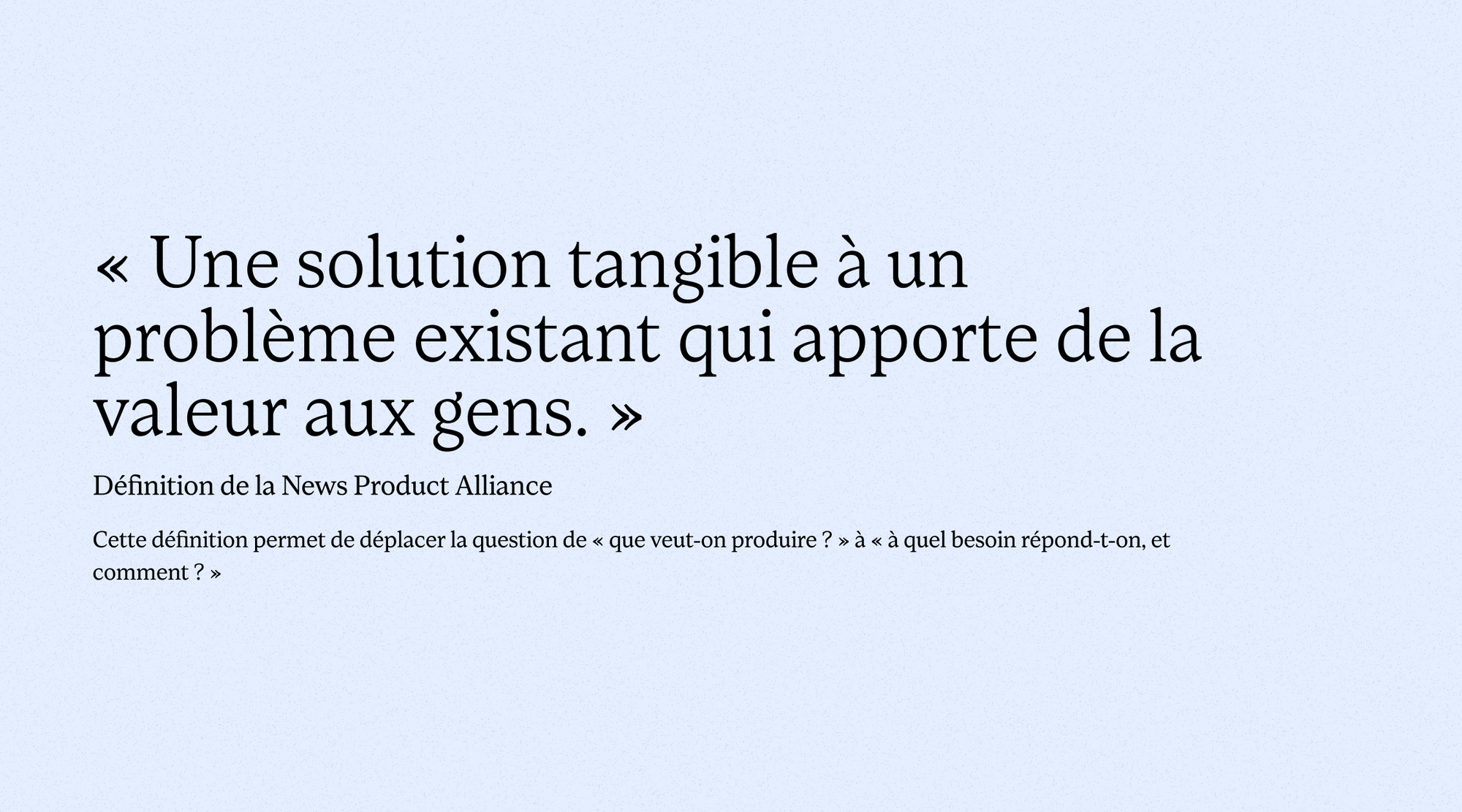
What an editorial product is not:
- a succession of content published
- a format launched without clear commitment or identified responsible party ;
- a good idea that relies on one or two overstretched people;
- content whose purpose and intended audience have become unclear.
Shifting from a content-driven logic to an editorial product logic isn't about "doing more." It's doing less, but better, and more sustainably.
A few concrete examples of editorial products
To make this definition more concrete, we can draw on well-identified examples.
Le Monde has developed several distinct editorial products to meet different needs:
- Les Lives du Monde is an editorial product designed for continuous coverage of breaking news. It is based on a promise of responsiveness, reliability and real-time prioritization, with specific editorial organization and validation processes. These live streams are freely accessible.
- Les Ateliers du Monde, by contrast, is an editorial product oriented toward transmission and experience: encounters, pedagogy, direct engagement with audiences. The subject matter counts, but it's above all the form, timing, and relationship with the public that define the product (and its price!).
At Vert, you can also find several clearly identified editorial products:
- Vert's daily newsletter is a flagship editorial product, designed as a regular meeting point with a promise of analysis, prioritization and humor.
- "It Was Better After" is a video podcast that addresses the need to give tangible form to and foster sensory understanding of ecological issues, with its own narrative codes and pace, and popular guests who are (rarely) heard discussing ecology topics.
- Club de Vert goes even further: it's an editorial and community product that brings together content, engagement, and business model.
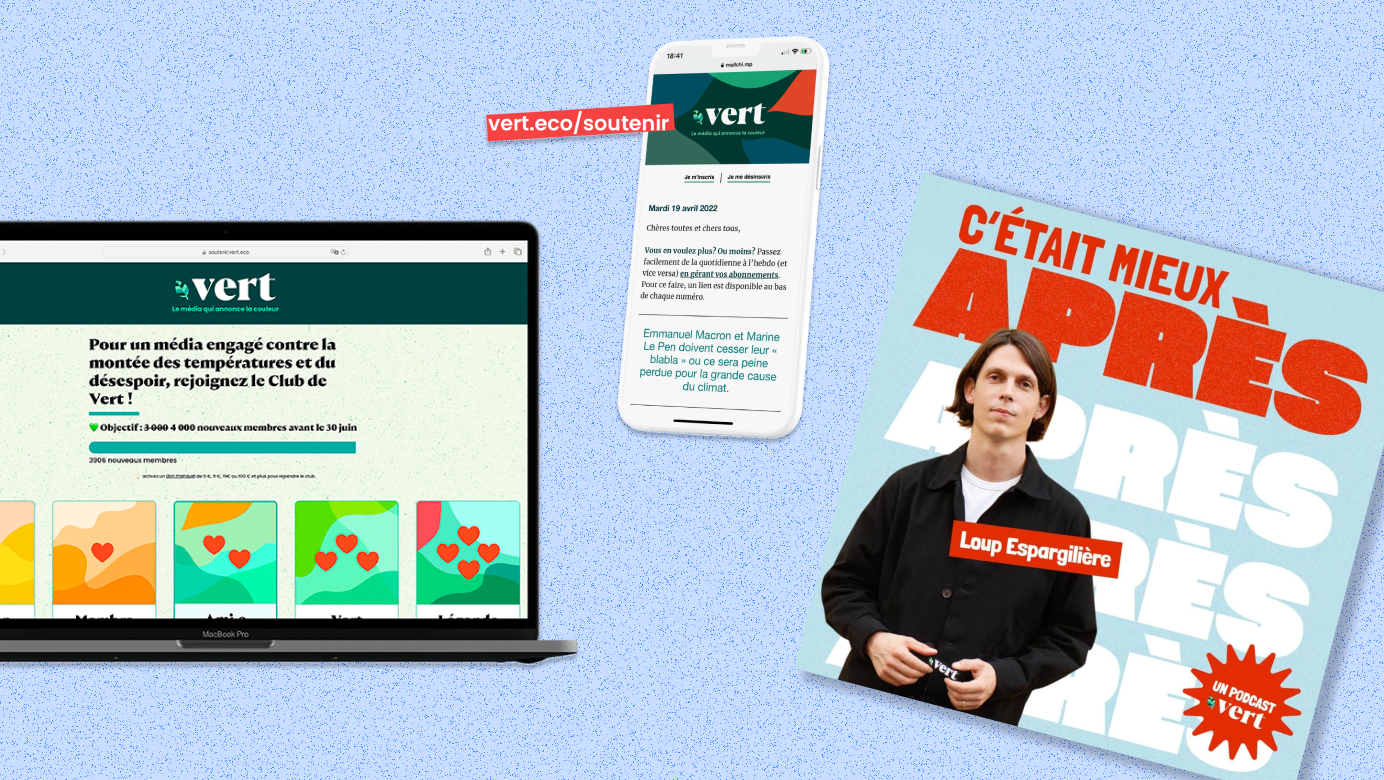
Transparency note: Médianes, the studio supported Vert (marketing, design, web, management) and Le Monde (marketing, management).
These examples show that an editorial product can be a livestream, a newsletter, a podcast, a club, or a proprietary format…as long as it rests on a clear promise, overall consistency, and explicit governance framework.
For independent media, thinking in terms of editorial products is not a whim, it is often a condition for sustainability: editorial sustainability (not covering everything); human sustainability (not having a product depend on a single person); economic sustainability (clarifying what creates value). The editorial product then becomes both a tool for making editorial choices and a tool for steering the organization.
2. How is an editorial product organized?
Once the editorial product is defined, the question of its concrete organization arises. At the heart of this organization: editorial workflows, that is, the production processes that define how content is launched, produced, validated and distributed. Who decides what? At what point? Who coordinates between departments? Who validates, who is informed, who produces?
Structuring this process isn't about adding burden to the work. It's about creating the conditions for everyone to know where they stand in the chain, so that urgencies don't swallow up foundational work, and so that coordination no longer relies on what's left unsaid.
This organization is based on two distinct but interconnected levels:
- the product implementation roadmaps;
- the roles that enable these journeys to work.
The ideal path of content
Editorial content follows a journey in four major steps, designed as a continuous process, whether for in-depth content planned over the long term or for content created within a limited timeframe.
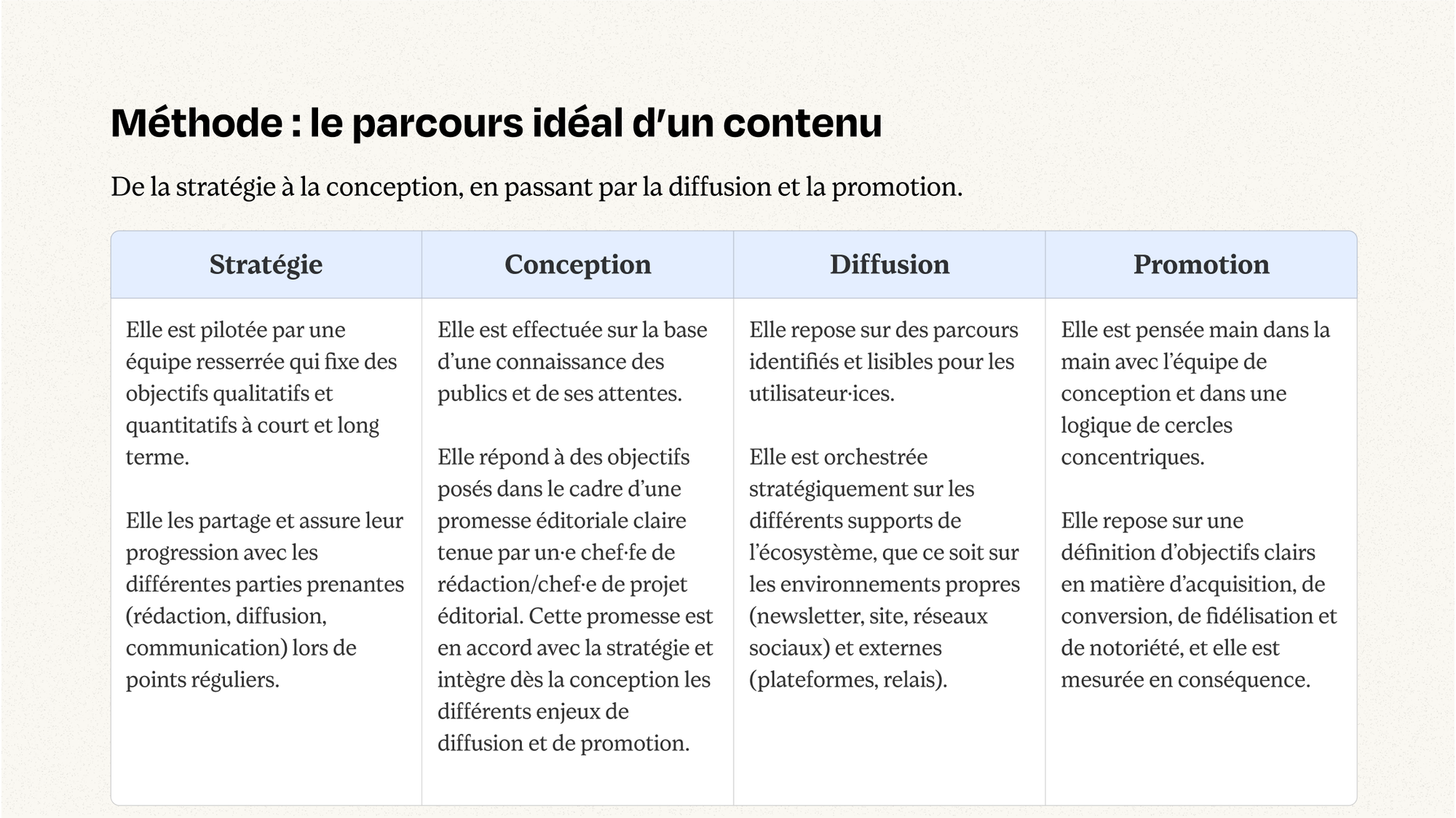
In summary
- The strategy sets qualitative and quantitative objectives, both short-term and long-term. It is carried out by a focused team, then shared with the relevant stakeholders (editorial, distribution, communications) and monitored over time.
- Design is grounded in a strong understanding of audiences and their expectations. It translates the editorial promise into clear formats, angles, and approaches, incorporating distribution and promotion challenges from the outset.
- Distribution is based on identified and clear user journeys. It is organized across the entire ecosystem: owned channels (website, newsletter, social media) as well as external environments (platforms, relays, partners).
- Promotion is designed in close coordination with conception. It follows a logic of concentric circles and pursues clear objectives (awareness, acquisition, conversion, loyalty), measured using appropriate indicators.
Two paths for two production approaches
The same editorial product can follow different implementation paths depending on context, level of anticipation, and degree of urgency. The paths do not define the product, but rather how it is activated and managed.
Not all content should (or can) follow the same workflow. An in-depth report and a reaction to breaking news don't have the same time constraints, coordination requirements, or decision-making processes.
Two main paths can be distinguished:
- the "in-depth editorial product" path ;
- the "responsive editorial product" journey.
The journey of a "in-depth editorial product"
This pathway concerns anticipated, foundational content that fits into a broader editorial strategy: a thematic special report, a series of content, an information campaign, a magazine, a podcast…
It rests on three pillars:
- Anticipation (the project is qualified upstream): editorial objective, target audiences, formats deployed, success indicators.
- Multi-disciplinary coordination: editorial, social media, video, and design teams work from a shared brief and regular synchronization checkpoints.
- Planned decisions: decisions are made at identified times, not in an emergency.
Key milestones in the long-distance journey:
- Project qualification (objective, targets, timeline, indicators)
- Designation of the product point of contact
- Shared editorial brief (angle, formats by channel, points to watch)
- Planning and coordination (key milestones, deadlines, interaction with others)
- Arbitrations (angle, formats, incarnation)
- Production and validation (role, responsibility and validation workflow)
- Dissemination and results (timeline, figures, lessons learned, results dissemination)
The journey of a
This process applies when the context calls for a quick response: breaking news, political or media emergency, or unexpected opportunity.
The issue isn't about deciding everything quickly, but about knowing who decides what, right away. The reactive approach operates on a short-circuit basis, with a deliberately limited number of stakeholders.
Key milestones in the reactive journey:
- Trigger (subject identification, assessment of its sensitivity level)
- Direct responsibility (designation of the project contact person or final decision-maker)
- Quick mini-brief (key message, tone, points to watch, formats by channel)
- Production (who produces, within what timeframe)
- Quick validation (what validates, based on what criteria)
- Broadcasting (where, when)
- A posteriori information (who is informed, where information is archived)
The common principle
These two paths are not rigid compartments. Content can move from one to the other, but always in an explicit manner.
The guiding principle to establish collectively: no content circulates without being tied to an identified pathway. This choice determines production pace, the level of coordination, and the decision-making process. It's also about adapting these two pathways to your own priorities and needs.
In late 2025, Médianes, the studio, carried out a mission with the City of Paris's information department, with the objective of harmonising and improving the practices of this department that brings together 55 professionals – writers, videographers, community managers, photographers – who collaborate every day to produce, edit and publish content across the city's various media and channels. During our mission, we co-designed these two pathways with the information department teams, adapting them to their concrete organisation. Each pathway resulted in a shared operational matrix that can be used directly in editorial meetings. Discover behind-the-scenes insights from this mission on our studio's website.
3. Roles in an editorial workflow
An editorial product doesn't work solely through good formats or a clear promise. It also relies on explicitly defined roles, which help avoid ambiguity, duplication, and organizational friction. Talking about roles isn't about describing job descriptions, but about naming the functions necessary to steer the product, regardless of the approach used (planned or reactive).
The editorial product owner
The product editor reference person (product manager) is responsible for overall coherence. Their role consists of translating editorial intent into concrete organization, structuring collective work, and securing decisions.
He or she ensures the circulation of information, adherence to the schedule, and the clarity of decisions. This role is central to preventing misunderstandings between teams and allowing other roles to work within a clear framework. The referent does not decide on the editorial line alone and does not necessarily produce the content. He or she creates the conditions for the right decisions to be made at the right time.
Creating this role does not necessarily require hiring. It is first about naming what needs to exist, then formalizing the role's contours so that everyone understands it.
A few best practices for installing it:
- Define the role collectively. Organize a discussion time with the team to formulate together: what the role is, what it isn't, who it reports to and in what form. A shared framework is better than an imposed job description.
- Create simple tools. The point person needs a shared brief, a clear timeline, a straightforward approval process, and a space to document decisions. Without these tools, the role becomes unmanageable.
- Establish synchronization rituals. A 30-minute weekly review (what's progressing, what's blocked, what we need) allows the point person to share information without creating multiple requests.
Editorial production
Editorial production teams bring together the people responsible for creating content: writing, video, audio, and social media. They are responsible for editorial quality, format consistency, and delivering on the promise made to the public.
They operate within a defined framework, with clear objectives and identified approval processes, so they can focus on their core business: producing relevant and demanding content.
The management
Management maintains a strategic arbitration role. It intervenes when structural, sensitive, or binding decisions need to be made, or when the editorial product raises political, economic, or image concerns.
Its role is not to replace day-to-day management, but to ensure overall vision and consistency with the media organization's broader project.
Defining your production workflows is about setting the framework. But for that framework to truly work, it's essential to define each person's role. That's exactly what the RACI matrix: our dedicated how-to guide helps you do—it explains how to build it with your team.
In brief
To structure your editorial production, remember these three essential steps:
1. Name your editorial products. What do you produce, for whom, and with what promise?
2. Separate your editorial workflows. Evergreen and reactive content don't follow the same structure. Set out these two streams explicitly, adapt them to your organization, and apply this principle: no content moves without an identified framework.
3. Install the role of product steward. Appoint them collectively, create tools usable by everyone. This role is what holds the organization together over time.
With Médianes, le studio, we can help you identify and structure your editorial products and their customer journeys, support your teams in implementation, or guide you through an internal transformation.
To go further
- On rituals and collective organization, discover our practical guide on the RACI matrix to clarify roles in an editorial organization.
- On management in media: consult the Guide to project management in newsrooms, translated and adapted for French-speaking audiences by us, or meet its author, Robin Kwong, former head of audience retention at the Wall Street Journal.
- Management is often viewed as the media's weak point. An overview of best practices.