
Facing public debate polarization and the evolution of media digital strategy, some outlets prefer to reduce the number of pages devoted to opinion and commentary, such as the Gannett group in the United States. Others, like the European Review of Books, bet on long-form content and emphasize ideas over opinions.
In our article on media outlets that build their editorial proposition around opinion, Sylvain Bourmeau, cofounder of the media outlet AOC, analyzes the place of opinion in American media: "There is a much clearer division in this overseasA press between what pertains to opinion and everything else, and it works very well with the public ". Yet some American media outlets are rethinking their strategy regarding the separation between news and opinion. Like the Gannett group, which owns 250 local newspaper titles—one out of every five daily newspapers in the United States, including USA Today, the Des Moines Register and the Detroit Free Press.
Facing financial difficulties, Gannett is choosing to reduce its daily opinion pages to just a few days a week, while refocusing its editorial offering on local journalism, discussion, and solutions-based reporting.
Fewer Opinion Columns
The group aims to invest more in digital. It therefore surveyed its readers through polls. Five main points emerge from this, as Poynter notes. According to the report, daily editorials and opinion pieces written by external contributors are still the least-read articles online. The public does not want to be lectured or told what to think. Readers can find a wide range of opinions on national issues online, and reproducing this type of content at the local level would therefore be a waste of time and budget.
Lucas Grundmeier, editor of the opinion section at the Des Moines Register, wrote in a column from last March that conversations with readers revealed several key points. The editorials kept repeating the same partisan debates and seemed designed to stoke division rather than discuss solutions. "We will now prioritize quality over quantity by moving to publishing a single opinion page per week. Our current four-page Sunday section will continue. And the remaining content will be local and even hyperlocal, with a focus on solutions," he clarified in his column.
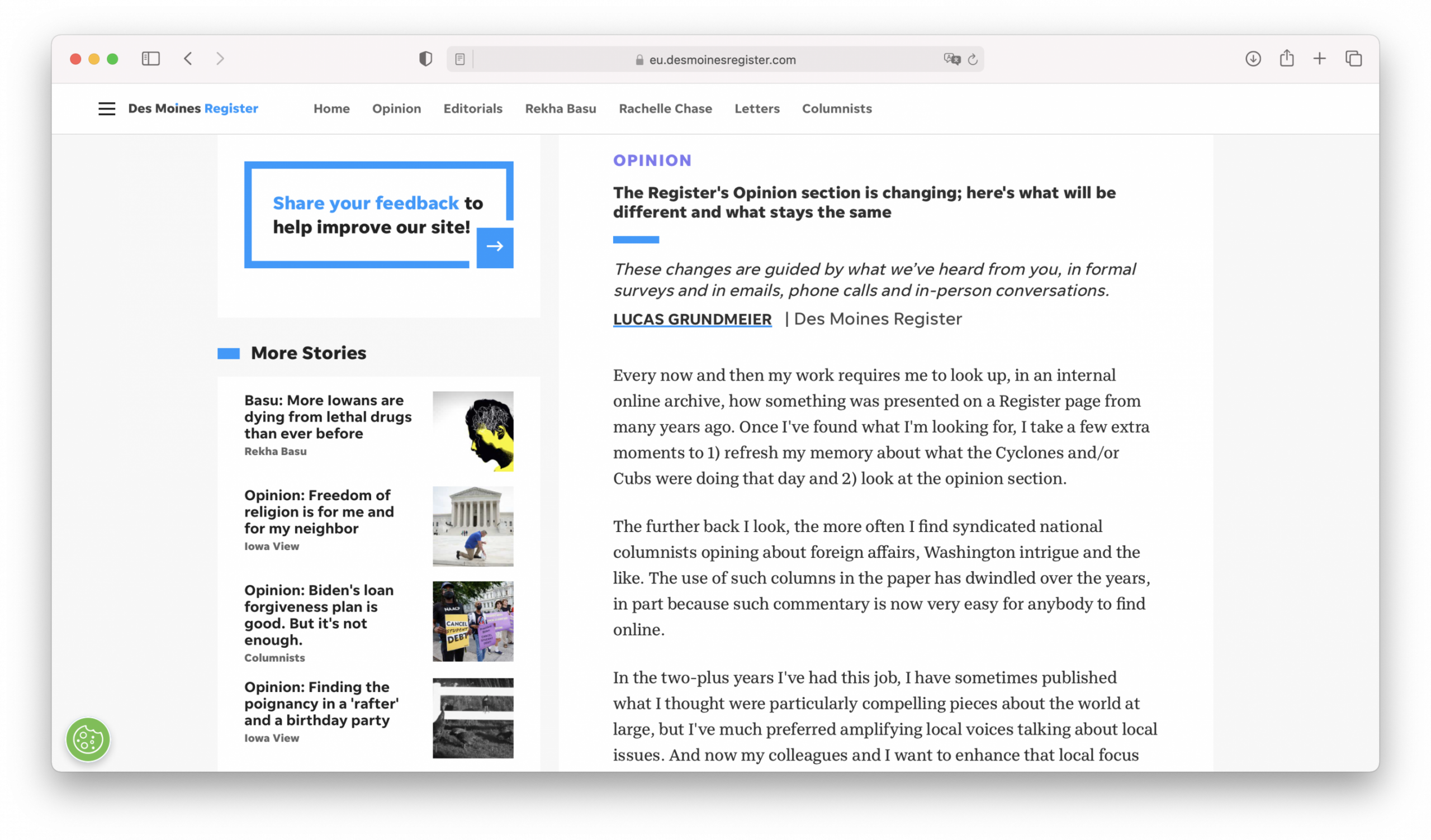
Screenshot of Lucas Grundmeir's column
To adapt to digital usage
The digital shift is the main reason for the reduction in opinion pages. For example, The Republic of Arizona, which also belongs to the Gannett group, announced that opinion columns will continue to be published daily on the website as unsigned editorials and guest pieces. There will be fewer of them, but they will be more engaging. In its print edition, these columns will now appear only three days a week in order to "refocus [the] time and [efforts] on facilitating deeper dialogue on key issues affecting Arizona residents."
However, in the digital space, audiences may have difficulty distinguishing opinion pieces from straightforward reporting. That's what a survey conducted by Gannett among its readers found.
Gannett now recommends that its newspapers refrain from making predictions or endorsing candidates in races for the presidency, House, and Senate, given their declining influence and potential to alienate some readers. The Republic, based in Phoenix, has already adopted the suggestion. A sign of objectivity or fear of taking controversial stances? Everyone will form their own opinion on that.
Distinction between ideas and opinion
Creating media that excludes opinion but chooses to highlight ideas: a distinction worth exploring. To understand it, Sander Pleij, editor-in-chief of the European Review of Books, sheds light on the matter. "I define opinion as a text in which an author defends his claims, and I don't find that interesting for the reader. I'm not saying I'm against opinions, which is itself an opinion, but you see them everywhere!" The European Review of Books is written in English and its editor-in-chief is Dutch. The magazine calls on authors to write on topics concerning Europe through demanding and diverse themes such as Ukraine, socialism, Google, literature, and history. In the magazine's preamble, Sander Pleij writes "we want a brilliant essay", which announces the magazine's ambition. The magazine doesn't stop there, as it's also an object that belongs to the reader: to continue reading the essays, we must detach the pages. The idea is to pick and explore the subjects that interest us. Like media outlets such as Le Grand Continent, a website and magazine dedicated to geopolitics and European issues, published by the Groupe d'études géopolitiques, an independent association founded at the ENS, the magazine publishes long articles that take time to read. Sander Pleij and his team designed it by observing the practices of mainstream media: "there is less and less culture in magazines, and when there is some, the content remains poor".
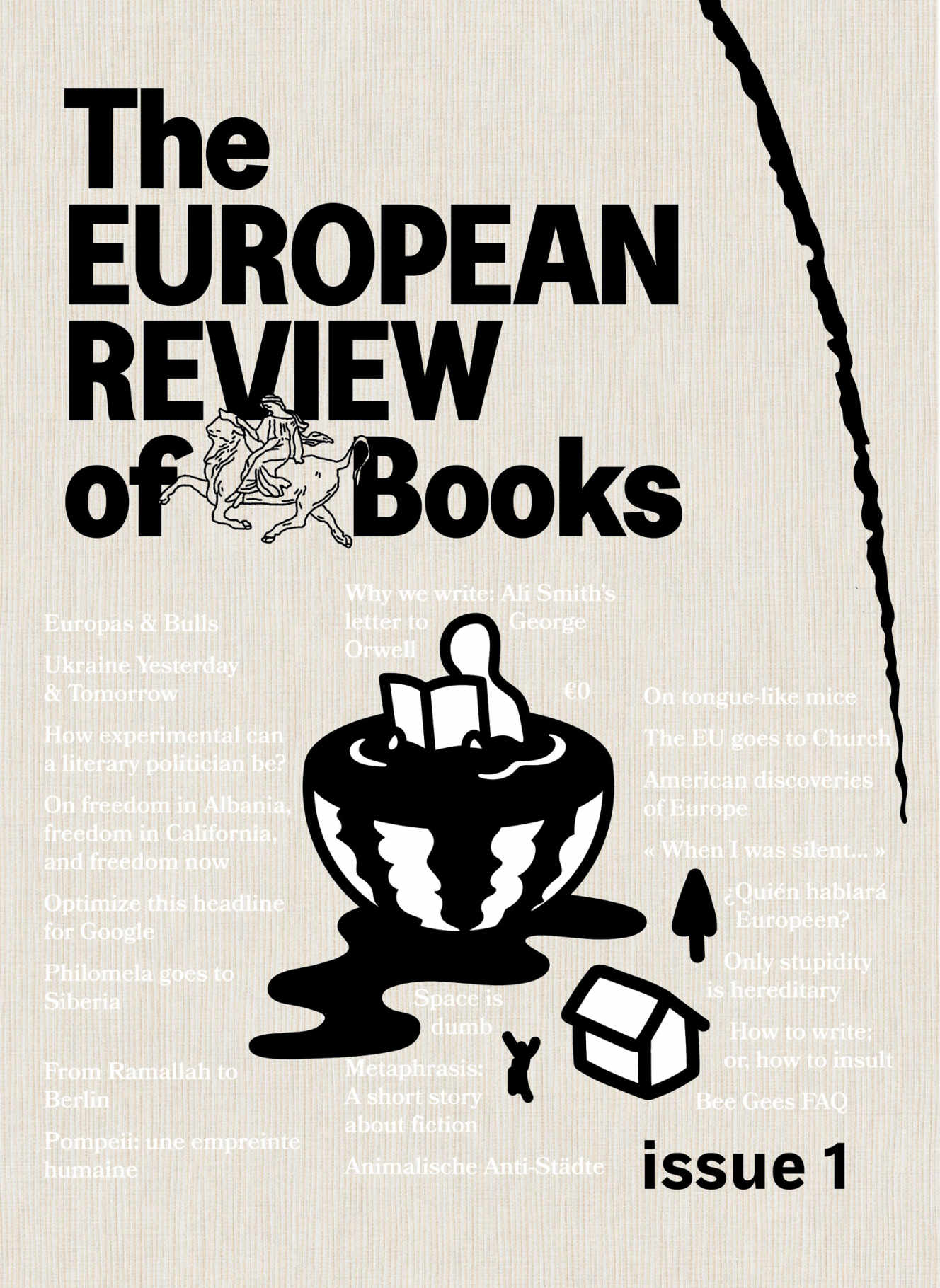
Cover of the first issue of the European Review of Books
Like any media outlet that gives voice to authors, a central question arises: who do we give the floor to and who is legitimate to speak on a given subject? The magazine's authors come from diverse backgrounds—journalists, writers, architects, and academic researchers. "I primarily look at their previous contributions, and these are often names suggested to me by colleagues". The question of subject selection is all the more important for the magazine given the breadth of topics it covers. "Anything can be a subject as long as it's explored in depth and approached as a discussion rather than a reaction". Sander Pleij positions himself as a defender of thoughtful debate, far removed from daily reactions to constant news cycles.
Vary the formats
Other outlets like the New York Times haven't cut back their opinion pages; instead, they're innovating with original formats. For example, the newspaper gives readers a voice to respond to opinion columns. Like this article where readers respond to a pro-life column amid the ongoing controversy over abortion bans in the United States. The New York Times also allows writers to revisit their past columns. Some have changed their minds and reconsidered their positions. As in this column about Facebook usage, where Farhad Manjoo urged everyone to create an account on the social network, before changing his mind when he saw that the platform's practices didn't respect users' privacy. Or take this piece by opinion columnist Bret Stephens, who hadn't anticipated how broad Donald Trump's electorate would be.
Fewer opinion pages, new formats invented, ideas highlighted over opinions—media outlets are innovating. The question remains whether audiences will embrace these new approaches.
To go further
Gannett group guidelines regarding the restructuring of opinion pages.