


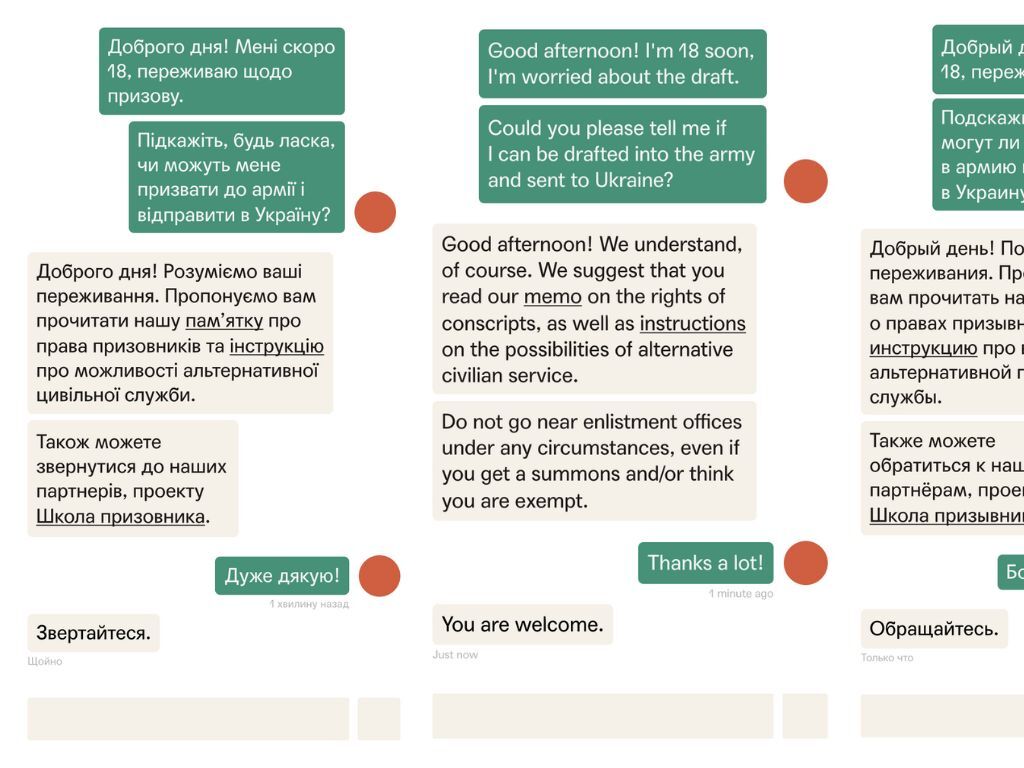
Its founder Ilia Krasilshchik doesn't know the average age, sex, or place of residence of the people who request help through their chat. He only knows that many are terrified.
Article translated by Marine Slavitch — Original version published on the Nieman Lab website on October 3, 2022.
« My son will surely be called up. I'm panicking. What can I do? », « Can I cross the border with a car that isn't registered in my name? », « Is it true that I can't be called to the army if I have a lot of tattoos? ».
These are the frequently asked questions received by Helpdesk on its online support service. Over the past nine days, this new Russian media outlet has received no fewer than twenty thousand requests, according to its founder. A team of about fifty people handles responding to them daily. Some work remotely. Others work in offices in Riga, Kyiv, and Tbilissi. The outlet's audience is composed of approximately 60% Russians and 40% Ukrainians.
« Our team also includes Russian and Ukrainian journalists. The situation is completely unique in the current circumstances », notes founder Ilia Krasilshchik.
Ben Smith, cofounder of Semafor — a newly launched American general-interest news outlet, editor's note — and former media columnist for the New York Times, describes Helpdesk as a form of " solutions journalism for people in conflict zones ". He considers the start-up to be " one of the most interesting media projects to emerge from the Ukrainian conflict ".
Beyond managing its help desk service, Helpdesk covers the war in Ukraine via articles published on Telegram and Instagram. The number of people turning to this independent news outlet for information is impressive. The Instagram page of Helpdesk reaches 2.5 million users per month while its Telegram account reaches 3 million per day, according to Ilia Krasilshchik. It's worth noting that Telegram is one of the few platforms where Russians can access independent sources of information. It's the most downloaded app in Russia in recent months.
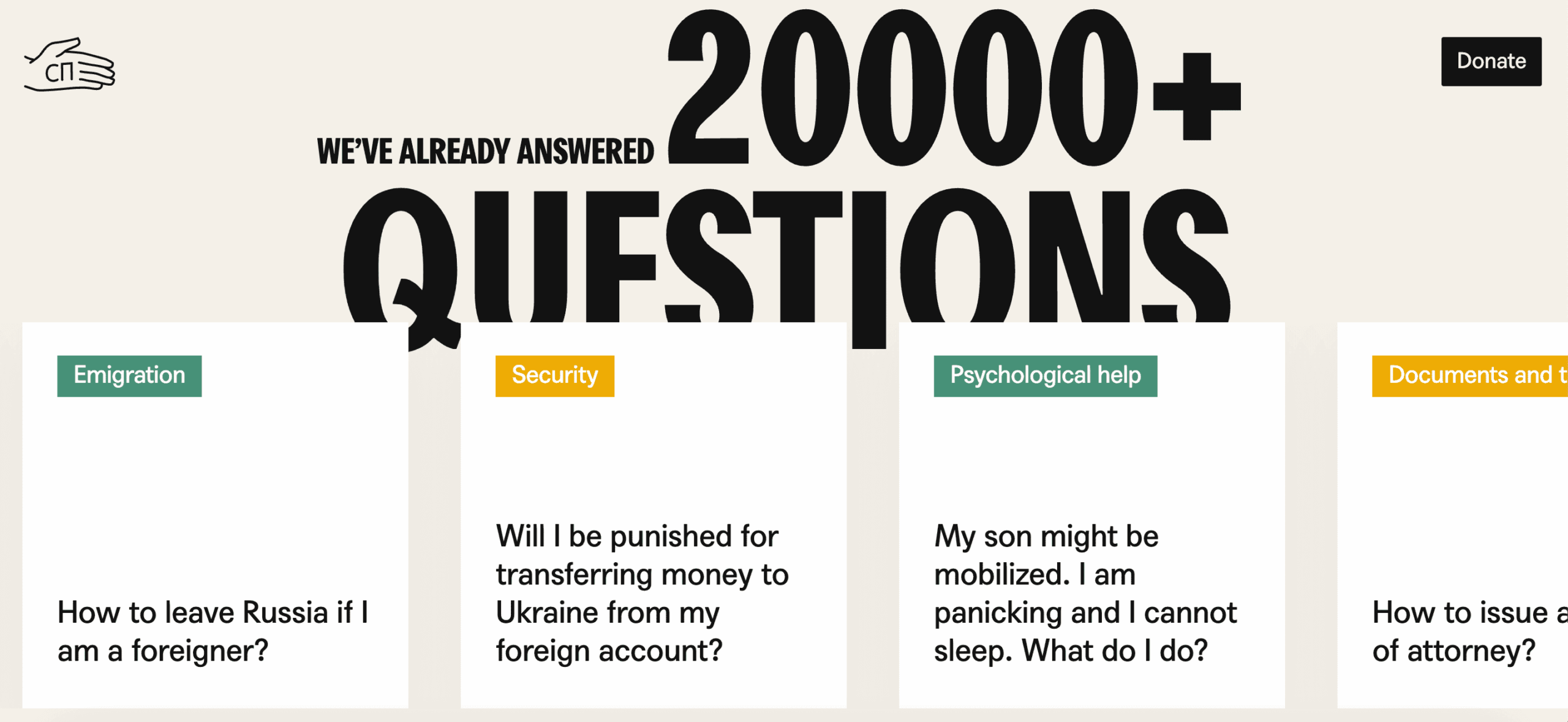
Screenshot of the English version of Helpdesk
Ilia Krasilshchik began developing the project shortly after the war in Ukraine started. The media outlet's English version was called War.evidence. The entrepreneur is the former editor-in-chief of Meduza, one of the leading independent Russian-language media outlets. He also took a break from journalism to work alongside Russian technology company Yandex, which specializes in internet search. "I realized that the best thing to do right now was to return to media," the journalist explains.
His dilemma? The desire to help populations directly. "It's an eternal conflict: you can't marry journalism and activism," he points out. "An idea came to us then. We could indeed launch a two-in-one project. The first part would consist of the media on social networks, and we had fifteen years of experience within the best Russian media to do it well. The second part, pure activism, would be our service launched by specialists in professional assistance that I know from my Yandex years. In such a scheme, these two parts support each other."
Unsurprisingly, the most frequently asked questions concern how to avoid conscription in the Russian army. When Russian President Vladimir Putin announced military mobilization, Helpdesk quickly published an online guide to avoid military service. "Remember that you can hide in Russia, and that war can be far more dangerous than criminal prosecution and prison," it stated. The guide was quickly blocked by the Russian government. The chatbot continues nonetheless to answer individual questions and regularly publishes updates on ways to escape via countries such as Finland, Norway, Georgia, Belarus, Mongolia, etc.
Last week on Telegram, Helpdesk was recommending, for example, avoiding the checkpoint at Ozinki in Kazakhstan, as travellers could wait up to three days in the queue. The Komsomolsky queue was shorter, only a day's wait, but readers were warned of the "poor condition" of the road after the checkpoint and freezing temperatures while waiting.
When operators encounter individuals experiencing psychological distress, assistance service operators follow a protocol to provide the best possible support. If an operator fears that a person may be suicidal, professional psychological support through a partner organization is offered.
En plus d’une présence sur les réseaux sociaux, Ilia Krasilshchik prévoit de lancer une application dans le courant du mois prochain, qui permettra aux discussions du Helpdesk de se poursuivre. « Pas la peine de lancer un site Web : La Russie le bloquera en quelques jours, soupire le journaliste. En Russie, Internet est suffisamment performant pour chatter, donc il n’y a aucun problème. » L’objectif principal consiste à sécuriser ces conversations.
« We developed our own password-protected chat system. No authentication needed, it's completely anonymous. You can delete your conversation whenever you want. And we automatically delete the entire conversation within seven days of resolving an issue », adds the founder of Helpdesk.
Of course, Helpdesk's support service collects no information that would identify the people asking questions. Ilia Krasilshchik knows neither the average age, nor the gender, nor the location of people who request help through their chat. He just knows that many are terrified.
The team behind Helpdesk considers its journalism, which includes first-person accounts from people conscripted against their will and graphic evidence of torture in Russian-occupied cities, as a funnel that allows more people to discover the chat service of Helpdesk.
« Their support gives us the ability to understand what's actually happening between Russia and Ukraine. This work is essential because almost no Russian journalists are yet in the country », explains Ilia Krasilshchik.
Fundraising has been difficult given that Visa and Mastercard suspended their operations in Russia. The organization can, however, receive money from Western nations. Helpdesk has raised some funds through North Base Media, a venture capital firm based in Maryland. The amount received so far stands at $1.6 million. Ilia Krasilshchik is planning an annual budget of around $3 million. Enough to survive for a few months, according to the entrepreneur. « But after the mobilization began, we hired a lot of people. So we urgently need to raise more money ».
Editor's Note
This text is not a word-for-word translation of the original article published on the Nieman Lab website. We have added contextual elements, adapted certain expressions, and removed passages containing specific references intended for English-speaking or American readers. We have also chosen to apply inclusive writing conventions to this translation, in accordance with the editorial guidelines in force across all content produced by Médianes.


