


A website often remains the foundation of digital presence and, frequently, the cornerstone of business models, even for a print publication. Yet too many creation or redesign projects get bogged down because technology is prioritized over strategy. Good news: an effective website doesn't necessarily require a substantial budget, provided you ask the right questions upfront.
Build the site from the editorial project, not the technology
When the founders of Republik (Switzerland) launched their online magazine in 2018, they made a radical choice: develop a custom platform built entirely around their editorial vision—one to three articles a day, no endless feed, no race for clicks. The site is structured around a timeline, a space for dialogue with readers, and since 2022, a stream of short-form content. This architecture reflects a conviction: the site's design should flow from the editorial contract with the audience. For a smaller media outlet, the lesson remains the same, even with standard tools: the time spent clarifying what the site should deliver—what promise? what uses? what content takes priority?—is the best investment before any design work begins.
Listen to your community before designing anything
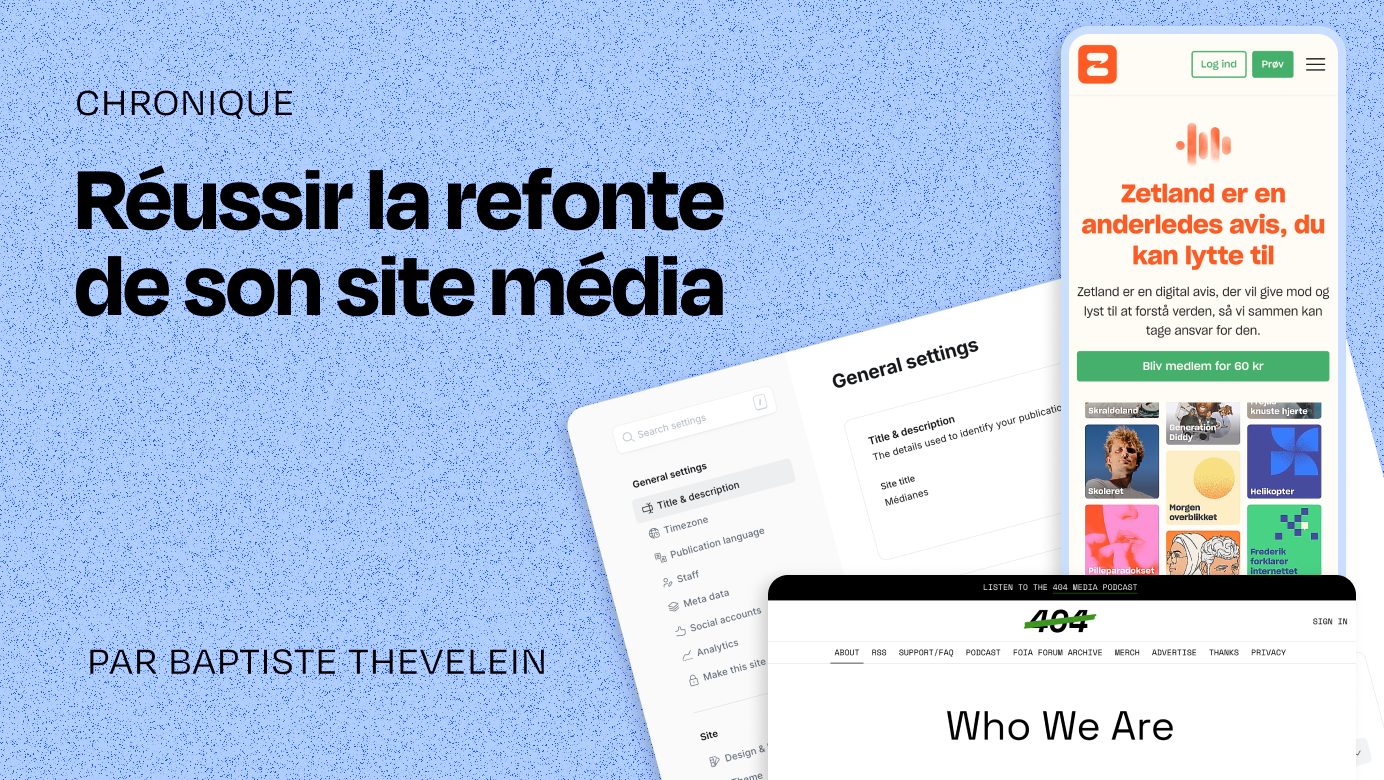
In Denmark, Zetland took this logic one step further. The subscription media outlet (50,000 paying members, profitable since 2020) designed the platform with its readership. Through meetings and survey campaigns, the team picked up an unexpected signal: the majority of subscribers wanted to listen to articles rather than read them. The result transformed the product: 60% of members now consume Zetland in audio. The website and app were redesigned around this discovery. As editor-in-chief Lea Korsgaard summed it up in an interview with Nieman Lab: "your readers and members should have the final say in how your product evolves". A useful reminder before handing a locked-down brief to an agency.
Launch or redesign a website with $4,000 and an open source tool
Stripping infrastructure down to what's essential: that was the bet four American journalists made when they launched 404 Media in summer 2023. Each cofounder put $1,000 on the table to cover startup costs. The site runs on Ghost, an open-source CMS that natively integrates subscription management, newsletter delivery, and paywalls, with no plugins or custom development needed. No office, no image library, no technical vendor. Six months after launch, 404 Media was profitable. The case is American, but the lesson applies everywhere: the technical building blocks that once required tens of thousands of euros in development are now available for just tens of euros a month. What nothing can replace is the upfront planning time needed to define precisely what the site should deliver.
For an independent website on a budget, we launched Socle. Do you have a project? Tell us more!
To go further
- Looking to redesign your newsletter? Check out our 5 tech and design tips.
- In France, media outlets are building shared infrastructure to reclaim their independence from technology platforms. Why is it so useful to strengthen technological independence? Find some answers here.
- Good design connects a medium to its readers, an editorial promise to an actual reading experience. Between the audience and the media, what role can design play? We clarify the stakes.
- Where democratic freedoms are threatened by the rise of the far right and where media concentration undermines information diversity, pooling resources becomes essential for independent outlets.


