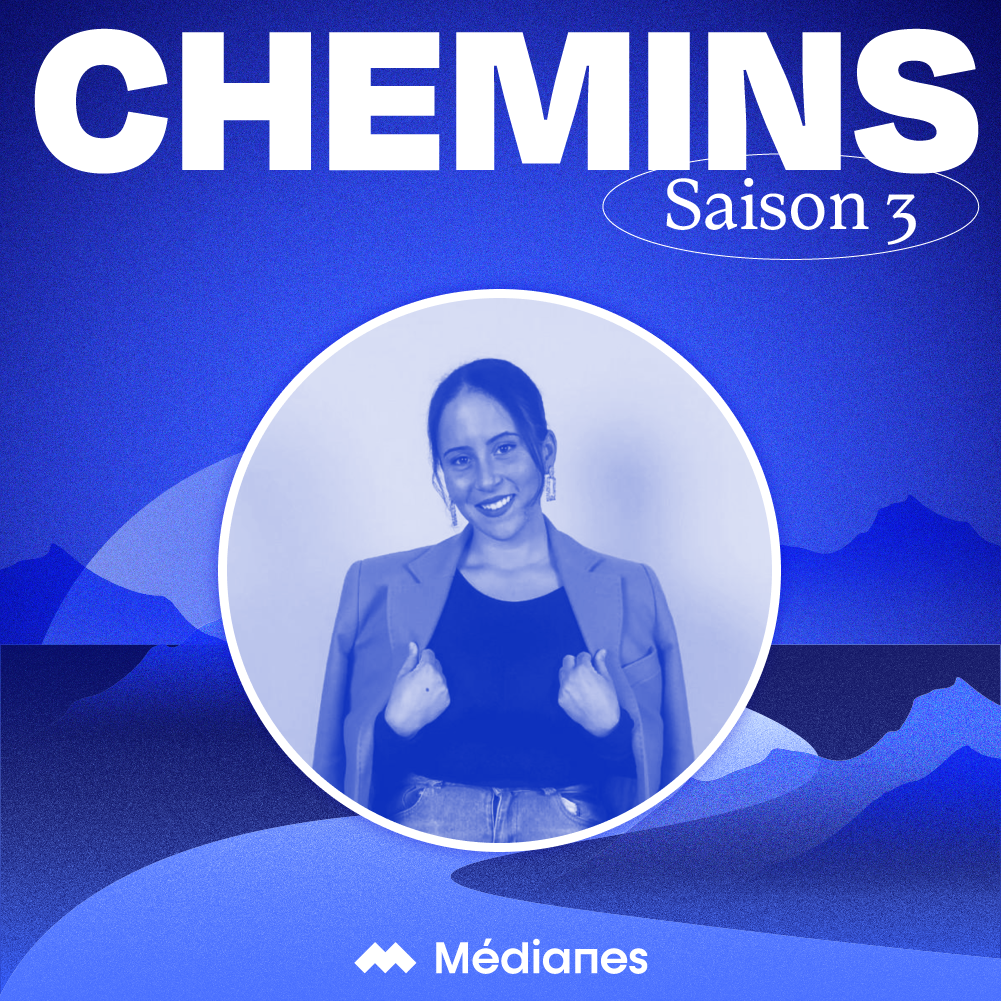
Marine Doux is a co-founder of Médianes, where she leads the editorial and marketing teams. She is a guest on this bonus episode of the third season of *Chemins*, the Médianes podcast.
Médianes is four years old. Four years of projects launched, experiments, transitions… and necessary endings. To wrap up this season of “Chemins sur les fins,” we return in this bonus episode to discuss the milestones that have marked Médianes’ journey with Marine Doux, co-founder and editorial director. Launched almost by accident, Médianes has evolved from a project among friends into a structured company, whose team doubled in size in 2024. How do you welcome new people into a close-knit collective? How do you learn to set boundaries in a company driven by commitment?
The End: A Starting Point
Médianes didn’t emerge from a carefully thought-out five-year business plan or roadmap, but rather from a specific goal and a series of circumstances. In 2020, Marine Doux and Baptiste Thevelein were working at Tank Media, a sort of incubator for emerging media outlets run by the Spintank agency. But with the COVID-19 crisis, the project came to an abrupt halt.
"Overnight, we find ourselves out of work. But above all, we're faced with one question: What do we do now?"
In the midst of the pandemic, the two of them were in lockdown with other professional friends in the industry, including artistic director Christelle Perrin, freelance journalist Manon Boquen, and photographer Benoît Michaëly. It was in a house in Brittany that the idea for two projects took shape: *Pays*, a journalistic guide to our regions, and *Médianes*, a studio (SAS) and a media organization (association) dedicated to supporting the creation and development of socially conscious media outlets. But at the outset, nothing was set in stone.
In April 2020, Pays launched with the publication of its first manifesto, ahead of a crowdfunding campaign in the fall. As for Médianes, the project began in the summer and came out of the woodwork in December 2020, when Jean Abbiateci, a journalist and newsletter expert, discovered the landing page and mentioned it on Twitter.
“Baptiste, Christelle, and I looked at each other and said, ‘Well, now we have no choice but to go for it.’”
The end of the friend group
In its early days, Médianes was built around a core group of people who already knew each other well. The founding team shared not only a passion for media but also a friendly bond that shaped the team’s dynamic. While this closeness had its advantages—a flat organizational structure and mutual trust—it also quickly raised questions. In 2021, with new members joining the team, the issue of professionalizing the project and separating personal and professional relationships became unavoidable.
“The first thing we’d say to newcomers was, ‘We don’t have to be friends.’ Looking back, that was probably the worst thing we could have said.”
The idea: avoid blurring the line between friendly relations and the work setting, and management where career advancement happens during regular informal drinks after work. But this approach could create an impression of distance and coldness, when the project culture is built on teamwork.
In this case, how can you build a healthy company culture in a context of close personal proximity?
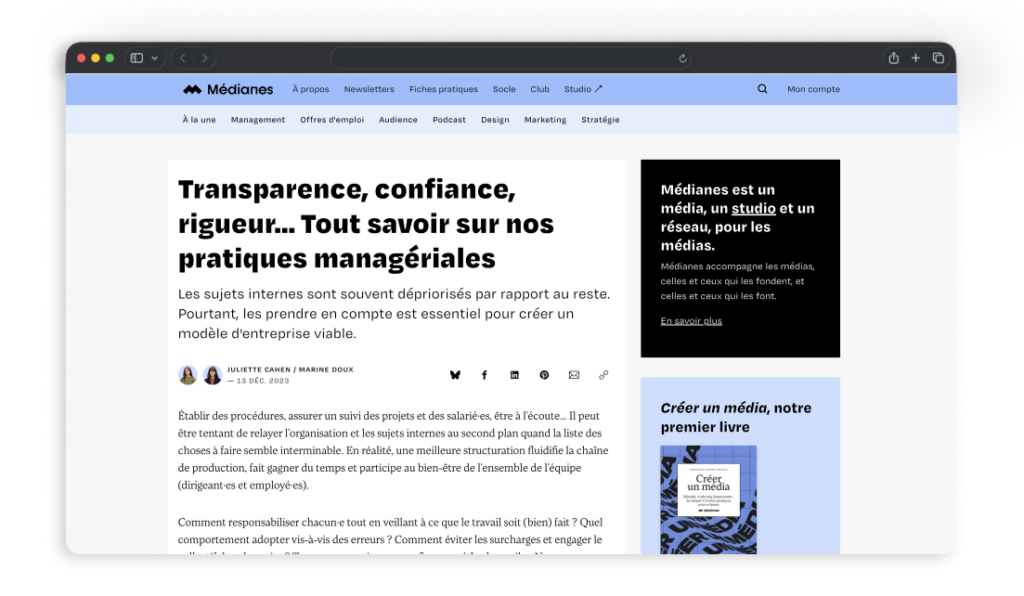
“It involves several steps: first, read a lot. Médianes, the Reuters Institute, and Spiil share a wealth of resources on management to support people starting businesses in the media. Networking also offers a great learning opportunity: it’s all about discussing these issues with other leaders. Finally, once you’re up and running, it’s very helpful to take training courses and use that time to ask all the questions you have.”
The end of the end of management
In media outlets, advocacy groups, and editorial offices, there is reluctance to discuss management. Work organization is often perceived as a constraint, even as a tool of domination, incompatible with progressive values. This approach can lead to a complete rejection of internal structuring logic in favor of an informal culture where everything seems to function spontaneously.
This phenomenon is described in Arthur Brault Moreau’s *The Left-Wing Boss Syndrome*, published by Hors d’Atteinte: the lack of a clear framework can lead to excessive workloads, poor distribution of responsibilities, and, ultimately, widespread burnout among teams.
“Since we don’t want to talk about management—because management is seen as something bad and conservative—we end up doing nothing. And we justify a certain form of exploitation in the name of the cause.”
For Marine Doux, this lack of structure can be just as harmful as authoritarian management. In a committed project, it is therefore essential to establish a sustainable work framework to prevent burnout.
“The issues we’re addressing are so important—funding for independence, pluralism, the defense of feminism… If we all end up burned out, there won’t be anyone left to defend anything.”
The end of personal attachment
Médianes was built around certain values: media independence, accessibility, social justice. These commitments, which are the reason for the project's existence, also entail a significant mental burden.
“We give our all to causes that are important to us, but if we all end up burned out, there won’t be anyone left to stand up for anything.”
The team then realizes that it is necessary to set boundaries, so as not to be overwhelmed by passion for the project.
"It's essential to treat this like a job. Otherwise, you get swept up in it and lose track of where your personal life begins."
Over time, Médianes has implemented adjustments to ensure better balance: structured working hours, a delegation culture with more equitable responsibility distribution, and a conscious effort not to bring everything back to the project, even in informal discussions. Taking care of the collective becomes both a priority and a sustainability imperative.
Besides, Marine Doux sees Médianes as a living project, meant to evolve over time. She stresses the importance of stepping back and not conflating professional commitment with absolute personal attachment.
“Médianes is what I do, but it’s not who I am. And if Médianes were to end tomorrow, that’s okay—it’s not the end of the world to say that—I know I’ll do something else. It’s important to put into perspective the fact that the project might come to an end. When things aren’t going well, it helps to remember that. It lets you take a step back.”
The end of Médianes?
In March 2024, after months of working on several projects at once—the book *Créer un média*, an event held in New York, and the co-organization of the Festival Imprimé—I reached a breaking point.
The growing number of projects and the release of the Médianes book—which compiles all the resources and practical guides produced over the past three years to launch its initiative—mark a turning point: have we reached the end of the cycle? At the same time, the team looks back and sees the projects that have taken shape thanks to their support: Vert, StreetPress, La Déferlante… all media outlets that have solidified their business models and found their audiences.
“We asked ourselves: Haven’t we run our course? Are we still useful? That was a very difficult time for me. I felt like everything was piling up and that it was time to move on. And to ask ourselves: Are we still the best people to lead this project?”
This reflection has led to in-depth internal discussions and a major effort to take stock. Should we stop? Should we reinvent ourselves? And if so, how can we increase our impact? This step back ultimately allows us to envision new possibilities for Médianes by exploring potential directions in different forms, and coincides with a development opportunity: the integration of Sphera, the European network of independent media, into Médianes—a step that broadens its horizons and strengthens its long-term viability.
“We could have become competitors, but we chose to join forces instead. Integrating the Sphera project into Médianes doesn’t change who we are, but it does amplify our impact.”
A union aimed at strengthening independent journalism in Europe, which resulted in team expansion, the arrival of a new partner and development director, Francesca Festa, and a new positioning.
"Chemins" is a podcast produced by Médianes. Season 3 is hosted by Marine Slavitch and produced by Morgan Prudhomme. The sound design is by Nicolas Peiron, and the visual design is by Christelle Perrin.