


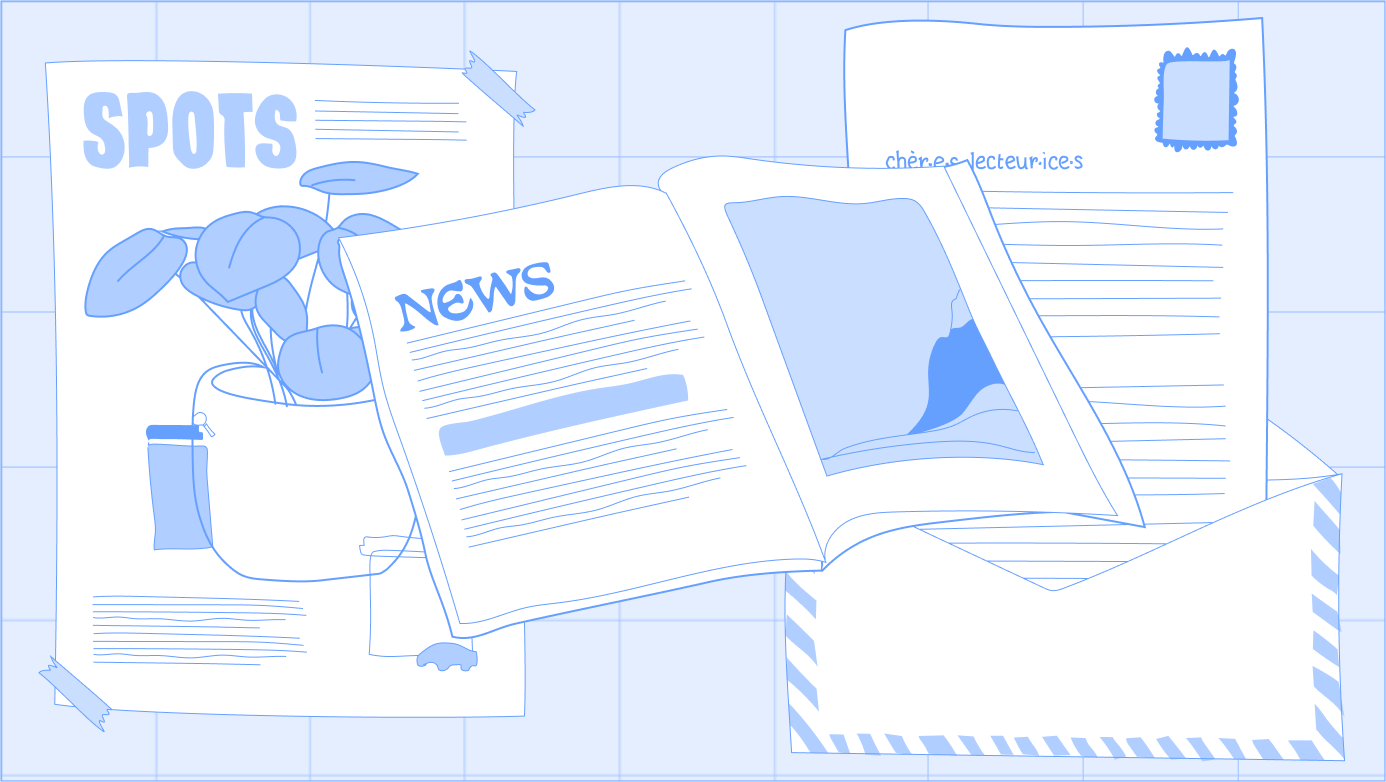
In the beginning there was paper. Before it (re)became a luxury product, it was a common and accessible commodity, firmly embedded in everyone's daily life. Then came the digital revolution. It's a whole story we won't retell here, but anyway, the Internet became the golden goose and a transformation took place.
Everywhere, and as with every new innovation, people predicted the end of paper. « […] apart from the very largest media outlets (The New York Times and The Washington Post leading the charge) and the very smallest, all other newspapers would go digital or disappear […] The United States tops the list with a predicted disappearance by 2017, France was supposed to meet the same fate in 2029 », according to Slate in 2011. The BnF, for its part, was more optimistic in 2012, announcing the end of paper media by 2040, which is cold comfort. Yet it's hard to blame them. Why venture into the complexities of the print news industry if it's possible to distribute information instantly without logistical constraints or printing and distribution costs?
Above all, this prophecy of extinction had good reason: the explosion of digital content, new consumption habits, rising costs of paper production and distribution, declining advertising revenue for print media… Everything seemed to work against print. What we failed to anticipate was that web media would themselves be outpaced by new rivals: platforms like Meta, Google and their ilk, monopolizing attention and advertising revenue at the expense of online media.
The challenge of web subscriptions rests on a different problem: monetizing content in an ecosystem shaped by a culture of free access. How do you convince internet users accustomed to unlimited, free access to information to pay for content? For media outlets, this means, on one hand, justifying subscriptions by delivering sufficient perceived value to warrant the cost, and on the other hand, educating the public about the value of journalism. Where advertising struggles with competition and scarcity, subscriptions face a cultural transformation challenge that won't be solved simply through technical or pricing adjustments, but through a redefinition of the relationship between the media and its audience.
In short, media finds itself trapped by its own choices. So what do you do when you get dumped for someone prettier, more popular, and richer? Like everyone else, you go back to your ex. Paper, that magnificent loser, suddenly becomes the most stable and reassuring option for bringing media back to the surface. Who would have predicted that after trying everything and anything, we'd return to something so uninnovative? A phenomenon reminiscent of the comeback of vinyl, of DVD box sets, or even of cassette tapes.
Today, several media outlets are choosing to relaunch their print editions to diversify their revenue streams and offer an experience that complements their digital presence. After abandoning its print edition in 2017 to focus on digital, Nylon recently decided to relaunch its print magazine. Inevitably, this reversal is less about creating a beautiful object than about generating advertising revenue, which has become too unstable online. The satirical media outlet The Onion is following the same logic, relaunching its print newspaper which it had discontinued a decade earlier.
If the return to paper is already a reality as a complement to digital, we might ask ourselves: what if we were at the dawn of a return to print as the norm?
In this scenario, paper would no longer merely support the web, but would become the central medium—the one around which other channels are built. This shift would reflect not only a reassessment of paper's value in terms of engagement and credibility, but also a recognition of its ability to capture attention in a digital-saturated media landscape, and could help media organizations (re)discover economic stability.
A few examples to help you envision
Climax, the paper for gaining legitimacy
In 2021, Climax, a paid newsletter dedicated to ecology, was launched. It has since become a free complement — and a marketing asset — to a paper fanzine funded by subscriptions, donations, and studio work. "The paper has increased interest in our offering," notes Lauren Boudard, co-founder. Here, the printed object gives the project an aura that implies it is more credible and professional. A symbolic weight that digital media struggles to match.
Monocle, paper as your entry point
At Monocle, the British magazine making its first steps in Paris this fall, everything begins with print. Deliberately absent from social media, the outlet prefers to invest in channels it fully controls. Its presence in physical retail locations thus becomes its sole storefront, making print not only a content medium, but also a key vector for capturing attention. The historic magazine founded in 2007 as well as its spin-offs (special issues, newspapers, travel guides…) thus represent an entry point to the media brand, without depending entirely on algorithms.
Green, the paper to get yourself known
So that everyone has the right data and true orders of magnitude on all ecology-related topics, the online media Vert launched its "poster library". The project consists of a series of posters containing key data on greenhouse gases, transportation, fashion, and digital technology. It's a clever strategy to reach new audiences and raise broader awareness of climate crisis issues: by choosing this format, Vert makes the information visually appealing, easy to consult, and shareable in public or private spaces, such as schools, offices, or events.
La Disparition, the paper that makes an impression
Initially, Annabelle Perrin and François de Monès — cofounders of La Disparition, an epistolary media outlet that documents what is or will soon be no more — wanted to launch a website.
— Annabelle Perrin, co-founder of La Disparition. Find the full interview in Creating a Media Outlet, our guide for those who want to start a media project.
Here, the epistolary form serves the media's purpose. That said, it doesn't preclude using the web. La Disparition also includes newsletters featuring cultural recommendations and behind-the-scenes content that helped the media build an initial community before its launch and remain an integral part of the project today.
To go further
- François de Monès and Annabelle Perrin are the co-founders of the epistolary media La Disparition. Conceived as a loss leader for their ambitious print project, their newsletter has become, despite their intentions, a part of their media.
- On TikTok, Kelsey Russell shares her passion: reading the print edition of the New York Times. Through her videos, she aims to reconcile the younger generation with print media. An initiative that hasn't gone unnoticed, particularly among media outlets.
- In this conversation, Clémentine Labrosse, cofounder of the journal Censored and trouble editions, reflects on the feminist dimension of printing, when paper becomes a tool of resistance and emancipation.
- Weight, texture, ink, grain: a series of insights from experience to help you choose your paper.
- Whether you print posters or cards occasionally to support events, or your media revolves around paper formats (magazine, newsletter, book…), the thorny question of paper always comes up eventually. Thick or thin? Textured or smooth? Bright white or warm ivory? Our Art Director Christelle Perrin helps you see things more clearly.
- We love them for their bold moves, their commitments and their aesthetics. Here are our team's favorite publications.


