


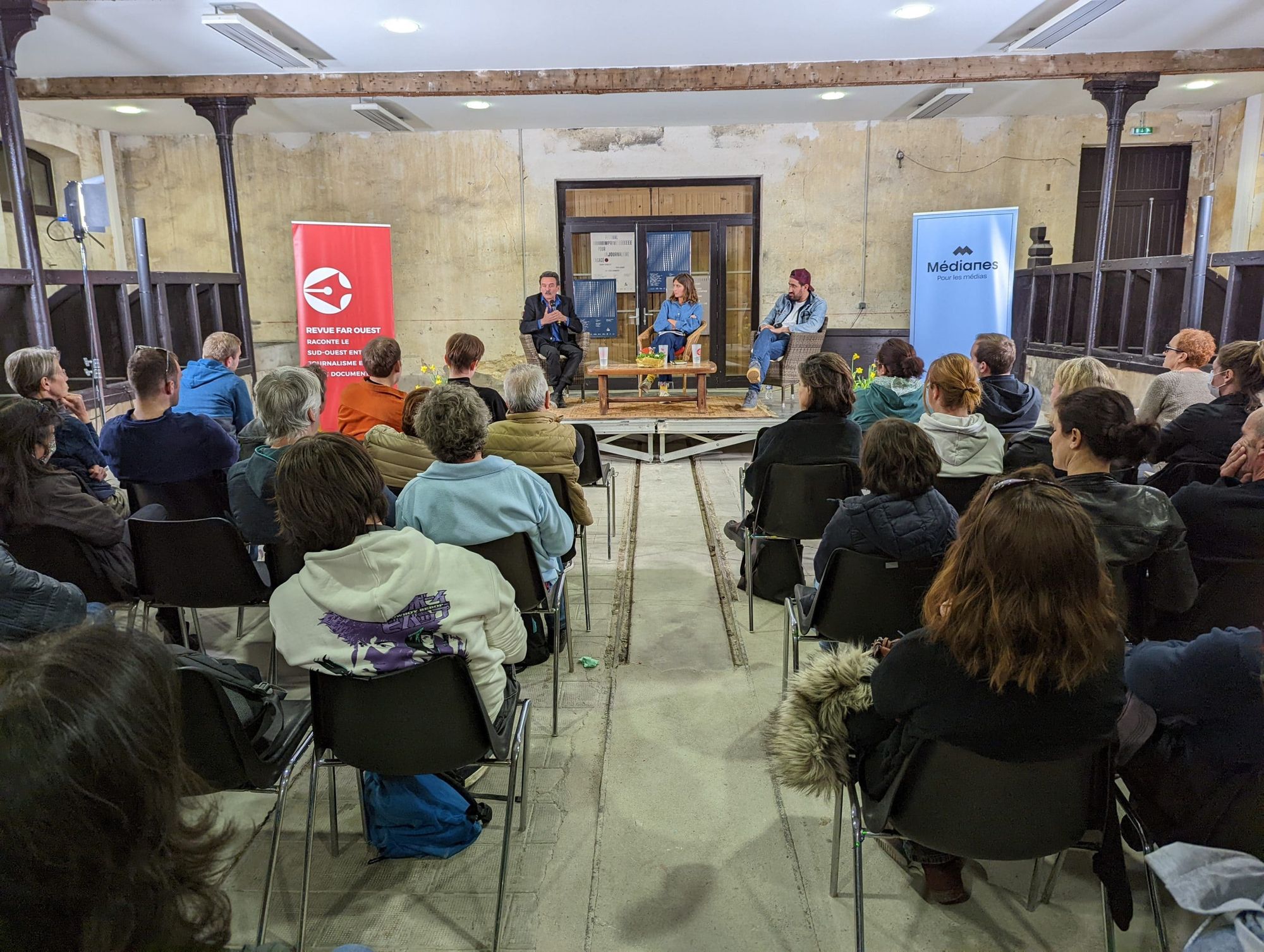
On March 26, the Festival Imprimé, organized by Médianes and Revue Far Ouest, brought together journalists, authors, and content creators at a former farmhouse near Bordeaux. What do they have in common? They all advocate for a form of journalism capable of bringing back to the forefront issues that have been sidelined by politicians—and, perhaps, by certain media outlets as well.
Ecology, feminism, social justice… With the presidential election just a few days away, we felt it was urgent to take the time to discuss these issues—which are so dear to us—with those who have made them an editorial priority. In a series of five roundtables, Médianes and Revue Far Ouest gave a platform to media outlets that champion socially conscious journalism. So how do they find ways to “imprint” these narratives on our society, in people’s minds, and on the page? Here are some insights.
Investigative Journalism: A Risky Endeavor?
Gender-based and sexual violence, corruption, matters of state: journalists investigate on the ground and bring to light the facts, actions, and mechanisms of our society. Through their writing, they challenge the established order, shed light on large-scale phenomena, and thereby transform society. “Judge,” “prosecutor”—beyond their writings, their roles are very often criticized.
That is why, on March 26, we wanted to learn more about their view of journalism and the conditions under which they do their work. When interviewed by Jean Berthelot de La Glétis, a journalist and co-founder of Podcastine, Patrick de Saint-Exupéry, co-founder of XXI and the magazine 6Mois, and series editor at Les Arènes, readily stated that “the driving force behind journalism is curiosity.” For him, a journalist is not a judge but rather a “facilitator.” Sophie Boutboul, a member of the Youpress collective who writes about sexist and sexual violence, asserts that investigative journalism cannot be learned in school, hence the importance of fieldwork: “Technical resources should not replace being on the ground.” The three guests highlighted the problems associated with media concentration and the way the media is managed by certain media moguls.
The media are described at times as a “battlefield,” a “weapon in the service of a specific agenda” (Patrick de Saint-Exupéry), or the “prime venue for internal pressure”—within non-independent newsrooms—says Pauline Bock, a journalist at Arrêt sur images. She also reaffirms the need to “cross-check sources” in order to conduct proper investigations. This task is hampered by the time required for an investigation, which, according to Patrick de Saint-Exupéry, has become a luxury: “Those who can take advantage of it are incredibly fortunate.”
And for good reason: the profession of investigative journalism is becoming increasingly precarious, especially for freelancers who have to handle their own bookkeeping (Pauline Bock) and devote a large portion of their time—unpaid, since they have no fixed salary—to legal proceedings (Sophie Boutboul).
⟶ To read the full live tweet feed from this conference, visit Médianes' Twitter account.
Ecology: Expressing the Inexpressible
Flo Laval a cofondé la Revue Far Ouest. Ce média a plusieurs ambitions, notamment celle d’échapper à la traditionnelle logique de rubriquage dans la presse, elle qui a tendance à faire d’un sujet comme l’écologie une thématique plutôt qu’un pré-requis éditorial… Alors c’est assez naturellement que pour cette seconde table ronde, Flo Laval a invité des intervenant·es à s’exprimer autour de la question suivante : « Écologie : peut-on sortir du déni ? ». Juliette Quef, présidente de Vert, Salomé Saqué, journaliste économie et politique chez Blast et Vincent Mignerot, essayiste et président d’honneur d’Adrastia — une association qui veut « anticiper et préparer le déclin de la civilisation thermo-industrielle de façon honnête, responsable et digne »—, auteur de L’Énergie du déni : Comment la transition énergétique va augmenter les émissions de CO2, se sont réuni·es autour de la table : changement climatique, pollution, catastrophes écologiques…
The signs of an ecological collapse are everywhere. Yet the threat does not seem to be taken seriously. Do we lack information? For Juliette Quef, there’s no doubt about it: journalists have significant power to effect change. The problem is the “agenda-setting effect,” which tends to steer public attention, notes Salomé Saqué, pointing out that the first part of the IPCC report was released at the same time as… Lionel Messi’s transfer to PSG.
Decisions regarding media coverage of environmental issues tend to be based on arbitrary criteria, especially when sensationalism takes precedence over involving specialized journalists in the debates. Yet “journalism is about informing citizens about matters of public interest, so that we can collectively solve the most pressing problems ,” continues the journalist from Blast. There are many reasons behind this media denial; for Vincent Mignerot, it is even the result of a demand, albeit an unconscious one: “We don’t want to ask ourselves where the things that provide our comfort come from. ” Solutions exist, argues Juliette Quef, who is advocating for journalists to build their expertise on these topics. “At Vert, we’re committed to bringing the media and citizens together around a compelling manifesto.” Promising.
⟶ To access the discussion from this second roundtable, check out our live-tweet.
Feminisms: Giving a Voice
Within the media ecosystem, the imposition of filters rooted in a largely patriarchal social context tends to stifle feminist discourse. In an interview with Amélie Coispel, a member of the organizations Médi anes and Les Inter nettes, Axelle Jah Njiké, founder of the podcast “Me My Sexe and I,” Léa Chamboncel, journalist and podcaster, author of *More Women in Politics!*, and Léa Drouelle, a journalist and co-founder of Sorocité, discussed the media coverage of feminist discourse.
The podcast is becoming a “free radio” (Léa Chamboncel), the only channel capable of providing a meaningful platform for minority voices. As a Black woman, Axelle Jah Njiké states that she “had no place anywhere else. (…) The very fact that [she] simply occupies the space is political. ” Since it offers a new outlet for expression, the podcast allows for a certain consistency between discourse and practice, as well as a focus on feminist perspectives. In this regard, Léa Drouelle laments that in the public debate, “the use of the middle dot is prohibited while the feminization of professions is encouraged.”
While Léa Chamboncel raises the issue of compensation, she takes a stand against the notion of “for-profit media.” Although she believes it is certain that journalists should be paid for their work, “a media outlet is not a traditional business.” She decided to base her funding model on listener contributions with one goal in mind: to remain independent. And being independent also means taking the risk of having one’s ideas picked up by the mainstream media. All of this happens without the content creators receiving a salary, Axelle Jah Njiké points out.
So, can new media be a game-changer? “The ‘new media’ are often new in name only. The mechanisms are old; it’s the same people behind them,” she continues. What if the strength of the feminist voice lies in its ability to politicize a personal account? “Once we start talking about it, we realize it’s a systemic issue,” says Léa Drouelle.
Visit our Twitter account to learn more about this roundtable discussion.
How can we tell the story of France?
Features, in-depth reports, surveys, editorial staff diversity… With Manon Boquen, founder and editor-in-chief of Pays magazine; François Vey, editor-in-chief of Zadig; and Inès Belgacem, deputy editor-in-chief of StreetPress, we asked ourselves whether it was possible to speak to all French people and whether there were editorial and strategic solutions for telling France’s story.
France—or the Frances, for that matter? That is the question implied by Clémence Postis, editor-in-chief of *La Revue Far Ouest*, a media outlet based in the Southwest, and moderator of this fourth roundtable discussion dedicated to the narrative of France.
People’s relationship to their local area is embedded in a system of power dynamics that can be seen on paper. At any rate, this seems to be the conclusion reached by Inès Belgacem, who, through the project led by StreetPress, advocates for the need to shine a light on those who are not spoken of, rather than the “‘experts pulled out of thin air’ (…) We’re going to give a voice to the people directly affected, who will tell us about their neighborhood and their problems—perhaps with a greater sense of reality.”
For its part, *Pays* focuses every six months on a single region, undertaking “a verbal exploration of France.” The project was born in the wake of the Yellow Vests movement, when Manon Boquen realized that the concentration of journalists in Paris was more than just a theoretical issue: “I was shocked that Parisian journalists didn’t understand what life could be like elsewhere (…) “When it comes to news coverage and representation, local journalists play a crucial role; major news organizations should also have more correspondents in the regions.”
C’est aussi pour cela que Zadig a pris le parti pris de documenter la France en dehors de l’actualité, et sous toutes ses facettes. Pour François Vey, il était urgent de raconter les histoires des Français·es « inaudibles » vivant dans une France « invisible ». C’est le travail conjoint d’écrivain·es, d’intellectuel·les, de photographes et d’illustrateur·rices qui a donné naissance à Zadig. Les illustrations sont d’ailleurs pour François Vey une manière de « se démarquer de l’ensemble de la production littéraire et journalistique qu’on peut trouver en librairie ». On en prend bonne note.
You can find the highlights of the roundtable discussion on our Twitter account.
The Future of the Left: Rejecting the Status Quo?
To conclude this first edition of the Festival Imprimé, it seemed necessary to reflect on the motivations that led to the organization of such an event. On March 26, we explored the profession of journalism, the profession that governs activities related to the production of information and a right belonging to every single person: the right to know and to have access to knowledge.
For Edwy Plenel, president and co-founder of Mediapart, this right is undoubtedly more important than the right to vote. But in a few weeks, will it still be possible to defend committed journalism? That is the question posed by Annabelle Perrin, co-founder of La Disparition, a media outlet that chronicles the disappearances currently taking place in our world. Who better to examine the disappearance of the left?
On the air, Edwy Plenel engaged in a debate with Rachid Laïreche, a political journalist at *Libération*, about the left and its future: ideals, values, causes, political parties… What remains of all that? For Rachid Laïreche, “today’s Left is a Left that wants to please the Right.” Edwy Plenel, for his part, seems to believe in building a new vision: “The Left will not disapear, for it is a permanent movement for emancipation, driven by rights.” If it is as Richard Laïreche depicts it—"a serious and orderly Left that tends to forget itself"—shouldn’t the critical role of the media be restored now more than ever? Tomorrow, how will the issue of journalistic neutrality be addressed? “We don’t ask journalists to think politically correctly, but to report while challenging their own views.” And that’s from Edwy Plenel, of course.
To see the highlights of the debate, click here.


