I started my studies in object design, where every project begins by identifying a need. This design methodology guides our graphic design practice today, prioritizing the interests of readers rather than following trends or pursuing personal preferences.
- We believe that design should serve readability, clarity, and accessibility;
- We believe that design should be consistent with the medium it represents and the people it aims to reach;
- We believe that design must take the project context into account, and be technically and financially feasible.
Form in service of substance
In our experience, graphic design education often emphasizes concept and originality of approach, without considering the people for whom the work would be intended. This approach can lead to unsuitable choices: colors inappropriate for print, beautiful but hard-to-read typefaces, or website interfaces that look great but are difficult to use.
These creations, which may be aesthetically brilliant, risk excluding or frustrating their audience. We aspire instead to inclusive, ecological, feminist, queer design — design grounded in genuine care for others, in what graphic design can mean, in economy of means, and in humility.
We advocate for graphic forms that, far from any ostentation, remain clear, simple, and coherent, with the aim of prioritizing content rather than complicating its accessibility.
Consistent and tailored design
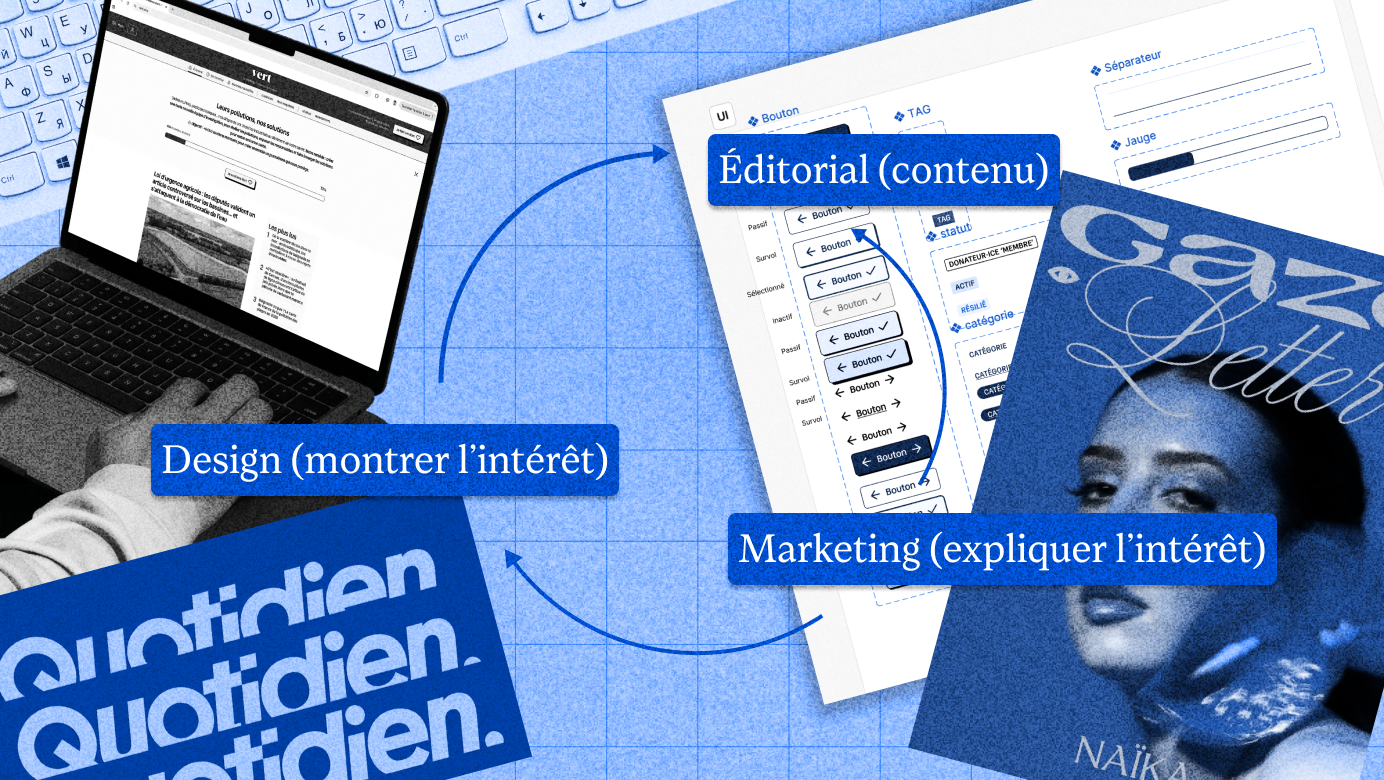
At Médianes, we believe that to exist sustainably and responsibly, independent media benefit from building a strong connection with their audience, particularly by investing in thoughtful graphic design. For us, graphic design isn't merely a surface element, but a strategic lever integrated from the media's inception, creating resonance between substance and form by conveying initial information about the type of media you're encountering, its tone, and who it's meant for. This visual identity can be regularly reassessed to reflect the media's evolution and the changing needs of its audience.
Why? Because no matter how rich the media content is, if no one feels drawn to the media or doesn't get close enough to read the content, we won't be able to tell whether the substance is good or not.
Our approach
We adapt our ideas to the specific needs of each project: every design assignment must account for the sensitivities of the medium and its audience, while being aligned with the project's stage of development and realistic budget.
To create a visual identity, we seek to understand the media, its audience, its vision and its positioning. Is it revolutionary media? Playful? Is it media about ecology, parenting, cooking, travel? We then situate each project within a graphic context: does it draw inspiration from current trends, or does it prefer to stand apart to assert its uniqueness?
We can also build on an existing artistic direction, whether to expand it, adapt it to a new medium (from print to web, for example), or update it.
For website creation, we focus on simplifying user journeys and select typefaces and colors that make content hierarchy clear and easy to read on screen, while ensuring accessibility for all.
One of our objectives, where relevant, is to make our clients more independent by using tools that make it easier for non-designers to use, while allowing us to establish precise templates. We also promote building sites through visual editors rather than hard-coded markup. We can also establish design rules and guidelines, and provide practical advice.
To ensure smooth collaboration, we organize regular progress check-ins, can propose multiple creative approaches, and refine the one that gains the most support.
In parallel, we invest in training and information: we organize workshops and training programs, we publish articles and newsletters to share best practices and insights.
To go further
- What's the point of a strong, cohesive visual identity? What matters most in an art direction? Read our interview with Thomas Steffen and me, designers for media.
- Bold text is often used as a crutch to fix text that’s too long or unclear. Learn why we recommend simplifying formatting.
- Needs, values, atmosphere, support, format: how to brief a graphic designer ?
- Lowercase, spacing, italics, cursive… We're taking you on a dive into the typographic lexicon.
- And besides, how do you choose the font for your project?
- Looking for visual inspiration? Resource collection