


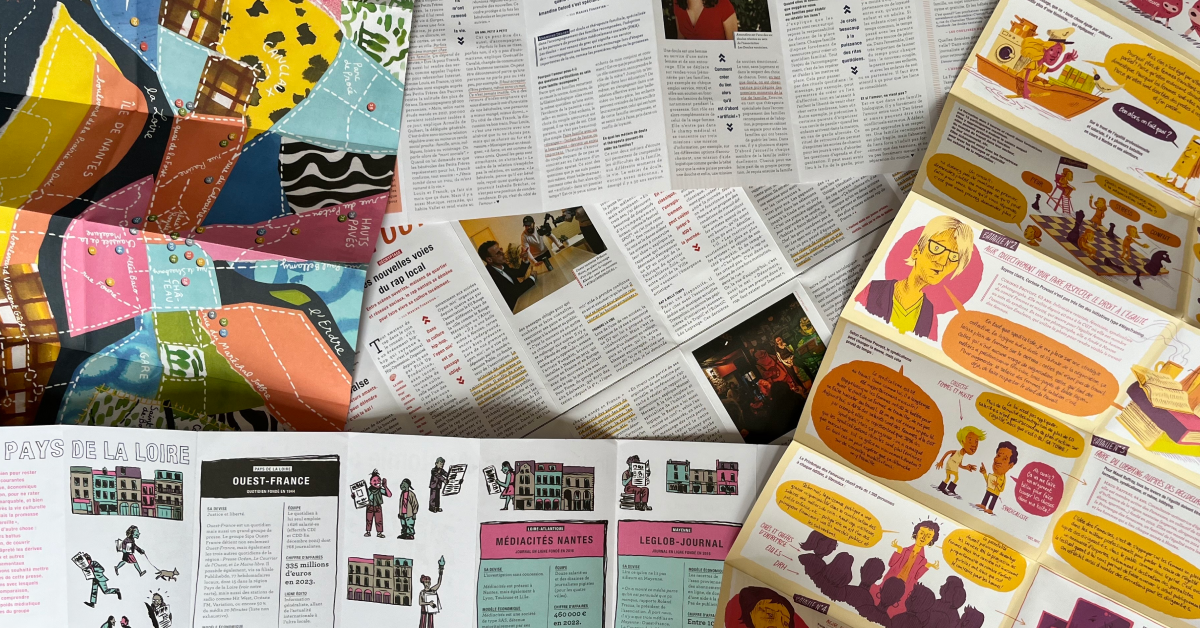
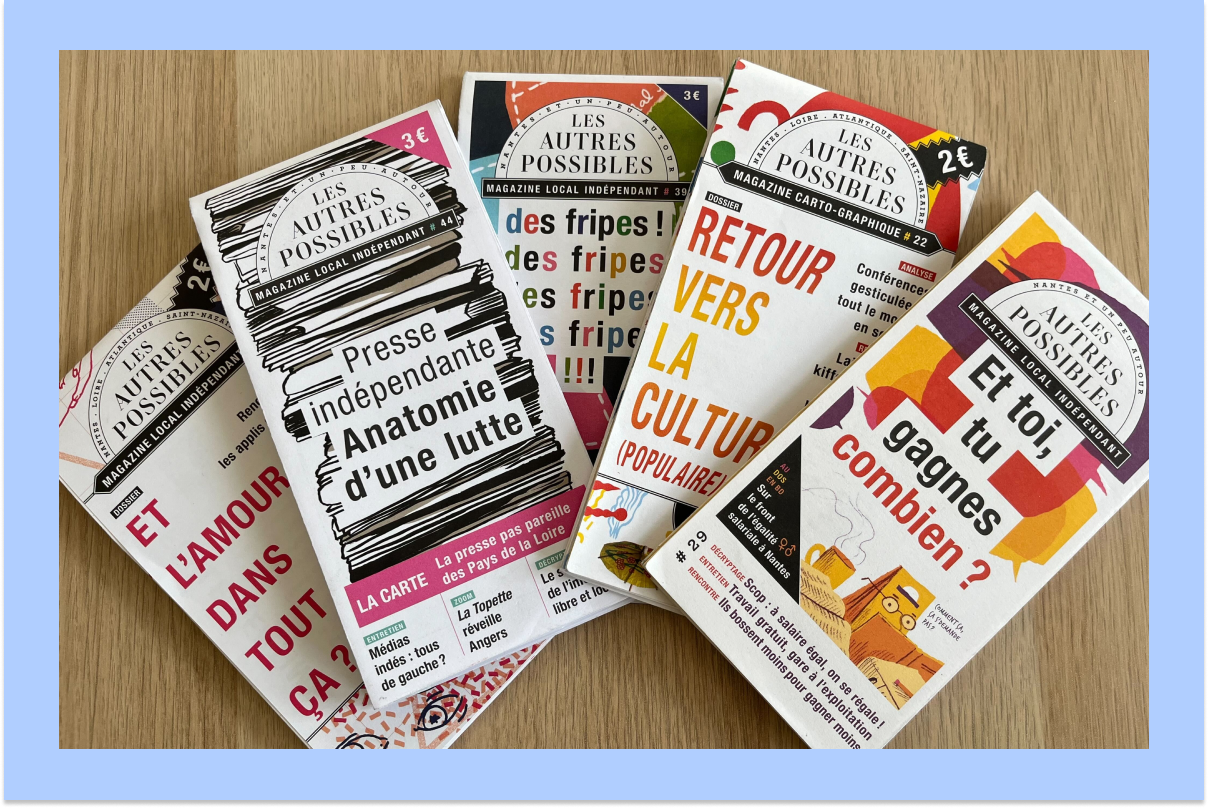
The Nantes-based media outlet Les Autres Possibles has been around for eight years. Over those eight years, I've occasionally come across information about this curious fold-out magazine, though I never really paid much attention, being neither from Nantes nor naturally drawn to road maps. So I decided to explore it when the latest issue came out, devoted, and I'll give you three guesses, to independent press. I went to their website intending to buy that one copy, and that one copy only, but then I felt guilty about having a three-euro map shipped to me – about supporting a local media outlet with just three euros, that is. I dug through the site's archives and ended up selecting five issues of Autres Possibles covering my favorite topics: independent press, of course, popular culture, love, fashion, and money.
Once the object — not yet unfolded — is in my hands, I gather initial information about the project from a small paragraph on the back. « Les Autres Possibles, a structure run by six employees and an association board who work to produce independent and local information through its publications and offer media education workshops. » I also learn at the bottom of the page that the media outlet has three co-founders; Marie Bertin, Jeanne La Prairie and Camille Van Haecke, and that the object is a bimonthly publication printed in three thousand copies.
Two-sided
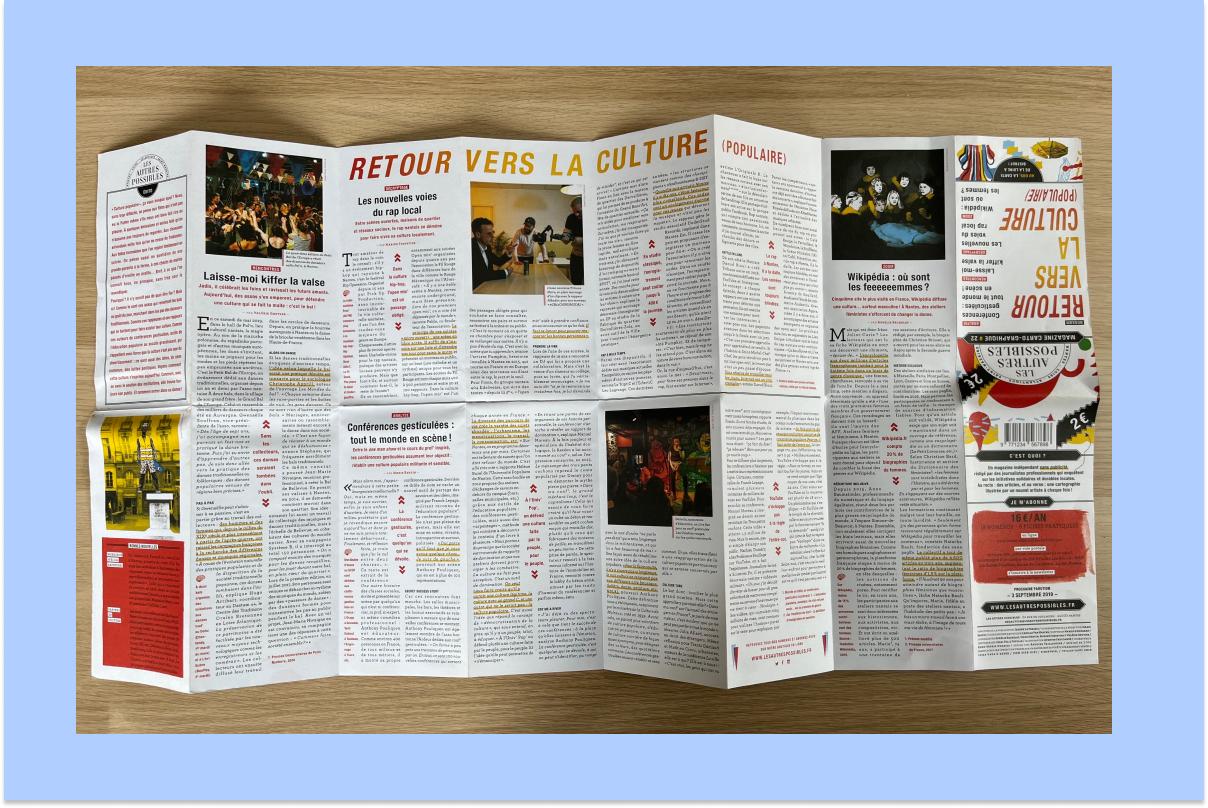
Concretely, what do you find in this road map that isn't one? First, as you've probably figured out, each issue has its own theme. On the front, different formats — reportages, interviews, conversations, explainers, portraits — find their place in a layout similar to that of traditional news publications, with headlines, opinion sections and sub-sections. Information is hierarchized and organized into sections (the feature, the editorial, reader mail, reading guides…), in short, visually, it's fairly conventional. It's on the back that the magazine stands out. This part, more surprising and cartographic, "makes it possible to explore another way of staying informed: infographics, practical location information, data journalism, personal accounts, how-to guides… ", the team clarifies in its manifesto.
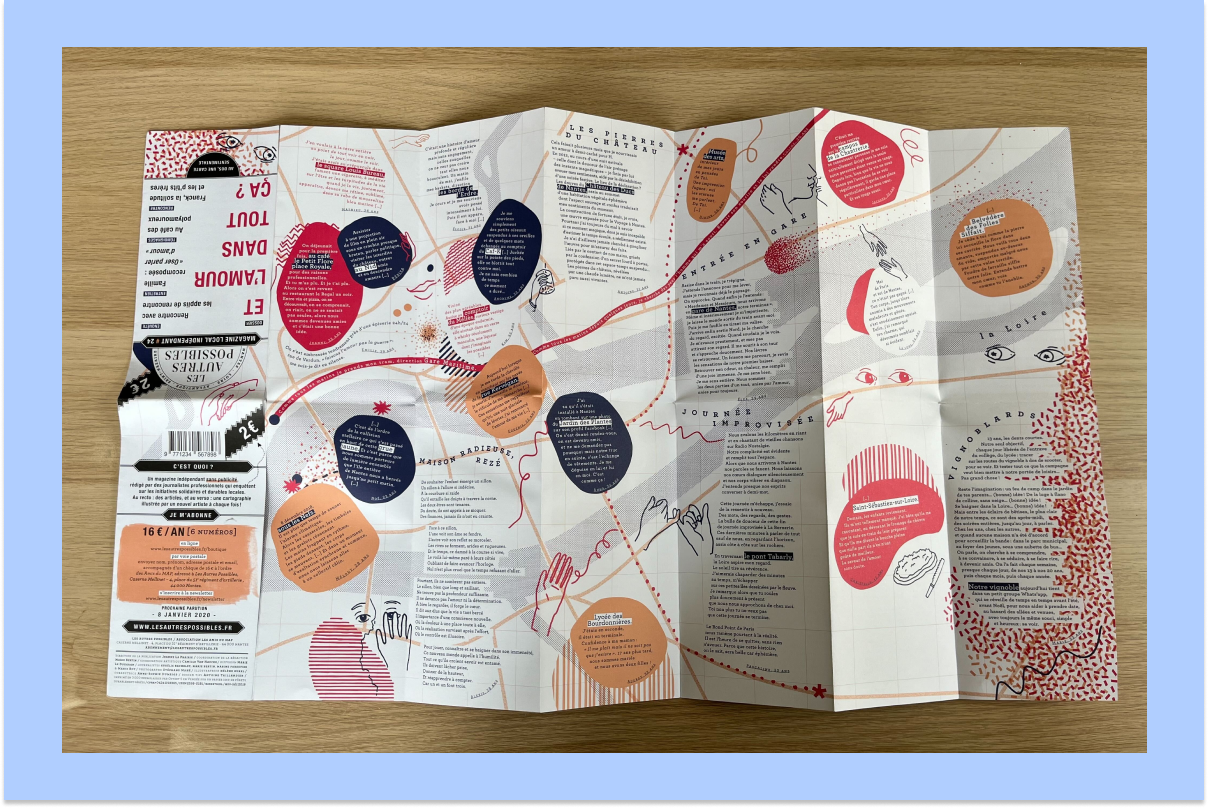
I like the idea that several forms of journalism can coexist on the same sheet of paper. On the front, classic formats to analyze a subject and on the back, something freer that allows for graphic creativity and gives space to more original stories. For example, the issue devoted to love invites readers to use the back to tell their love-at-first-sight stories across different places in Nantes.
"I was sitting in the dusk in Louis Bureau Square, smoking a cigarette and meditating on life and its depravities when I saw her, right then, appear before my eyes, sublime, in her navy blue muslin dress", Mathieu tells it. Near him, Émilie recalls a first kiss that happened "near a 24-hour grocery on rue de Verdun", while Didier prefers to remember this visit to the Museum of Arts, where he once had the impression that the statues were all speaking to him about a certain "You".
This made me think of that quote from The Spanish Apartment. « When you arrive in a city, you see streets stretching out before you. Sequences of buildings empty of meaning. Everything is unknown, untouched. And then later you'll have walked those streets, reached the end of those perspectives, come to know those buildings, lived stories with people there. » I love the idea that a local media outlet can tell the most intimate experiences of a city's residents; how some, perhaps, were able to cross paths, live one thing on this street, something else in that place. It's simple but beautiful, and it tells us a lot about our attachment to places. As for me, it's often an intimate hook that makes me want to look into a subject or not.
Of course, format also plays a role. Let's acknowledge that this layout offers a particularly immersive and engaging reading experience. The articles, arranged side by side, provide a visual overview where readers can sample different topics and read what interests them first. Here, each person chooses their own reading path, which encourages exploration and curiosity compared to more linear experiences. I also have the sense that this format creates a connection between the contents, how they complement and respond to each other. A good way to explore all the facets of the chosen theme.
Two or three euros
Let's now turn to the price of Autres Possibles. It comes to three euros. A road map costs much more. For reference, the one Michelin offers for Nantes costs 6.5 euros, and if you head to Le Vieux Campeur, you're looking at nearly ten euros. We can also compare this price to that of 1, Eric Fottorino's weekly publication that covers a single topic per issue in a folded format. So Le 1, in newsstands, is four euros. There we have it. I did do some research to understand how Les Autres Possibles justifies its per-issue price, which struck me as quite low right away. On May 2, 2022, the team published a blog post to explain that the magazine would be increasing by one euro due to rising paper costs. And indeed, when I look at the older copies I acquired, some of them list a price of two euros.
So that's for the paper publication, the star of the project. And because two or three euros aren't enough to fund a magazine of this type, parallel activities like media education and strategic and creative services allow the team to make ends meet. I could list all the projects carried out by the organization since its creation, as Les Autres Possibles demonstrates transparency on this matter. Each year, the media publishes an activity report that outlines these activities and the health of the project or lack thereof. It also details the organization's revenue evolution year after year, the breakdown of revenue by activity, that of turnover and expenses as well as the various expense categories.
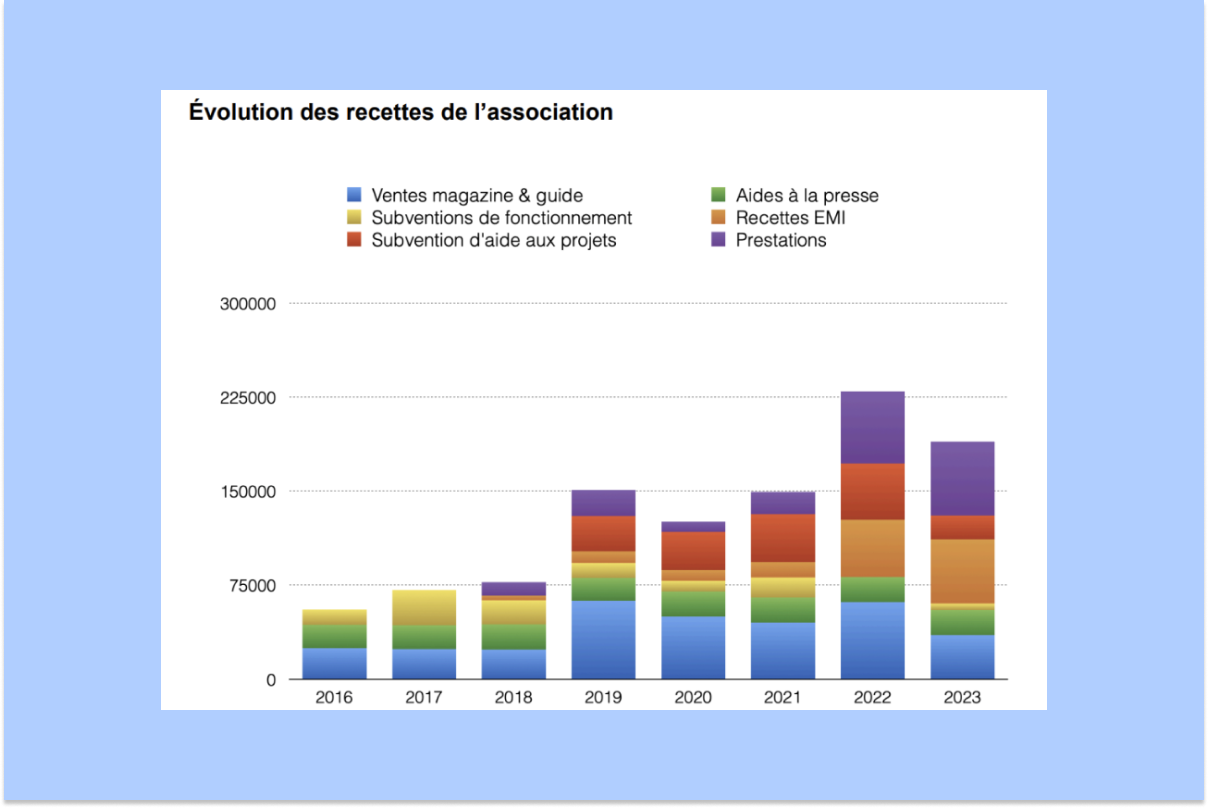
Next year, a new line will be added to these charts: it will concern revenues from donations. « Facing recurring cash flow difficulties linked to the health crisis and then the economic crisis, the association made the decision to launch a donation campaign to ensure greater peace of mind in 2024 », according to the latest report. The team hoped to collect 15,000 euros in donations by December 31, 2023 to continue its work with peace of mind. To date, 237 people have donated to Autres Possibles, for a total of 14,400 euros.
A committed news outlet
On its various presentation pages, Les Autres Possibles explains its desire to offer "local, solidarity-based and sustainable solutions" in response to social challenges. In 2021, the magazine even received the Solutions Journalism Innovation Prize from the NGO Reporters d'espoirs. What I find rather appealing about this media outlet is that it doesn't wield solutions journalism as its sole editorial and commercial argument. I would be more inclined to describe it as an engaged media.
I tend to be somewhat skeptical of media outlets that claim to practice "solutions journalism" because I'm not convinced this editorial approach is sufficient on its own. For me, solutions journalism is inherently built into any media that takes a genuine stance on feminism, ecology, and social justice. No one questions whether StreetPress or La Déferlante are doing solutions journalism. It seems to me that this pursuit is more of a value than a technique, much like gonzo journalism, which involves doing immersive reportage by writing in the first person. And it strikes me as a rather convenient label behind which even a completely uncommitted media outlet can hide, when these issues can easily be addressed across every story in a cross-cutting way.
The reason is that beautiful words aren't just window dressing. It's a media outlet co-founded by women that practices equal pay, advocates for inclusive language, and doesn't erase women's experiences from its pages. It's a printed magazine « on paper from sustainably managed forests » that addresses environmental issues in every issue, even when that's not the main topic. It's a transparent company that regularly reports to its readers. I'm not sure, ultimately, whether it's truly a local media outlet. Let's say it's a media outlet that offers local solutions to major social issues. If I wouldn't read Presse Océan in Paris, I'd be happy to subscribe to Autres Possibles, because its reach goes far beyond local proximity.
In its issue dedicated to independent press, the team announces a change. This issue will likely be the last one that can be unfolded. The reason? Les Autres Possibles wants to develop an economic model " in which the media lives solely from magazine sales ". So what can we expect? I would bet on a biannual review, with each issue funded through a crowdfunding campaign, somewhat along the same model as the Pays review. Only time will tell, but I'll miss this format.
To go further
- Last month, Maëlle Ledu, a graphic designer at Médianes, chose the independent British magazine It's Freezing in LA! as media of the month and you can read her column here, which focuses heavily on design.
- Love at first sight, breakups and compromises. Natalie Thiriez tells us the story of a close but tumultuous relationship between Le 1 and its paper.
- Out of ideas? Panicking to find inspiration? Here are some resource suggestions to enrich your visual culture, whether for publishing, communication campaigns, typography, or color.
- Weight, texture, ink, finish: a series of practical insights to help you choose your paper.
- Printing means paper stock. What elements change from one type of paper to another? What impact does this have? We present practical cases.


