


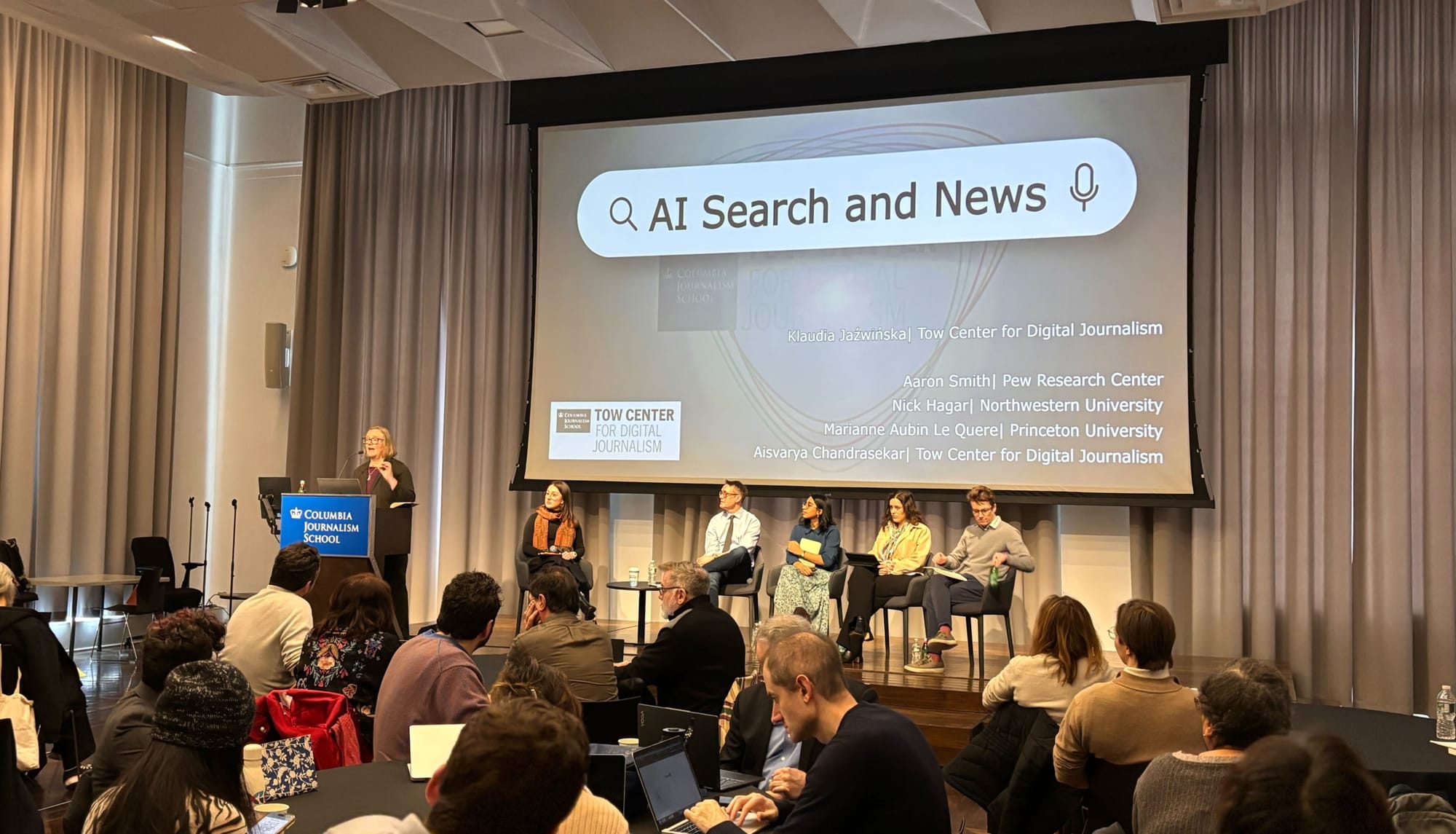
Researchers working on the links between artificial intelligence and journalism are highlighting a striking tension: people who use chatbots like ChatGPT or synthesis tools such as Google's "AI Overview" boxes to get information seem to prefer these tools to consulting articles directly, while being aware of their limitations in terms of accuracy.
"They know that the answers they get are not perfect," explains Nick Hagar, postdoctoral researcher with Northwestern University's Generative AI in the Newsroom (GAIN) initiative, presenting recent work at a Tow Center panel focused on AI, research, and news. "But it's so convenient to be able to quickly ask a question, let the AI do the research, and then get a synthesized and clear answer that, for many people, the tradeoff is worth it in most cases."
According to Nick Hagar, all twenty study participants reported preferring to use AI rather than visiting a news organization's website directly to find information. Participants describe these platforms as more convenient, perceived as less biased, and more effective at providing information they consider more comprehensive. Findings that align with those from a study conducted by the Center for News, Technology, and Innovation (CNTI), based on fifty-three interviews, where participants particularly value chatbots' ability to tailor responses to their needs.
These two studies are based on limited, restricted samples, however, and their results cannot be generalized to all news audiences. Nevertheless, it is notable that two independently conducted studies reach such similar conclusions. Both also show that audiences prefer AI tools for getting information because they offer a smoother experience than many news publisher websites, which are often cluttered with ads, paywalls, and information overload. Users also appreciate having control over how they receive information: they can ask follow-up questions, challenge certain ideas, or request context—something news articles do not always allow.
Yet this sense of simplicity and control can be misleading. Last year, the European Broadcasting Union published a guide detailing the main ways AI-generated content can distort information: confusion or fabrication of facts, omission of essential context, blending opinion with fact, or reliance on incomplete or unsuitable sources. AI systems also struggle to distinguish between types of sources. In his research, Nick Hagar observes that models sometimes interpret information very differently from a journalist. Unlike someone trained in journalism, an AI model is "not really able to distinguish between levels of expertise, reliability or credibility among these sources," he explains. "It tends to flatten everything onto the same level."
Even when audiences are cautious about the accuracy of chatbots, certain signals can strengthen their confidence, notably the assertive tone of responses. Research from the Tow Center shows that AI systems tend not to sufficiently qualify their responses: they can appear confident when they are false, or hesitant when they are accurate. Nick Hagar and his colleagues observed similar results.
The presence of citations from recognized media outlets also plays a role in how credibility is perceived. In the GAIN study, participants reported identifying sources like the New York Times or CNN as shortcuts for assessing credibility, often without clicking on the links. "Some explicitly told us: 'It's transitive property. I trust CNN, so I can trust what this AI is telling me,'" reports Nick Hagar. But these citations are not always reliable indicators. In the experiment conducted by the Tow Center, we observed that chatbots sometimes attributed citations incorrectly, fabricated links, or directed users to republished or copied versions of articles rather than to their original versions.
More broadly, the usefulness of AI-generated responses depends on the information environment they rely on. Another study presented during the panel, conducted by Marianne Aubin Le Quéré, a postdoctoral researcher at Princeton University's Center for Information Technology Policy, shows that queries about information deserts — for example, asking about local crime statistics — produce shorter and less accurate answers in Google AI Overview summaries, drawing mainly on databases and aggregators. The data is not necessarily false, but it reflects the absence of local news coverage.
Meanwhile, the volume of articles accessible to AI systems is shrinking, as many publishers are seeking to block AI crawlers (indexing bots) for fear of unauthorized uses or distortion of their content. Readers don't always realize that the information returned to them is incomplete.
The good news is that audiences don't rely on AI indiscriminately. Nick Hagar points out that study participants mainly use chatbots to quickly get their bearings on a topic, while continuing to turn to established media for in-depth research or sensitive subjects. Other research also suggests that convenience hasn't replaced the need for human-produced journalism: according to the CNTI study, respondents view chatbots as information supplements, not substitutes for reporting work. A Reuters Institute report published last fall identifies what it calls a "comfort gap" between news content produced by AI and by humans: on average, only 12% of respondents said they were comfortable with journalism "entirely generated by AI".
During the panel, Marianne Aubin Le Quéré nevertheless emphasized that access to information via chatbots could eventually benefit audiences, particularly younger people, who are often overwhelmed by the volume and negative tone of news, provided that these tools are designed responsibly. For now, the technology is still far from being able to serve as a primary gateway to information.
But one lesson already stands out for publishers: if access to information is simple, fast and understandable, the public will embrace it.


