🔎 Étapes, ressources, conseils… Cette fiche pratique est conçue par le studio Médianes, qui accompagne depuis 2020 les fondateur·rices de médias dans la conception, la structuration et la diffusion de newsletters fidèles à leur projet éditorial. Envie d’aller plus loin ou besoin d’un accompagnement ? Découvrez notre expertise ou contactez-nous via ce formulaire.
1. La newsletter : de quoi parle-t-on ?
A newsletter is an editorial product that takes the form of an email. Its objectives vary depending on the media project and the importance given to it.
A newsletter can be viewed as a way to strengthen your connection with a community, build reader loyalty, reinforce a commercial strategy, share behind-the-scenes stories of a project, generate subscriptions (directly or indirectly), etc.
Au-delà d’être un produit d’appel, la newsletter peut être aussi le support principal d’un média ou la marque de fabrique d’un projet comme c’est le cas pour le média destiné aux professionnel·les Axios qui en compte une vingtaine, ou pour le média sur l’écologie Vert, accompagné par Médianes, le studio.
Zoom sur Quoi de mum?
Une newsletter peut aussi bien être un produit éditorial qu’un média à part entière. C’est le cas de Quoi de mum?, une newsletter bimensuelle, lancée en 2025, qui vise à libérer la parole sur la parentalité. Après 18 mois d’existence, Quoi de mum? compte 6300 abonné·es.

2. Se poser les bonnes questions
Cibles, positionnement, proposition de valeur, modèle économique… pour poser les bases d’un nouveau produit éditorial comme une newsletter, vous pouvez suivre notre méthode pour créer un média pas à pas.
Vous êtes déjà à l’aise avec cette méthode ? Vous la découvrez ? Cela tombe bien, nous allons vous guider pas à pas, via une série de questions essentielles pour développer votre newsletter. Alors avant de vous lancer dans la conception de votre newsletter, revenez aux questions de base :
- Pourquoi : quel(s) besoin(s) avez-vous identifié ? quel format, sujet ?
- À qui : pour quels publics ? à qui souhaitez-vous rendre service ? vous adresser ?
- Comment : quelle stratégie pour votre média ? quelle animation ? quel temps mobiliser ? quelle(s) source(s) de monétisation ?
- Quels objectifs : fédérer une audience ? fidéliser une communauté ? vendre des produits ?
Question 1 — Quels publics visez-vous ?
Who do you want to serve with this product? To get started on this project, it's essential that you've already identified and defined your audiences beforehand. It's certainly important to know who your media is intended for (a step required from the maturation of your media project onwards), but also which target audience your newsletter primarily addresses. If you already have a newsletter and want to optimize it, ask yourself for example whether you can name 10 of your subscribers, or whether you're able to describe your core audience and secondary audience. Working on the practices, habits, and consumption patterns of your target audiences will help you design your product better from an editorial perspective, and will also help you determine when and how to distribute it.
🖇️ Pour vous guider sur le sujet des cibles, nous avons créé une fiche pratique pour définir vos personae.
Question 2 — Où cette audience se trouve-t-elle ?
Where does she get her information? By identifying the platforms and moments when consumption happens, you'll be able to test your project against reality — you'll know whether you're making the right choice by offering this format (imagine discovering that your target audience largely doesn't use email!) — but also which channels to invest in to distribute it. Similarly, understanding what your target audiences read and listen to will help you identify what you can offer beyond your competitors (consider both direct competitors — newsletters sent in the time slot you're considering, for example — and thematic competitors).
Zoom sur Médianes
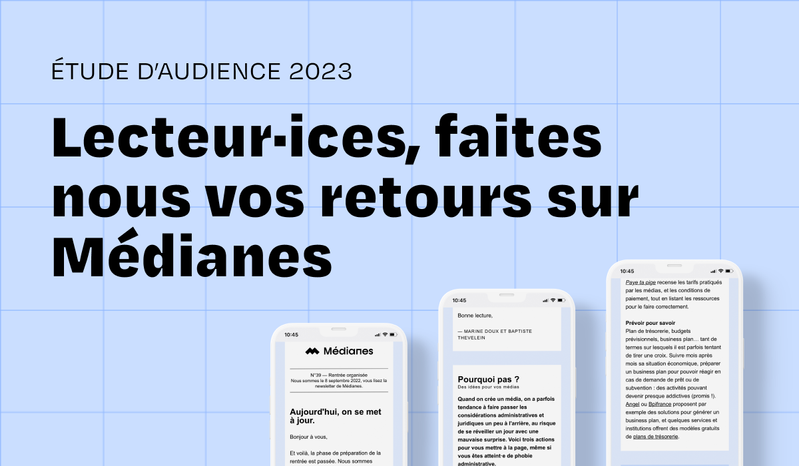
To learn more about our own audience (you 👀), and especially that of our newsletters, we conduct an audience study every year, such as this one in 2023. A way for us to understand the uses and habits of our audience: media founders, media leaders, marketing, product, and technical managers at established media organizations, and journalism school students.
If this subject interests you, we've shared a practical guide for conducting an audience study, with many examples.
Question 3 — À quel(s) besoin(s) votre newsletter va-t-elle répondre ?
What does your audience expect from a newsletter like yours? Now that you've identified your targets, ask yourself what benefits they can get from reading your newsletter: what are your audiences' expectations? Industry updates, advice, best practices, recommendations… what kind of content would they like to take away? What do they need?
Question 4 — Quel est le lien entre le contenu de cette newsletter et le contenu disponible sur d’autres supports ?
What will be this newsletter's place in our ecosystem? Is your newsletter designed as your flagship editorial product or does it complement another product? Do you have social networks to promote it?
This is the moment to lay out the pieces of your production and distribution strategy — the goal is to identify the points of contact between your content, your audiences, and your newsletter. Ask yourself how you plan to integrate your newsletter into your overall communication strategy — to do this, you must have thought through the templates of your various editorial products, meaning you must have established both the editorial and economic model of your project.
For example, a dedicated post on LinkedIn — does it plan to highlight a key article from the newsletter, or a special section? On Instagram, are the formats meant to be featured in stories, rather than posts?
🖇️ Nous vous renvoyons vers notre fiche consacrée à ce sujet pour construire le canevas de votre newsletter.
Case study with La Disparition
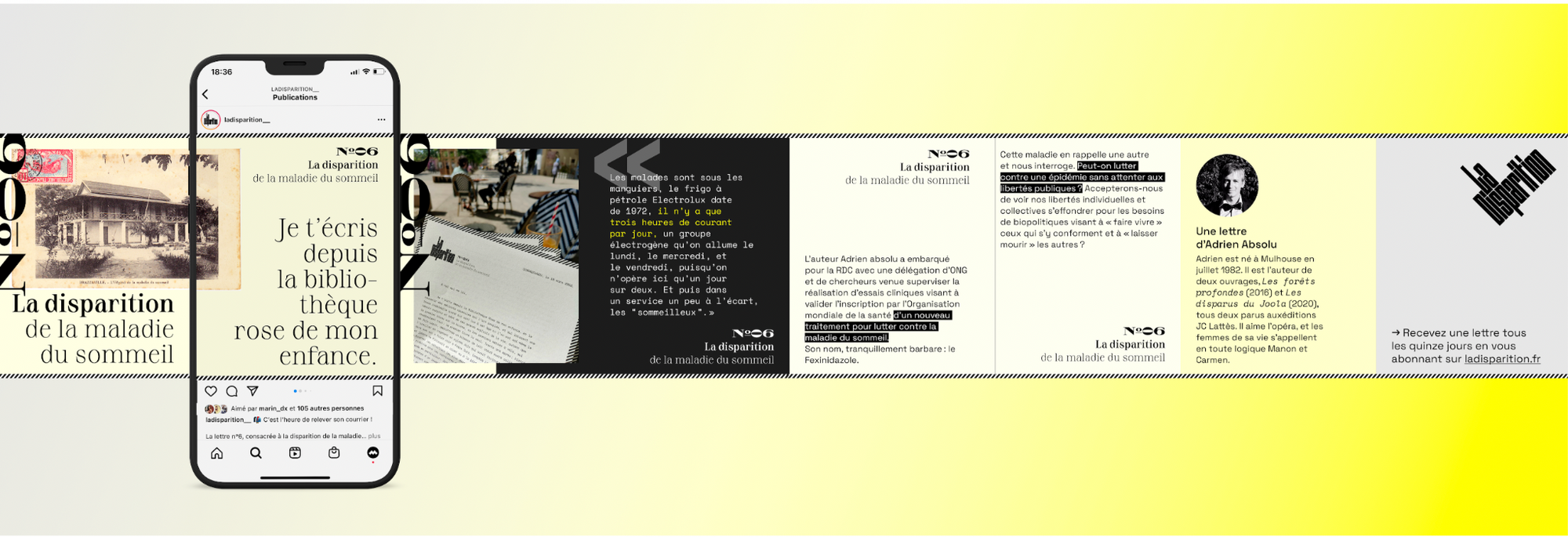
The epistolary media La Disparition — supported by the Médianes studio — chose for example to create carousels dedicated to the newsletter on Instagram: a good way to display its editorial markers and create desire.
And to learn more about the role of the newsletter in the strategy of La Disparition, you can read the interview with its co-founders François de Monès and Annabelle Perrin on our site.
Case study with Arrêt sur images
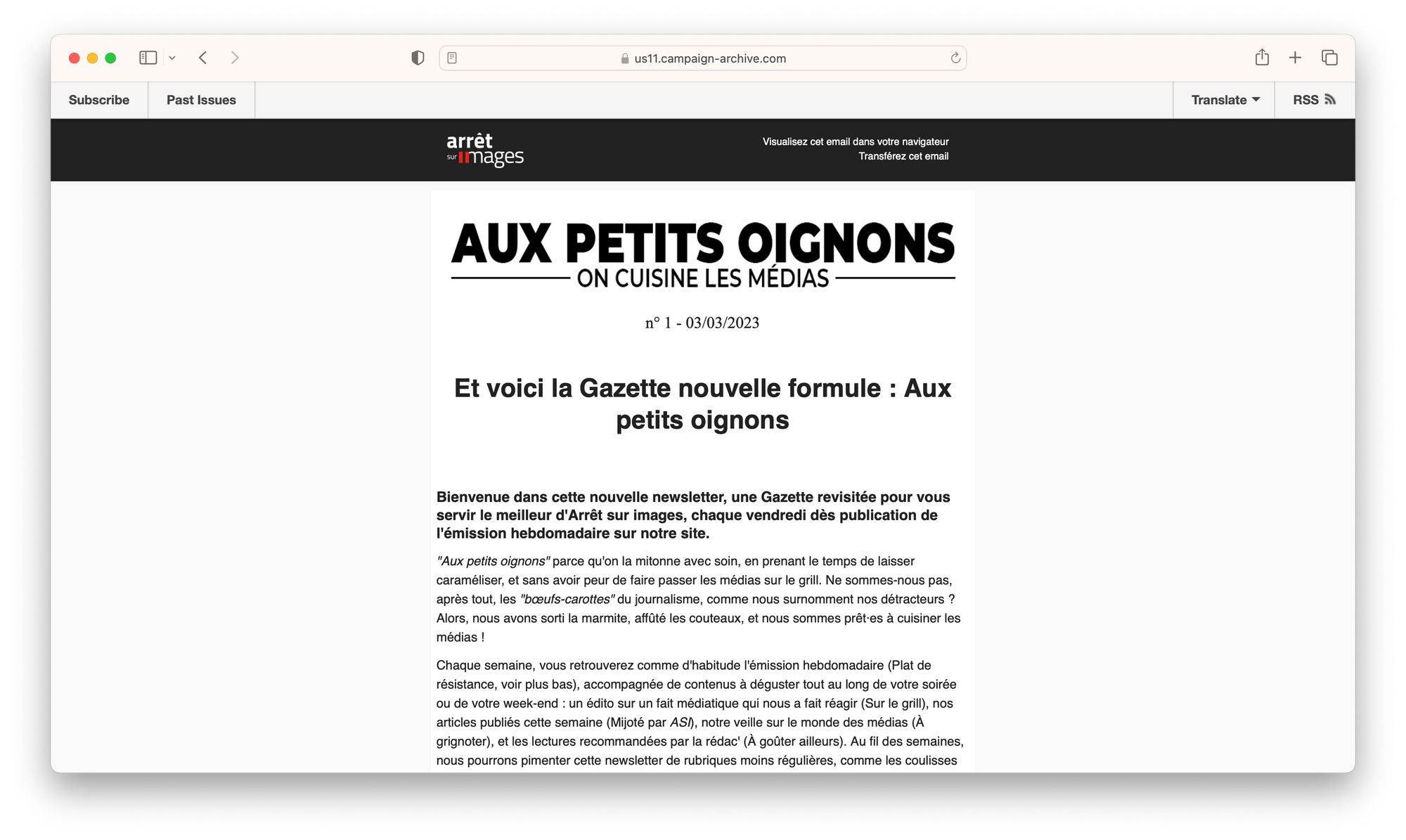
For its part, in March 2023, Arrêt sur images — supported by the Médianes studio — launched its new newsletter format: "Aux petits oignons" replaced "La Gazette", their original newsletter. Aux petits oignons is a weekly newsletter that decodes media discourse of the moment and shares information not to miss in the media. The idea was notably to have a media in its own right, rather than just a channel redirecting to the site.
Question 5 — Où seront les abonné·es lorsqu’ils et elles liront cette newsletter ?
This might seem like a minor question, but answering it will help you think about the day and frequency of distribution (Tuesday? Thursday? Evening? Morning? Sent daily? Weekly? etc.).
Could your audience be engaged on a Monday? Email inboxes are generally saturated that day; your newsletter, on the other hand, can be designed as an essential part of the start of the week — like a local newsletter recommending outings and things to do for the week.
Will your audiences be at their desk, on the metro? The idea is to identify when they'll be most available and engaged (which is less the case when you're cooking, dropping kids at school, or at fencing class!)
💡 Du côté de nos newsletters de veille, chez Médianes : nous avons fait le choix du lundi à 14h pour notre newsletter de curation, les 10 liens, et du jeudi à 7h, pour notre newsletter de Stratégie. Une façon de partager des conseils, analyses et bonnes idées en début et en deuxième partie de semaine (bien commencer/bien terminer sa semaine), et de façon bimensuelle, pour rythmer le mois.
Question 6 — Quel ton et quel style trouveront écho auprès de ce public ?
How best to present content so it reaches these people? Pedagogy, seriousness, conversational tone, distance, humor, authenticity, surprise, sarcasm… What tone do you prioritize to remain consistent and reach your audiences? Is this newsletter meant to spark interaction?
Zoom sur Climax
To stand out, the co-founders of the newsletter Climax — supported by the Médianes studio — chose for example to denounce political inaction on ecology by using sarcastic humor. Ecological policy is thus approached with a biting tone; a way to alert otherwise and denounce inactions.
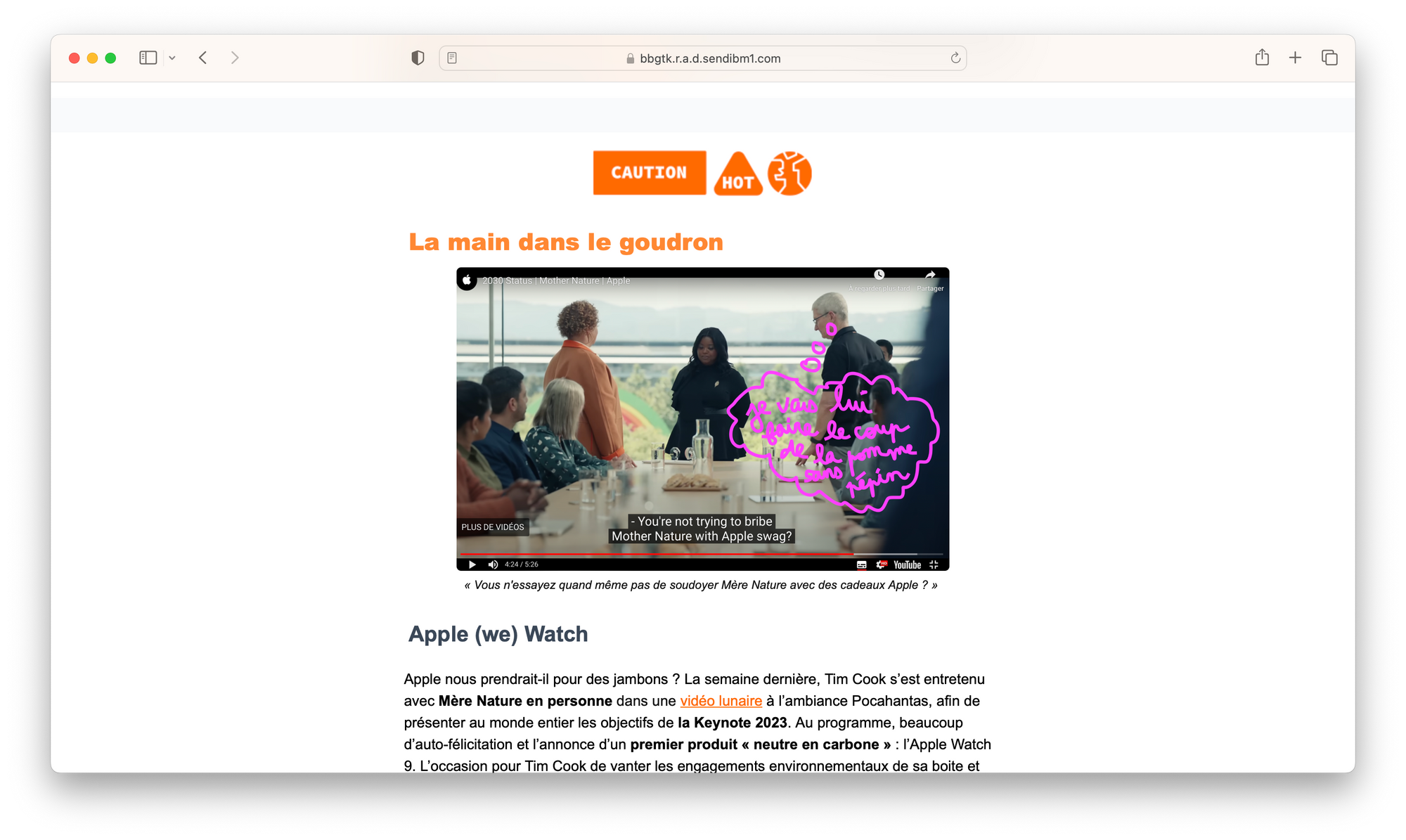
🔗 To learn more about Climax:
- The report from our event "Launching and developing your media in the age of ecological urgency" with notably Dan Geiselhart and Lauren Boudard, co-founders of Climax
- Their interview to learn more about the transition from TechTrash to Climax
- Their feedback on choosing the fanzine — Lauren Boudard on the mic of Chemins, the Médianes podcast
Question 7 — Quel contenu et quel format serviront le mieux ce public ?
Time to think editorial! What formats and editorial direction do you want to establish and adopt? The challenge is to create editorial continuity with your other products/content, to have good structure, to think about
Zoom sur Axios
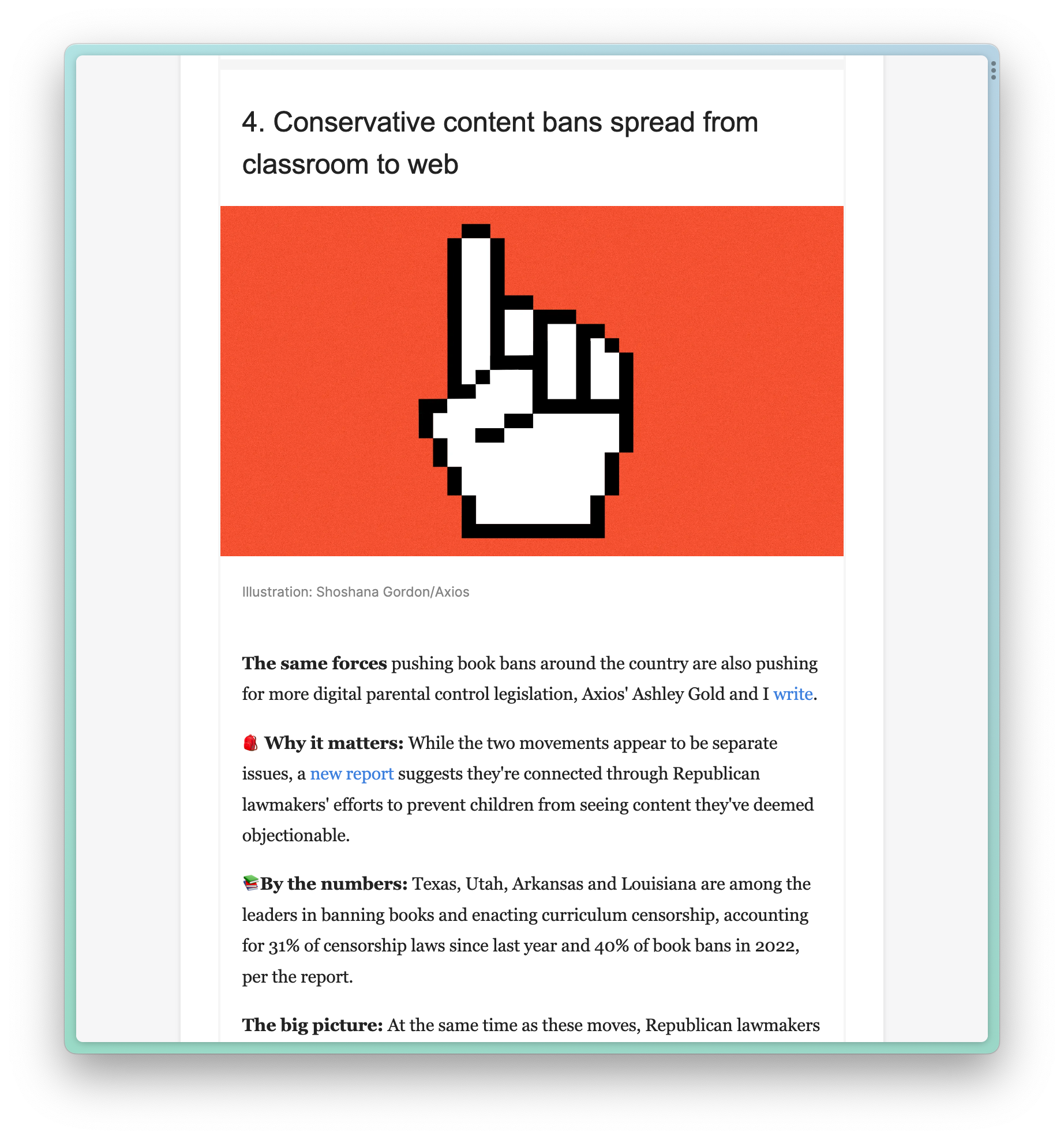
In its newsletters, the media outlet Axios targeting a professional audience (on specific verticals/topics) champions the logic of Smart brevity: a key concept for "saying more with less," which lies at the heart of their value proposition and enables them to stand out.
Axios does indeed manage to organize its content categorization in an efficient and spacious way: paragraphs are short and interspersed with bulleted lists. Among other notable elements: content embodied by its journalists, a local strategy (cities).
And for more information on Axios's newsletter strategy, check out this Digiday article.
Zoom sur Médianes
At Médianes, we have three newsletters, one dedicated to our behind-the-scenes content and case studies, and two dedicated to sharing our insights.
Designed as a service for media founders and leaders, the Stratégie de Médianes newsletter is also a meeting point for journalists, journalism students or those studying media, as well as marketing, digital, and product managers at traditional media outlets and creative agencies.
In autumn 2023, 2100 founders, executives, journalists, and media leaders read us daily, with an average open rate of 55% and a click-through rate of 12%.
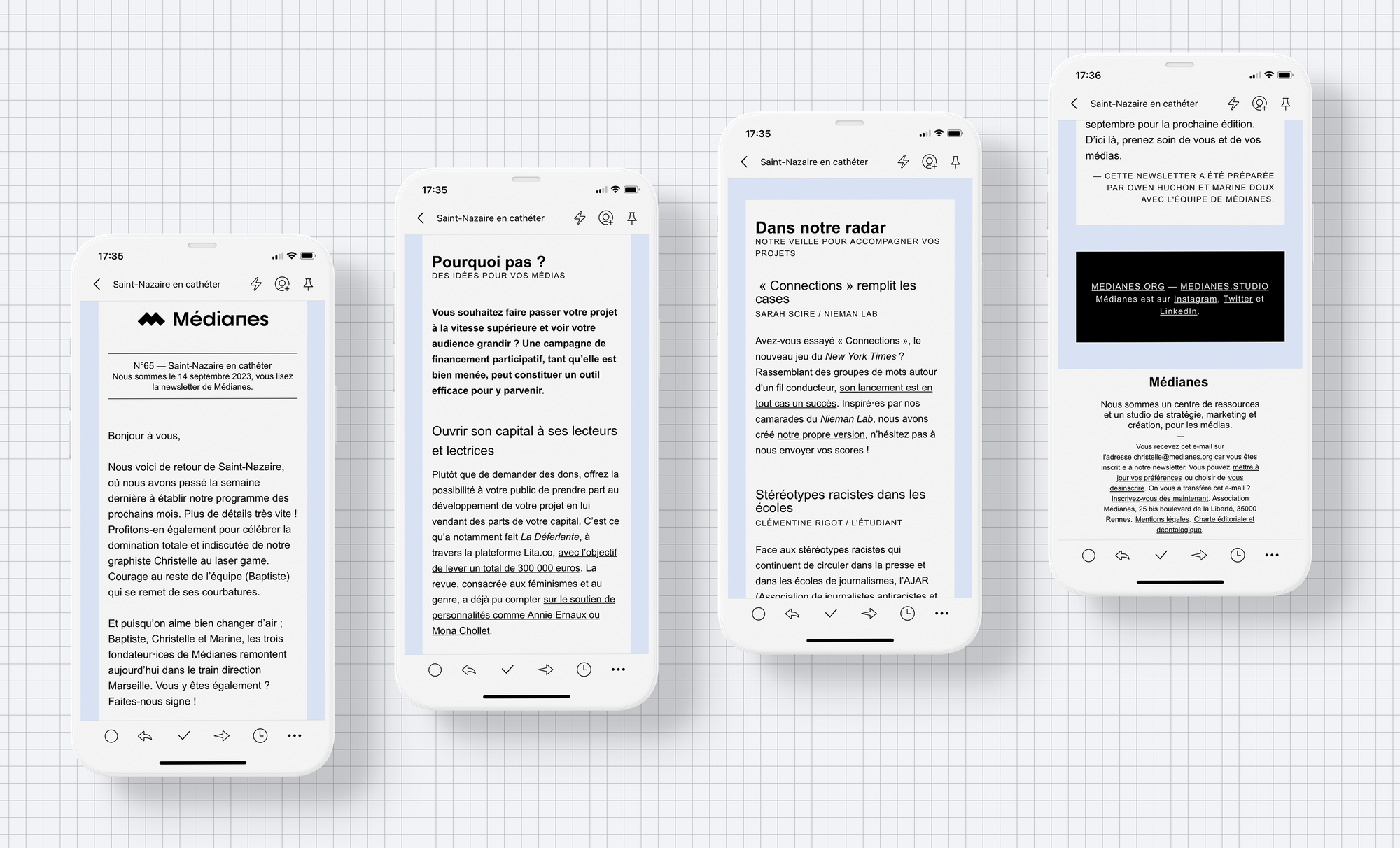
- Editorial A short personal editorial to tell today's stories, behind-the-scenes insights, and what's on the horizon.
- The strategy A trend to adapt in your media. A trend or idea broken down into 3 concrete actions and illustrated with examples from emerging or traditional media that have adopted it. This section is primarily aimed at media founders. They need tools and best practices, strategies and ideas for their projects, and to be part of a network.
- From the studio's perspective… Focus on a project. Spotlight and behind-the-scenes look at a project supported by Médianes, the studio.
- On our radar Our watch to support your projects. A selection of 2 or 3 articles/content pieces: an analysis article, a free and practical resource, and a case study. Here, we primarily address media leaders, marketing, product, and technical managers at established media companies. Their needs? Staying informed about the latest media trends, understanding the ecosystem to make decisions within their organizations.
- On Médianes Our latest publications. A selection of an article, a report, an interview, written by one of our journalists or a column by one of our columnists and published on Médianes' resource center.
- Briefly So you'll know. A highlight of initiatives, news or appointments not to miss. For example: the latest job offers in media, a new project, an event, a call for projects, media coverage, a practical tool to use… Here, we mainly target journalism school students who want to be inspired by media that align with their values and commitments. Médianes also addresses another need: finding a job, internship or apprenticeship in the media world. We regularly publish a job board on our website, social networks and in our newsletter. The latter is updated twice a month.
We invite you to post a scoping document that describes the templates and formats of your newsletter — this internal guide will be useful for establishing the product's editorial principles and will also serve you if you ever need to hand it over to someone else to take it over. Find the Médianes example here ⟶
Question 8 — Où allez-vous recruter ces abonné·es ?
Social media, ambassadors, press relations, personal accounts of team members, word of mouth, flyers, sponsorships… What touchpoints or customer journeys do you envision between your newsletter and your audiences? Answering this question will help you refine your distribution strategy. The idea is for you to associate each journey with actions to be implemented that will allow you to reach these audiences more or less directly (dedicate a regular post about the newsletter to one of your personal accounts, speak at an event, etc.).
Question 9 — À quoi ressemble le succès dans trois mois ? Six mois ?
Open rate, relay by a public figure, financial returns, number of subscribers doubling… Ask yourself what pride you would take from the project you've launched with your newsletter in three months, six months, a year… This step allows you to have a roadmap and set objectives for the medium to long term.
🖇️ Nous vous invitons à vous aider de notre fiche pratique dédiée pour construire votre feuille de route.
Question 10 — Quel objectif une newsletter aidera-t-elle votre structure à atteindre ?
Are you looking to build customer loyalty? To increase product sales? To create a network? To gain credibility? It's important to define the objective or objectives your newsletter should aim for.
Zoom sur POLITICO
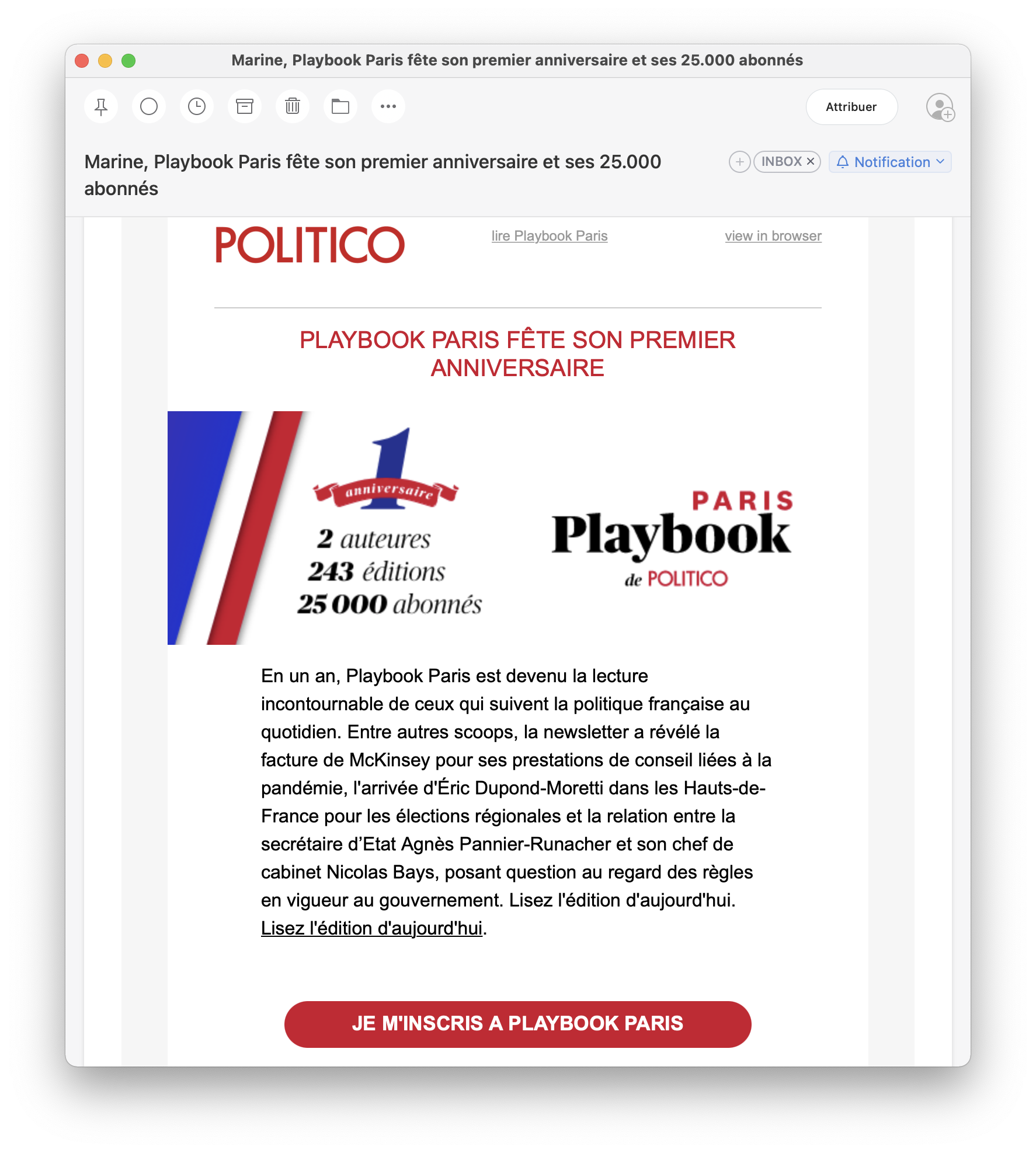
A newsletter can enable a media outlet to think bigger, as was notably the case with POLITICO's Playbook when the media launched in France. Launched in 2021, POLITICO's Playbook Paris surpassed 25,000 subscribers in February 2022. A daily political briefing sent every morning at 7am, Playbook is hosted by one or two journalists. POLITICO's Playbook franchise has editions in Washington, London and Brussels and brings together more than 600,000 subscribers. The Brussels edition, launched in 2015, now has more than 100,000 subscribers.
Note: Médianes, the studio, has collaborated with POLITICO in Europe since 2023.
Question 11 — Qui est responsable de la réalisation de cette newsletter, jour après jour, semaine après semaine, mois après mois ?
How does this fit into your team's workflow or business activities? Whether you're working alone or with others, it's necessary to structure a production and distribution pipeline for your newsletter.
Try to define a working method and a workflow/approval process:
- Divide responsibilities as much as possible: who is responsible for writing? Who handles proofreading? Who is in charge of integrating it? Distributing it? Is there a need to produce visuals? If so, who is responsible for that?
- Set procedures: depending on the newsletter send date, when should the first draft be edited? When should the person in charge of communications have received the necessary elements for distribution (texts, images)? Is a test email shared before the final send?
- Assess the maximum time you can allocate, and review the tools that can save you time.
3. Quelques bonnes pratiques
Rédiger un e-mail de bienvenue
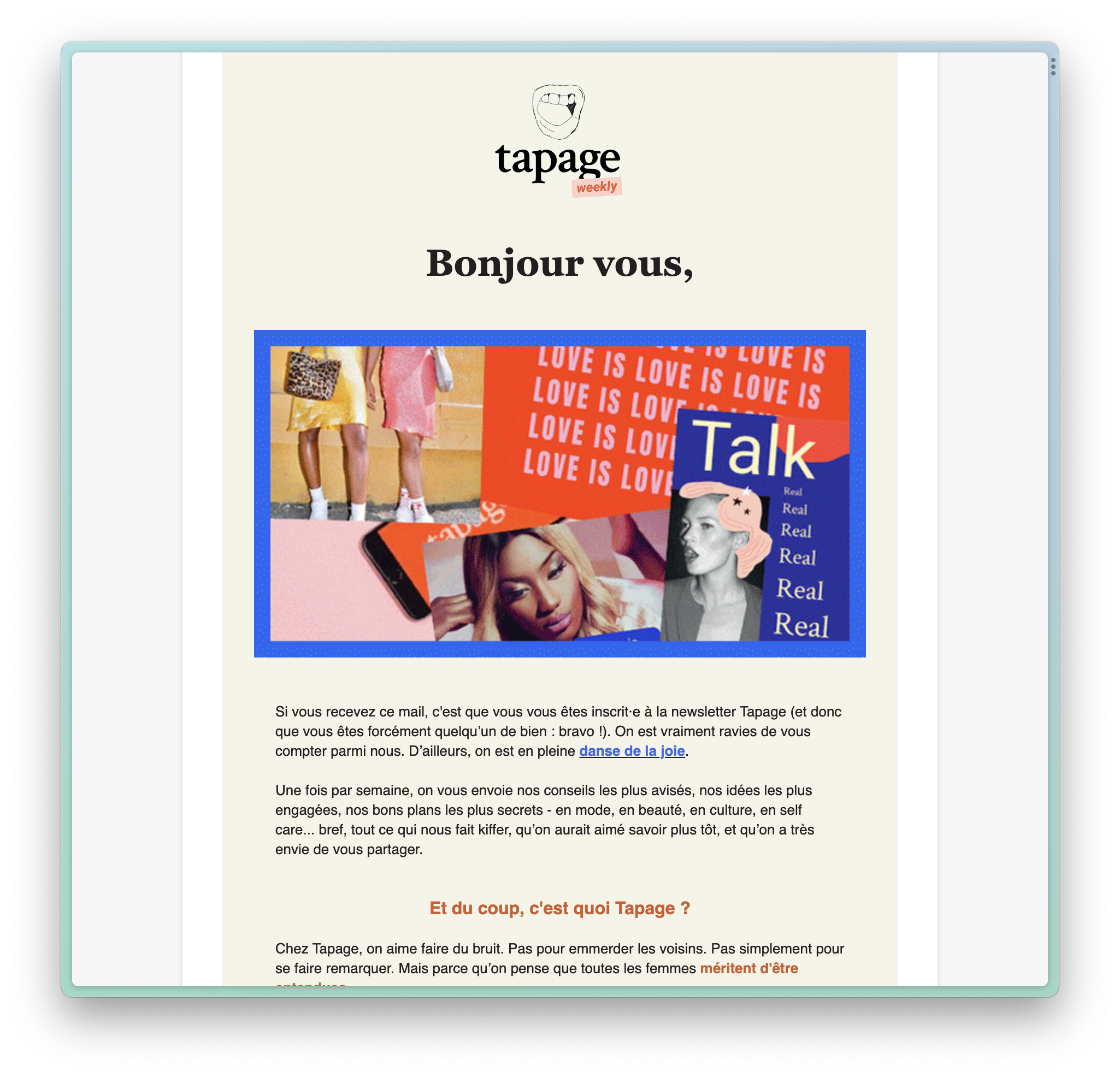
Think about the email that will reach your readers once they've signed up: a first step in building their loyalty. Ideally, you'd have a genuine welcome email sequence (acquisition, conversion, retention) that embodies and stays true to your media's editorial line. What matters is saying more about who you are, your value proposition, your business model…
Our journalist Marine Slavitch shares practical cases in a dedicated article: the choice of embodiment at Axios, the promotion of Tapage's vision, and the development of a welcome sequence at This is Tucson.
Penser en cycle
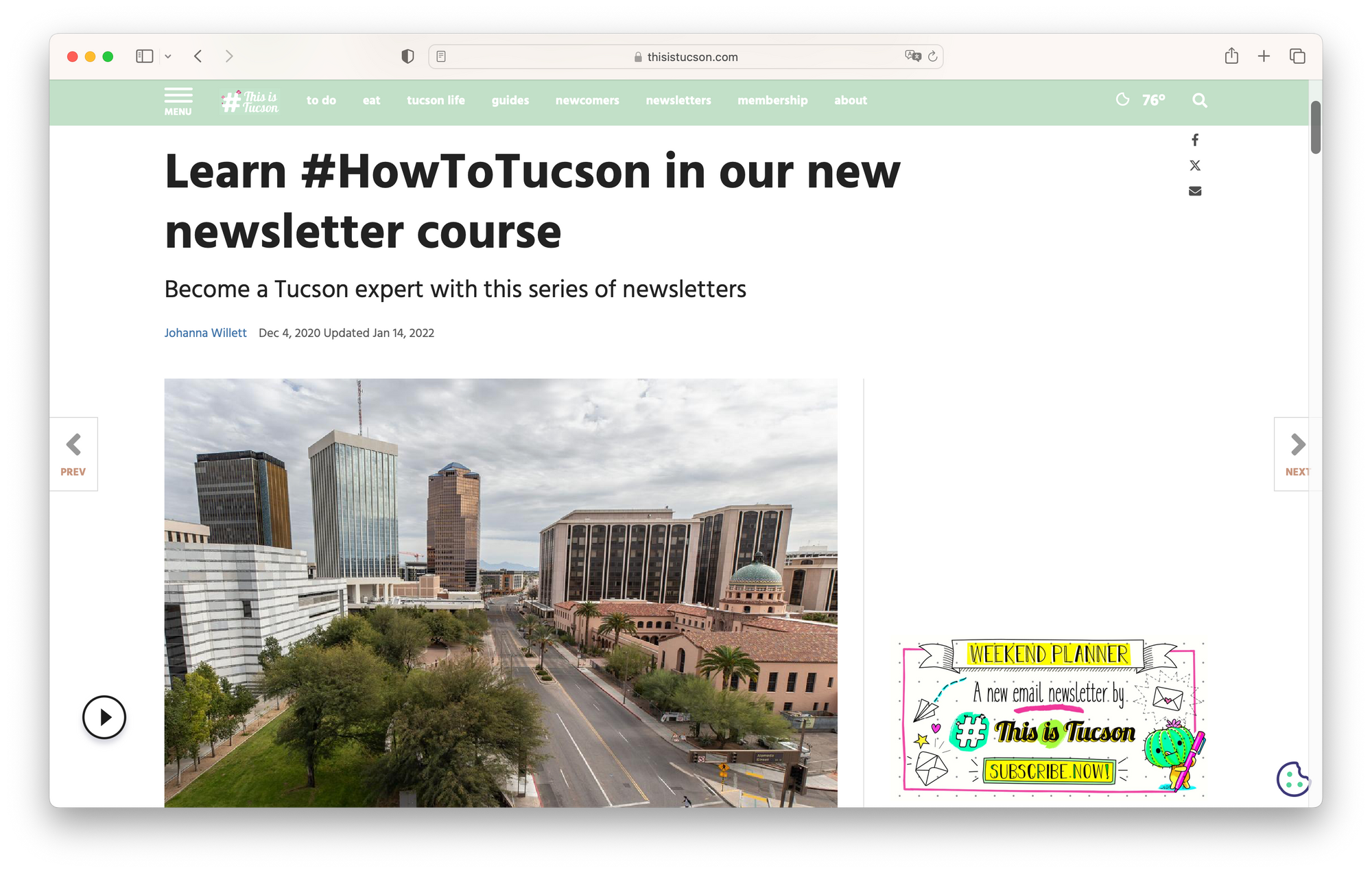
You can choose to have an email sequence to promote a product, or launch a communication series around a particular announcement.
Zoom sur This Is Tucon
To answer questions from newcomers to Tucson, in the U.S. state of Arizona, the local community news outlet #ThisIsTucson launched a mini-guide in eight emails: "#HowToTucson". A great idea to adopt if you're pursuing a local strategy and want to become essential to your readers.
🖇️ Pour en savoir plus sur les cours en ligne, lisez notre newsletter dédiée sur le sujet.
Trouver un nom et une baseline
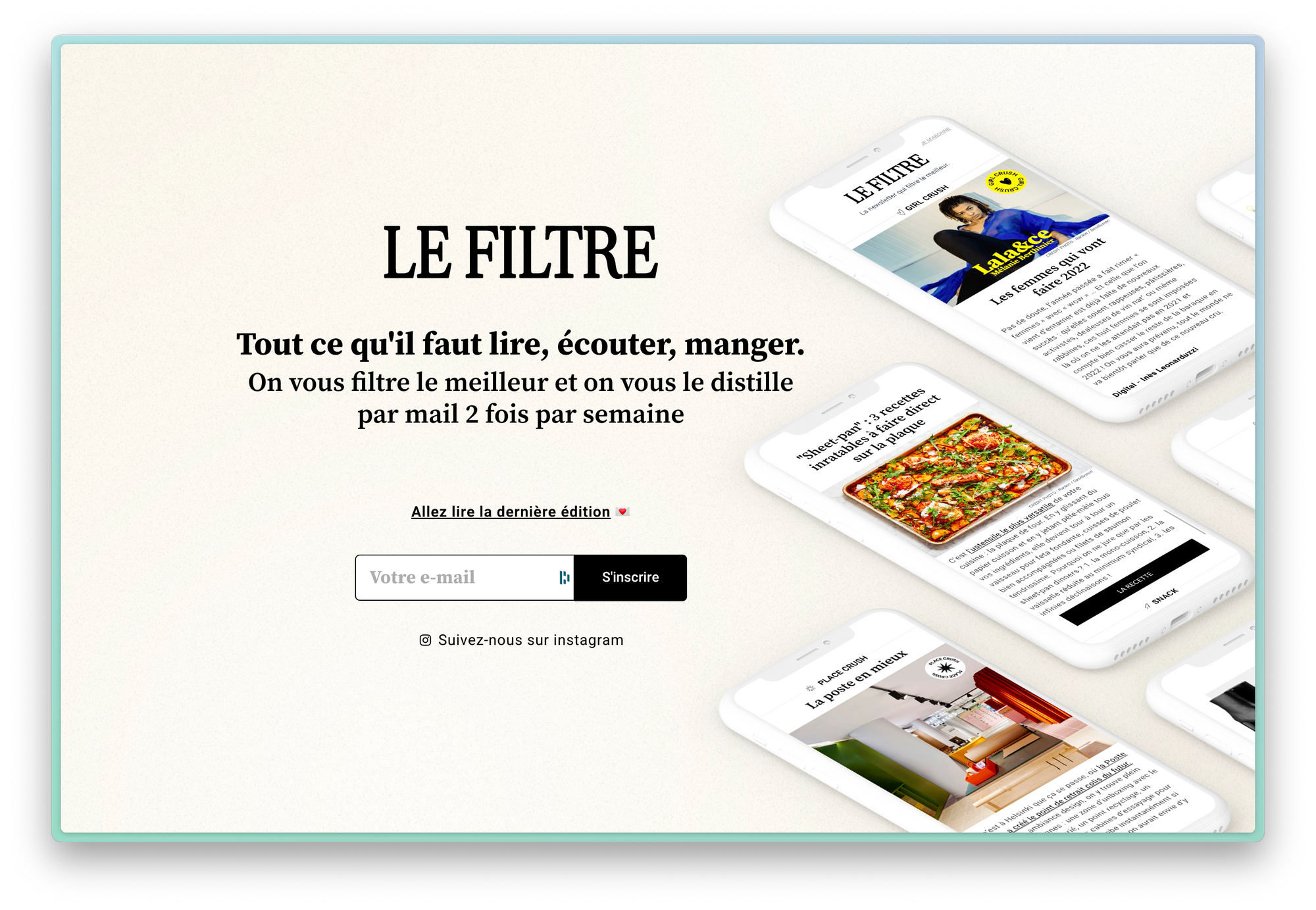
To find a name and tagline for your newsletter, think of it as a media in its own right: it should be evocative and reflect your value proposition. To define the latter, you can consult our dedicated resource on the topic.
Les bonnes idées ne sont pas ce qu’il manque dans le paysage médiatique. Voyez plutôt la newsletter du média lifestyle Le Filtre, « La newsletter qui filtre le meilleur » qui propose de recevoir deux fois par semaine « Tout ce qu’il faut lire, écouter, manger ».
Raconter les coulisses
Demystifying the journalistic process, sharing the motivations driving your editorial team, highlighting the challenges encountered along the way… There are countless ways to tell your behind-the-scenes story. Once again, this approach strengthens the bond of trust with your audience. By personalizing their communication, media outlets foster this connection and also encourage readers to get more involved in the outlet's development. A smart strategy for humanizing the media and building audience loyalty.
Zoom sur Kometa
In one of its newsletters, the publication Kometa, which puts Eastern Europe at the center of the map, revisited the behind-the-scenes of the project: its origins, the motivations and difficulties, all in photos. The newsletter channel enables and showcases a highly personalized tone—a smart choice for connecting with those who make the media in a launch context.
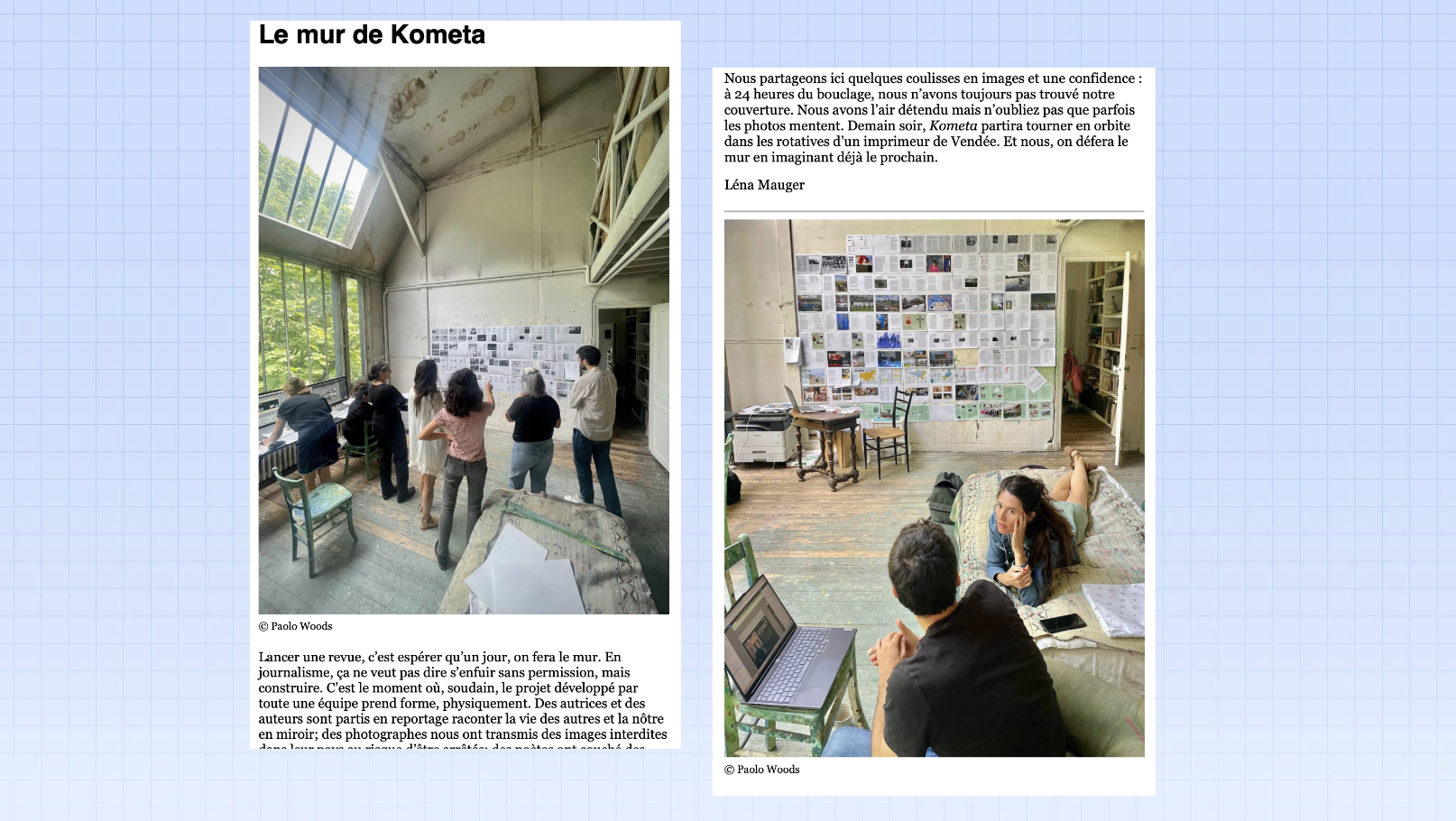
Note: the team at Kometa is supported by Médianes, the studio. You can learn more about our support services via this link.
🖇️ Pour en savoir plus, on vous livre trois façons de communiquer sur vos coulisses.
Incarner vos contenus
Whether your newsletter is written in the first person or by multiple authors, you have every reason to personalize your content. It's then up to you to define the right tone, suited to your voice and your readership's habits.
Zoom sur mūsae
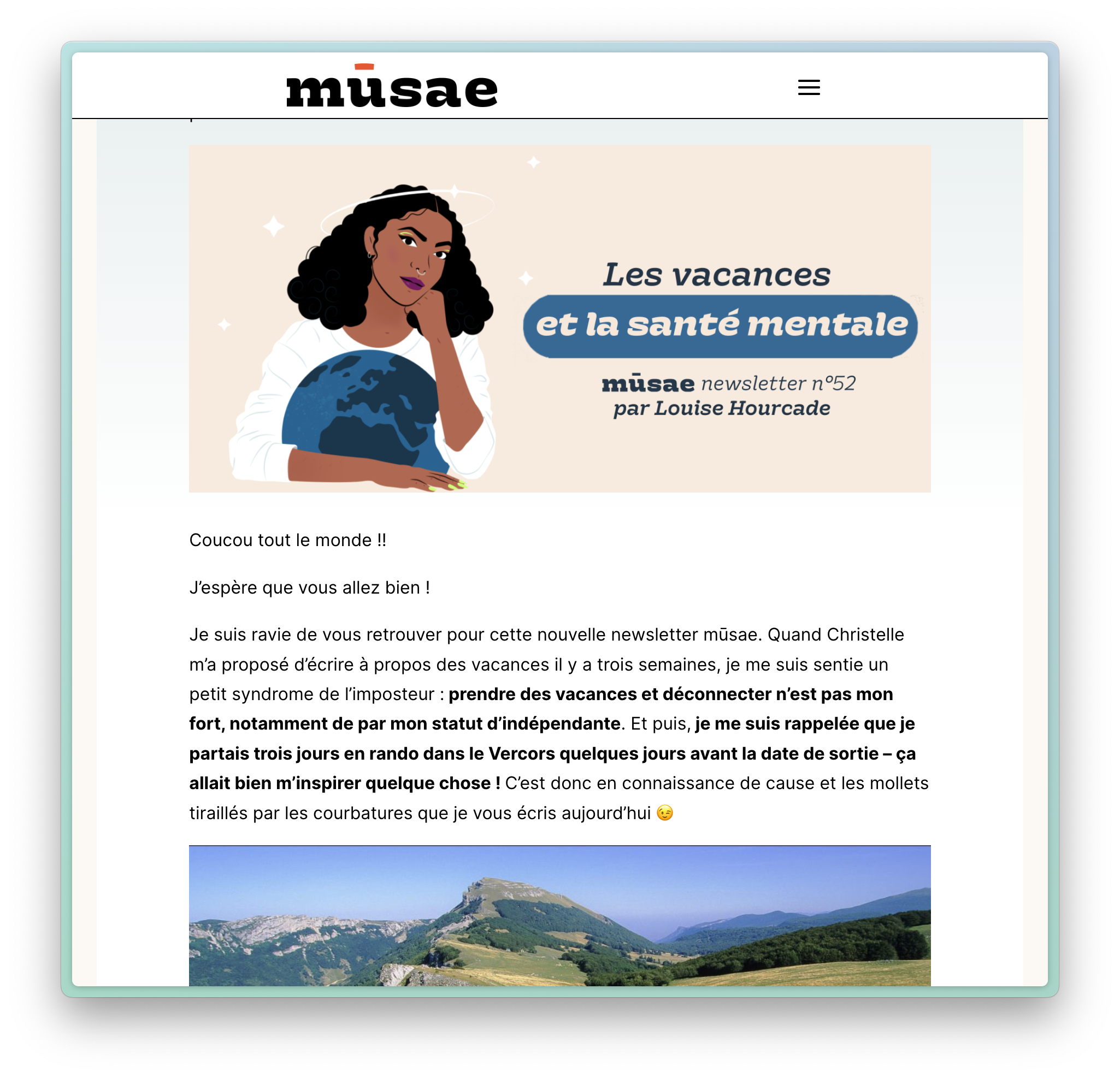
A media founded by Christelle Tissot and supported by the Médianes studio in its development, mūsae notably has a newsletter to demystify and democratize mental health. Regularly, the writing of this newsletter is entrusted to author Louise Hourcade, allowing the media to take on a different voice, with a tone and references such as in this edition dedicated to vacations.
Ensure follow-up
Track your data! A good tool for doing this: key performance indicators—or KPIs (Key Performance Indicators). These are quantitative and qualitative measurement tools that help you manage your project and strategy day-to-day.
They allow you to measure a result or an impact; here you might measure, for example, the number of clicks, an open rate, an engagement rate, a conversion rate… It's thanks to these that you'll know if your newsletter is effective or not, whether you need to modify things in your strategy or completely change course. So make sure to record the quantitative data related to your newsletter in a dedicated document to track its progress.
⟶ To learn more, visit medianes.org: our journalist Owen Huchon demystifies KPI usage for you!
Événementialiser
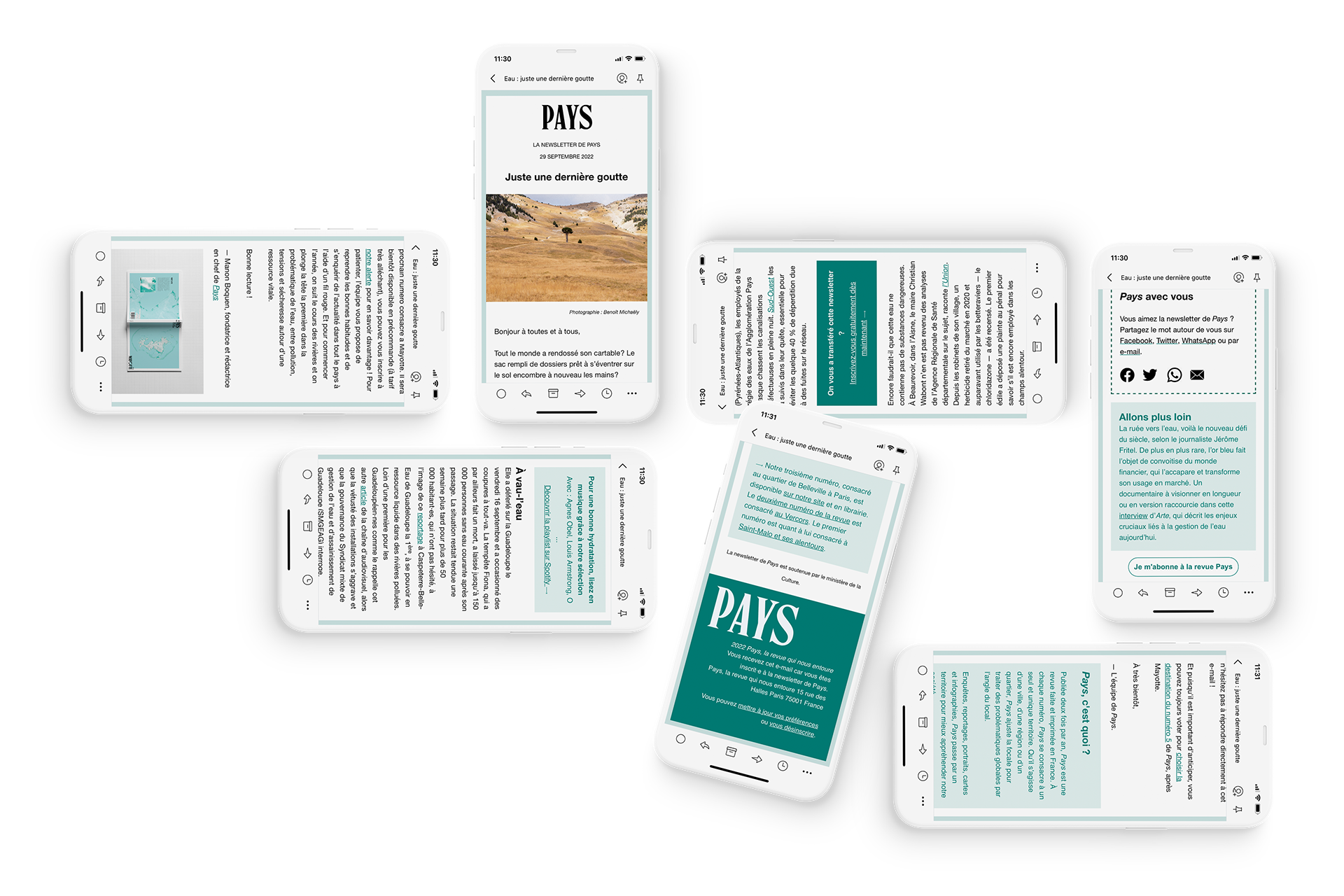
Colors, formats… You can decide that your newsletter changes form on the occasion of an announcement, a redesign, or any change in your media: a good way to mark the moment, as did Pays when launching its new issues.
Zoom sur Pays
The newsletter from Pays, a magazine about territories co-founded by Médianes, presents in the form of a press review a topic addressed in one of the magazine's articles. With each new issue, its colors are adapted to the design of that volume, creating a visual alert about the upcoming release of a new publication. The newsletter can thus offer the possibility of presenting the issue and 5 reasons to subscribe to the magazine.
Zoom sur StreetPress
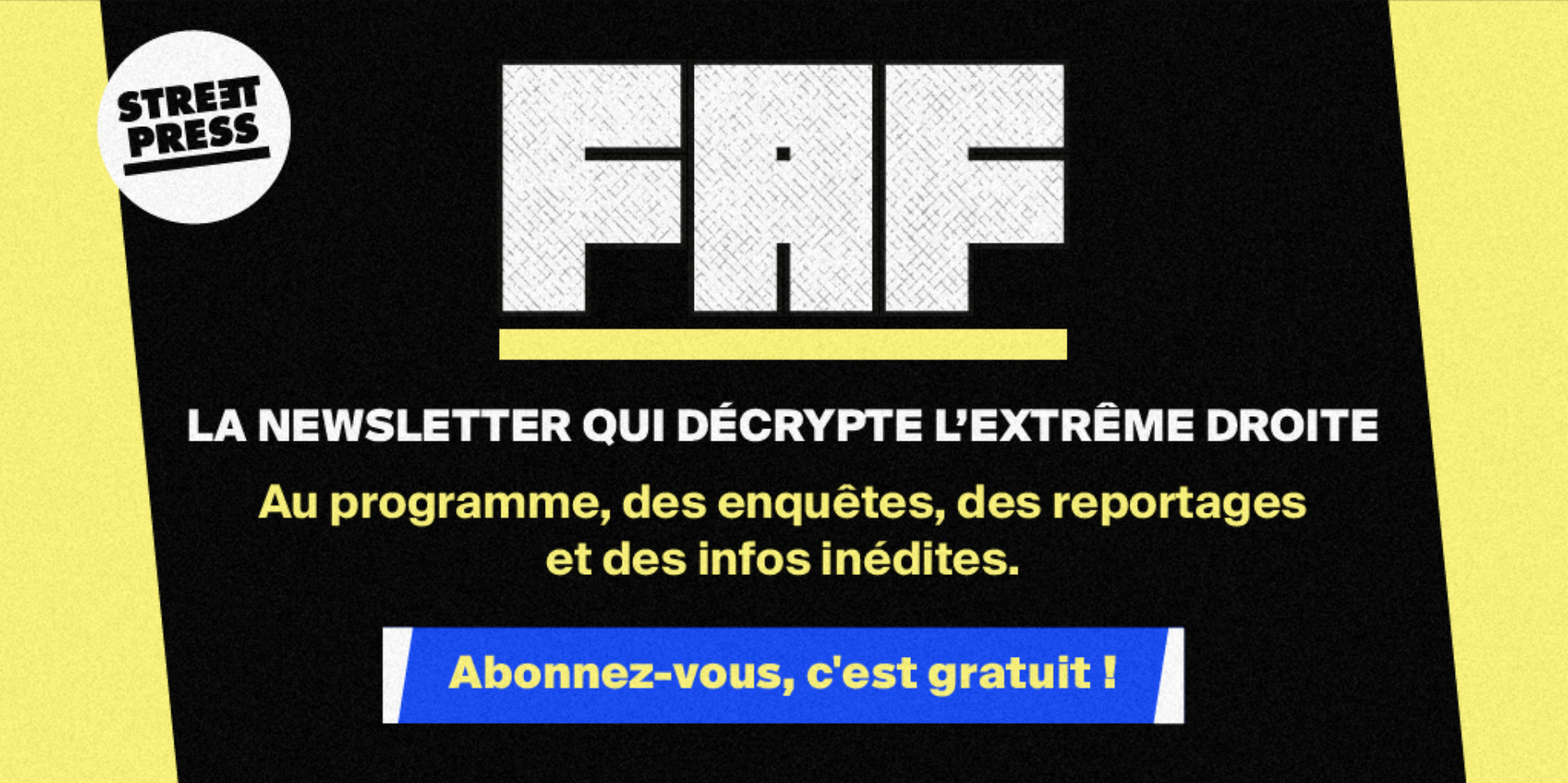
In winter 2021, the investigative and impact media outlet StreetPress launched FAF, a newsletter to combat the far right.
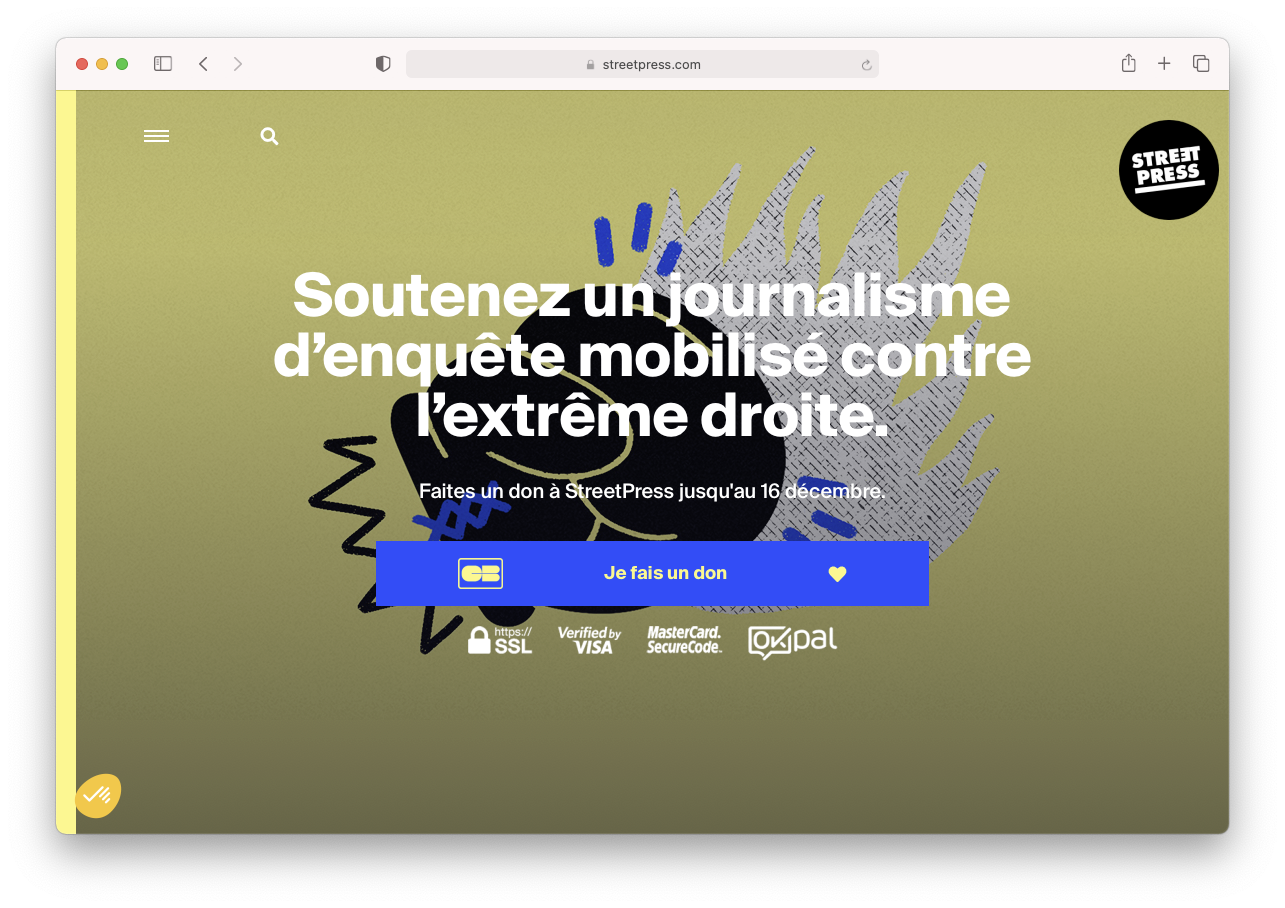
Le média, accompagné par Médianes, a lancé une campagne de dons pour financer le produit, permettant de récolter 75 000€ sur un objectif de de 48 000€.
The fundraising campaign, centered on the argument of supporting StreetPress as a media outlet fighting the far right, helped to create buzz around the launch of the newsletter dedicated to the subject.
Créer une page dédiée pour s’inscrire
You can create a signup page for your newsletter; the idea is to clearly explain the service you're providing to your audience. If you have multiple newsletters, make sure readers don't have to enter their email address multiple times, as this will discourage many from signing up!
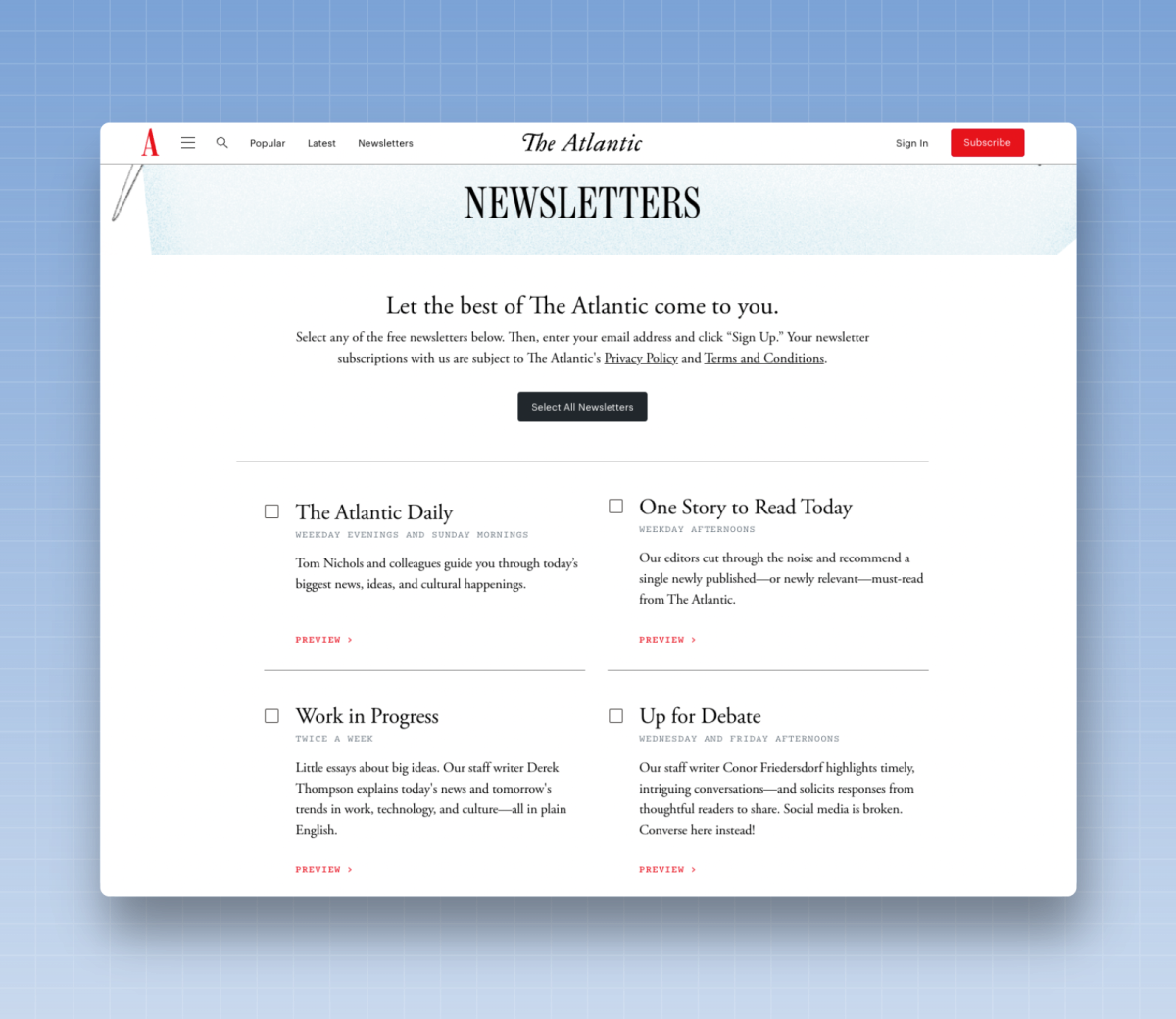
Zoom sur The Atlantic
The newsletter page of American media outlet The Atlantic allows readers to enter their email address just once and then select multiple newsletters. A way to streamline the signup process.
Donner des nouvelles !
Highlighting key moments and figures to update your audience on your newsletter and its evolution is both an engagement driver and a way to launch a communication sequence to build awareness, particularly on LinkedIn. Many media leaders do speak up to discuss their strategy and inform their audiences (readers or professional audiences to acquire).
Choisir les bons outils
Follow best practices from a technical standpoint: poor newsletter management can cost you (unsubscribes, deliverability issues).
- To choose the right platform, we share our insights in this practical article.
- A tool for testing the deliverability of your emails: mail-tester.com;
- A tool for testing whether your emails might be blocked: dnschecker.org.
4. Notre ressource pédagogique
Un document pratique pour mettre en œuvre les apprentissages de cette fiche à votre propre projet, inspiré par nos camarades de NPR.
✉️ Vous avez lu et utilisé cette fiche ? Nous avons besoin de vos retours ! Une question ou une remarque ? Écrivez-nous à [email protected]. Merci de votre aide, l’équipe de Médianes.