

👉 Étapes, ressources, conseils… Cette fiche pratique est conçue par le studio Médianes, qui accompagne depuis 2020 les médias dans la conception et la structuration de leur modèle économique. Envie d’aller plus loin ou besoin d’un accompagnement ? Contactez-nous via ce formulaire.
Comment financer son projet en restant cohérent avec vos publics et vos valeurs ? Cette fiche vous propose d’observer à la loupe différents modèles économiques existants centrés sur les publics. L’objectif : définir le vôtre !
1. Définir son modèle économique, pas à pas
Cibles, concurrence, besoins… Se poser les bonnes questions
What would my audiences be willing to pay for? How can I optimize the journey between my paid product and my audiences? To consider funding models for your media outlet and ways to generate revenue, you need to ask yourself a series of preliminary questions. Defining your media outlet’s business model requires that you take all aspects of the project into account. What is your vision? Who is your competition? Who are your target audiences? What are their needs? What is your editorial offering? What platforms will you use? What are your touchpoints? What are your costs and revenues? What benefits will your target audiences gain? Answering these questions will help you define the framework of your media outlet’s business model.
To do this, there’s a method: the Business Model Canvas, which involves mapping out your media outlet’s editorial and business model. The business model must always be consistent with your editorial vision and your target audience. That’s why, first and foremost, you need to have defined your target audience (using the persona method) and your editorial and business models (using the Business Model Canvas method).
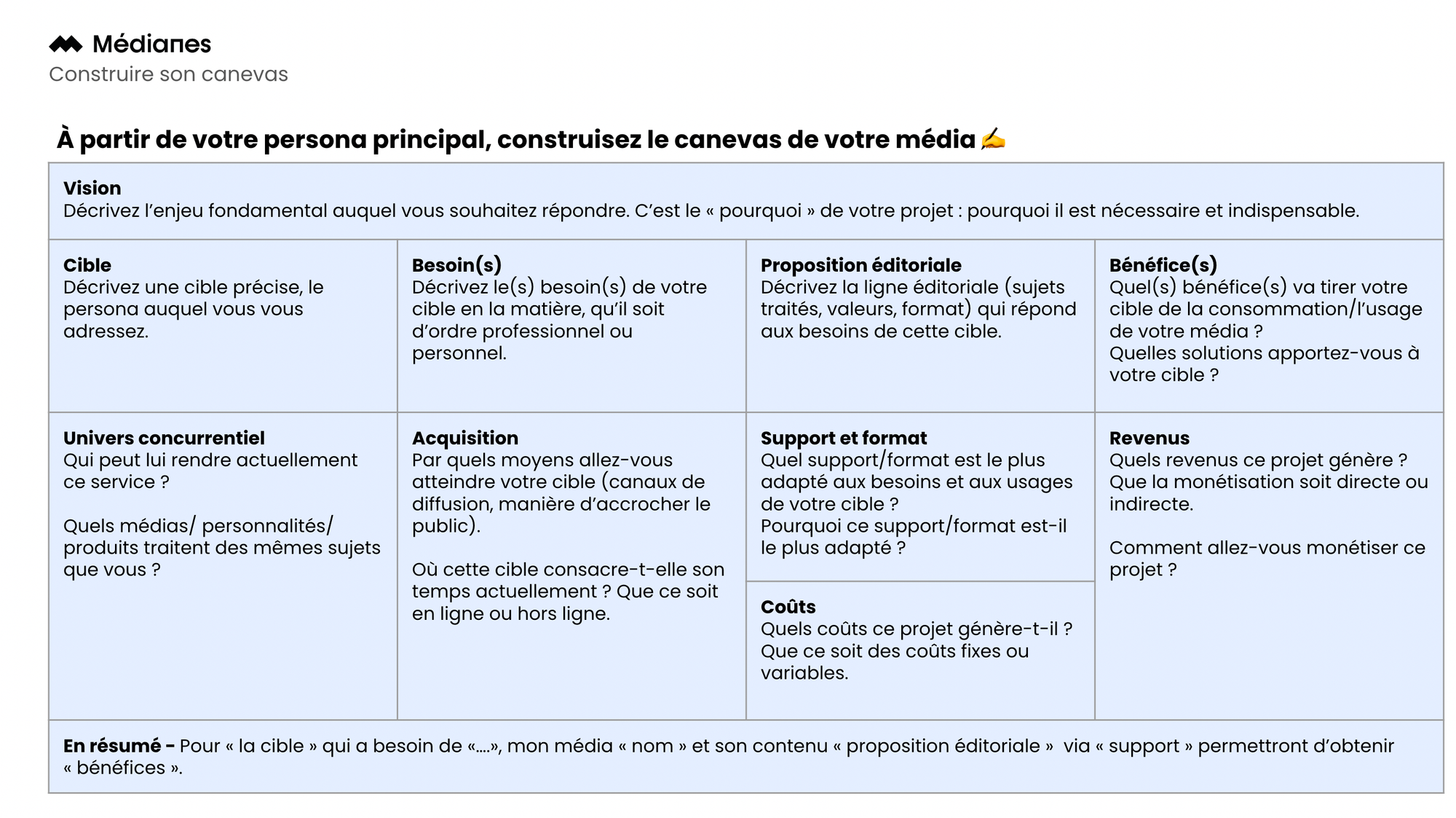
🔗 Chez Médianes, nous avons construit deux fiches pratiques dédiées, avec des ressources pédagogiques à télécharger pour vous épauler sur ces chantiers. ⟶ Construire un canevas ⟶ Définir ses personae
Outline Your Business Plan
Working on the framework allows you to develop your business plan. If your media venture is a project from which you’d like to generate income (and thus make a living), you’ll need to establish assumptions to achieve your sustainability goals.
It is, in fact, necessary to assess the costs your project will generate and the sources of revenue—whether direct or indirect. The cost must be in line with your financial resources and the values of your target audience.
- Revenue: What revenue does this project generate? How do you plan to monetize this project?
- Costs: What costs does this project entail? Whether they are fixed or variable costs (labor, office space, routing, technical solutions, etc.)
In practical terms, you need to strike a balance between revenue (sources of income) and expenses (sources of spending).
Depending on your target audience, the content you want to produce, the format and medium you’ve chosen, as well as your financial and strategic goals, various business models may be feasible. We’ll tell you more about them later in this guide.
🔗 Pour aller plus loin : Business plan, gestion, administratif… Retrouvez l’entretien d’Augustin Naepels, directeur général des Jours ⟶
Conduct market research
Researching existing models and their effectiveness is the first step in developing your own: this allows you to understand your place within an ecosystem, avoid potential mistakes, and draw inspiration from ideas that align with your project and your target audience. Research media outlets that are structured like yours, target similar audiences, or offer the same formats. Ask yourself the right questions: Do these media outlets tend to monetize their content, implement subscriptions, crowdfunding, donations, paywalls, or sponsorships? In which cases does this work? Conversely, what lessons can be learned from the failures of your peers?
You can browse media websites and see how their offerings are structured. Another way to learn more about their performance is to follow media founders and executives on LinkedIn—many of them share updates about their projects, particularly from a financial perspective. Check out our educational resource at the end of this fact sheet, which will guide you through this process.
Ensure consistency with your editorial promise
A business model is based on a media outlet’s content, editorial direction, audience, and values—in short, on its value proposition.
When defining your business model, be sure to carefully consider your media outlet’s financial viability, editorial independence, and the bond of trust with your readers. It is important that no one pillar stifle the others. In other words, while your media outlet must be able to meet the goals of reach, influence, and financial independence, it must also remain true to its editorial vision. If your media outlet lacks a community aspect, the conditions for implementing a membership model may, for example, be called into question: What project is the audience participating in by becoming a member? Similarly, if your editorial approach isn’t centered around the concept of support, you may not be able to opt for the donation model. We’ll tell you more about these models a little further down.
🔗 Gardez toujours en tête ce qui fait la raison d’être de votre média grâce à notre fiche pratique dédiée à la proposition de valeur ⟶
Placer les publics au cœur de votre offre
We can’t stress this enough. By choosing to generate revenue from your readers or listeners, you’re acknowledging that you depend on them—or largely on them—to fund your media project. It’s therefore important to always keep in mind their profiles, expectations, and habits. Check out our practical guide on defining personas, which is also linked above.
You should assess your audiences’ financial resources (are they willing to pay? If so, how much? Under what terms? For how long? For what type of service? etc.) Also keep in mind that you’re not alone in the market: ask yourself which media and types of content your target audience is accustomed to paying for (or not!). Furthermore, one essential point to keep in mind is that you’re addressing an audience to whom you’re providing a service.
Messages encouraging contributions should be tailored to different audiences (target audience, paying subscribers, regular readers of the newspaper, online community), both in terms of messaging and distribution channels (social media, newsletters, in-person events, website, flyers, etc.). You need to identify the touchpoints with your target audiences: what platforms do they use, and what are the potential paths between those platforms and your media outlet? This requires you to integrate your audiences into the marketing funnel: acquisition, retention, conversion, and brand awareness. We’ll soon be offering a practical guide dedicated to this topic.
2. Identifier le bon modèle
Donations, membership, subscriptions: In the rest of this fact sheet, we’ll take a closer look at business models centered on their audiences.
Note: Keep in mind that defining a primary business model does not mean you can neglect to identify other sources of revenue to fall back on. To ensure financial stability and limit the risk of becoming overly dependent on a single source, it’s essential to review all potential revenue streams for your project in light of your target audience and editorial content. Events, e-commerce, merchandise… To round out your model, don’t hesitate to diversify your revenue streams and take into account any public funding you’re eligible for. At Médianes, we have two resources that can help you.
🔗 Subventions, diversification : d’autres sources de revenus à la loupe : ⟶ Une fiche pratique pour vous aider à diversifier vos revenus ⟶ L’État fournit des aides directes ou indirectes à la presse. Les aides directes sont versées dans une logique de pluralisme et de modernisation ; les aides indirectes permettent de leur côté à une entreprise de presse de se dispenser de certains coûts. Retrouvez des informations clés sur les aides à la presse.
A. L’abonnement
Argument de contribution : Je paie pour un service, un produit éditorial identifié. Contrat : Bénéfice direct ou indirect, accès des contenus exclusifs. Mécanique : Hard paywall, metered paywall, freemium.
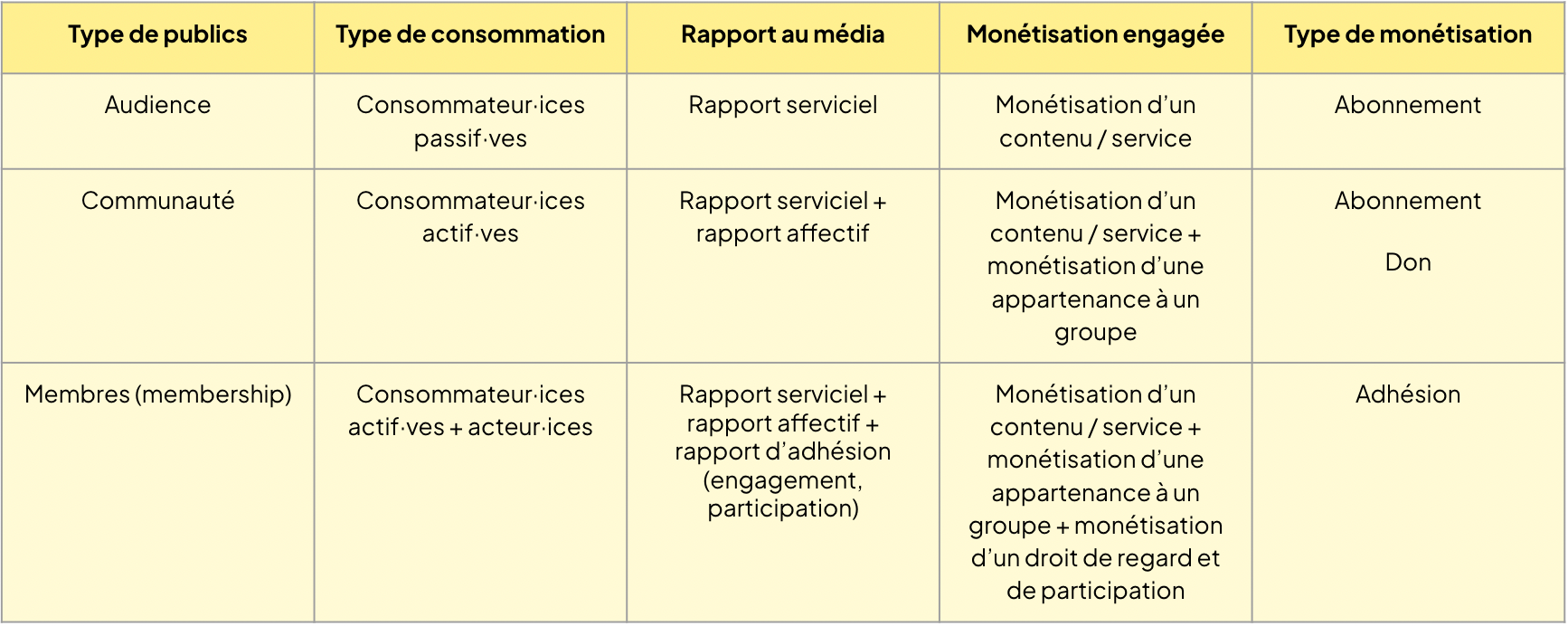
Dans le cas de l’abonnement, les lecteur·rices paient pour un service, un produit éditorial identifié. Contrairement au don et à l’adhésion, l’abonnement repose moins sur un sentiment communautaire et affectif que sur un rapport serviciel : la contribution financière garantit l’accès exclusif à un contenu, à un produit, qui répond à un besoin personnel ou professionnel. Les consommateur·rices sont davantage passif·ves, moins engagé·es dans le projet de média en tant que tel que ce n’est le cas pour le don et l’adhésion. Plusieurs stratégies peuvent être opérées dans le cadre des formules d’abonnement. Certains médias :
- set tiered prices based on readers' profiles (preferential rates);
- adjust their plans and prices based on the content they want to access.
- Content and the user experience can also be monetized (e.g., paywall systems).
Some best practices;
- Create a clear, simple, and concise user journey and subscription process;
- Display a small number of simple options with clear subscription plans;
- Set commitment periods and payment frequencies that are tailored to your business model;
- Payment options tailored to your audience’s profiles (no-commitment or limited-term plans, by credit card, by check via La Poste, etc.);
- Choose payment methods that help build customer loyalty (SEPA direct debit rather than credit card or check);
- Prioritize psychological pricing that aligns with the public’s perceptions of “fair prices.”
Cas pratique avec Arrêt sur images Arrêt sur images propose des offres d’abonnement ciblées en fonction du profil économique de ses publics. Une offre est par exemple destinée aux publics peu argentés (2€), une autre aux publics en mesure de payer pour de l’information à hauteur d’un tarif moyen (10€). Une offre cadeau est également poussée. Des offres sont également proposées pour toute structure souhaitant faire bénéficier différents membres d’une équipe de l’accès à Arrêt sur images.
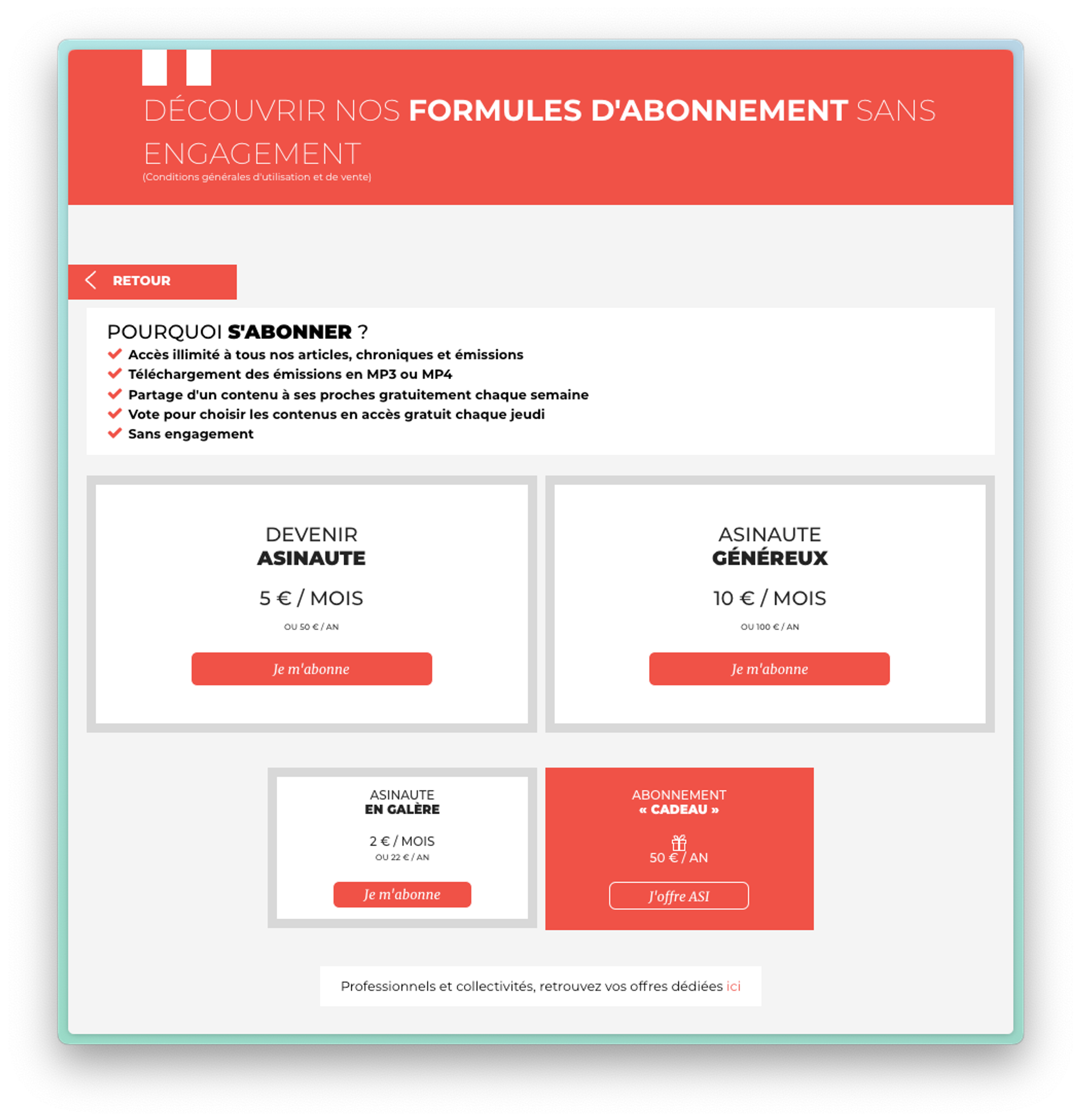
👉 Médianes, le studio, a accompagné Arrêt sur images sur des enjeux de marketing et de communication. Il accompagne également La Déferlante dans ses développements stratégiques et opérationnels (marketing, design et tech) depuis l’été 2019.
B. Le don
Argument de contribution : Je soutiens une cause, une idée que je partage. Contrat : Sentiment communautaire, pas de contrepartie particulière en échange. Mécanique : Don ponctuel, régulier, événementiel ou permanent.
In the case of media outlets funded by donations, audiences make financial contributions either occasionally or regularly (usually on a monthly basis). The donation model is linked to support for a cause, a vision, an idea, or shared values. Donations stem from a sense of community; no specific reward is offered in exchange. Donations can be encouraged in a low-key, event-based manner—as part of donation campaigns and on an ongoing basis across the media outlet’s various platforms (such as pop-ups on the website or dedicated sections in the newsletter).
When you set up a donation system, it's in your best interest to:
- Ensure that you have a sufficient community base;
- Carefully choose the time when you reach out to your audiences (taking into account the overall schedule, the media calendar, your own outreach efforts, etc.) so that you can reach them when they are available;
- Find effective marketing arguments while remaining as honest as possible;
- Be completely transparent about the amount you need and what the money will be used for;
- Develop a strategy for donation-focused event campaigns and prepare them well in advance (visuals, messages and donation appeals, engagement of the community and Circles 0 and 1, press outreach, etc.).
🔗 Pour des conseils et cas pratiques sur les campagnes de financement participatif, consultez nos deux fiches pratiques sur le sujet : Tout savoir sur le financement participatif et Mener une campagne de financement participatif.
Cas pratique avec StreetPress Lancé en 2010, StreetPress est un média d’enquête et de culture urbaine qui affiche une proposition de valeur forte et incarnée. Il défend un modèle de journalisme engagé, gratuit, soutenu par ses lecteur·ices.
A donation to fund a publication
- As part of the November 2021 launch of FAF, a free newsletter dedicated to monitoring and combating the far right, StreetPress is running a campaign to raise awareness and support, in collaboration with Médianes, le studio. The campaign took off with a key call-to-action: supporting investigative journalism dedicated to combating the far right. The goal was set at €48,000 by December 16. It ultimately raised nearly €75,000 in donations, with a more than 50% increase in the number of monthly donations.
- In late 2023, StreetPress is back at it again, this time launching a collaborative platform focused on the far right. The idea? To allow anyone to report the presence and activities of far-right groups or activists, the events they organize, their meeting places, and so on. As part of this effort, the media outlet—once again partnered with Médianes—has planned two phases: an initial fundraising phase to recruit donors, and a phase dedicated to promoting the platform on a larger scale, while also encouraging donations. The result? More than €185,000 raised against an initial goal of €100,000.
Le don pour soutenir un média en accès libre À l’automne 2022, nous avions accompagné l’équipe dans le cadre d’une campagne de dons, cette fois-ci davantage orientée autour du soutien à un média à prix libre. L’objectif de 80 000€ initialement fixé a été atteint et dépassé puisque ce sont finalement 100 000€ qui ont pu rejoindre les caisses de StreetPress (125% de l’objectif). Se défendre contre les menaces de la fachosphère, financer les procès, protéger les journalistes des menaces, pérenniser un média qui enquête sur l’extrême droite, la police… Ces argumentaires ont été filés en slogans et ont constitué des arguments sérieux pour contribuer.

It’s worth noting that donations are the preferred funding model for community-based media. Like an NGO, StreetPress publishes an annual impact report—a way to engage with its community while being transparent about its budget and strategy.
🔗 Pour en savoir plus sur le cas de StreetPress : ⟶ L’intervention de Marine Doux, co-fondatrice de Médianes au Web2day qui revient, à 24:41 sur le cas de StreetPress. ⟶ L’intervention de Mathieu Molard, co-rédacteur en chef chargé des enquêtes et responsable du développement du média, aux États Généraux de la presse indépendante (1:06) ⟶ Le détail des missions réalisées par Médianes aux côtés de StreetPress.
C. L’adhésion
Argument de contribution : Je contribue à un projet éditorial et économique. Contrat : Relation éditoriale et économique nouvelle entre le média et sa communauté. Mécanique : Accès libre ou limité, implication forte ou mesurée.
Le modèle de l’adhésion ou membership est corrélé au soutien à un projet éditorial et économique. L’adhésion nécessite de convertir les lecteur·rices en véritables membres de la communauté. Cela pointe un modèle à mi-chemin entre l’abonnement et le don ; il contractualise la relation entre le lectorat et le média sur une base mercantile, mais aussi participative et symbolique.
The media outlet invites its audience to contribute to its existence—that is, to directly fund the outlet and its editorial production in exchange for various rewards, whether symbolic or tangible (special rates, involvement in the editorial process, exclusive meet-and-greets, etc.). Community members do not pay for access to content, but rather to gain a say or a role in the outlet’s editorial direction, economic structure, or overall strategy. These benefits add value to the user experience by granting users greater access, rights, and influence. This is often a participatory model.
🔗 Pour aller plus loin, nous vous invitons à lire « Passer d’une audience à une communauté », la chronique de Maxime Leroy sur medianes.org.
The relationship established between the media outlet and its members is a horizontal one based on a sense of belonging and mutual trust. It is a relationship of giving and reciprocity based on transparency in exchange for financial support. To make this membership effective, spaces and mechanisms similar to those used in community management must be established to facilitate dialogue, exchange, and interaction among members, as well as between members and the media outlet. Membership can be promoted through ongoing and/or event-based efforts—as part of membership drives and on an ongoing basis across the media outlet’s various platforms.
Some best practices:
- Align your editorial strategy with your business model to engage your audiences through a project that forms a coherent whole;
- Clearly communicate this editorial and business proposal;
- Clearly define the scope of what you are offering members as part of their membership (your expectations of them; the forms, levels, and limits of their participation);
- Take into account the needs and expectations of your audiences when developing this membership system;
- Create sufficient opportunities for participation to foster a sense of belonging among audiences;
- Choose participation formats that are tailored to your audiences’ availability, habits, and expectations.
Cas pratique avec Tortoise Lancé en 2018 avec un financement participatif sur Kickstarter, Tortoise est un média britannique qui promeut le slow journalism. Son modèle économique principal ? Le membership (adhésion). La page membership de Tortoise est très bien construite avec une liste claire et détaillée de ce que permet l’adhésion pour les publics (accès et tarifs privilégiés, produits éditoriaux exclusifs…). 3 ans après son lancement, Tortoise comptait 130 000 membres en incluant les membres payants et les membres en période d’essai.
This approach wasn't enough to make the media outlet profitable, so it decided to expand into podcasting in addition to articles in order to attract a younger audience. (Today, the average podcast listener is 29 years old, while the average member is 39.)
Tortoise thus turned to the podcast to secure a £10 million investment to expand into the audio sector. A six-part podcast series released following the death of Queen Elizabeth II even reached 100,000 downloads during the mourning period alone. Tortoise requires a financial contribution for access to ad-free podcasts (on its own platforms outside of third-party services). It also funds its offerings through its studio (branded podcasts).

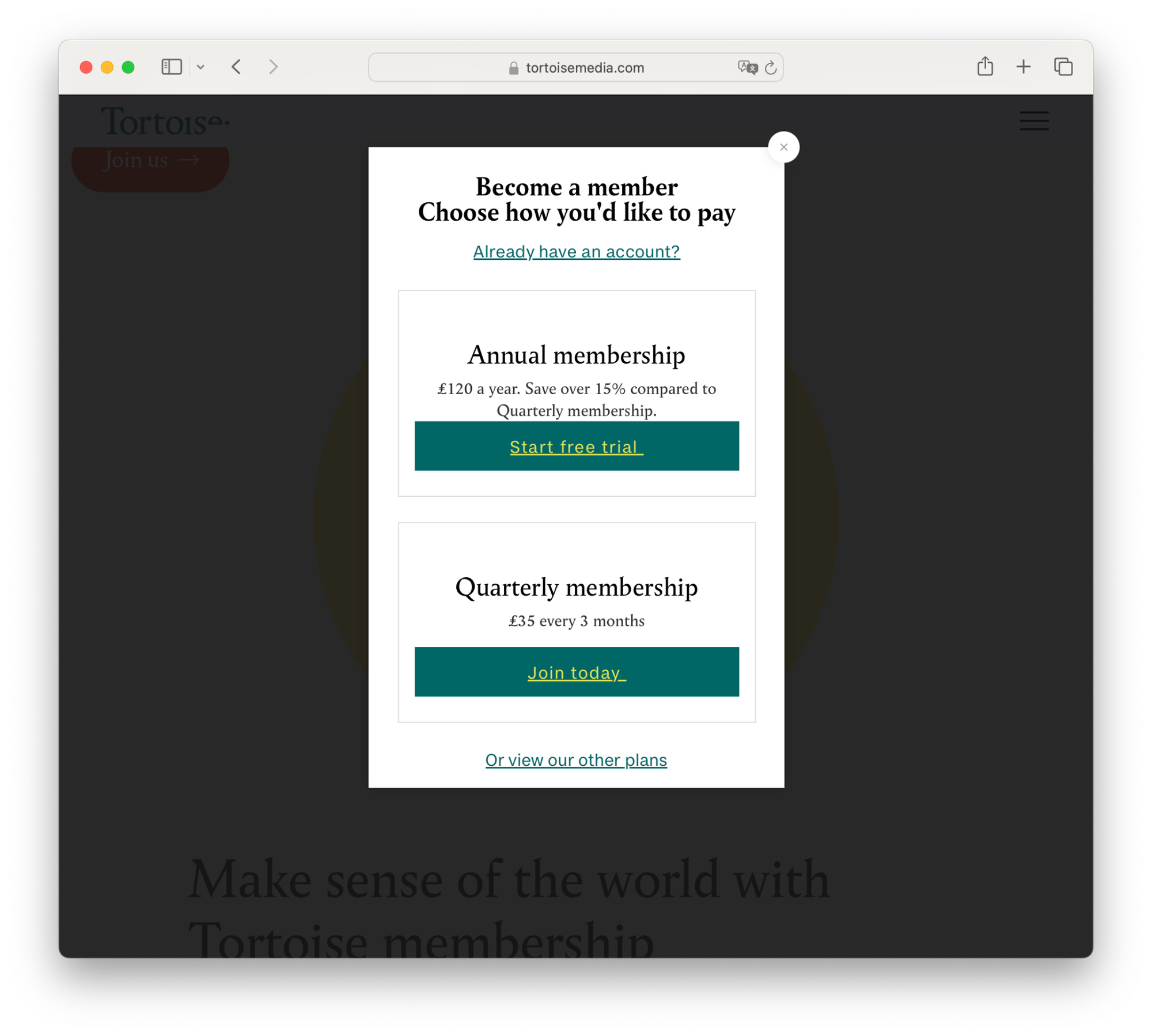
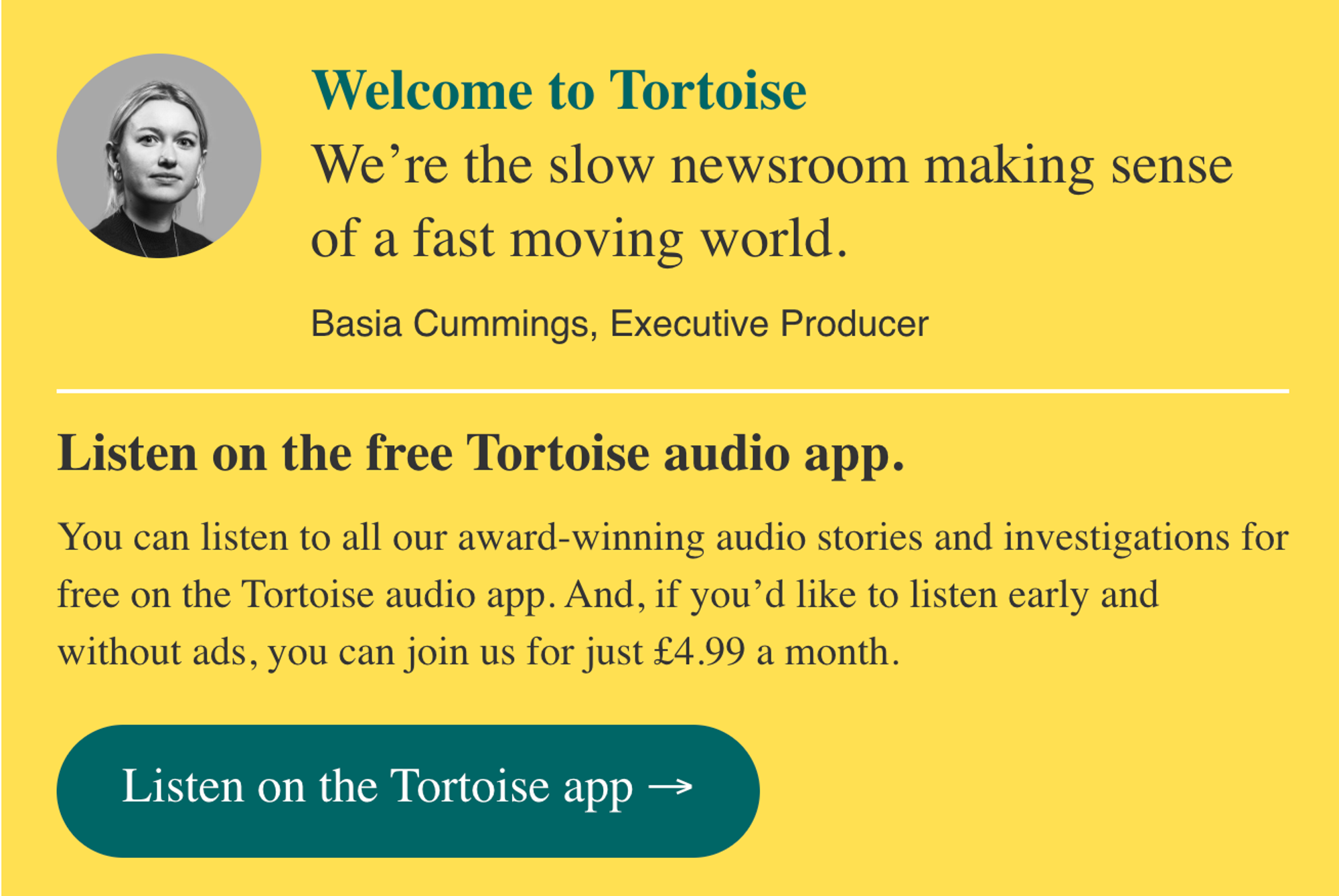
🔗 Pour aller plus loin sur le cas de Tortoise : ⟶ Une analyse de leur passage à l’audio, à lire sur journalism.co.uk ⟶ On vous en dit plus sur les ThinkIn, les formats événementiels de Tortoise, dans l’édition n°15 de notre newsletter.
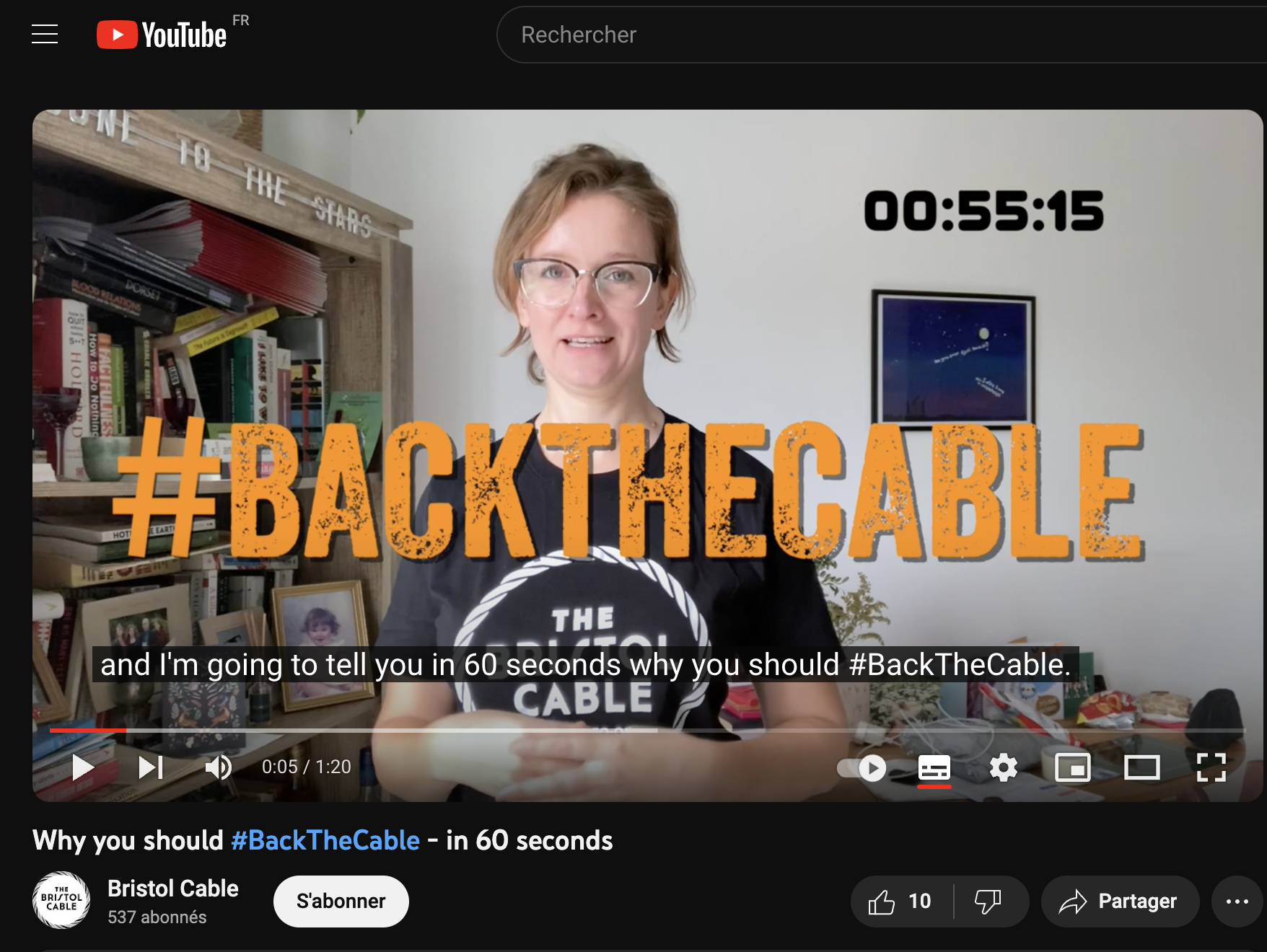
Cas pratique avec The Bristol Cable The Bristol Cable est un média d’enquête local anglais en accès libre qui appartient entièrement à ses 2 700 membres. Les lecteur·rices peuvent devenir membres en payant une cotisation mensuelle ou annuelle. La communauté contribue aux enquêtes grâce à l’outil Cable Links, les citoyen·nes peuvent témoigner pour enrichir des articles comme celui sur l’habitat dans les gratte-ciel. Des événements, recensés dans le calendrier de la communauté, viennent renforcer le lien local.
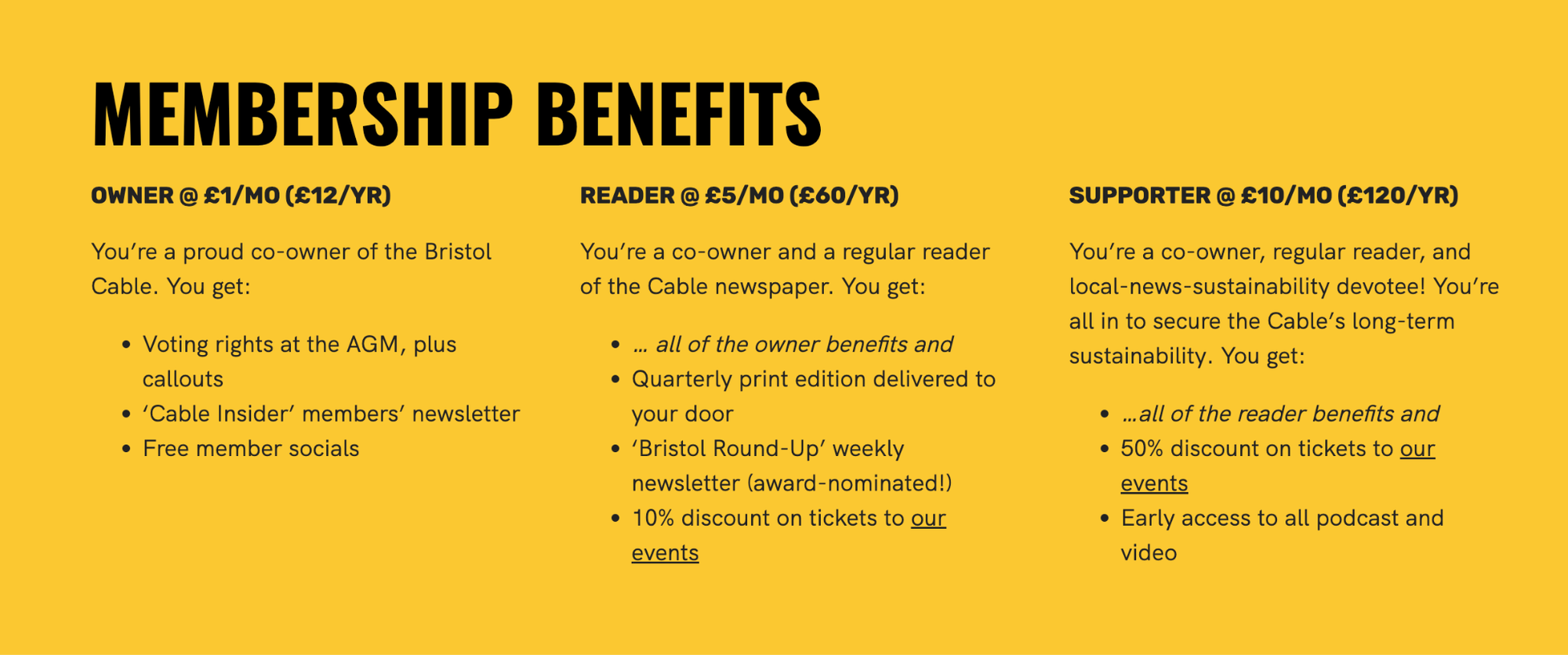
36% of its annual revenue (approximately 375,000 euros) comes from its 2,500 members; the remaining two-thirds come mainly from foundations and grants. To avoid dependence on grants and donors, the media outlet launched a membership drive in late 2023 to increase revenue from its readers by 50%.
D. Du don à l’adhésion
Properly structuring a donation model makes it possible to transition to a membership model (membership encourages recurring donations). To do this, the media outlet must ensure it has a community base that is sufficiently engaged and willing to make recurring payments.
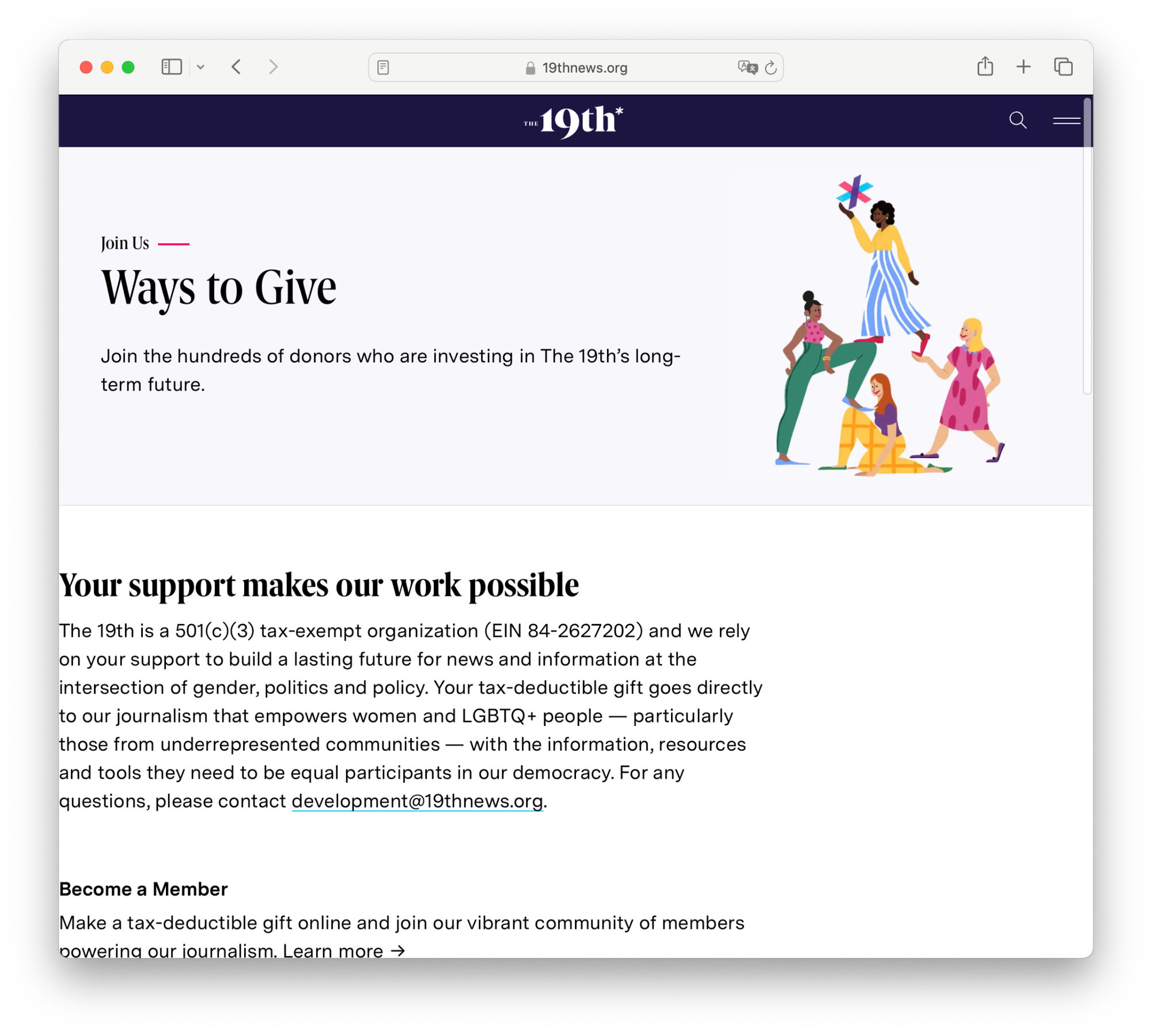
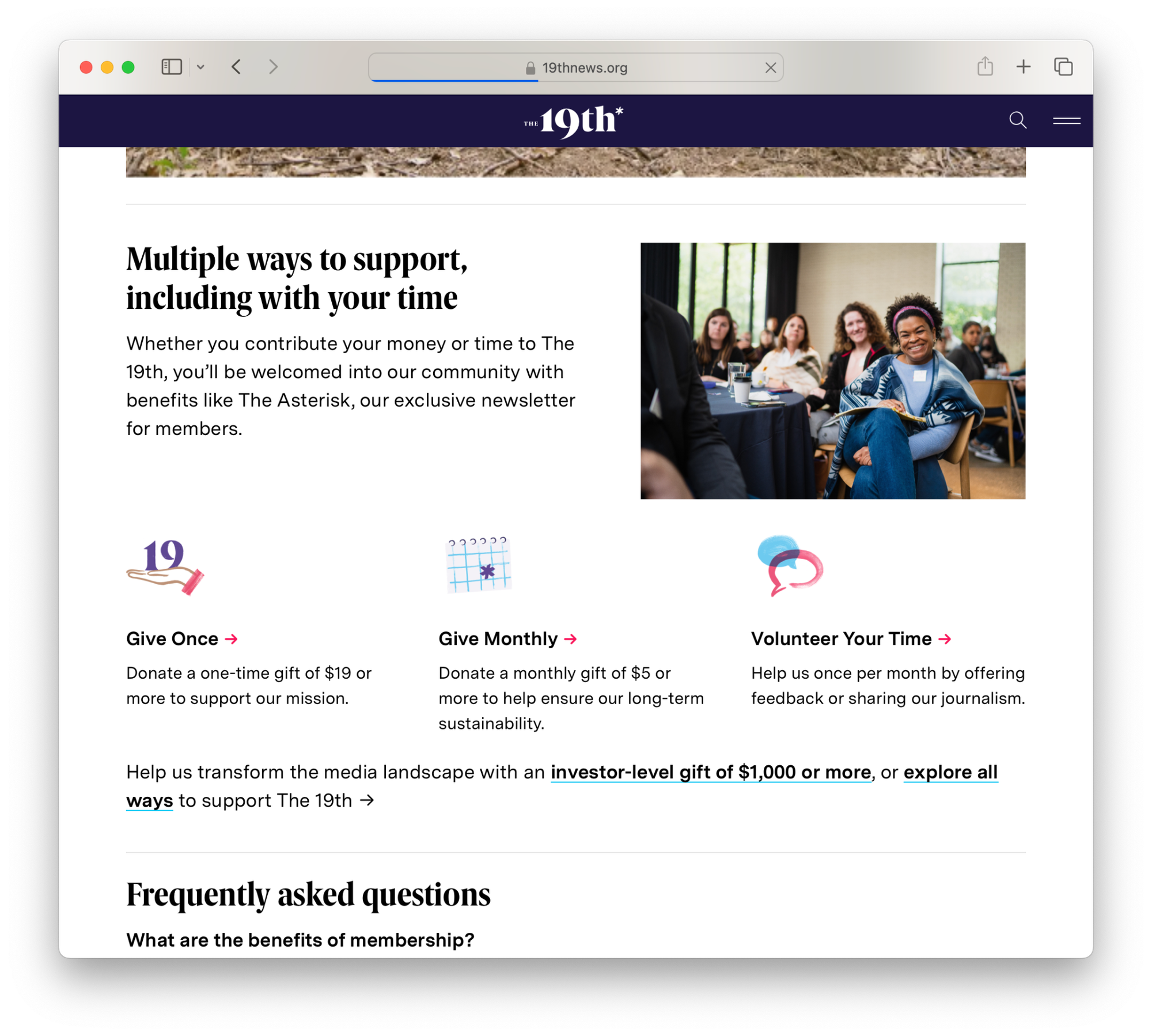
Cas pratique avec The 19th Le média féministe américain The 19th affiche la nécessité de son projet sur le plan démocratique (féminisme) : « Notre objectif est la viabilité à long terme afin de soutenir un avenir durable pour la presse et l’information à l’intersection du genre, de la politique et des politiques ». The 19th s’est lancé en 2020 avec une levée de fonds auprès de grands donateur·ices et repose sur l’adhésion et le support de ses lecteur·rices. Si la proposition est essentiellement symbolique, elle accorde toutefois aux lecteur·rices l’accès à la vie économique du média et aux décisions stratégiques. Les arguments sont les suivants :
- Become a Member: Make a tax-deductible donation online and join our vibrant community of members who support our journalism.
- Make a Major Donation: Help us innovate through your ongoing support and enable us to make significant progress toward our mission and long-term growth. Our community of investors supports The 19th with annual donations of $1,000 or more.
- Planned Giving: Dedicate your legacy to independent, nonprofit media and make a lasting impact on our organization.
- Corporate Support: Expand your reach to a diverse, multigenerational community that seeks to make a meaningful contribution to society.
3. Communiquer sur son modèle économique
In your special relationship with your audiences, you are committed to transparency—all the more so because you are an independent media outlet. Sharing your business model so that readers can understand and accept it—and so that they can get behind it—is a real added value.
Zoom sur StreetPress
StreetPress multiplie les actions pour faciliter la compréhension de son modèle auprès de ses publics. Cette stratégie se déploie d’abord de manière froide, sur la page « À Propos » (renommée habilement « Pourquoi StreetPress » au regard de la proposition de valeur du média) avec un call-to-action « Je fais un don » renvoyant vers la page d’appel aux dons.
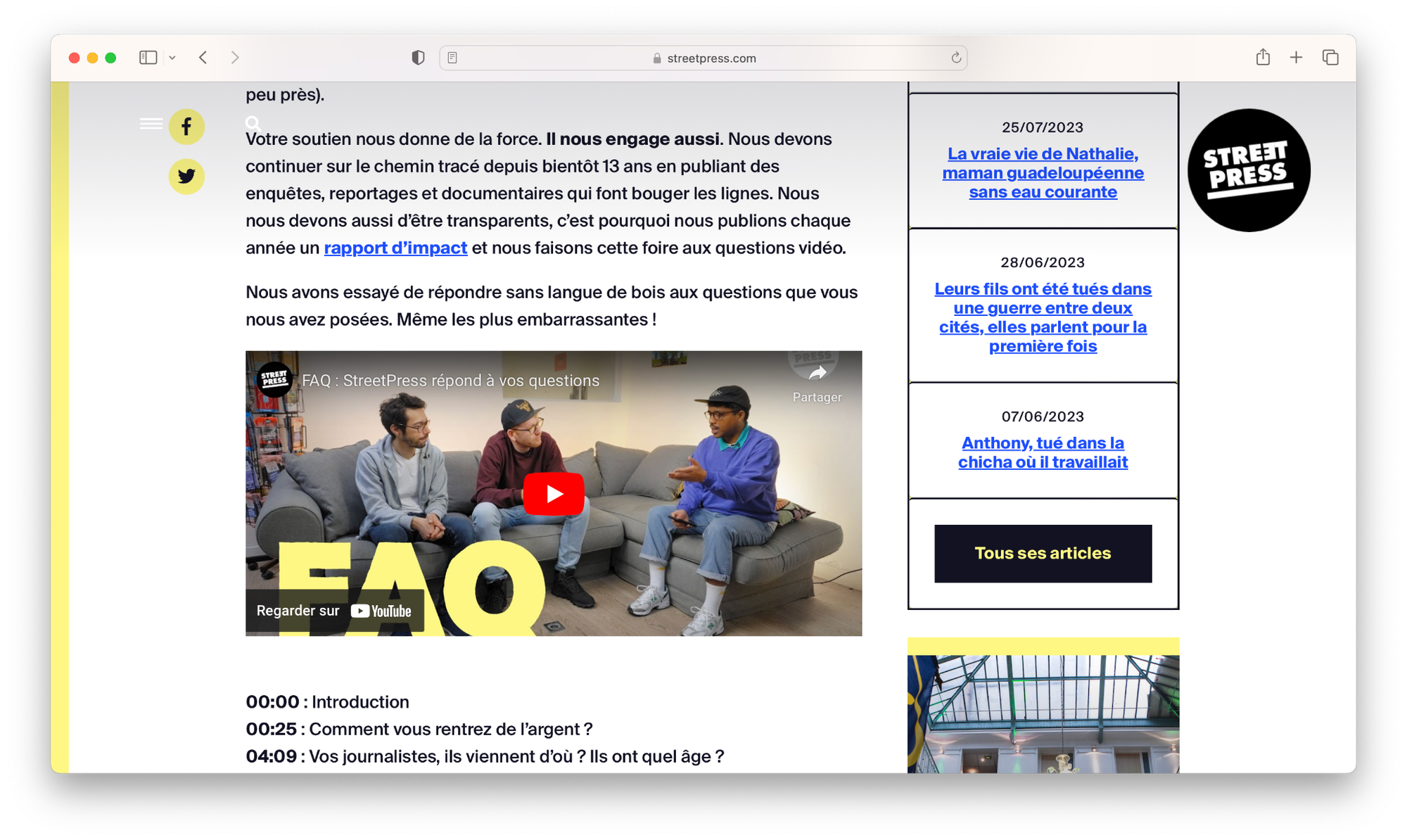
Le média profite également de temps forts pour communiquer sur sa raison d’être, le projet qu’il porte et son modèle économique. En novembre 2022, dans le cadre de sa campagne de dons, StreetPress publiait des contenus (vidéo FAQ, article manifeste, Space Twitter, rapport d’impact) pour expliquer sa démarche.
4. Concrètement, quelles étapes ?
A. Repartir de ses cibles
To provide a cohesive offering and monetize your editorial content, it is essential that you ensure the following:
- Effectively address a specific need of your target audience;
- Offer formats and media tailored to their uses and consumption patterns;
- Offer a price that your customers will perceive as fair for the service provided;
- Offer a pricing structure that is in line with your audiences' financial means.
🔎 Aidez-vous de nos fiches pratiques pour bâtir votre proposition de valeur, vos personæ et votre canevas.
B. Identifier le degré d’adhésion des publics
C. Préparer son plan d’affaire
In a highly competitive media landscape, the challenge is to show how your product stands out and why it’s useful and interesting enough for people to pay for it. It’s not just about creating a balance between supply and demand, but also about offering good value for the price!
- Commencer par choisir le(s) modèle(s) économique(s) adapté(s), en repartant des cibles de votre projet ;
- Construire ensuite les contours de votre business plan ;
- Lister les potentielles sources de revenus, directes ou indirectes ;
- Lister les dépenses allant de pair avec cette stratégie ;
- Develop a plan to track your income and expenses over the next six months.
5. Nos ressources pédagogiques
L’équipe de Médianes vous a préparé deux documents pratiques pour mettre en œuvre les apprentissages de cette fiche à votre propre projet :
- La fiche générale à remplir pour vous épauler dans la définition de vos sources de revenus ;
- Ce tableau qui vous permet de poser votre business plan.
✉️ Vous avez lu et utilisé cette fiche ? Nous avons besoin de vos retours ! Une question ou une remarque ? Écrivez-nous à [email protected]. Merci de votre aide, l’équipe de Médianes.