



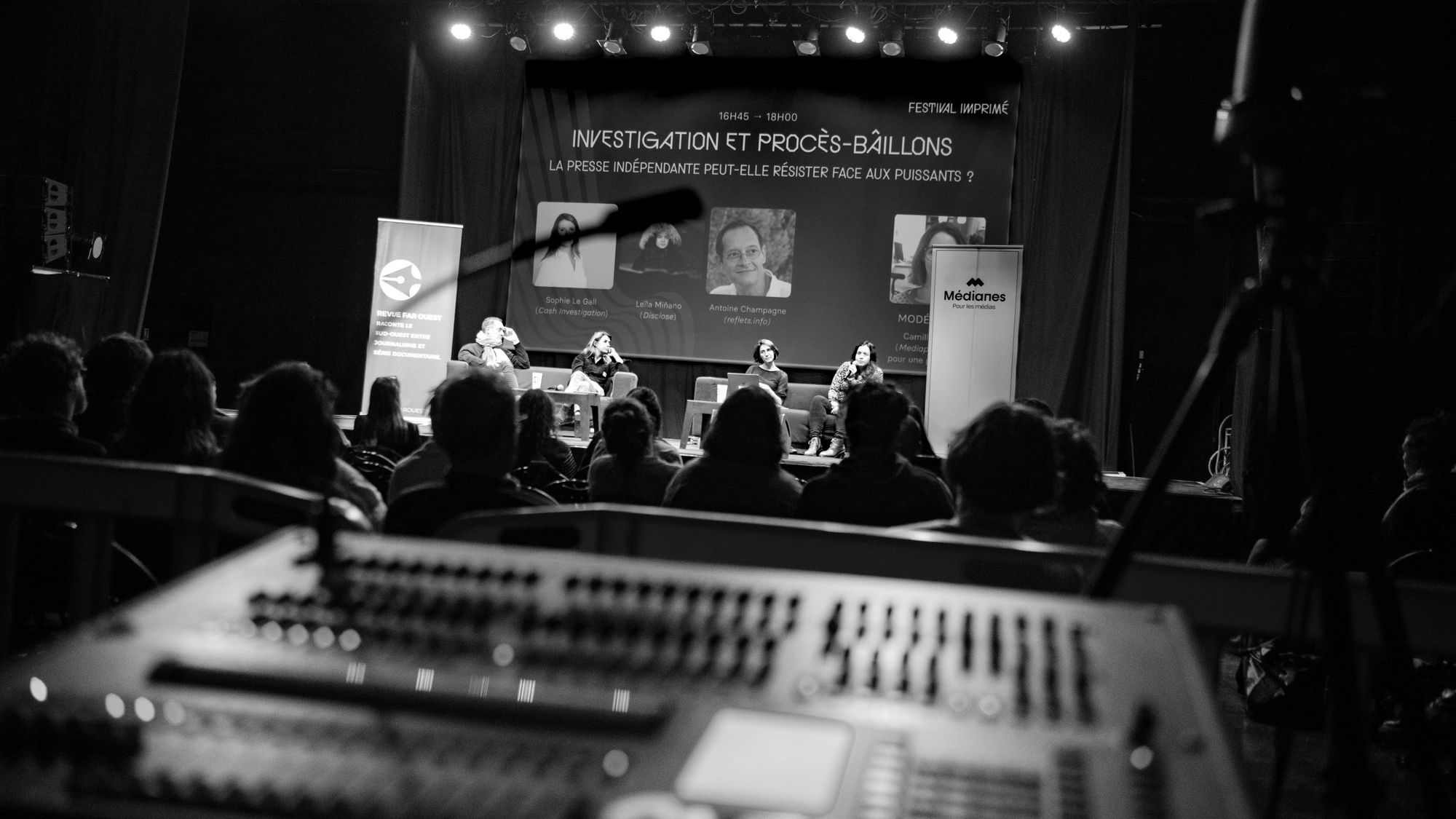
Placing trans identity at the heart of feminist discussions. Examining media coverage of civil disobedience in environmental movements. Speaking about rap, gag orders, femicide. For its second edition, the Imprimé Festival, organized by Médianes and Revue Far Ouest went deeper. Four panel discussions held at Rocher de Palmer in Cenon (33) on Saturday, April 1st explored ecological issues and equality in journalistic coverage, topics already addressed in the first edition, to collectively find ways to build new, more inclusive and more sustainable societal models. Here's a summary.
Feminism and trans identity: giving trans people their place in the media space
Round table discussion moderated by Clémence Postis (Editor-in-Chief of Revue Far Ouest) with Rachel Garrat-Valcarcel (political journalist for 20 Minutes), Maud Royer (feminist activist with the collective #ToutesDesFemmes) and Lexie Agresti (feminist activist and founder of the Instagram account @aggressively_trans).
In France, the number of transgender or non-binary people amounts to more than 180,000. This segment of the population remains far from media attention. How can we restore transgender women's place in the media? A reflection on including those who make up society but are unjustly disparaged or rendered invisible.
Often treated as objects of spectacle and reduced to the stereotypes imposed on them, trans people are still not included in substantive coverage, particularly in Politics and Society sections. "It's time to move beyond shock and inaction," calls out journalist Rachel Garrat-Valcarcel, highlighting the many concrete challenges trans people face in their daily lives, such as finding housing, securing employment, or accessing healthcare. Especially since this lack of visibility can prevent some people from undergoing their gender transition due to the absence of role models.
For her part, Lexie Agresti, founder of the Instagram account @aggressively_trans, shares that she receives death threats every day because of the committed and independent stance she takes. It was in fact due to new threats that Lexie Agresti decided not to speak in person in Bordeaux alongside us, and instead participated by video conference. Today, social media alone offers trans people the opportunity to make their voices heard in the public sphere. The lack of legitimacy in traditional media marginalizes this part of the population and fuels tensions stemming from a lack of education on these issues. Yet, opposing trans people amounts to opposing « equality in general, any progress on gender issues as well as feminists », denounces activist Maud Royer.
Removing rights from trans people necessarily sets back the feminist cause. No feminism without trans women, then. Because for them too, the way they are perceived is misogynistic. "Trans women will have to pay the price that all women pay if they are not feminine, if they are violent, if they take up too much space.", Maud Royer reminds us. What they all have in common? Patriarchal domination.
⟶ To view the full live tweet feed from this conference, visit the Festival Imprimé Twitter account.
When rap media gives a voice to popular culture
Panel hosted by Marine Slavitch (journalist at Médianes) with Lise Lacombe (co-founder of rap magazine Mosaïque), Mekolo Biligui (freelance journalist and contributor to rap show La Récré) and Emmanuelle Carinos Vasquez (doctoral researcher in social sciences, specialist in French rap and journalist for L'Abcdr du son).
Year after year, the rap industry continues to dominate France's Top 50 most-streamed tracks. Yet in the media, this music style continues to be discussed through the lens of violence, when it isn't simply snubbed by music awards ceremonies. To make up for this treatment, rap created its own media outlets in the early 2000s: small specialized blogs launched by fans that became, over time, fixtures of popular culture. Notable examples include Abcdr du Son and Booska-p.
Their success now allows them to address broader social issues, ranging from Islamophobia to sexist and sexual violence. How have rap media managed to reach an audience that traditional media still struggle to reach?
While rap is increasingly making its way into mainstream media outlets, that doesn't necessarily mean it's covered better. Often, rap is covered through a political lens. « It's a distortion that mainstream press often makes. Rap isn't interesting just because poor people are talking about their lifestyle. It's an art », notes researcher Emmanuelle Carinos. Because of this misunderstanding, artists from the rap industry sideline mainstream press and instead focus on promotion through their personal social networks, becoming their own « media », reports journalist Mekolo Biligui.
Following the same logic, some rap enthusiasts began creating their own platforms to share information about this industry. "Specialized media outlets were born on social networks, and it's an influential economy that works," notes Lise Lacombe, co-founder of the magazine Mosaïque. What appeals to audiences is the sense of closeness, authenticity, and family culture that these specialized outlets maintain with artists, far removed from the dismissiveness and misunderstanding of traditional media.
Yet these quasi-friendly relationships — when they aren't financial — sometimes create a problem of media dependence on labels. "Being paid by labels, even if explicitly stated, is a problem," regrets Emmanuelle Carinos. "Being independent or doing volunteer work makes it possible to cover whoever we want, and especially, to critique what we dislike. I think we're lacking critical reviews these days."
⟶ To view the full live tweet feed from this conference, visit the Festival Imprimé Twitter account.
Ecology and civil disobedience: what is the role of media?
Roundtable moderated by Millie Servant (editor-in-chief of Climax magazine) with Patrick Maupin (environmental activist at Greenpeace Bordeaux), Léna Lazare (spokesperson in France for the Youth for Climate movement and member of the Les Soulèvements de la Terre collective) and Laury-Anne Cholez (journalist for Reporterre).
Blocking the construction of mega-basins; disrupting private meetings; chaining themselves to airport fences; deflating SUV tires. Acts of civil disobedience are numerous in alerting us to the urgency of climate change and reminding us that we hold the future of the planet in our hands. Yet fatalism, largely fueled by a discourse of discouragement, tends to pervade public debate, thereby favoring inaction.
In response, citizen movements are emerging to highlight political and civic inaction. Yet the mobilization of these grassroots forces too often suffers from inadequate or misrepresented media coverage… What role for the media in a context of climate emergency?
First, it is necessary to define civil disobedience. Léna Lazare explains these transitions to action as the act of "considering that we have no choice but to go beyond the legal framework to make things change. We believe that our actions are entirely justified in the face of the ongoing ecological devastation."
While protests against the mega-basins at Sainte-Soline have been ongoing for six years, the demonstration on Saturday, March 25 was distinctive for being the scene of violent clashes with over 200 people injured. "Today, a counter-narrative is beginning to emerge in some media outlets like Reporterre but in mainstream press, these actions were presented as coming from black blocs wanting to attack cops. ", comments journalist Laury-Anne Cholez. The reason for this gap? The fact that journalists belong to the dominant classes. " As a journalist, socio-culturally and financially, you move in an ultra-privileged sphere. You have no interest in questioning the foundations that put you at the top of the pyramid ", continues the journalist from Reporterre.
To advance media coverage of these ecological struggles, we must first change the conversation. "Word choice matters, says Millie Servant. Destroying something built by humans is vandalism, destroying something built by nature is progress." Then, we must step back. "A journalist's job isn't to judge, it's to ask why people act the way they do, it's to analyze. I'm not here to judge, I'm here to tell the story," concludes Laury-Anne Cholez.
⟶ To view the full live tweet feed from this conference, visit the Festival Imprimé Twitter account.
Can independent press resist against the powerful?
Roundtable moderated by Camille Polloni (journalist at Mediapart, board member of the Fund for a Free Press and partner of the Imprimé Festival) with Sophie Le Gall (editor-in-chief of Cash Investigation), Leïla Miñano (journalist, secretary general of the investigative outlet Disclose) and Antoine Champagne (editor-in-chief of the investigative website Reflets.info).
Patrick Drahi against media outlet Reflets.info, Gaël Perdriau against Mediapart, Thierry Kovacs against Mediacités. Over the past year, media outlets have faced numerous strategic lawsuits: legal attacks designed to prevent the press from conducting investigations. Power dynamics, institutional dysfunction, injustices, abusive behavior… Attacks that serve a phenomenon: media concentration and the stifling of independent journalism. Can it survive in the face of the powerful?
“Mediapart spends €200,000 a year on legal fees to defend itself,” Camille Polloni points out. That’s why it’s essential to weigh and verify every word in an investigative article. “We no longer discuss our articles just with an editor or editor-in-chief; we have them reviewed by a lawyer. Every time we’re summoned, every time we receive questions by email, we’re with our lawyer,” emphasizes Leïla Miñano, a journalist at Disclose. This enormous legal pressure sometimes causes media outlets to back down and prevents them from publishing certain information due to a lack of sufficient resources.
Faced with billionaires like Patrick Drahi, Antoine Champagne, editor-in-chief of Reflets.info, resorted to crowdfunding to finance his legal costs. "We could change things and say that when a company loses against a newspaper, it covers its legal costs," the journalist argues. Like Mediapart facing Saint-Étienne's mayor Gaël Perdriau, Reflets.info experienced prior restraint [the practice of censoring an article before publication, ed.] on its revelations about Patrick Drahi, accusing them of breaching trade secrets. Circumventions of press freedom that have been increasing lately.
These gag-order procedures also send an alarming message to journalists' sources. « It's extremely distressing to realize that you've exposed your source to potential retaliation», says Leïla Miñano. Especially as media outlets sometimes play along with the powerful. « We're not naive about certain media outlets that always publish the same type of stories against us. We've seen, particularly in the case of Lidl [an investigation by the program into the inner workings of the German retailer and its working conditions, editor's note], in court documents, articles that disparaged us», says Sophie Le Gall, editor-in-chief of Cash Investigation.
⟶ To view the full live tweet feed from this conference, visit the Festival Imprimé Twitter account.
Femicide: A Lack of Understanding in
the Media
A roundtable discussion moderated by Amandine Sanial (journalist at Revue Far Ouest) featuring Laurène Daycard (journalist and author of *Nos Absentes*, which sheds light on femicides) and Sarah Barukh (author of *125* and *Des milliers*).
Their names were Salomé, Géraldine, Myriam, and Sylvia. Like more than 2,000 other women over the past fifteen years, they were killed by their partners or ex-partners. Although femicide has been declared a “major cause of the five-year term,” the government still fails to protect women from male violence. The media also bear some responsibility for treating these cases as isolated incidents when they are part of a systemic problem: why publish wedding photos to illustrate a femicide? Why write that “nothing foreshadowed such a tragedy” when the victim had filed complaints multiple times?
"In France, femicides have long been linked to 'the expression of passion by drawing parallels between concepts that have nothing to do with one another: love, possession, and violence,'" Laurène Daycard points out. Hence the infamous “crimes of passion,” a phrase all too often found in the crime sections of traditional media.
Drawing on her own experience with domestic violence, Sarah Barukh sought, in her book *125 and Thousands*, “to tell the story of what made the victims unique individuals who were loved and had dreams.” ” This was a way to move beyond statistics, which, while necessary, can sometimes dehumanize the victims of these crimes. In *Nos Absentes*, Laurène Daycard explored the roots of femicide, which she describes as a societal disease: “Domestic violence functions as a hostage situation within the victim’s private life, in which the victim is held for months or even years. It takes many forms: financial abuse, micromanagement of daily life, control over household chores…”
⟶ To view the full live tweet feed from this conference, visit the Festival Imprimé Twitter account.
Editor’s Note: The studio is supporting Climax (Millie Servant) in its strategic development and Youpress (Leïla Miñano/Disclose) in the launch of the investigation “Femmes à abattre.” MédianesIt is also co-producingMédianes the Festival Imprimé alongside *La Revue Far Ouest*.
You can find the detailed program for the event and the list of our partners on the Festival Imprimé website.


