


It all started with an Instagram story: " Monday, April 14th, it'll be the 10th Croque-Marseille aperitif ! If you work in food and want to come, let me know via DM 🙂 ". A special edition, clarifies Ezéchiel Zérah, founder of Croque-Marseille : " An American TV network will film the event: no-shows are out of the question ".
At Médianes, we've been following Ezéchiel's work for quite some time. For five years, this food journalist, published in Le Monde and Libération, has been feeding Pomélo — 6,000 paying subscribers — a flagship newsletter on culinary trends in France and abroad. At the same time, the journalist is developing Croque-Marseille, an Instagram account featuring top dining spots in "France's new gastronomic capital", as he calls it. A more accessible, service-oriented media focused on community. What sets it apart? The famous "apéros".

Every month, in her living room, a large Tupperware gathering with about fifty players in Marseille's food scene: chefs, cooks, bakers, pastry chefs, sommeliers and mushroom producers, yes, but also journalists, influencers, communicators, publishers, photographers, designers, people working in events, creating brands, opening venues… Everyone brings something to drink or nibble on, and conversations start naturally. The deliberately informal environment fosters direct, genuine interactions and sparks lasting connections between participants. By betting on conviviality, Croque-Marseille's aperitifs allow the media outlet to strengthen its community, as well as its local roots.
An intimate and welcoming space, designed for gathering
The idea came about following the publication of Ezéchiel's book, Marseille, A Day Without Hunger! published by Hachette in November 2023. "It's a bible of Marseille gastronomy with around thirty contributors," explains the journalist. The desire to extend the book through these events came naturally, especially since I need to constantly meet new people to feed the various media outlets and projects I'm working on". The goal: to strengthen visibility, network and community engagement by building on the credibility acquired by the book. What better setting than an intimate, warm space designed for connection?
Among the roughly fifty people in his living room, about a dozen will soon be opening cafés or restaurants and thus give Ezéchiel the scoop. « Since we're in an informal setting, there's no longer a barrier between interviewer and interviewee. It's my home, they talk to me about their news, their projects. I always ask them before discussing it publicly, but there's a very free-flowing aspect to it », he points out.
These events don't just benefit the journalist. They give everyone the opportunity to exchange with their peers about the profession, but also to find work or create collaborations.
First exchanges on WhatsApp
I'm in luck—there are still a few spots left when I ask Ezéchiel if I can join the next aperitif. Without hesitation, I'm added to a WhatsApp group that functions as a pre-engagement space. Before the event even takes place, participants have the opportunity to get to know each other and start interacting. A great way to strengthen community spirit and facilitate networking on the day itself. This time, there are fifty-two of us. Everyone introduces themselves and shares their Instagram account link.

There are some jokers around. "Hey, I'm le Muge and I'm bringing Ricard," warns one Jacquemuge. "Hello, I'm Driss from la Meulerie and I'm coming with cheese that will go really well with our friend le Muge's Ricard." Ezéchiel also points out the presence of the creator of Huile Smith, supposedly a very good olive oil.
There are also very serious people. « I've been in Marseille for about ten years, and I'm committed to highlighting those who make local food by helping to build connections between players in the industry ». « I'm in the process of opening a restaurant-bakery in Marseille. Beautiful, good, well-sourced with respect for people and animals. »
And then, more cryptic messages. « I will come with my pumps, and surely some other surprises. »
Myself, I'm hopeless in the kitchen but I more or less master baking cookies so there you have it, I'm saying I'll bring those. I'm also including the link to the Instagram account for Médianes and I think we're gaining about twenty followers just like that.
Everyone in socks
Ezéchiel's apartment is easy to spot—it's the one with a mountain of shoes piled up in front of the door.

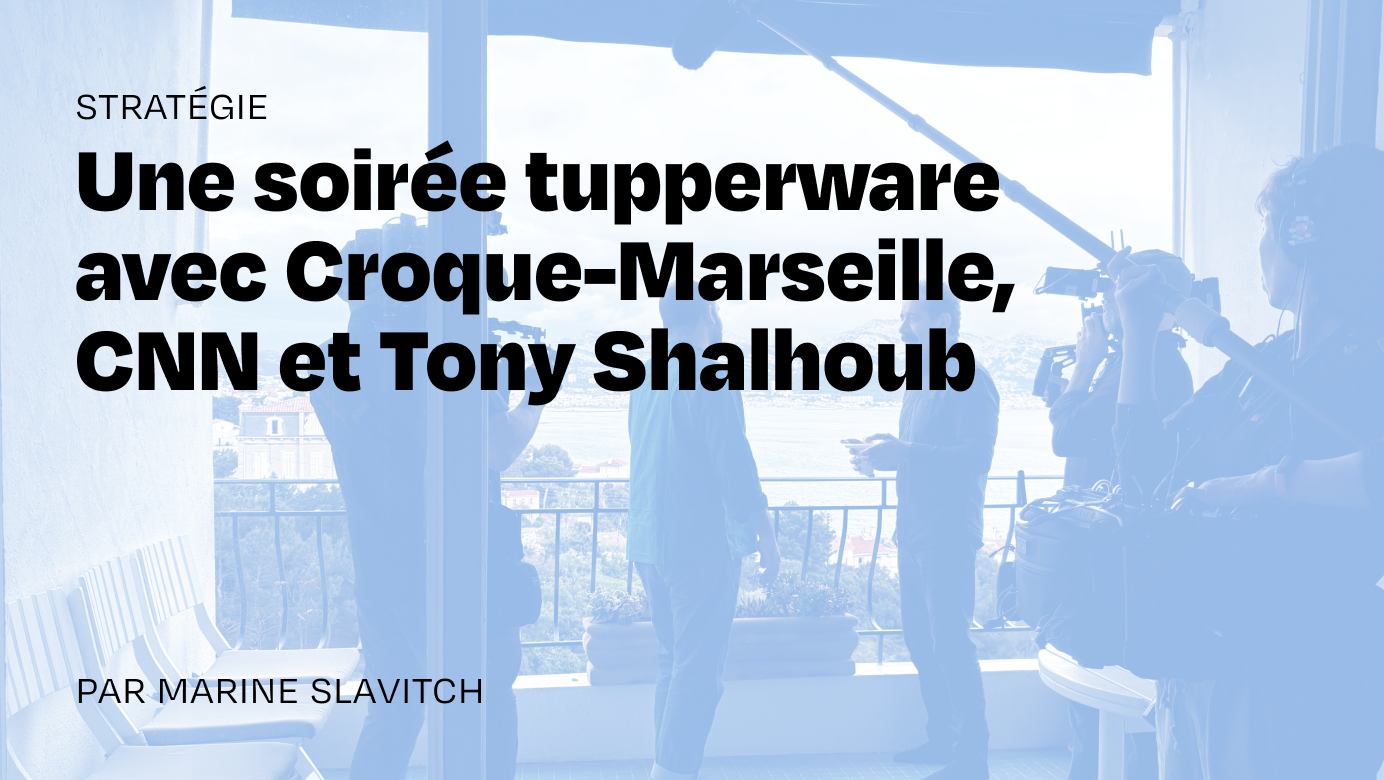
This evening, everyone in socks so as not to stain the carpet. A woman photographs me and asks for my name and surname "for the Americans". The living room opens onto a large balcony with sea views where two camera operators and a boom operator are busy not to miss a word of the conversation taking place between Ezéchiel and Tony Shalhoub, the lead actor in the Monk series. You don't understand everything? Imagine how I feel.
Later, Ezéchiel fills me in: "CNN is preparing a culinary documentary series coming out at the end of the year. It's called Breaking Bread, and the host is Tony Shalhoub, who's also a co-owner of the Michelin-starred Italian restaurant Rezdôra in New York. They've done Brazil, Lebanon, and now they're wrapping up the France episode by showcasing the Croque-Marseille aperitif. " Here, no special treatment. Monk is in his socks, just like everyone else.
The Americans eventually bring their cameras to the kitchen side, allowing the balcony to host the first rounds of gossip. « I heard the actor came with his bodyguard? » — « Yes, he's the guy in socks on the stairs. He insists on keeping the front door open. He's very nice, I gave him a piece of chicken. »
Meetings and reconciliations
Between two agenda changes, Ezéchiel navigates between groups and takes the opportunity to make introductions. His superpower? Finding common ground with everyone.
" When you go to a professional networking event, it's super intimidating. Here, you barely have time to take your shoes off before you're already talking to someone. "
« Ezéchiel is a very welcoming host. He introduced me to the founder of the Howard restaurant. The best burgers in Marseille! I was able to tell him how much I loved his cooking », says Cassandre, founder of the culinary events agency La Spatule. Beside her, Alice, cofounder of Local Club, a creative agency of designers, architects and artists that helps restaurant owners open venues, confirms: « When you go to a professional networking event, it's super intimidating, you never quite know where to stand, how to introduce yourself. Here, you barely have time to take off your shoes before you're already talking to someone. »
With rare exceptions, here, plus-ones are not allowed. You come alone and conversations happen naturally. In the kitchen, Sidi, chef and manager of Château Beaupin – Pavillon Sedille, a hotel restaurant and spa at Pointe-Rouge, has just met Livan, a cook at Howard — the famous "best burgers in Marseille." " I saw him making fried chicken, I saw mushrooms next to it, and I thought, let's go, we'll make fried mushrooms. We made a kind of tempura with a little marinade on the side, it's a little vegetarian thing. " Sidi didn't know Livan. Now, "he's [s]his boy ".

" This guy shows up and tells me "Oh, you invited so-and-so? He owes me money". »
While most people who cross paths end up staying in touch, as in any tight-knit circle, tensions sometimes resurface. On the hunt for anecdotes, some mention a dark affair. A few months ago, in this salon, there supposedly was a fight. It's through talking with Valentine, Ezéchiel's partner, that I finally get the full story. "At an aperitif, we had the chef of a very well-known gourmet restaurant in Marseille. It turned out that that evening there was also a journalist who had written a terrible article about his cooking. We were worried it might come to blows, and in the end they laughed together—it was all very good-natured." Ezéchiel confirms: "He was a bit shaky at first, but they talked, and that's what interests me. There are times when I've invited people and the guy arrives and tells me 'Ah, you invited so-and-so? He owes me money.'" That's the thing about aperitifs: (re)creating connections.
For Héloïse and Ngoc-Hân, who organize culinary events, the evening was already off to a great start: "In two conversations, we've already come up with new residency ideas. Just now, a girl was telling me about her events company and the possibility of organizing events together. We're exchanging Instagram handles, it's working out great!" Nearby, Arthur, a baker and co-manager of the GRIGNE coffee shop, prefers to let things unfold. "I have no idea what I'm looking for, I'm not planning anything and whatever happens, happens. Coming here is a bit like squeezing a fruit you happened to find in nature. It might turn out disgusting, but at least you'll have learned how to do it. We'll see what we end up with."
Towards new places
In just under a year, Ezéchiel received nearly six hundred people. "I don't have the audience of La Marseillaise or La Provence, but I have the flexibility to do this kind of thing. All these people I've welcomed, it's an incredible database."
Soon, he would like to bring together everyone who has passed through his living room in a larger venue, so that everyone can meet. Because at each gathering, different people come. Only a handful of privileged people (and friends of the founder of Croque-Marseille) are allowed to experience it again. Despite this success, the journalist is not (yet) thinking of monetizing these events. "I've been offered the chance, but that's really not the spirit of an informal evening in socks."

As for the future of Croque-Marseille, Ezéchiel imagines it more in print format, but always tied to the idea of fostering encounters. "I'd really like to create a magazine that would only be distributed in cafés, for example. We'd keep that personal touch, that connection aspect: readers would in any case have to go out and find it." The idea reminds us of Marsactu, a Marseille investigative media outlet that makes its online newspaper freely accessible via QR codes placed in cafés and community centers.
Another idea: take the drinks elsewhere. Why not Paris? "I love tribal cities, those where modern and traditional types cross paths without actually meeting," smiles the journalist. When you start exploring the possibilities, you realize these drinks could adapt to other circles. "Imagine a gathering with the head of Radio France and someone creating a fanzine about Formula 1 drivers!" What unites them: journalism, the desire to explore, to capture the times. We told you Ezéchiel had a real talent for finding common ground.
To go further
- With Marsactu Unlimited, the media outlet offers free access to its content in various locations, including cafés and community centers. By making its offering tangible, it hopes to reach new audiences, sometimes disconnected from news, while reducing its dependence on digital platforms.
- Collages or digital campaigns, media outlets are inventing new ways to occupy public space. Here are some recent or less recent examples from Brut, Usbek & Rica and Merci Simone, which might give you some ideas.
- Membership as an editorial and economic model requires converting readers into genuine members. When The Bristol Cable includes its audience in the editorial process, Scalawag organizes events for its community, and Zetland turns its subscribers into media ambassadors.
- It's a bubble where people come to find refuge. A space open to those who share the same passion or values. Even VIPs find it worthwhile, seeing it as an exclusive circle to cultivate their network. Long reserved for the nonprofit and business sectors, what if media outlets also began to form clubs?
- To stay connected with their audience, media outlets are multiplying formats that integrate citizens. Overview from Reporters without Borders, France Inter, Ouest-France and Centre-France.


