Definition Elements
What is an audience study? 🤔
An audience study is a monograph, namely a study limited to a specific object X at a specific time T based on empirical analysis of concrete facts and data. In this case, specifically in our case, an audience study is an analysis of the existing and/or target audiences of a media outlet at a given moment in the existence of this project.
An audience study aims to refine understanding of targets, their needs and their usage patterns in order to offer them tailored editorial products. It is part of broader work on audience insight: creating personas, analytically tracking audiences, etc.
An audience study draws on marketing knowledge but also and especially on sociology. Its methodology and construction share certain aspects with reception studies developed in the humanities and social sciences.
It is underpinned by specific axes that make it possible to find useful answers for the media through precise questions. The more an audience study is precise, prepared in advance, specific to the project, to its needs, to what it must know about its audiences in order to solve its problem/evolve, the more effective the audience study becomes.
The audience study is both quantitative and qualitative. It thus covers:
- Quantified, concrete, and varied data that depends on the questions asked to audiences. For example, it could involve measuring the percentage of viewership by age group, finding out the average budget of users regarding paid media and cultural subscriptions per month, measuring the conversion rate and subscription take-up from a free newsletter sign-up, the engagement rate on social networks, etc.
- Qualitative data that depends on the questions asked of the public. A distinctive feature of this data is that it requires greater use of scientific concepts drawn from the humanities, social sciences, or marketing in order to be analyzed. It helps us understand how things work and how people behave, as well as gain insight into audiences’ perspectives, opinions, feelings, needs, habits, and potential desires. This might involve, for example, understanding when, for how long, through which medium, and in what formats a user feels most comfortable; understanding what prompted them to subscribe or unsubscribe; their relationship with the media; their grievances; their expectations for the future; and so on.
Why conduct an audience research study?
Address lack of understanding of your audiences 😶🌫️
All too often, precise knowledge of audiences is overlooked – even in the media world. Yet audiences should always be placed at the heart of projects, particularly editorial strategies, communications, and marketing. Audiences should be a backbone from which the media develops, evolves, and deploys its project.
It's important to remember that media is not created for oneself but for others—for audiences you want to share a certain type of information with for one reason or another. To do this effectively, you must understand your audiences' profiles, their mental frameworks, their media landscape, their needs, their habits, their preferred formats and platforms, their reasoning patterns, and more generally their tastes and financial means. Audience analysis thus supports the broader work of creating personas, which typically runs in parallel with or even precedes the audience study itself.
If the media outlet does not know its audiences, their profile(s), their gender, their age, their habits, their preferred content, the media they consume, their budget dedicated to media, information and culture, their satisfaction level and their relationship with the media outlet, their sensitivities in terms of preferred content/formats/platforms, an audience study seems necessary.
Support the media outlet through different stages of its life 👥
Likewise, audience research makes it possible to fill the gap in a media outlet's knowledge of its audiences. It can be general and allow for a comprehensive profile of audiences at a given point in time, but it can also be more specific and allow for a deeper examination of certain aspects necessary for redirecting a media outlet's strategy, ensuring its proper development, its redesign, its rebranding (modification of its brand image), etc.
As a snapshot in time, it goes without saying that audience research must be repeated regularly to track changes in audiences (profiles, needs, engagement, satisfaction) and keep them at the center of the media outlet's strategy. This allows the media to measure the success or failure of implemented strategies, new content, and new formats.
Audience research can be conducted at different stages of a media outlet's existence:
- Before launching their project, to conduct market research ;
- Shortly after launch, 6 months to a year later once an initial community has already formed;
- Annually, to stay connected with audiences, their developments, and their feedback;
- As part of a new positioning, an overhaul of the editorial line, an evolution of the media's value proposition;
- As part of the evolution and development of the media (new formats, new types of content, new platforms, etc.) ;
- In the event of a crisis situation (mass unsubscriptions, significant drop in media visits/purchases).
Limitations of an audience measurement study
However, it should be noted that an audience study has limitations.
First, if it is imprecise in the questions asked, the usable data will be weak and will not provide the material needed to develop an effective strategy.
Secondly, an audience study cannot be as comprehensive as one might hope and must not take more than 5 to 8 minutes for the user, since the user must agree to participate. Also, the audience study must be short, engaging, potentially fun, above all precise, and must not require the user to make an effort to read, understand, or write.
Third, we must take into account the fact that responses given by audiences are not necessarily complete, nuanced, or entirely candid. Indeed, the user will agree to reveal part of their opinion and usage patterns, but may not disclose everything, nor will they necessarily be entirely accurate or transparent.
That said, an audience study makes it possible to identify trends, directions, formulate hypotheses, and propose avenues for reflection and exploration, but it does not have the value of absolute, complete, or immutable truth.
Finally, an audience study is just one step among several for understanding your audience. Other steps include analyzing usage based on existing studies, creating personas, analyzing your channels' metrics, and conducting qualitative interviews.
How to conduct an audience analysis?
Start from your media project
Vision and editorial direction, values, content, formats, tone, user journey: Make sure you have a clear understanding of your project.
Your initial insights into your audiences will help you identify some initial areas to explore in your audience research.
Before you begin designing the questionnaire, start with the identified/target audiences. Whether you’re drawing on more general studies or your personas.
Your role is essential to the successful distribution of the questionnaire. Make sure that the format is as consistent as the content, and that your team is fully informed about its distribution and communication.
Ask yourself the right questions
An audience study must serve a clear objective of the media project. Without a clear vision, the data will be difficult to use.
Before designing a questionnaire, it is essential to ask yourself what kinds of answers you want to obtain and on what topics. For example, you might want to:
👉 Dresser un portrait-robot — Avoir une connaissance plus fine des profils de l’audience actuelle ou recherchée (lecteur·ices, contributeur·ices, donateur·ices, abonné·es à la newsletter ou aux réseaux sociaux) ;
👉 Assess engagement — Learn more about an audience’s existing or potential sense of belonging to a specific topic, cause, or media platform.
👉 Assess satisfaction — Gather feedback from the community on the editorial formats and content of an existing media outlet, or on usage patterns and media coverage of a particular topic;
👉 Assess understanding — Gain a clearer picture of what the target/current audience understands about the media outlet’s value proposition (editorial line, approach to topics/subjects) or the specific topic/subject being covered.
Would you like to extend the experience afterward? Invite your audience to express their interest by signing up for a newsletter or providing more detailed answers during an interview, for example.
Organize Your Questionnaire
Divide your questionnaire into several sections by topic (for example, 1. Respondent profile and usage; 2. Current relationship with the media; 3. The future of the media);
Write short introductions for each section to present the media outlet, including details relevant to that section, in order to accurately convey the outlet’s identity, current offerings, and objectives.
Keep the user experience in mind when designing the questionnaire: the more concise the questionnaire is, the less likely respondents are to abandon it halfway through!
Keep in mind that this questionnaire may be shared outside the media outlet’s channels (newsletter, social media, website); as such, it serves as a communication tool for the media outlet.
Be sure to ask respondents for their email addresses if you feel it is necessary, and at the same time explain how and by whom this information will be used.
Be specific when designing your questionnaire
Use existing categories as a starting point to develop your questions (age groups; socioeconomic status; usage patterns) and draw on existing studies (such as the Digital News Report, or any other study relevant to your project).
Identify specific areas you want to explore, which will lead to a series of questions. Ask clear, concise questions—get straight to the point.
Provide as much context as possible for your questions. Use subheadings to clarify your points or provide examples. You can also add visuals to break up your questionnaire, if they are helpful.
Embed Your Survey
When embedding surveys, we often use Typeform and Tally. There are also open-source solutions available. The most important thing is that the tool be suited to your needs and those of your audience.
In the questionnaire, use single-choice or multiple-choice questions rather than open-ended questions to make data processing easier. If you include open-ended questions, limit the length of the responses.
Use colors and formatting that are consistent with your project's visual identity.
Share your audience research
How many responses would you like to receive? At what point will you be satisfied with this survey? Set your goals before publishing the survey. For an existing audience, the ideal is to aim for 10% of that audience. This figure should be considered in the context of the nature of your questionnaire and the stage of your project.
The study should be shared with the target audience—whether internal or external—through the team’s and media outlet’s own channels (website, social media, newsletter, radio, video, etc.). The study may also be shared on external platforms, media outlets, and groups (Facebook, LinkedIn) with similar target audiences.
To maximize the number of responses and ensure the sample is as representative as possible, we recommend running the survey for at least two weeks. This timeframe should be considered in context and adapted to the target audience and the publication schedule of the media outlet.
Be sure to encourage your target audience to take your survey—by highlighting the benefits, offering a prize, etc. And say thank you! Your audience is taking the time to complete your survey, so treat them well.
Promote the release of your audience survey by creating dedicated content on your website, social media, or in your newsletter to introduce the survey and its objectives to your community. The goal is to inspire your audience to get involved and help you.
You can share the results of your audience survey and offer tailored content across your various distribution channels. You can also announce the changes you’ll implement based on your audiences’ responses to strengthen your connection with them.
Review the Results of Your Audience Study
Once your survey is complete, it’s time to move on to analyzing the responses. Be sure to close the survey in the tool you used to process a specific number of responses. You can use the summary generated by Typeform to help guide your analysis.
Once again, feel free to compare these findings with existing studies (Reuters Digital News Report, INSEE, Mediamétrie, etc.).
Compile the study’s findings, section by section, into a single document, summarizing the methodology used and highlighting both qualitative and quantitative data.
Think about the best way to visualize your data (data visualization screenshots, key metrics), and then share the results with your team, those who took the time to respond, potential partners, your community… through the appropriate channels (newsletter, social media).
Finally, make your strategic decisions and guide your actions based on the study’s findings.
Make studying a part of your routine: go ahead and schedule your next study session!
Drawing inspiration from other studies
When creating your audience study, feel free to draw inspiration from various audience studies focused on topics different from your own, while keeping your specific objective in mind (gaining a comprehensive understanding of your audiences, repositioning your brand identity, strategic realignment, launching new content or a new format, a post-launch review after one year, etc.).
To illustrate, here are a few examples
Audience studies conducted by media outlets we work with through our studio 🫶
- Kometa: An initial audience survey conducted in conjunction with the media outlet’s pre-launch, shared in the first newsletter sent to subscribers who signed up on the launch page — 2023
- The Dial: An Initial Audience Study, a Few Months After the Launch of the Email-Shared Media Platform — 2023
- Snapshot: The first audience survey of the outlet’s readers (both subscribers and non-subscribers), 15 years after its launch. The survey gathered nearly 6,500 responses. The publication’s team also publicized the study and shared our analysis report — 2022
- La Déferlante : une étude communauté, un an après le lancement de sa newsletter ; Partage du bilan de l’étude communauté via une newsletter et sur Instagram — 2022, 2021
- Vert: An Initial Audience Study, Two Years After the Publication’s Launch, Among Newsletter Subscribers — 2022
- Country: Community Survey, one year after the project’s launch, and a dedicated email to share the survey — 2022
- Basta!: An audience study focusing on a specific editorial product—the “Chez les Indés” newsletter—conducted via an online survey and a communication campaign — 2022.
- Mediabask: An audience study to envision the future of local news media, in French and Basque, shared on social media — 2022.
- Les Jours: A survey sent via email to better understand the media’s readers’ expectations regarding TV series — 2022
- *La Disparition*: A satisfaction survey regarding a print publication, sent out a few months after the project’s launch — 2022
- StreetPress: An Audience Study of the Media Outlet’s YouTube Channel — 2022
- La Revue Écossaise: A Market Study Conducted Before the Project's Launch, Shared on Facebook — 2021
- euradio: an audience and readership survey conducted ahead of the media outlet’s digital overhaul, published on its website, on euradio’s radio station, and on its social media channels — 2021
- Les Others: A series of shared surveys to launch and test a new editorial product: Recto Verso. — 2021
- Ville Hybride: Community Survey to Launch a Magazine as Part of an Existing Project — 2020
- Médianes: We also conduct an annual audience survey for our own content—as we did in 2022 and 2021—as well as to test our how-to guides and to launch our project in 2020. — 2022, 2021, 2020
Audience studies from around the world 🕵️
- Louie Media: Every year, the podcast studio conducts an audience survey among its own audience and podcast listeners (2023, 2022, 2021, 2020) and shares the results on social media platforms such as LinkedIn and Twitter. Louie Media also uses the Typeform survey tool to assess the satisfaction of members of its club, Club Louie — 2023
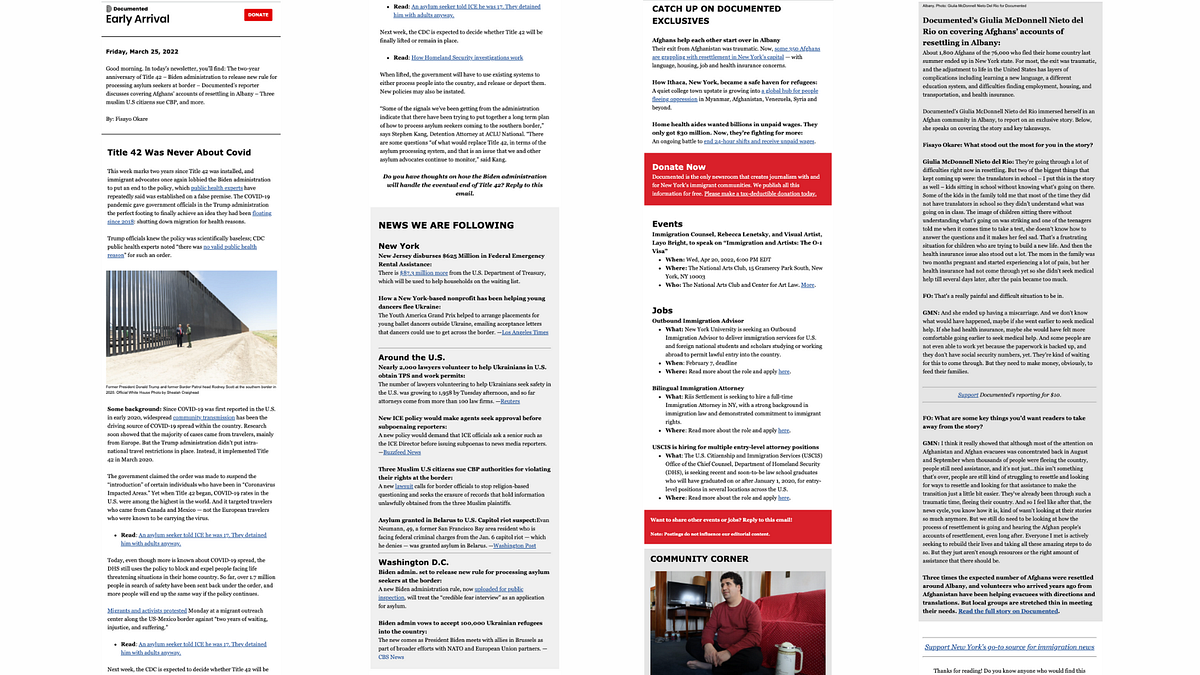
- Mediacités : Chaque été, le média d’investigation local propose un questionnaire à ses abonné·es pour préparer la rentrée du média, via l’outil Tally, envoyé par mail — 2022
- Binge Audio: After more than 600 episodes of its show *Programme B*, the podcast studio Binge Audio conducted an audience survey in May 2022 among its listeners. And to test its proposed paid newsletter/podcast, La Dose, Binge launched a test campaign featuring regular email surveys — 2022
- étapes: : To better understand its readership and refine its editorial content, the graphic design magazine Étapes created a survey using Google Forms and shared it on its website — 2021
- Black Ballad: A Study of Media Community Members and a Shared Case Study on the Experience — 2020
I'll conduct my audience research
✏️ The Médianes team has prepared a practical document to help you apply the learnings from this sheet to your own project. To do so, please click the button below and follow the instructions.
To go further
💡 Find inspiration
 Written by Emily Roseman
 Maxime Leroy
 Marine Slavitch
 Madeleine White
 Fisayo Okare
 Margaux Vulliet
📖 Browse through
- Our book, “Creating a Media Outlet,” is a practical guide for anyone who wants to launch an independent and socially conscious media outlet.
- All our how-to guides are here.