


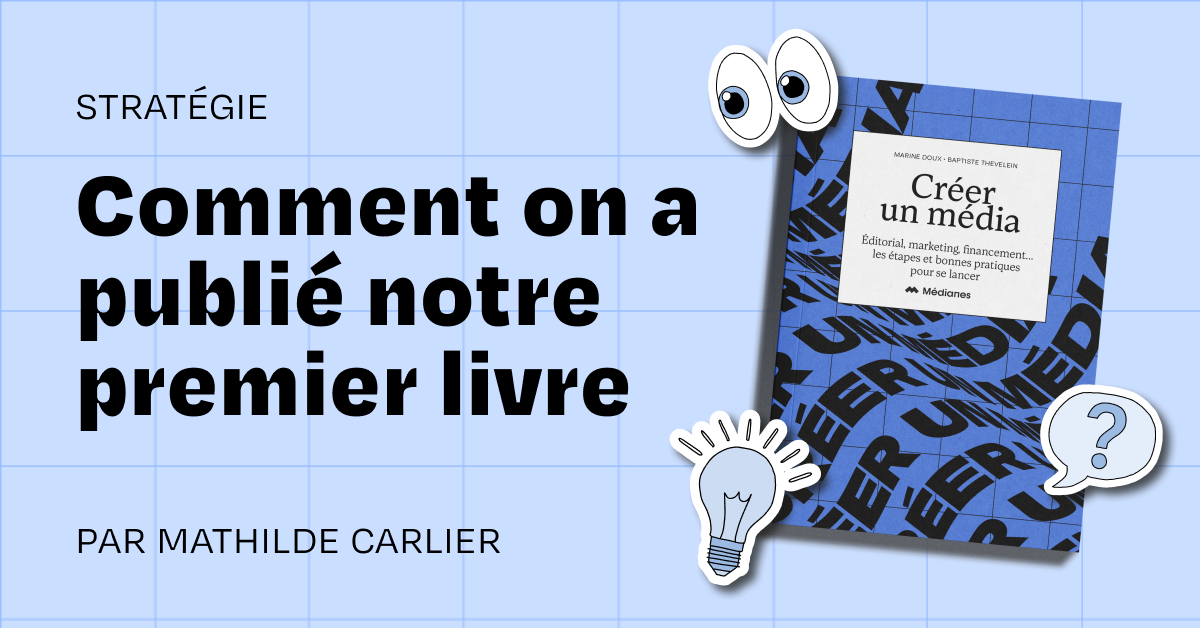
Last April, we published our first book dedicated to media creation, an idea that had actually been sitting in our drawers since Médianes' early days. Publishing a book represents a form of completion for us of the project we've been carrying for over three years; it's about making methods and advice accessible to help media outlets structure models in which audiences are at the heart. It's also an opportunity to share firsthand experience from founders and practical case studies that prove to us that independent, quality journalism is possible. But also to highlight methods to help leaders create or redesign their editorial products (newsletter, podcast, etc.)
The idea re-emerged during our team seminar in September 2023, when we were all gathered around a table in Saint-Nazaire, with our notebooks and a few Post-it pads, collectively asking ourselves what our priorities would be for the year ahead. Very quickly, creating a book became part of our roadmap, with a publication date planned for February 2024, six months later (a bit ambitious, but we'll come back to that).

After thinking through the project's scope, we had to get moving – and organize ourselves well – to shape our ideas and create a book in just a few months. No small feat, especially since this initiative was new to all of us, even if the experience some team members have in publishing journals – including the Pays magazine of which Baptiste Thevelein and Christelle Perrin are co-founders – saved us countless hours, particularly in the page layout, printing and distribution stages. While we drew on basic project management principles, we also had to adapt to certain specificities of such a project.
So, where do we start?
Roadmap, calendar and mobilization: the first steps
Ask the right questions
Before diving in headfirst, it's always useful to take time to think about your value proposition and your target audience – like with any editorial product really. So the first step was to ask ourselves: Why a book? What are our objectives? Who is the target audience? What do we have to tell? What's the business model?
Plan, anticipate, organize
Next, we break it down. What are the key steps to creating a book? What tasks stand between us and publication? This is when working on the roadmap becomes critical: we detail as thoroughly as possible the various tasks and milestones to keep in mind – content writing, art direction, layout design, printing, distribution, communication… – while trying to anticipate from the start the elements we'll need to move forward to the next stages.
For example, we'll need to have collected almost all of the text to allow the art director to move on to page layout. Similarly, contacting bookstores requires already having a summary of the work and ideally a cover and page count in order to present it in the best light.
So we created at the same time a detailed project schedule with delivery dates for each phase, aiming for a final publication in mid-February. Things are already becoming clearer, it seems to be coming together, so far so good.

Build the project team
In parallel, there is obviously the crucial question of mobilizing the team. We sought to identify everyone's roles: who will be responsible for steering, content, layout, distribution and communication? At what stage(s) should each team member be involved?
For the book Creating a Media, a large part of the Médianes team participated in the project: myself, Mathilde Carlier on project management, our journalists Marine Slavitch and Owen Huchon for conducting interviews, studio members – Juliette Cahen, Pauline Butel, Caroline Fauvel – on writing practical guides, Christelle Perrin on art direction and layout design, Maëlle Ledu on illustrations, Marine Doux and Baptiste Thevelein on writing and project direction.
For several weeks, we made it a habit to hold a weekly meeting to check in with the key team members involved – varying from week to week depending on the stage we were at – on project progress, potential roadblocks, and priorities for the days ahead.
Ensure yourself room to maneuver
Obviously, the timeline set at the beginning of the project is initially indicative, and it naturally evolves as we go. On our end as well, adjustments have been made: some stages moved faster than expected, and – more often than not – others took longer than we initially imagined. We quickly realized that the deadlines set initially risked putting us in difficulty – unless we devoted 100% of our time to it, which was neither desired nor desirable – and therefore decided it was necessary to push back our deadlines by a few weeks.
Writing, layout and printing: it takes shape
Create and gather content
Now that we have a team, a schedule, and a clear to-do list, it's time to actually launch the project. This is when we need to think about the book's content, imagine an overall structure, and then break down our chapters in more detail. We identified the practical guides and resources we already had—which we later updated and enriched—and that we wanted to include in the book. We then thought about what content to add to create the most comprehensive guide possible on media creation: new practical resources, a toolkit, exclusive insights from leaders, and more.
To do that, we had to create a new document in a tool we affectionately called the railroad. This allowed us to gather all the content in one place so we could imagine a coherent flow. Look, these two sections complement each other well, we could put them one after the other in the same chapter. Here, on the other hand, maybe there's a missing section to develop this idea. Until layout, this was the single document we referred to throughout writing, to complete the different chapters and organize the book's content.

Thinking Through the Graphic Design of Paper Objects
In parallel, while the dedicated team advanced on writing the content, Christelle Perrin, art director at Médianes, was sharpening her pencils and starting to envision the final object: its visual identity, its format, its cover. The goal? To let Médianes' visual signature shine through while developing an identity unique to the book. All while designing a layout that makes reading easier and optimizes navigation through the content.
In this column and this video, Christelle goes over the graphic choices she made for the book — format, colors, paper, layout — to think through the form in keeping with the content.

Toward the final form
We're now at the heart of the project, the longest phase – but also certainly the most important one – involving writing, editing, proofreading, finding contributors, conducting interviews, integrating content into the timeline, and then laying out the materials as we go.
So several weeks pass, marked by trips back and forth between the wireframe and the mockup that's starting to take shape. And then, the magic happens—you start to envision it, and feel your heart warm at the sight of a beautiful layout, far more appealing than a word processor (yes, we were starting to get a bit tired of the wireframe, to be honest).
Sending to print
After finalizing the content, engaging project stakeholders for additional proofreading and making final edits, it's finally time to send the proof to print—the final version of the document approved for printing. We had previously estimated the number of copies to print based on our budget and objectives, and discussed this with the printer, from whom we had requested a quote and timeline in advance.
If sending off the proof is more of a relief, the truly delightful moment when pride and a sense of accomplishment blend together is when you receive the copies, when you can finally discover the object you've created and leaf through it. That's when you feel all the more ready to move on to the next stage: the launch!
Communications, events and distribution: launch time
A step to prepare for
We're only telling you about this now for the sake of clarity, but in reality, the launch phase requires anticipation. On our end, it was sometimes challenging to carve out time to prepare the book's release while we were simultaneously busy wrapping up and managing day-to-day projects, between proofreading and finalizing chapters. Yet preparing the launch is no less essential!
This tension can be all the more acute within a small team that doesn't have an entire department dedicated to each stage: production, communication, distribution… To ensure we prepare the launch phase as effectively as possible, we decided to temporarily strengthen the team with support from Audrey Cristea, who worked with us on the book's distribution and communication plan.
Announce and present the project
Several weeks before launch, we began to trickle out information here and there, in our newsletters or in casual conversation, about this book in preparation within the team, in order to spark interest in the project and allow interested people to stay informed through a mailing list.
But then it was time for a more official announcement. To do that, social media posts and an email series allowed us to present the book Créer un média and announce the launch date, while beginning to showcase the fruits of our work and discuss our motivations and the behind-the-scenes of the project.
At the same time, we worked on public relations and press outreach by distributing a media kit to our various networks. The goal? To centralize key information and useful links about the book, present the project, and encourage sharing, even beyond our networks.
Make the launch an event
To mark the occasion and build momentum around the launch of Creating a Media, we also organized a launch event at the Gaîté Lyrique in Paris. We brought together several media founders including Vert, Le 1, Urbania and StreetPress to share their experiences launching and developing an editorial product. It was also an opportunity to meet our readers and sell the first copies of the book!


The book launch party at Gaîté Lyrique — Photo credits: Benoît Mickaëly
Organize the distribution
To prepare the release of Create a Media, we had to consider how to distribute it. Where do we want our book to be available for sale? In an online store? In bookstores? Both?
On our side, we chose to prioritize sales through our own online store, set up for this purpose, to make purchasing easier from our site from its launch, as well as distribution in bookstores to reach readers beyond our usual audience. On this last point, we're still at the very beginning of the journey, so if you're a bookseller, don't hesitate to write to us!

What's next?
Not so fast…
And there we have it—the book is out, the launch event went well, and the work is already in the hands of our first readers who have started giving us feedback. It would be a shame to stop while we're on a roll, wouldn't it? For our part, it seemed essential right away to put in place a marketing and communications strategy for after publication, in order to sustain the project and maintain interest over time.
This required creating a new editorial rhythm around a sustainable product, moving away from immediate communication, to continue promoting the book in our publications and across our various channels (website, newsletters, social media…)
For example, next month we're organizing a gathering at the Canal Pavilion, centered around Creating a Media. It's on Wednesday, July 17th starting at 7pm and will be an opportunity to discuss the release of a book and the steps involved in creating media. If you'd like to join us, you can register now.

Time for a reckoning
Back to today. The summer period and the quieter weeks it brings seem to us conducive to taking stock, in order to close this chapter as best as we can, draw the best lessons from it and envision what comes next.
After taking time at our HR seminar in Bordeaux in late April to review how the project was organized and how the team mobilized around the book, this is the moment to ask ourselves new questions for a more comprehensive assessment. What worked well or less well? – whether in terms of sales, media coverage, or organizational efficiency. What are we taking away from this? How many copies did we sell? Are we satisfied with the feedback on the subject? With how people engaged at events?
Put simply, once the peak activity of the project is behind us and we have a bit more time and space to reflect, this is the right moment to evaluate its success, celebrate the work accomplished, and identify areas for improvement going forward!
To go further
- Come chat with us about the project! We're organizing a book discussion session at Pavillon des canaux on July 17, 2024. Sign up now!
- Printing, a feminist act? Discover this interview with Clémentine Labrosse (éditions trouble, Censored) about paper as a tool of resistance and emancipation. We also recommend their feminist self-publishing alphabet !
- In this column, our creative director Christelle Perrin describes how she designed the graphics for the book Creating a Media.
- If you'd like to learn more about how tools are used at Médianes, check out this article by Baptiste Thevelein.
- Are you considering launching a new editorial project within your newsroom? Download this guide for efficient project management.
- Have feedback or a question? Want to distribute our work? Looking for support creating your book or media? You can contact us by email at [email protected]


