


On May 20, during its annual Google I/O conference, company employees took turns on the ultra-colorful stage at the Shoreline Amphitheatre in Mountain View, California, to promote “the future”: Deep Think, Deep Search, Deep Research, Gemini (formerly Bard), AI Mode, AI Overviews, AI Pro, AI Ultra… An avalanche of countless products—supposed to simplify users’ lives—that signal a clear strategic shift: integrating AI everywhere, especially into the search engine.
On stage, everyone is smiling. But offstage, among the journalists transcribing the announcements, one question may be crossing some of their minds: Will their article actually be read… or simply processed and summarized by a robot? Because what Google is announcing isn’t just yet another machine-learning-powered gadget, but a radical transformation of its flagship product. The list of blue links? That’s ancient history. The new motto is: “Let Google do the Googling for you.”
Some of these features, which have already been tested in the United States, are now being rolled out on a large scale. Here’s an overview of what’s changing—and what that means.
Why this change of direction?
Il y a le feu chez Alphabet, la maison mère de Google : pour la première fois depuis 2002, le nombre de recherches Google effectuées dans Safari a baissé confiait récemment un cadre d’Apple, pour qui le coupable n’est nul autre que l’IA. Une déclaration (que Google a toutefois contesté) qui a provoqué un recul de l’action d’Alphabet en bourse, signe de plus que l’IA fait la pluie et le beau temps chez les firmes de la tech.
Is this real progress, or just a way to reassure investors by waving the magic wand of the “prompt”? It doesn’t matter. Google has no intention of letting ChatGPT steal the spotlight, nor of ending up like Skype—that once-indispensable tool (which even became a verb in everyday language) that eventually faded into obscurity. Even though AI isn’t yet widely replacing traditional search engines, its use is growing to answer everyday questions, as several studies confirm.
Another factor driving this shift: younger generations are embracing more “authentic” formats. Fewer sponsored links, more direct responses. Rather than sifting through pages of search results, they prefer, for example, to get the unfiltered opinion of an average user on TikTok, which is perceived as more sincere and relevant. This preference has prompted Google to prioritize forums and short videos in its search results.
How?
Three products today exemplify how AI is transforming research at Google:
- Gemini
Formerly known as Bard, Gemini is Google’s conversational AI, similar to OpenAI’s ChatGPT or Anthropic’s Claude. While it isn’t a search engine in the strict sense, Google has added a “search” feature—just like its competitors—allowing Gemini to scan the internet to support its answers with up-to-date data rather than relying on a static database.
For subscribers to the paid AI Ultra plan, a “Deep Research” feature uses Gemini to generate longer and more complex summaries on specialized topics.
And that’s not all: a Chrome extension announced at Google I/O will allow Gemini to track what you’re reading, watching, or listening to online and provide you with additional information in real time. For example, the AI will be able to “clarify complex information on a web page you’re reading or summarize information,” according to the company’s blog. In short, even if a reader lands on your page, it’s not certain that they’re the one actually reading it.
- AI Overviews
These small snippets that appear at the top of search results are now available in more than 200 countries (excluding France) and in more than 40 languages. Their purpose is to summarize the information found on indexed pages and provide you with details without you even having to click. Unlike Gemini, these snippets are directly integrated into the search engine and generally appear when a user asks a relatively simple question.
However, this feature has been mocked for its rather embarrassing mistakes. Ask Google if it’s a good idea to put glue on a pizza, and it will reply without hesitation that it will indeed give the pizza a better texture. Others have fun asking it about absurd expressions, such as “you can’t lick a badger twice,” to which the AI doesn’t hesitate to come up with made-up explanations. Some users would therefore prefer to do without it, but… there’s no way to disable this feature. In desperation, some have found a surprising solution to make it disappear: typing aggressive requests like “give me the f***ing links” into the search bar.
- AI Mode
This is the big revelation of this conference. Rather than just a simple feature, AI Mode is a full-fledged search mode with its own tab built into the search engine. Whereas AI Overviews is an addition to the traditional experience, AI Mode could very well replace it.
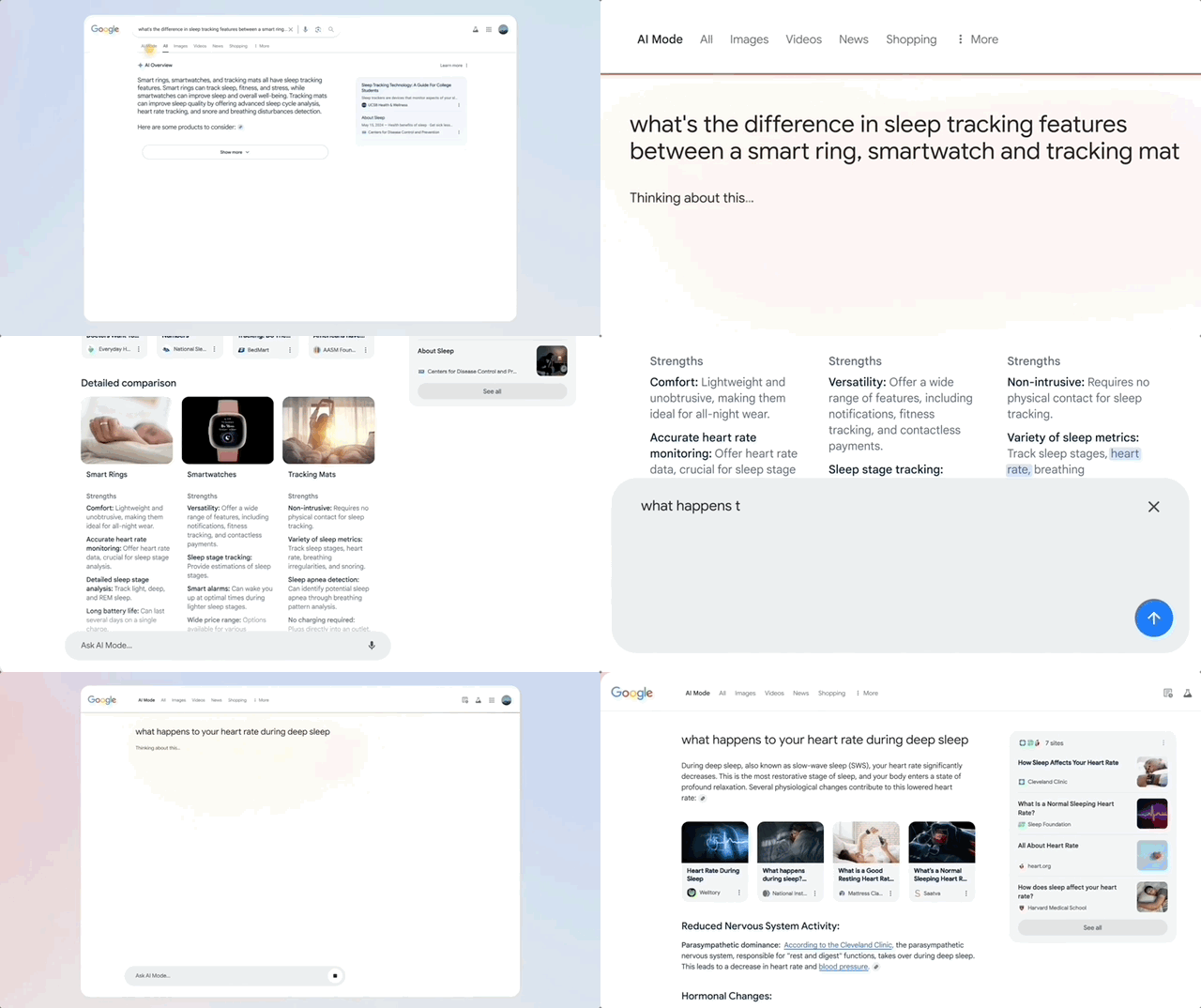
AI Mode’s responses are presented more like an article, offering longer answers drawn from multiple sources, with some articles displayed in the margins or within the body of the text. In addition to providing answers, AI Mode also offers to interact on your behalf with the pages you’re viewing—such as buying concert tickets, booking a hotel, or checking your emails. However, early users of this feature have noted some shortcomings regarding the reliability of the information.
At Google I/O, the company confirmed its launch in the United States, ahead of a broader rollout in the coming months.
What impact will this have on the media?
The first effects of AI in Google Search are beginning to be felt and several studies appear to show a decline in click-through rates to sites caused by summaries generated by Google in its search results. An observation confirmed by some newsrooms, even though it remains difficult to measure this phenomenon precisely, as Google shares very little precise data. When asked about this by The Verge, Google's CEO Sundar Pichai merely claimed that "more than any other company, (Google prioritizes) driving traffic to the Web", also suggesting that these features could generate "higher quality" traffic, without providing clear evidence.
Following the company's event, Digiday surveyed several media outlets. While the change remains minimal for most, many have observed a new phenomenon: a surge in traffic from Google Discover, the article recommendation tool based on user interests (available primarily on mobile). Digiday's explanation: "It may be no coincidence that publishers are seeing increased Discover traffic while search traffic is declining. An SEO manager at a lifestyle media outlet believes Google will likely "boost" Discover traffic when rolling out AI mode so that traffic to publishers' sites isn't too "affected"".
But beyond the traffic question, it's the relationship between media and platforms that's at stake. Several lawsuits are underway to determine whether indexing and automated reuse of content constitute an infringement of publishers' rights. Following Google's announcements, the News/Media Alliance directly called AI Mode a "theft" that deprives media of traffic and revenue. Internal documents also reveal that Google chose to exclude the possibility for news outlets to have greater control over how their content is used. Thus, if a media outlet doesn't want to appear in AI Overviews, it must completely forgo its indexing in standard search results.
The risk appears even greater for small publishers. While Discover can offer a boost in visibility, access to this channel remains opaque, random and unequal. Moreover, AIs tend to favor established brands in their answers. It's better to cite Le Monde, BBC or The Guardian to build user trust than to direct them to a lesser-known site, even if it's the original source of the information. Press Gazette has documented this bias: in some cases, Google displayed a summary generated from one of its articles… crediting The Guardian as the source.


