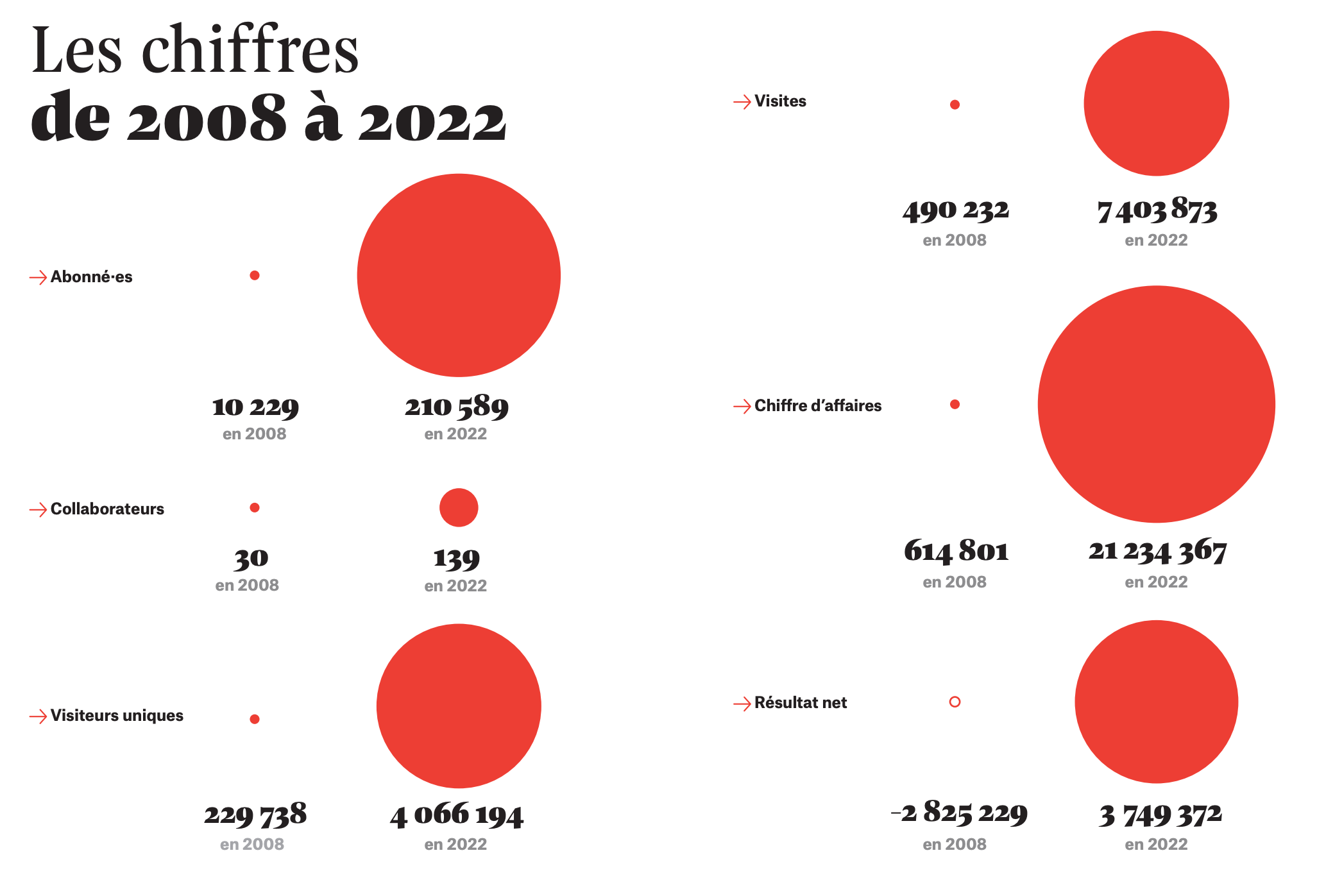
In this first episode of the second season of our Chemins podcast, we welcome Cécile Sourd, chief executive of the independent online news outlet specializing in investigative journalism Mediapart. With 220,000 paying digital subscribers and 139 staff members, the media is celebrating fifteen years this year and reaching a milestone with the departure of Edwy Plenel, a historic figure in the newsroom. How do you manage this transition? How do you build support from 200,000 subscribers? How do you apply the same rigor to management as you do to journalism?
Key points
- Mediapart's teams are made up of 50% editorial staff and 50% commercial, marketing and strategic personnel.
- Mediapart's revenue comes 98% from subscriptions. The newspaper refuses all forms of public subsidies, advertising, and commercial partnerships with large platforms.
« More than ever, we believe that independence is the key to our success. But we're constantly competing with media outlets that can offer discounted subscriptions backed by deals with Google. It's a peculiar situation—we find ourselves somewhat isolated. We refuse to use certain workarounds, but at the same time, we don't lose sight of our goal, which is to grow even further in order to bring our information to an ever-larger number of readers. »
- Since 2019, Mediapart's capital has been controlled by the Fund for Free Press, which the newspaper created itself. The FPL is a non-profit organization dedicated to freedom and diversity in the media industry. It allows the newspaper to guarantee its economic independence while also returning funds to independent media outlets.
« The Free Press Fund is part of Mediapart's philosophy. But it doesn't give us any money and couldn't help us if we needed it. We see it as a way to contribute to the emergence of initiatives that seem more necessary than ever in today's context of media concentration. »
- 2023 marks the beginning of a new era at Mediapart with Edwy Plenel's departure from leading the newsroom and the handover of general management between Marie-Hélène Smiejan and Cécile Sourd. The news organization had already experienced a first leadership transition in 2018 between François Bonnet, the newspaper's cofounder who served as editorial director for ten years, and Stéphane Alliès and Carine Fouteau.
« These are moments that require long preparation. Before being appointed chief executive, I worked for five years alongside Marie-Hélène Smiejan. Edwy Plenel's departure is also being prepared given that he embodies the newspaper. That said, we don't want to erase him—he will continue to exist and we're sharing our thoughts on this with the entire team. On the other hand, it's clear that we want to move beyond Edwy Plenel's well-known media presence and represent a plurality of faces, as Mediapart is a collective project. We want the newspaper's new faces to represent society as it really is. »
- The key to success lies in preparing the transmission and continuation of media.
« Handing over a project that was the brainchild of co-founders to a new team requires groundwork but also a great deal of trust and humility from the original co-founders. »
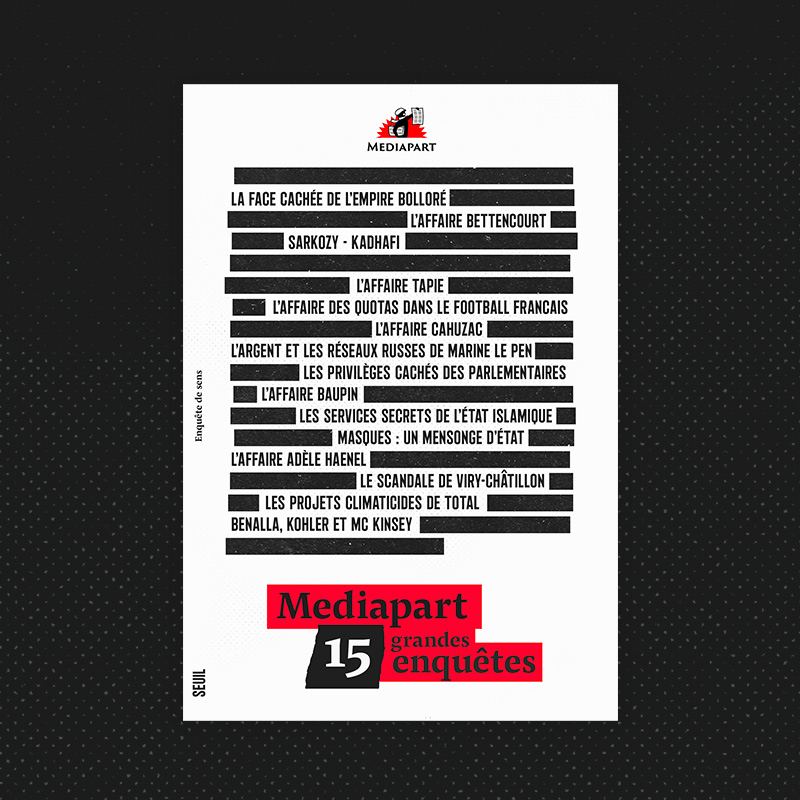
- This year, Mediapart is celebrating its fifteenth anniversary. For this occasion, the newspaper is publishing a book that synthesizes fifteen of its most emblematic investigations, going on tour in fifteen cities, and promoting itself through a poster and radio spot campaign.
« It's a rare expense but one we're satisfied with. There's a kind of invisibility around Mediapart's work. We're rarely cited in traditional media, less often invited onto television shows. This campaign is a way to reach back out to the public, and the investment was worth it. As for the tour, our meetings are open to everyone and we approach it as a dialogue with our audience. It allows us to avoid being above society as it is. You have to always go out and meet people—they're the ones who sustain us and they're the ones we need to listen to. »
- Mediapart regularly publishes investigations into toxic management in major French companies. How can we be as demanding about management as we are about journalism?
« Mediapart is a company that must embody what it writes in its pages. You can't expose wrongdoing in others while ignoring problems at home. This translates into very active social dialogue. Our internal practices have evolved considerably, particularly in how we communicate with each other. We've improved manager training, and our HR department has been strengthened. »
- Since 2020, Lénaïg Bredoux, formerly a journalist in the political department, has been editorial lead on gender issues at Mediapart. Her role involves ensuring parity and inclusivity in the topics covered. She also works with HR departments.
« It's an additional step we could take to improve inclusivity and parity at Mediapart. It ensures we address women-men inequalities and acts internally on the distribution of speaking time in meetings between men and women, on how we talk to each other. It's an internal watchdog but we've also invested heavily in training and raising awareness among all team members from their arrival. We direct them to these trainings if we feel they've forgotten some things. We're committed to always being consistent with what we advocate for. »
Since the podcast was recorded, Lénaïg Bredoux has become co-editorial director alongside Valentine Oberti.
- Investigation is the heart of Mediapart, but it remains a form of content that requires time and investment. A concern that is also factored into management.
« We've put in place a full set of tools to structure work. We want to motivate people to disconnect more often. We have an agreement on working time, and we've implemented self-reporting time management tools that allow people who have worked too much to declare an extra day and get compensatory time off. HR closely monitors this and sends out many individual reminders about taking leave. We've established a charter on the right to disconnect, on remote work. Work-life balance is central to delivering quality work. »
To go further
- Discover our interview with Lenaïg Bredoux on the role of editorial lead on gender issues at Mediapart.
- On the topic of management, listen to the Chemins episode with Jean-Christophe Boulanger, president and co-founder of Contexte, an independent online media outlet for political professionals in France and Europe.
- Find all episodes of season 2 of our Chemins podcast dedicated to accelerating a media project, featuring Cécile Sourd (Mediapart), Jean-Christophe Boulanger (Contexte), Lauren Boudard (Climax), Frédéric Desiles (Alternatives Économiques), Emmanuelle Josse (La Déferlante) and Valentin Levetti (Stupid Economics).
Editor's note: the Free Press Fund was a partner of the 2023 edition of the Festival Imprimé, an event co-produced by Médianes; journalist Camille Polloni (Mediapart) spoke on behalf of the Fund during a panel discussion.