While some media outlets work to separate the "opinions" section from the rest of the news, others do the opposite and place it at the heart of their editorial offering. Le Drenche has made it an educational tool, AOC uses it to highlight researchers and target a discerning audience.
Le Drenche built its entire editorial approach on pedagogy and opinion: enabling researchers and experts to express their viewpoint, so as to give readers the tools to form their own opinion. Articles are presented in such a way that those unfamiliar with a current topic can grasp its key issues.
Both a website and a free monthly print magazine, Le Drenche covers major current affairs topics that need clarification: pension reform, electoral systems, and economic issues. At the top of each article, the editorial team provides context and explanation. Then comes the opinion section: two researchers present their viewpoints on the topic, one in favor and one against. Comments are also open to readers so they can share their opinions.
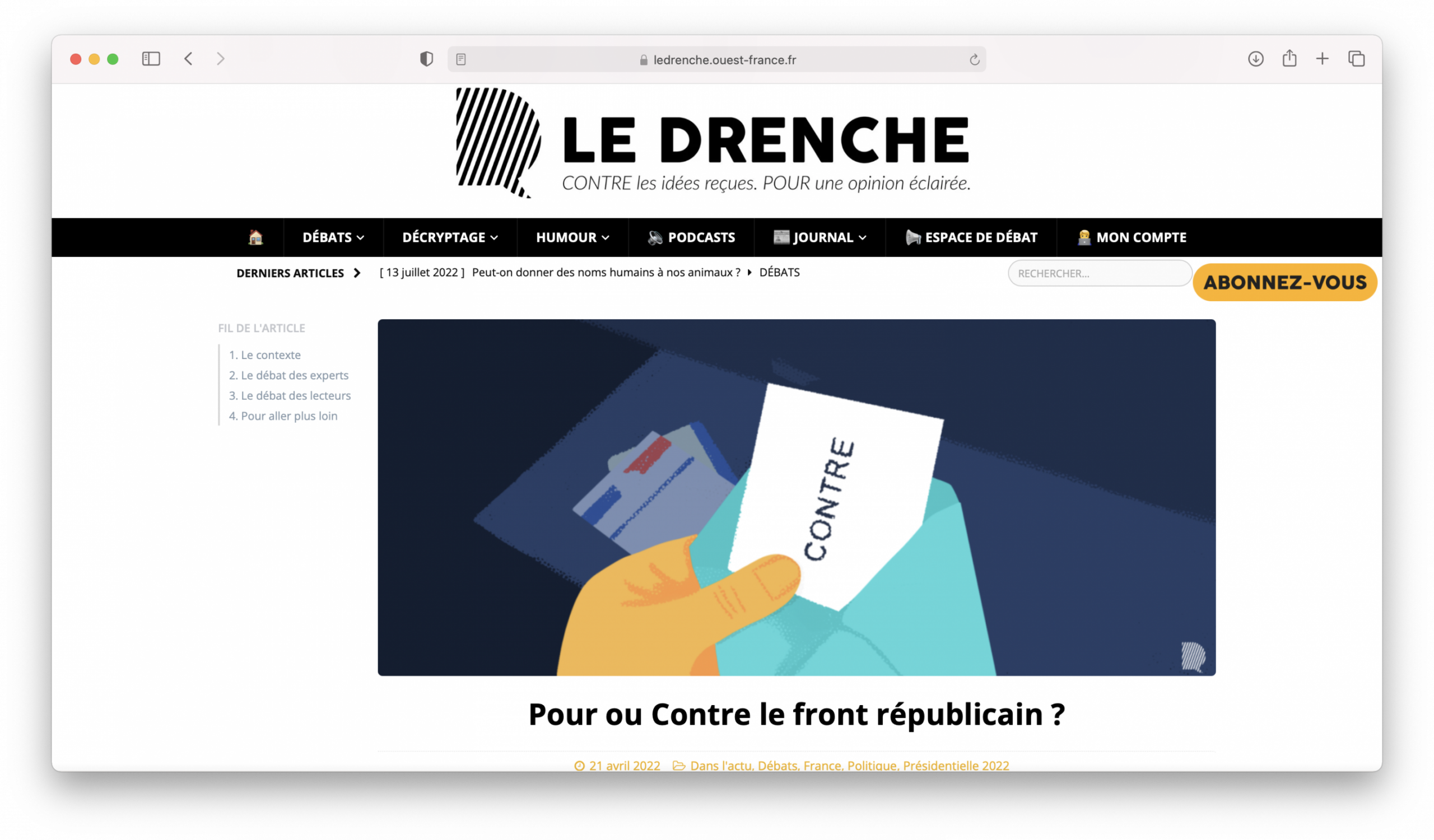
The pros and cons
Originally, the two co-founders Florent Guignard and Antoine Dujardin are not journalists but energy engineers. Before launching Le Drenche, they started from a realization and personal frustration: "We believe that explaining current events is a democratic necessity, because ultimately, it's citizens who vote. We seek to have a social impact", says Florent Guignard, co-founder. He regularly uses the example of the Wealth Tax: "The Wealth Tax is telling because it's hard to grasp its basics, so we take it upon ourselves to explain it to readers, and we do this for all sorts of other topics. We have, for example, a section in the print version called 'explain it to me like I'm 5 years old.'"
As former engineers, they maintain a certain scientific methodology in their editorial approach: reasoning and argumentation, which ultimately aligns with journalistic work.
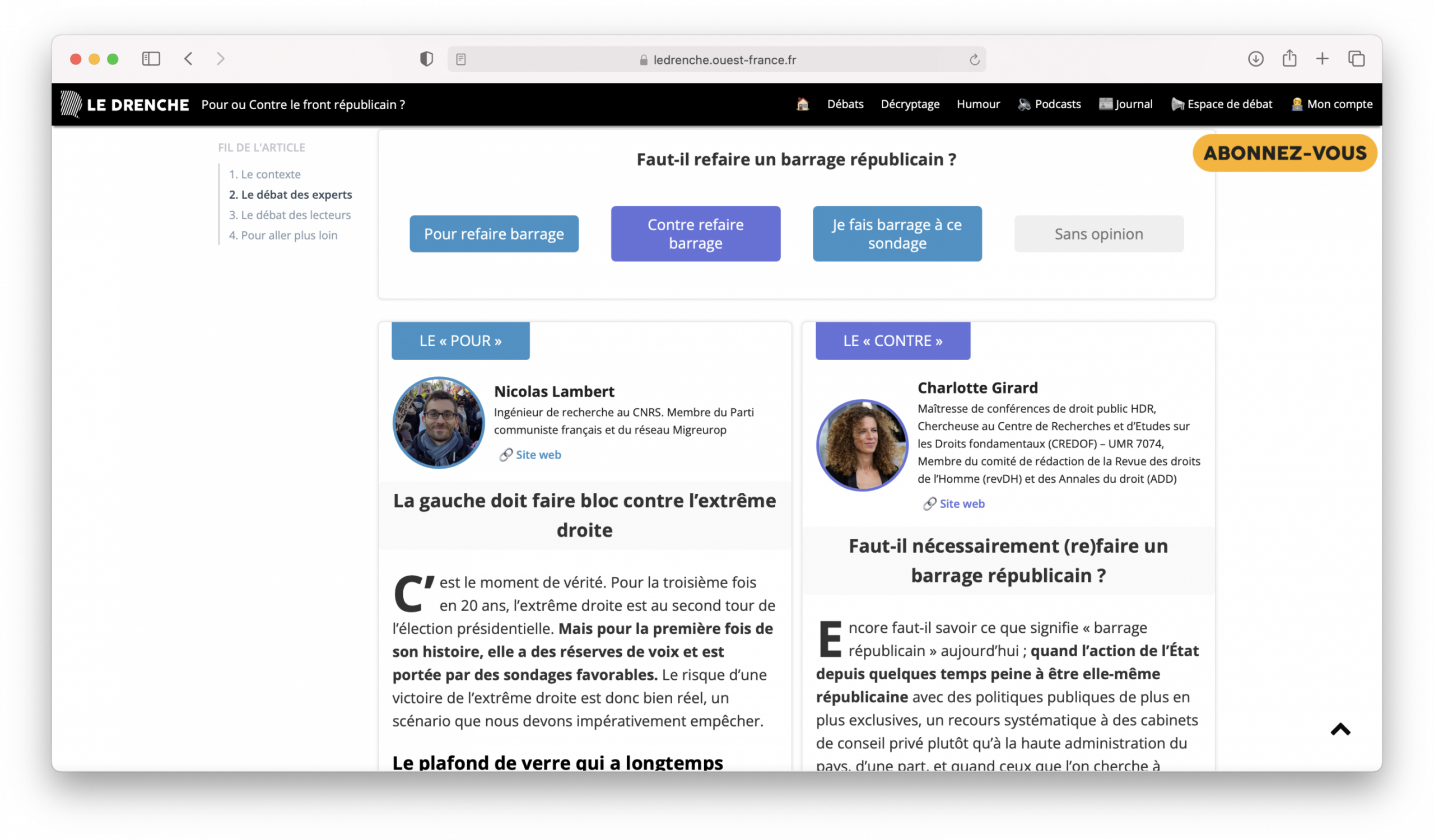
The other challenge for Drenche at its launch in 2017 was the question of where opinion belongs. The two co-founders believe that media outlets don't always clearly display their positions and the public doesn't always distinguish between opinion and facts, which contributes to citizens' distrust. "The lack of trust, especially among younger people, in the media is also a challenge we're trying to address". Drenche aims to bet on transparency in presenting those it interviews. In practice, on the site, the opinion section is clearly separate from the explanation section, and the media highlights the names and positions of the experts interviewed.
Choose who gets to speak
“How do we decide who gets a voice? What right do we have to decide who can speak and who cannot?” These are the questions the co-founders asked themselves. To address this, they established a charter governing the opinion sections of their articles. “We wanted to define objective criteria, both for the selection of topics and for the experts we interview,” explains Florent Guignard. When it comes to editorial decisions, the editorial team does not cover topics related to the search for truth. For example: Is the vaccine effective? Nor do they cover matters involving a court ruling or a person’s moral judgment, “which helps us avoid problematic statements.” Interviewees are selected based on three criteria: legitimacy, expertise, and commitment. The position and responsibilities held by the person offering their opinion are the central factor. Florent Guignard cites the example of an article covering a 2016 news story: “Should abandoned churches be converted into mosques?” A bishop explains why he is in favor. “His position serves as a point of reference; the article sparked discussion among readers after publication, and that is exactly what we are looking for.”
Anglo-Saxon inspiration
AOC defines itself as a "daily of ideas." Every day, three texts are published: an analysis, an opinion piece, and a critique, which is where the media gets its name. In search of journalism that is once again in-depth, AOC aims to be a landmark in the flow of information we receive.
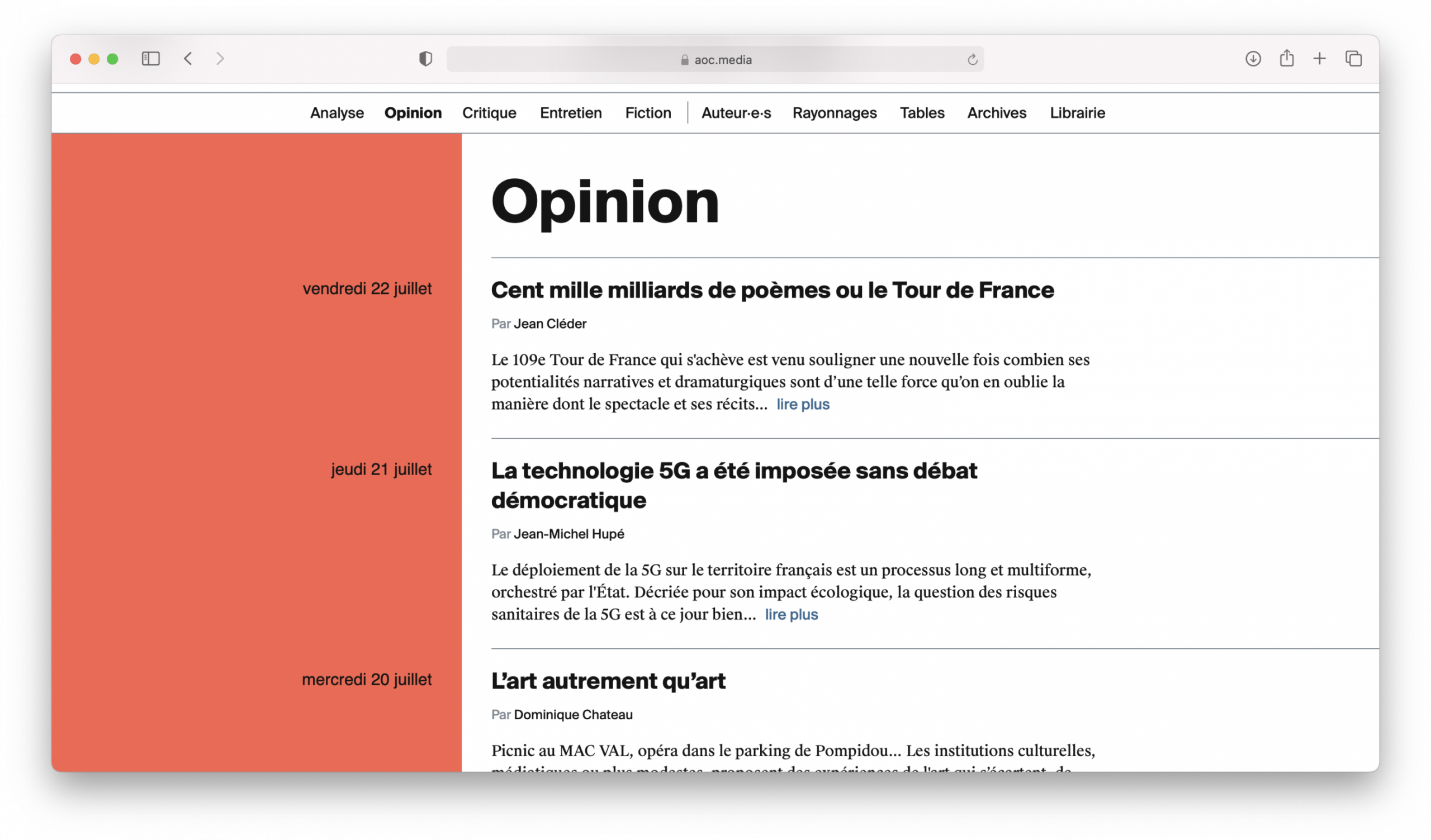
Sylvain Bourmeau, its founder, draws on the American and Anglo-Saxon press. “There is a much clearer distinction in that press between opinion pieces and other content. In France, there’s an undesirable blurring of genres; a great deal of importance is placed on the byline and the journalist’s public image.” In newspapers across the Atlantic, you’ll find what are called op-eds—articles by contributors outside the newsroom who express their viewpoints, placed opposite the editorials. The New York Times, for example, replaced its “op-ed” section in 2021 with “Guest Essays”: “an essential update in the digital age,” according to the newspaper. And Sylvain Bourmeau points out that opinion pages are a huge hit with the American public.
AOC designed its editorial approach by drawing inspiration from this clear separation in the American model. In this media outlet, launched four years ago, texts are written by researchers, academics, artists, and journalists. What they have in common: they are all authors and have thorough expertise in their field, recognized for it. How do you distinguish analysis from opinion? "It's not an exact science," observes Sylvain Bourmeau, someone with deep knowledge of a subject tends toward analysis. An opinion suggests a constructed point of view, coming from an author who has the legitimacy to speak on a subject".
The author's opinion: authority marker
Championing the research community on current issues lies at the very heart of AOC's editorial mission. "We have published over 2 000 authors, we don't rank them by fame but choose those who seem most relevant to a given topic. We recently published Judith Butler on the situation in the United States. She may well be one of, if not the, greatest American philosophers." As for the question, "who would you not give a voice to in the opinion section? ", AOC's only limit is not covering illiberal or oppressive subjects.
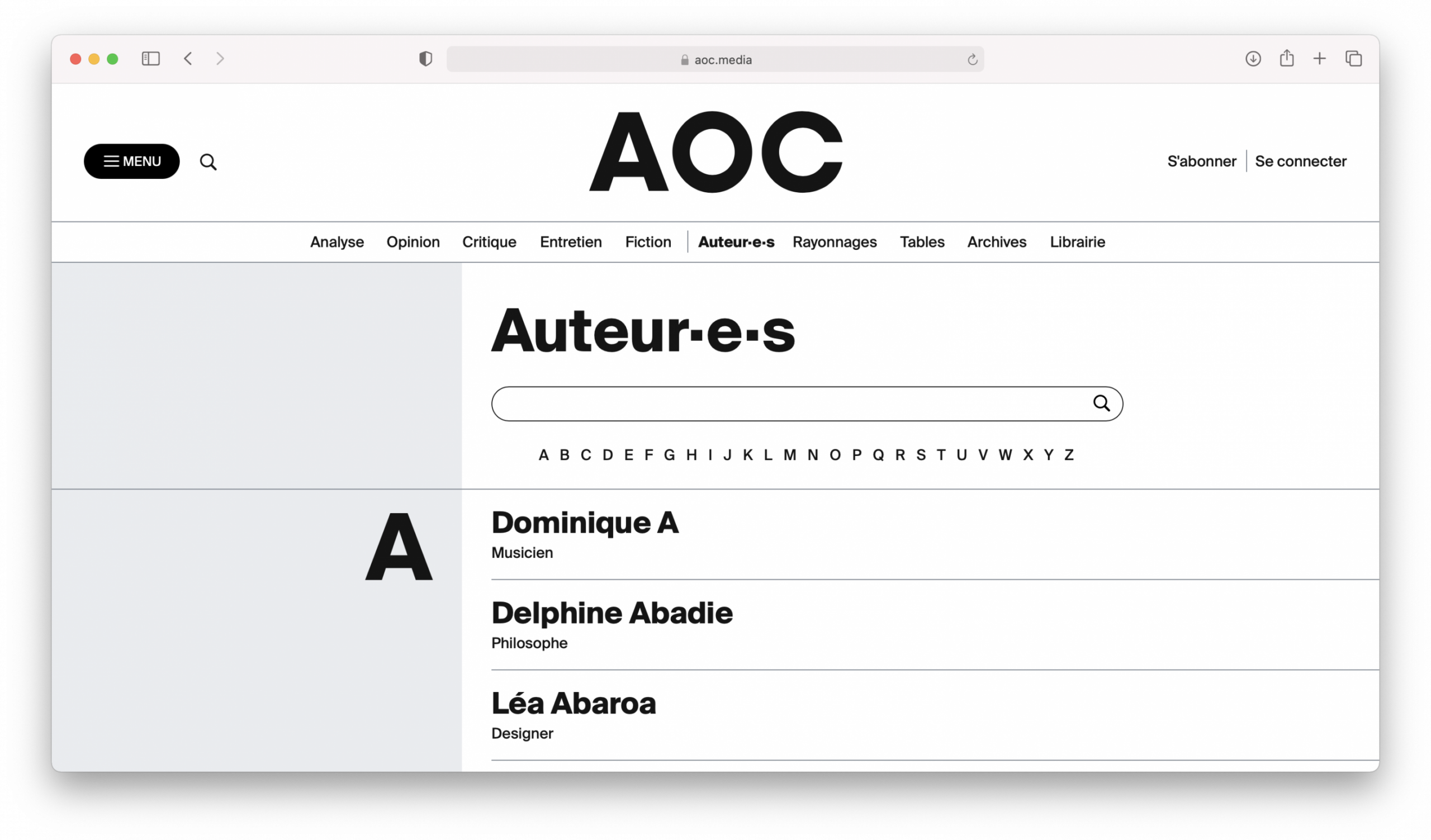
The media is committed to durability and comprehensiveness, since « we are an encyclopedic project in the sense that we talk about everything. We want to fight against the tendency to specialize in just one subject and ignore other areas. We want our readers to think by analogy ».
According to Sylvain Bourmeau, the hierarchization of information has been sacrificed in recent years. Authors make it possible to find this figure of authority and reference. "We are therefore seeking this verticality, with our radical idea of proposing only three articles per day." AOC did not start from a diagnosis but from a personal desire: "It's up to us to make unprecedented proposals to our readers."
And readers are demanding it. Le Drenche also gives a special place to readers' opinions since the media organizes editorial conferences on Twitch, we talked about it in a newsletter. The public can give their feedback on the topics, the experts interviewed, the project, and the partners.
Editor's Note: Médianes, the studio, has been supporting AOC on editorial marketing topics since April 2022.
To learn more
- Shape your opinion in a world of debates? Listen to Florent Guignard talk about Drenche on Mediarama's microphone.
The coverage of the AOC launch in 2018 to read in Les Inrocks.
- This article is part of our Media & Opinion series published in summer 2022. Read the introductory episode with Ben Smith, media specialist and cofounder of the startup Semafor and the second episode about the launch of À Vif, an opinion section in La Croix.