


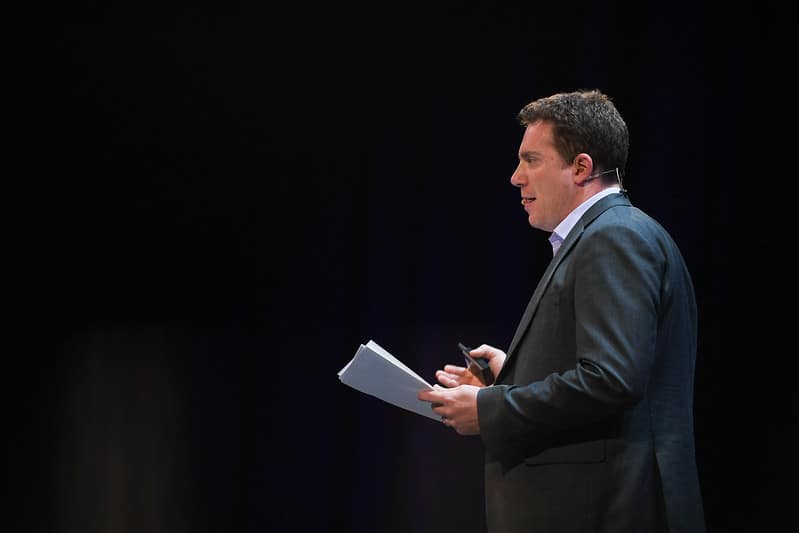
To kick off our Media & Opinion article series, American journalist Ben Smith, a media specialist, agreed to answer our questions. In our exchanges by email, he shared his analysis of opinion's place in media and told us more about the editorial thinking he is conducting on this subject in building his new project: Semafor.
A specialist in the world of media, as illustrated by his varied professional career wearing many hats, Ben Smith is the cofounder of the media Semafor. After serving as editor-in-chief of BuzzFeed News, he was a media columnist for the New York Times between 2020 and 2022. Before that, he covered politics for numerous outlets including Politico.
Semafor, a general-interest news outlet under construction, is scheduled to launch on October 15, 2022, as announced at a pre-event on July 7. The two co-founders Ben Smith and Justin Smith (no relation), both prominent figures in American media (Justin Smith was chief executive of Bloomberg), announced last January that they were leaving their respective newsrooms to launch their own media outlet. They also brought on key journalists from major American newsrooms to join the Semafor venture. Among them are already Gina Chua, former editor-in-chief at Reuters, journalist Liz Hoffman from the Wall Street Journal, tech journalist Reed Albergotti from the Washington Post, Joe Posner who co-founded the Vox Video division at Vox.com, and Kadia Goba, a political journalist at BuzzFeed News. These very specific choices are no accident, as Ben Smith sees journalists as benchmarks and reference points for readers. He intends to give their voices prominence.
According to an article in the New York Times, Semafor will focus on key topics such as finance, technology, climate, international security, and American politics. "There are 200 million people who have a university education, who read in English, but whom no one really treats as an audience, but who talk to each other and talk to us, Ben Smith said last January, that's what we consider our audience."
How do you analyze the distinction between facts and opinions in today's mainstream press?
I think the traditional English-language news article is a "black box" in which the journalist's viewpoint and the facts are merged.
It is therefore understandable that readers may not know how to distinguish between facts and opinions. Much of this confusion spreads on social media. These platforms send all sorts of other information and misinformation that reinforce readers' preconceived notions.
Do you have examples of media outlets that do a clear job of separating facts from opinions?
I won't name names, but I think there's a way of doing this that seems tedious to me, which simply consists of removing all analysis and erasing the journalist's voice. Opinion journalism in the form of a column is quite common in France and still rare in the United States. I was allowed to do it at the New York Times. An article in which you can both report the news and give your point of view on it, while being aware that the facts and your point of view are two different things.

Semafor will place importance on the separation of facts and opinions. What editorial reflections have you conducted on this subject?
We're integrating this element into our design, and we hope you'll enjoy it at launch!
Editor's note: The New York Times article provides more information on this: "Press articles will be divided into sections distinguishing facts from opinion. Journalists' bylines will be as prominent as headlines. Press articles, designed with a pale yellow background and cobalt blue headlines, will be divided into sections in order to distinguish between factual information, journalist analysis and a range of viewpoints on news. Reporting headlines will be sized the same way as main headlines, with the aim of building direct relationships between Semafor journalists and its audience".
You also make a point of cultivating direct relationships between Semafor's journalists and its audience. Is sharing your opinion as a journalist a sign of transparency toward your readers?
I won't ask journalists to share their political opinions, but rather their expert analysis of the subjects they write about. It's a fact that today people trust individuals more than institutions. Proof in point: you have Macron!
Editor's Note: In the New York Times, Ben Smith clarifies that journalists will be encouraged to share their own viewpoint on social media "in a fair and analytical manner."
To learn more:
Axios revealed in March the business model of Semafor. The founders must raise 50 million dollars and are turning to major investors like crypto-billionaire Sam Bankman-Fried; Jessica Lessin, founder of The Information; David G. Bradley, president emeritus of The Atlantic; and John Thornton, cofounder of the American Journalism Project and the Texas Tribune. Operations will initially be supported with approximately 25 million dollars from investors, with initial revenue coming from advertising and live events. The well-known journalists they recruit allow them to attract subscriptions.
Unlike Semafor, the BBC does not want its journalists to express their opinions on social media.


