When yesterday’s news strangely echoes today’s events. That’s what media outlets like Retronews, Rembobine, and La Disparition, which aim to analyze current events through the lens of the past using archives, reports, and flashbacks. Whether it’s a magazine, a newsletter, or an online platform, these are all ways to take a step back and reflect on the world around us.
The National Audiovisual Institute (INA) has clearly recognized the public’s appetite for video archives, as evidenced by its MediaClip service, which provides ready-to-use videos for content creators. In 2020, the INA launched its paid streaming platform, Madelen, which provides access to more than 13,000 programs. Among them are iconic shows like *Apostrophe* and *Cartes sur table*, cult films, and documentaries. Social media is also very useful for the INA, which regularly posts archival content. Like this one, on men’s views of women in the 1960s. This connection between the past and the present highlights how social issues have evolved over time.
As for video, the archives are certainly there, but what about print media? The National Library of France (BNF) comes to the rescue.
Retronews: A Dive into the Press Archives
“History engages in a dialogue with current events—and vice versa,” noted Sonia Devillers in *L’Instant M* in October 2021 while hosting Laurence Engel, president of the BNF. “Retronews is an inexhaustible source for understanding what happened and connecting it to what is happening today,” explains the president. Specifically, Retronews is both a website and a search engine that indexes more than 1,500 newspaper titles published between 1631 and 1950. That’s three centuries of digitized documents offering a deep dive into the intricacies of the French press. It is designed for those seeking specific archival material on a particular topic using the search engine, as well as for those who wish to gain insight into current events through past articles foundthrough the “Press Coverage” section.
Staying grounded in the present is also a key focus for Retronews. With that in mind, the platform launched a print magazine in September 2021. “The idea was to show that our present isn’t always as modern as we think. After all, people were already talking about assisted suicide two centuries ago. We’re talking about homosexuality, gender, the environment…,” noted Mahir Guven, the publication’s editor-in-chief, last September on France Info.

"The Disappearance": Between the World Before and the World After
So, back to print. The medium that some say is on the verge of disappearing. “La Disparition” is, in fact, the name of the project launched in 2021 by journalists Annabelle Perrin and François de Monès. The founders decided to bring the letter back into fashion—the kind we used to send to our grandmothers, or, for reference, the ones Sam and Suzie write to each other in Wes Anderson’s film *Moonrise Kingdom*. While developing the project, Annabelle Perrin explains how the team came to this realization: “Everything can disappear. These are serious times; we’re facing demographic, health, economic, and ecological crises, so our only hope lies in taking action and raising awareness. *La Disparition* therefore offers a journalistic account of the upheavals we are currently experiencing.” And the co-founder adds: “ We are neither reactionaries nor nostalgic; our job as journalists is to observe and document. A good story is one where we seek out the small, personal narrative to place it within a broader context.”
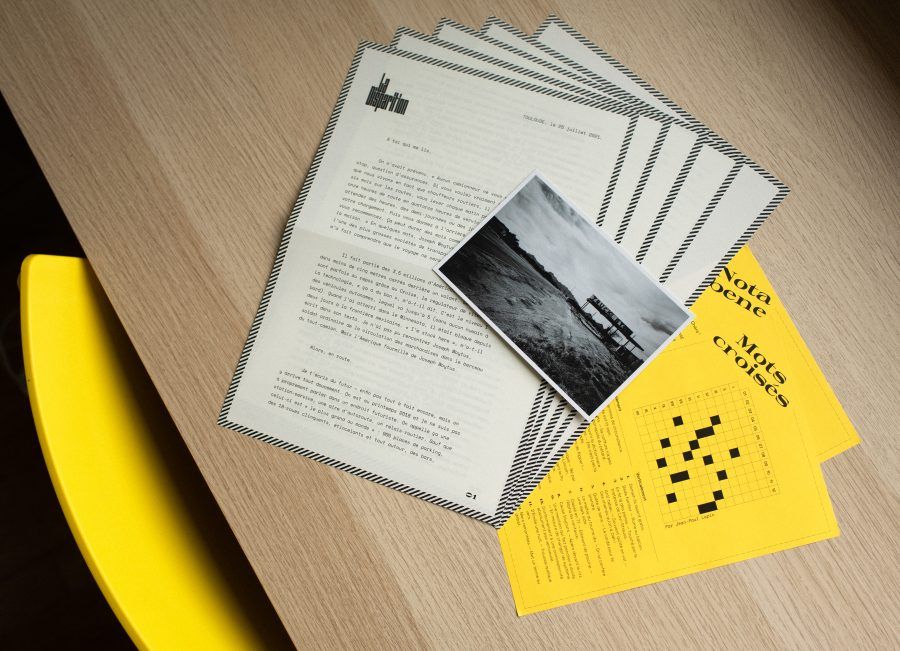
To describe these upheavals, *La Disparition* has chosen a unique format that we thought we’d never see again. An epistolary medium or a journalistic letter—take your pick.
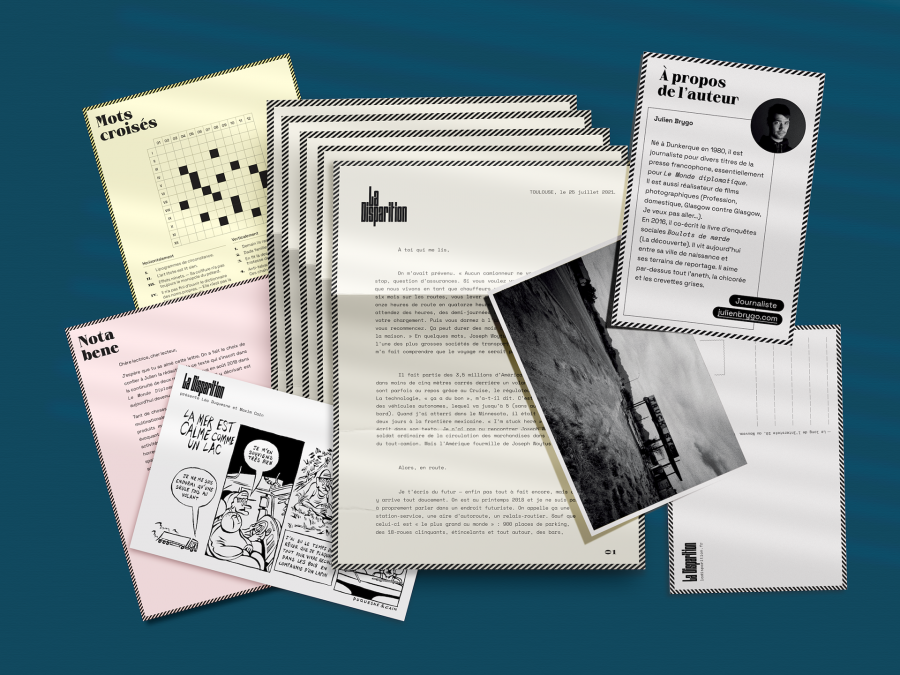
"Letter Zero," published in the summer of 2021, is an in-depth report by Julien Brygo on the loss of millions of truck-driver jobs in the Uniteddue to the expansion of platforms like Amazon, thereby highlighting broader issues. He then set out to meet them. “If I am here, it is because the situation is grave,” he writes. He takes the reader along to meet these workers. Here is an excerpt:
"You should know that in most of the country's fifty states, truck driver is the most common occupation, ahead of retail sales associate, teacher, and software developer. More than 1.8 million truck drivers, 93% of whom are men, operate on long-haul routes in the U.S., transporting approximately 70% of consumer goods—the rest is shipped by rail.”
“Before he disappears, I wanted to tell you what it’s like to be a trucker today. Its predicted decline signifies much more than just the tragedy of millions of people losing their jobs. This decline is just the tip of the iceberg in a world shaped and controlled by giants like Amazon, Google, and Uber. “I’m telling you this story so you’ll know about it and can decide for yourself if this future suits you.”
There are also those who prefer the modern mailbox—email. *La Disparition* also ensures that this digital correspondence doesn’t get lost among the rest. So that, for once, the reader will take the time to read it. This exercise is featured in a newsletter published every two weeks. Once again, the theme is “disappearance,” explored through an editorialized press review. Each issue is different—it’s a surprise twice a month.
[Editor's note: Since December 2021, the team at La Disparition has been supported by Médianes, the studio.]
Rewind: Catch Up on the News
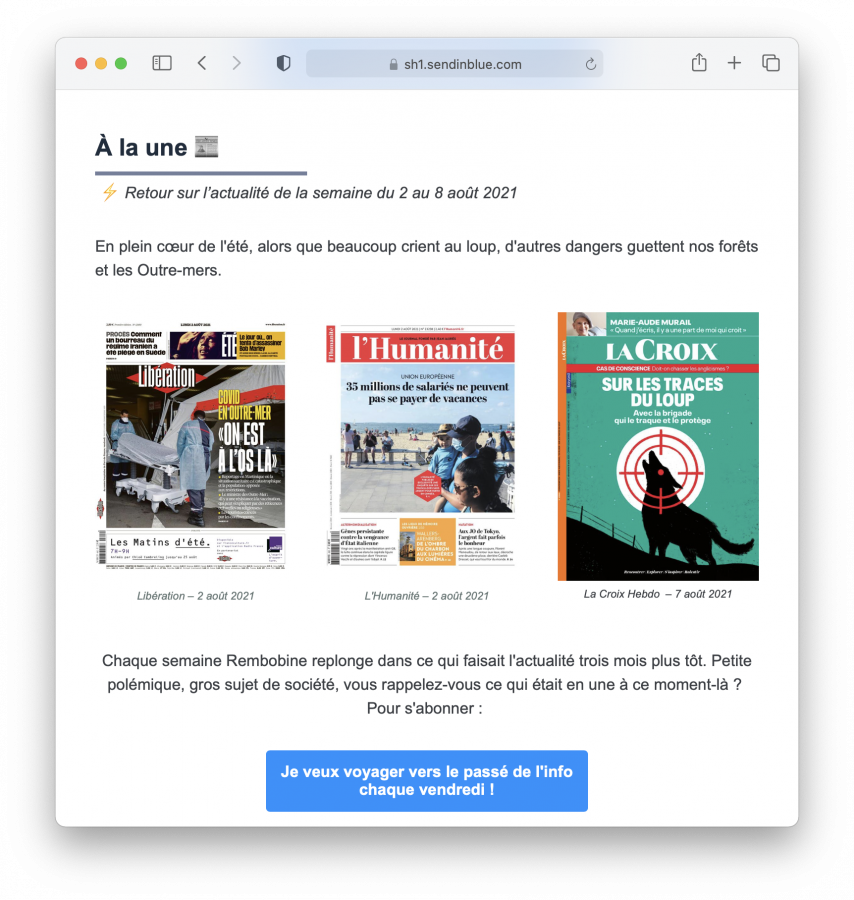
So, emails pile up and we lose track. It’s the same with the news—sometimes we tune out. In his newsletter *Rembobine*, Tim Vinchon, an independent journalist who is part of the La Friche collective, addresses all those “who no longer follow the news because it moves too fast.” “When I lead media literacy workshops, I notice that the news stories we’re talking about now—no one will be talking about them in three days.” The idea behind the newsletter is therefore to pause and reflect, “to find a new entry point for those who have lost interest or become disillusioned.” Faced with the ceaseless flood of information, the journalist decided to look back at events from three months ago. He thus suggests taking a step back to better understand them.