


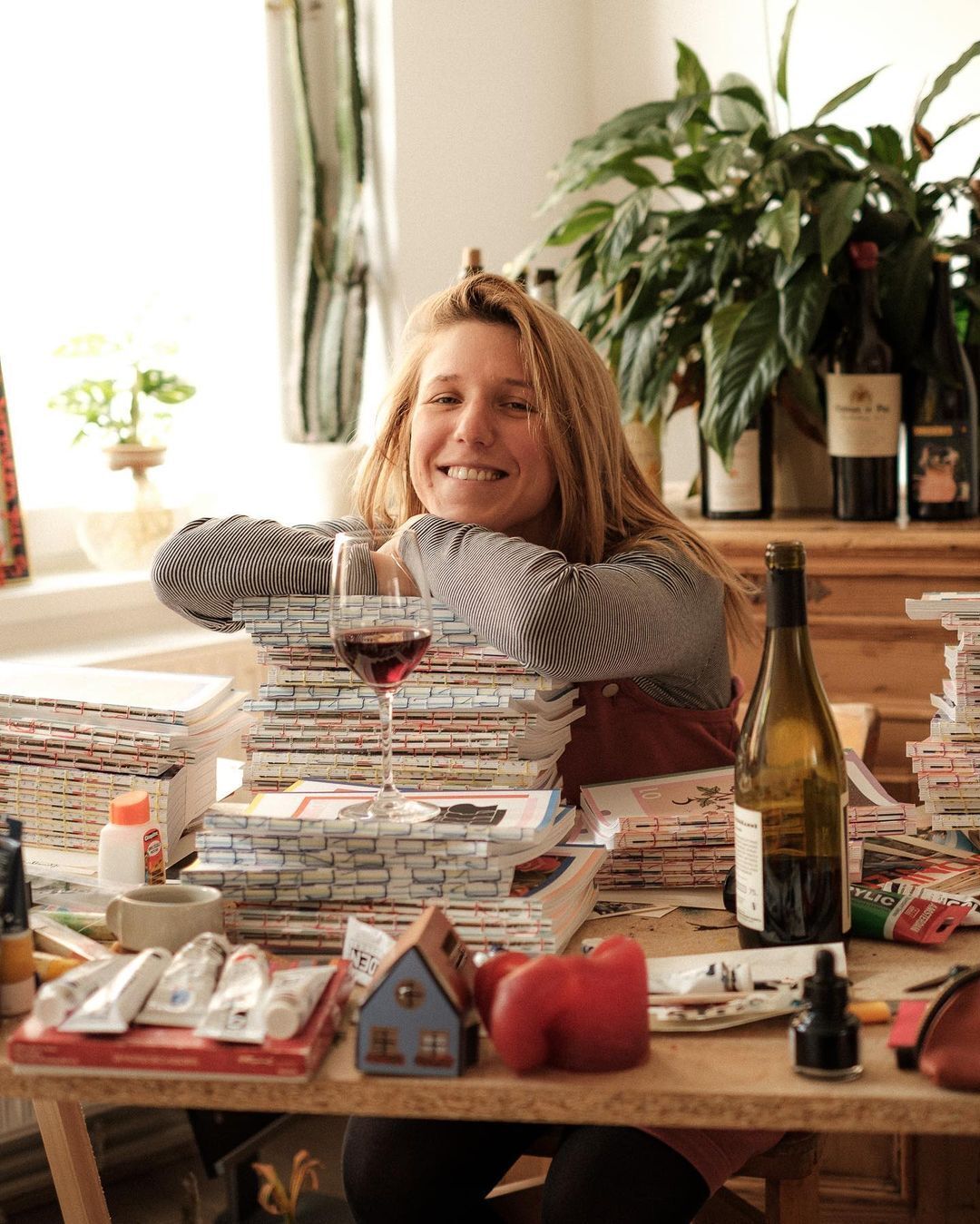
Pauline Dupin-Aymard is the founder of *Chassez le naturel*. While traveling the wine routes, she chronicled her adventures online. Then she felt the urge to share her experiences in print. After launching a magazine, the adventurer tells us how she started a fanzine with a pilot issue that was entirely handmade.
She traded in her truck and the open road for a permanent home in Alsace. In 2018, Pauline Dupin-Aymard set out in her converted van to meet natural wine producers. Between her visits and tastings, Pauline keeps a journal: conversations, daily life, flavors, and landscapes. Without technical jargon, she is driven by the desire to recount these moments and share them with others.
As her journey unfolds, the woman who describes herself as a writer and artist maintains a website and an Instagram account for her followers. Then she came up with the idea of creating a paper product—a 96-page notebook—every six months. “I’ve always loved working with my hands, whether it’s painting or writing.” In May 2019, she launched a crowdfunding campaign to finance her first project—a magazine—and raised 17,000 euros.
« Quelque chose de spontané »
The first issue came out in June and was reprinted a few months later. A year later, Pauline wanted to create something more intimate and artisanal. That’s when the idea of a handmade fanzine took hold. “I wanted it to be like a logbook to share my encounters.”
In April 2021, issue 0 of a fanzine limited to 100 copies was released. Was putting together issue 0 by hand and all on your own a challenge? “No, I really enjoyed doing it. You’re not really putting yourself out there with an issue zero—it’s mostly about testing out a new format. A limited-edition issue zero is also an opportunity to tell your own story: I wanted something very intimate and spontaneous—it’s handmade, I write in the first person; it’s almost like an enhanced notebook.” About thirty pages featuring text written in pen, photos, colors, and collages about her encounters and adventures on the road.
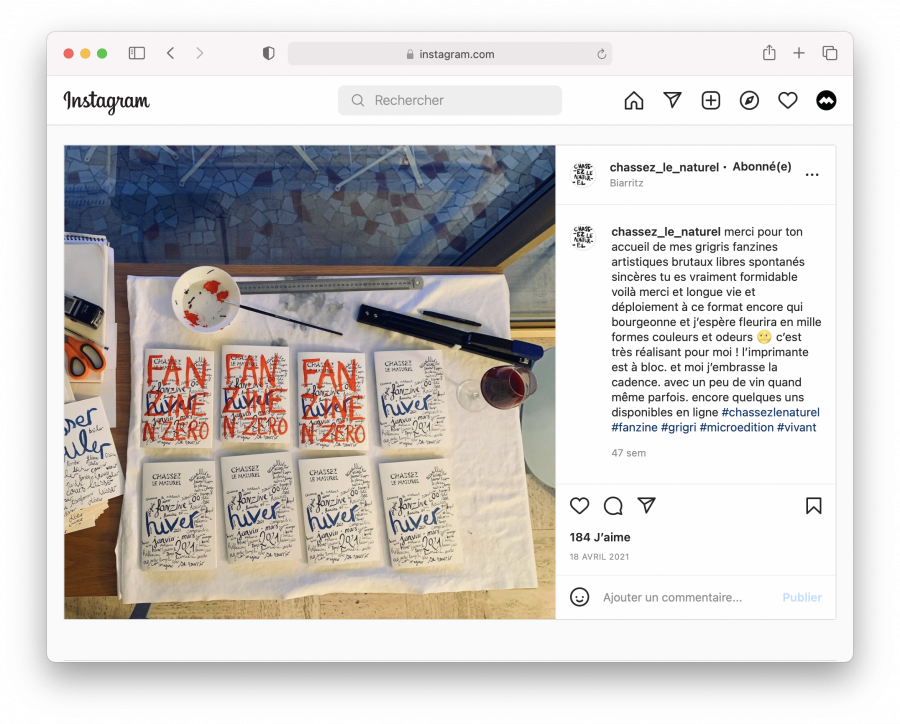
Of course, it takes time to do everything by hand, but “the advantage is that the only investment needed is a good printer.”
Readers come for the format
Pauline has more than 9,000 followers on Instagram; this is the main channel she has used to share information about her fanzine project. She can count on a dedicated community. “Most of my readers are people who follow me on Instagram. They’re people who connect with the style, who are drawn to the format beyond just wine—they love meeting new people and traveling.”
Sales were mainly driven by social media and word of mouth; the entire print run sold out in just a few days. “This reinforces the idea that testing out new projects truly meets the demand of certain curious people.”
Thinking About the Entrepreneurial Side
An already established community helps spread the word about its issue zero. “The idea was really just to have fun doing it.” Following the success of Issue 0, Pauline Dupin-Aymard launched, in the summer of 2021, Issue 1, with a print run of 150 copies, which complements the release of four more substantial issues of the magazine. It, too, is now out of stock.
Beyond the artistic and editorial project, one must also consider the commercial aspects, distribution, and business model of a print project, which can be disorienting. As a self-taught artist, Pauline quickly adapted to this challenge: “When you’re fully immersed in the creative process, you have to learn the communication side of things, how to reach out to people, and how to find the right contacts. It’s obviously an extra workload, but when you enjoy what you do, you don’t really see it as a burden.”
Four years after its launch, many kilometers, piles of paperwork, paintbrushes, and bottles of wine later, Pauline Dupin-Aymard continues her journey.
To go further
- This interview is part of our series on testing. Find more tips, including the example of The Others and their Recto-Verso project, how to create a beta test campaign with Brief.me, and the example of Le Progrès’s Asapp project.
- To learn how to create your media project step by step, check out our how-to guides.


