



Laurent Mauriac is the co-founder of Brief.me, a mini-newspaper that breaks down the day’s news via email. Economics, science: building on its success, the team has launched new topics since 2015. What do they have in common? A beta-testing campaign to launch the project, evaluate the value proposition, and build a subscriber base.
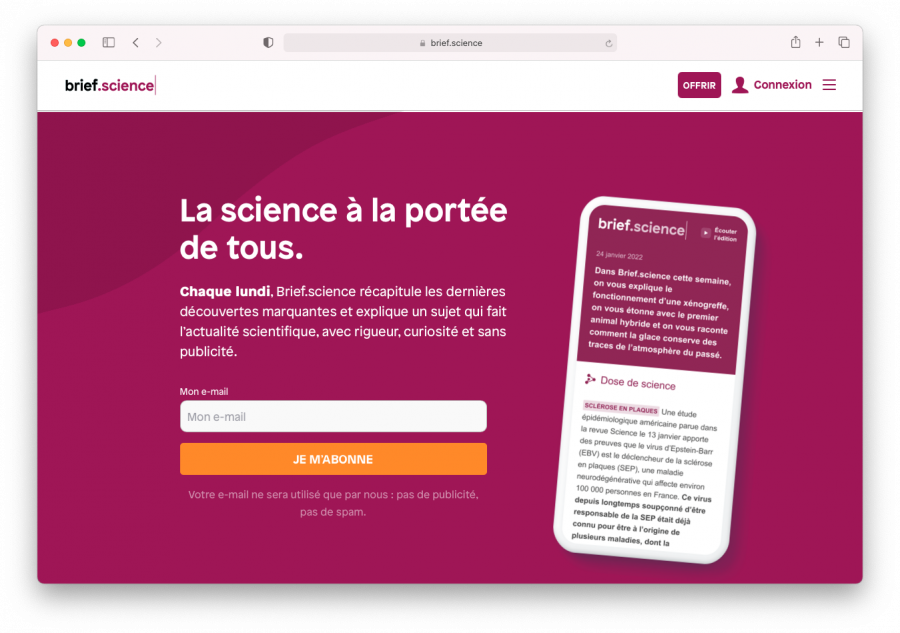
Laurent Mauriac is confident. The journalist, who cut his teeth over 12 years at Libération before co-founding Rue89 and then Brief.me, is no stranger to launching new ventures. As of early December 2021, the team is getting ready to send out the second “test” edition of the brand-new Brief.science newsletter. This edition is shorter than the first and was put together by science journalists Morgane Guillet and Imène Hamchiche, based on initial feedback from readers. A survey is also included in the email to gather readers’ opinions on specific points, including the order of the sections. Four test issues are planned before the official launch, which will take place in February 2022.
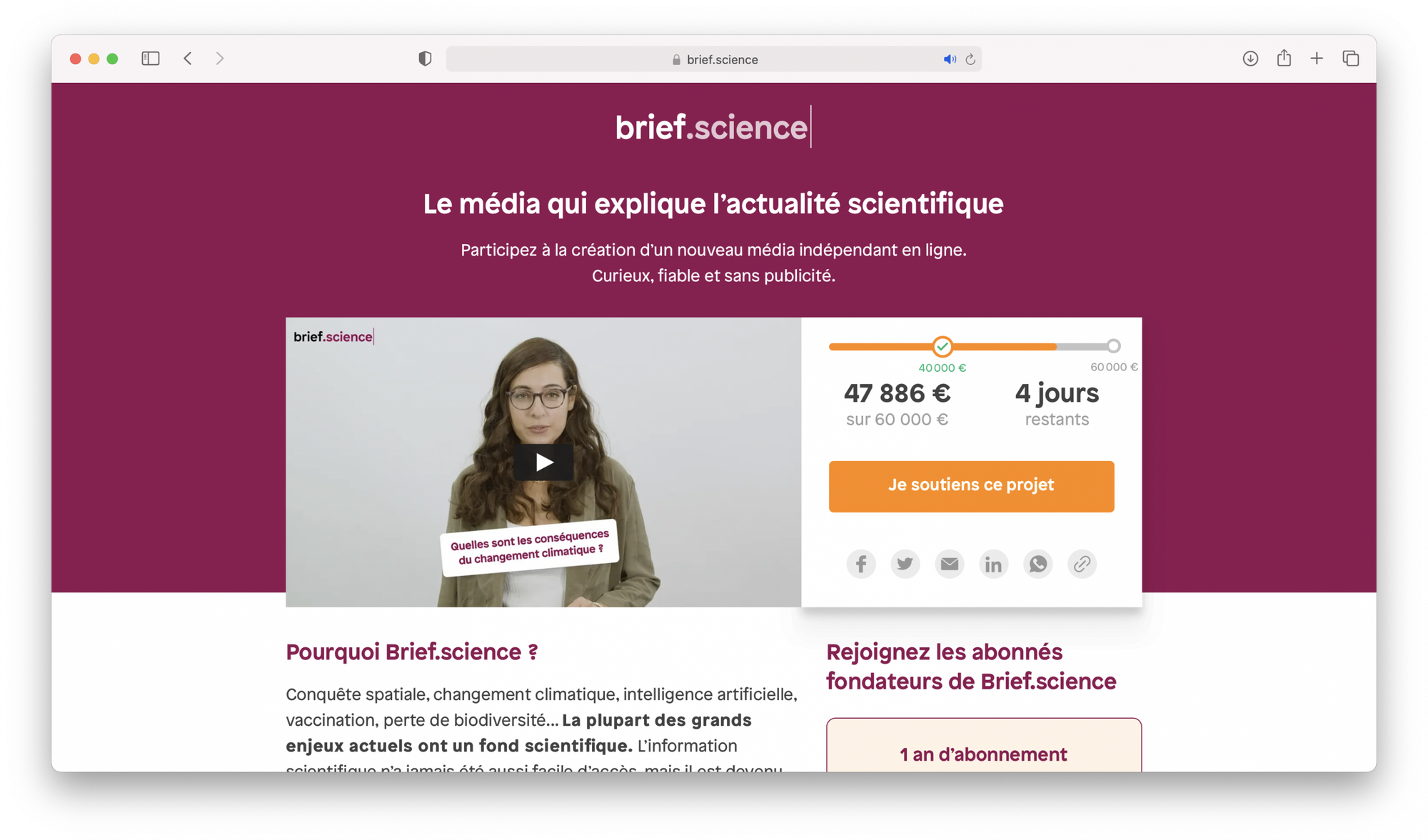
Just as it did when Brief.me first launched in 2014, the team is relying on a crowdfunding campaign to launch its new section. The difference is that this time, the newsletter can count on its base of 12,000 paying subscribers and its experience. By choosing to fund the new project, readers subscribe for a year and get to try out the first few issues. But above all, they contribute to the project by providing direct feedback and can help create a media outlet that best meets their needs and expectations. “Since Brief.me’s inception, we’ve operated this way: co-creating the media with our readers, whether it’s for a launch or to improve what we do,” explains Laurent Mauriac.
"Engage the readership"
Back in 2015. On January 22, the first Brief.me newsletter was sent out. The format—an editorial-style email—was still in its infancy in the media at the time, but Brief.me had seen it coming. Over the previous six weeks, Laurent Mauriac and his team had asked 900 volunteers to receive the newsletter issues and provide their feedback. “We’d send it out three days a week and then set aside two days to review the feedback. Some details have changed, but the original idea has remained the same”: a daily newsletter sent by email every evening to help readers make sense of the news.
Reader feedback is then collected in various ways: open-ended feedback via email, surveys, and sometimes live sessions. A best practice from Brief.me worth adopting? Encouraging the community to respond via a question embedded directly in the newsletter.
What’s interesting about Brief.me’s strategy is precisely its ability to attract, through a crowdfunding campaign, both readers interested in reading, trying out, and subscribing to the editorial product. An initial, loyal community that is helping to build the project and will become its best ambassador in the future.
"Try the beta version"
As a pioneer of paid newsletters in France, the co-founder of Brief.me knows what he’s talking about when it comes to launching a new media outlet. “A beta version lets you present a minimum viable product. Keep in mind that it’s a good way to test your concept, so you should take advantage of it. The idea isn’t to present a finished product, but to see what works and what doesn’t in our initial project.”
But in the end, what’s the point of a beta version if the project is already finalized? “To test it, to see if the concept resonates and if we’re in line with what readers expect—such as the publication time, the sections, the layout, how links are highlighted, and so on.” ” Laurent Mauriac also points out that this can be an opportunity to get started without too many resources. The pre-subscription campaign is an immediate source of funding for the launch.
Test, test, test. Whether by engaging your community before launch, creating a pilot issue, or setting up a beta test campaign, testing your media platform allows you to deliver a project that is as closely aligned as possible with your readers’ needs. It’s a way to test financial viability, refine the editorial line, and build trust with your community. Shall we give it a try?
To go further
- This interview is part of our series on the test. Find more tips, including the example of *The Others* and their *Recto-Verso* project, the creation of a pilot issue with Pauline Dupin-Aymard of the magazine *Chassez le naturel*, and the example of the *Asapp* project by *Le Progrès*.
- To learn how to create your media project step by step, check out our how-to guides.
- Are you looking to launch your crowdfunding campaign? Follow this guide.


