


Depending on which generation you belong to, you probably heard from your teachers during school criticize Wikipedia as a source for your presentations, along with the warning: "Anyone can write anything there". Today, the discourse is quite different. The encyclopedia is now presented as one of the last bastions of a free and reliable web, while tech giants compete for its content to feed their AI. The systems they develop, largely nourished by Wikipedia, are now in turn in the sights of teachers.
While the encyclopedia can claim to have restored its image, it faces a significant challenge. Internet users visit the site less often, with AI answering in its place. Result: Wikipedia recorded a decline of around 8% in page views over a year, while 65% of its most costly traffic comes from bots, putting strain on its technical infrastructure and financial model. An evolution far from trivial for an organization that relies heavily on donations from its users. Does that ring a bell?
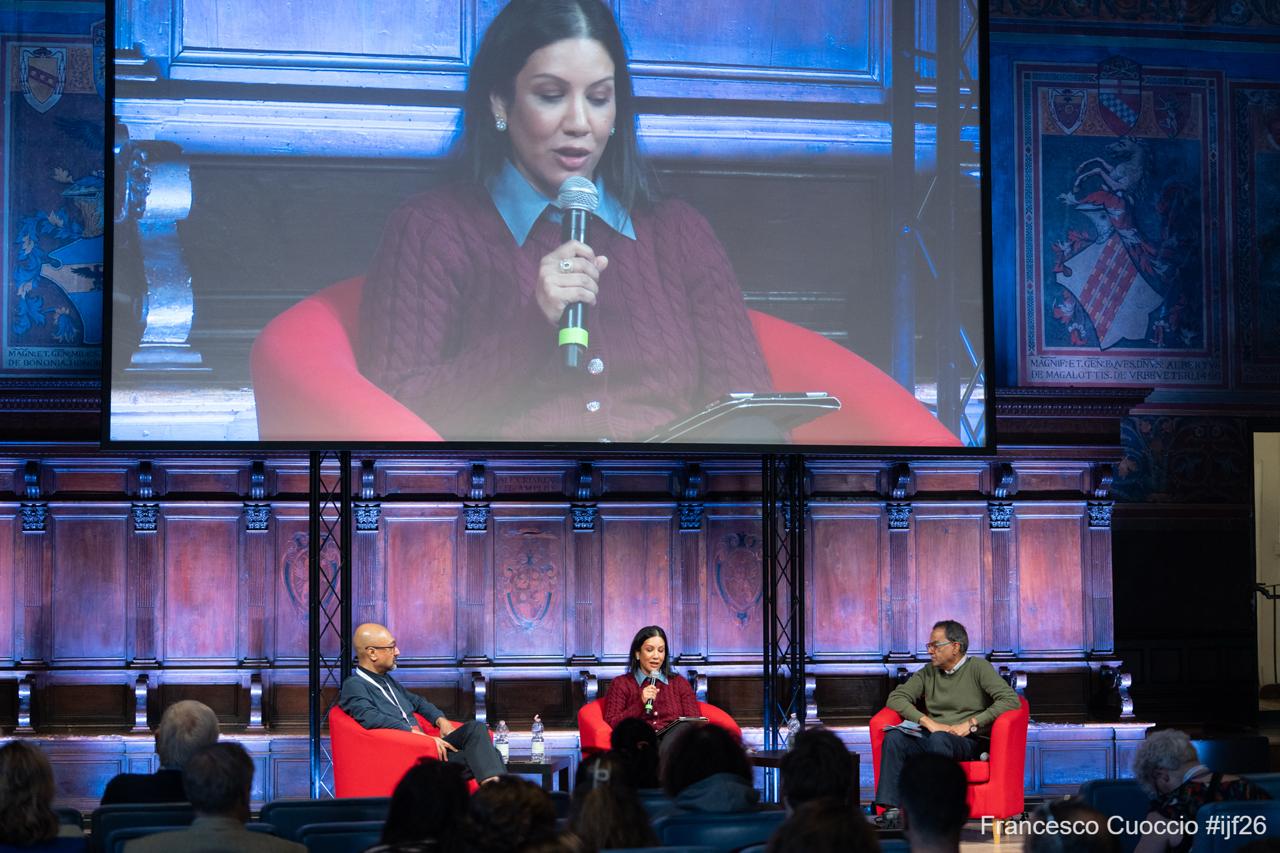
These challenges are largely shared by the press, as evidenced by the presence of numerous journalists and editorial leaders gathered in the Sala dei Notari, in Perugia, for the International Festival of Journalism. Anusha Alikhan, director of communications for the Wikimedia Foundation, and Raju Narisetti, a member of its board of directors, explained how the free encyclopedia is preparing this new chapter in its web history, with a few lessons for media. We'll tell you about it.
Building loyalty before asking for support
Less traffic mechanically means fewer opportunities to convert readers into donors. Approximately 90% of the Foundation's revenue comes from individual donations, with an average contribution of 11 to 12 dollars, Raju Narisetti points out. A model now threatened by disintermediation: "Why would you give eleven dollars a year if you never visit Wikipedia and simply access information through a chatbot?".
In this context, a simple donation appeal banner may no longer be enough, and the Foundation is anticipating a future with less traffic and betting on building a more engaged user base. To achieve this, Wikipedia is adopting a more aggressive strategy centered on the notion of impact, with strengthened presence on various platforms and the use of multiple formats. A notable evolution for an organization that has long invested little in marketing, admits its communications director, Anusha Alikhan. The Foundation now publishes videos and articles to explain its principles, its behind-the-scenes work, and how it operates.
"What makes Wikipedia different from social media?"
The digital encyclopedia seeks to distinguish itself from AI and social media by emphasizing the specificities of its model: absence of recommendation algorithms, refusal of advertising, data protection, etc. It also plans to soon release a series of videos to "debunk" and deconstruct certain misconceptions about how it works — first and foremost the idea that "anyone can write anything" — by detailing the verification, editing, and transparency processes it adopts.
Stop relying only on Google
For a long time, Wikipedia could rely on search engines to capture the bulk of its audience. But this dependence is now showing its limits, and the encyclopedia no longer sees Google — which displays AI-generated answers directly in search results — as an obvious traffic source. The Wikimedia Foundation is now looking to reach its audiences by investing in platforms like TikTok and Instagram, with the goal of reaching new generations where they are.
This shift involves a strategic and cultural turning point. Breaking with the image of anonymous contributors hidden behind an IP address or pseudonym, Wikipedia is seeking to better embody the production of its content. A way to respond to the search for authenticity, especially among younger generations tired of an increasingly artificial web. Recently, Wikipedia published a series of videos on its social networks, "Meet the editors", highlighting the volunteers who actively contribute to the platform.
The encyclopedia doesn't just adopt the codes of content creators in its video formats: it collaborates directly with them, notably on TikTok, to produce formats adapted to these platforms, to tell anecdotes about the encyclopedia, explore fascinating pages, etc. This desire to humanize the Wikipedia "brand" is also reflected in its communication around its 25th anniversary, with the launch of a mascot, "Baby Globe", sold as a plush toy in its shop.
For media, Wikipedia's experience recalls an obvious truth sometimes forgotten: usefulness is no longer enough. In a web where platforms and AI can capture the answer, direct relationship with audiences becomes a strategic infrastructure. This requires telling your story, embodying your work, diversifying your channels, and giving readers good reasons to come back and then contribute.
To go further
- AI versus accuracy? A compromise that readers seem ready to accept. Read our translation of the latest Tow Center report studying how technologies are transforming journalism, its practices, and uses.


