1. Editorial Status, ISSN and ISBN: the administrative foundations
The legal and tax status of your publication has concrete consequences on administrative procedures, applicable VAT, possible financial assistance, and postal agreements.
What is ISSN?
The ISSN (International Standard Serial Number) is a unique identification number for serial publications, that is, those that:
- are published on a continuous or periodic basis (with no time limit),
- share the same editorial line,
- are numbered or dated,
- are broadcast under the same title.
Legal deposit is mandatory for all periodical publications and books. It is carried out with the Bibliothèque nationale de France (BNF) and is assigned automatically upon legal deposit, free of charge. It is recommended to include it in the magazine from the first issue: "ISSN: pending".
The ISSN is required for any periodical seeking a press contract with La Poste. However, it is possible to launch a first issue before it is assigned.
And the ISBN ?
The ISBN (International Standard Book Number) is the identification number for books. It is mandatory for any publication sold in bookstores. The ISBN is assigned by AFNIL (Agence francophone pour la numérotation internationale du livre). The application is paid and depends on the processing time. Once the ISBN is assigned, you will also receive an EAN code, which will allow you to generate a barcode for sale (using tools like barcode.tec-it.com). The ISBN number must be mentioned in the book (for example on its back cover or in the colophon).
If a publication is identified by both an ISSN and an ISBN, both identifiers must be mentioned.
Magazine or book: a tax distinction (before an editorial one)
The distinction between journal and book is based on a tax definition rather than an editorial one. It directly impacts the applicable VAT:
- A book → subject to ISBN and reduced VAT.
- A periodical is a periodic publication with no end date → subject to ISSN, also eligible for a reduced rate but with specific conditions (frequency, multiple authors, etc.).
ISSN and ISBN numbers are not incompatible. A publication can have both numbers (e.g.: book series).
For more details, feel free to consult the website of the Syndicat de la Librairie Française or the BOFiP.
2. Opening a press subscription: when and how?
To benefit from preferential postal rates for shipping, the first step is to open a press contract with La Poste – Service Presse. This requires meeting several conditions:
- Be a registered entity (association, business, sole proprietorship, etc.) with a SIRET.
- Publishing a review.
- pending assignment
Different contracts exist depending on your needs and status, which can affect your budget.
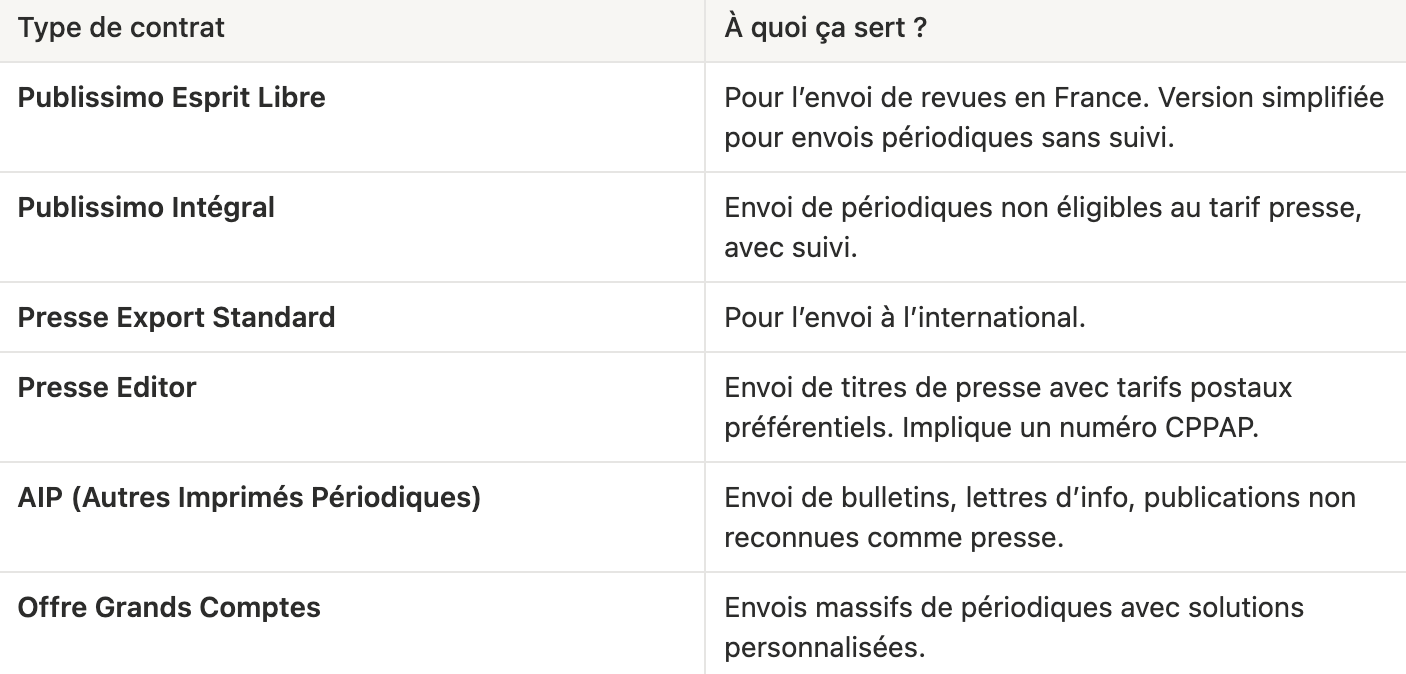
Press contract types
Not all press contracts offer the same rates or the same uses. The choice depends on the type of publication, its recognition as a press title, and the volume of distribution. We recommend comparing the different contracts based on your needs.
Your shipment may contain more than just a magazine (e.g., postcards, stickers, goodies, or rewards for a campaign), but it must not exceed your magazine's size. Otherwise, you could potentially fall outside the press agreement.
In this case, we recommend opening a Colissimo contract alongside your press contract. Each addition to the magazine will need to be weighed and assessed to establish accurate quotes.
3. From Printing to Sending
Once the review is finalized, it is essential to anticipate the entire supply chain: printing, packaging, shipping, and storage.
Start by choosing a printer early enough (at least two months in advance), as certain periods are very busy. We recommend thinking carefully about the final weight of the magazine, as it directly affects the cost of mailing.
Next, you'll need to organize distribution. This is most often entrusted to a mailing house, whose role is to insert the magazine into envelopes, affix the recipients' addresses, and then deposit the shipments at the postal service. Some printers also offer mailing services, which can simplify management and reduce costs. Finally, not all service providers handle press mailings—this is something to verify beforehand. Outsourcing your mailing is generally the least time-consuming and most convenient solution in the long term, depending on the quantities involved, but it is also costly. This mailing step can therefore be handled in-house for smaller print runs, initially for example.
However, it is possible to manage this step internally when volumes remain modest.
In summary, plan these steps with as much care as you would the content itself: quickly identify suitable service providers, clarify costs and timelines, and adapt your organization to the scope of production. Good planning allows you to control the budget, secure the schedule, and deliver a quality reader experience to your audience.
NPAIs (undeliverable mail) refer to shipments that cannot be delivered because the address is incorrect, incomplete, or the person has moved. These returns are common when sending a magazine to a large subscriber base, especially if it hasn't been updated recently.
When mail is identified as NPAI, it is generally returned to the sender's address. This is a point to verify beforehand with the mail house. Some mailing companies can also handle NPAI management and send you a file summarizing these returns.
With Médianes, le studio, we can help you with the technical and logistical aspects of printing your publication, in addition to marketing, financial, or design needs. Whether it's choosing the right paper, adjusting the format to postal weight, finding a reliable printer or mailing service, or organizing storage and distribution, we're here to guide you in making the right choices from the start. The goal: a well-produced publication, well-sent, and well-received.
To go further
- Starting a print publication: where to begin? From idea to printed product, overview of the stages, strategic choices and pitfalls to avoid when embarking on a paper project.
- Responsible printing is possible. Paper, inks, formats, volumes: nine tips to reduce the environmental impact of printing without compromising quality or editorial ambition.
- Going it alone in print media: lessons learned. Julie Hamaïde, founder of Koï, shares the realities, doubts, and lessons from running a solo print media project.