One spring twilight, some young people suggested I meet them on the steps of Place des Grands Hommes, in Paris, for a flash mob gathering.

On April 29th, while scrolling through Instagram, I stopped on this post: "Le Bruit qui court is launching its gazette […] do you want to become a town crier and shout scoops in the streets of your city? Sign up!" The images show a lovely newspaper, typewriters, road maps and an old-fashioned satchel containing a notebook and a pen.
Right away, I contact Julie Pasquet, co-founder of this collective of artists committed to ecology and social justice. She explains to me: « Le Bruit qui court is an association that tries to reinvent forms of activism. We connect artists with activists who have on-the-ground expertise and mobilization experience to conduct aesthetic and joyful campaigns. » What makes them special? Banking on emotion. « We work on the art of conveying messages by going beyond figures and statistics. » Among the mediums the collective uses to touch people's hearts: the gazette.
An excellent communication support
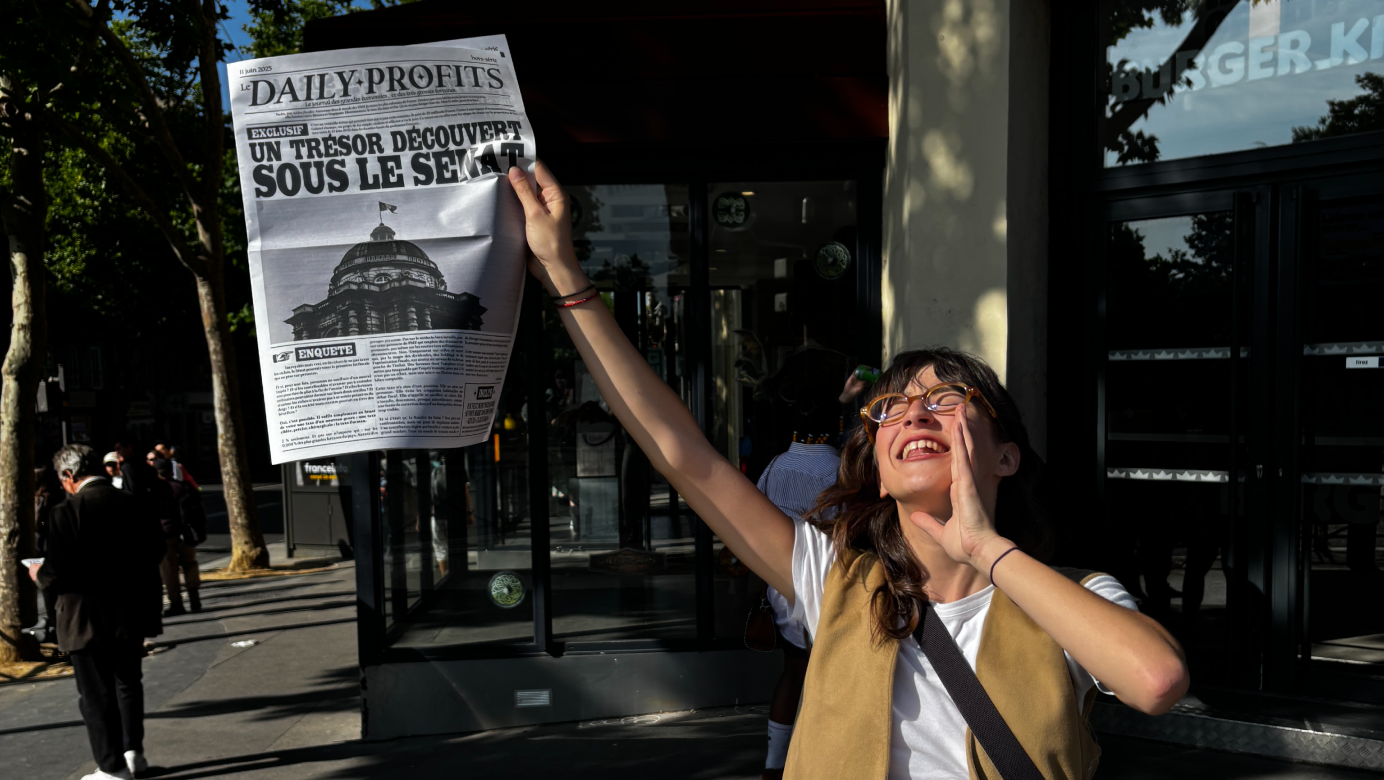
Last January, the collective seized an opportunity by partnering, as it regularly does, with other associations and non-governmental organizations. NGO ActionAid wanted to organize a publicity stunt targeting BNP Paribas, whose significant funding contributes to deforestation, particularly in the Amazon," says Julie Pasquet. This sparked the shared idea of organizing a gathering in front of the bank's Paris offices in the form of activist performance art. Volunteers, made up as street criers, brandished a fake satirical free newspaper, Le Daily Profits, and announced a scoop: "BNP Paribas is changing its name to an acronym more faithful to its commitments: Bank of Planetary Nuisances! "
The action unfolds as follows: passersby stop to grab a copy, and the sharing of ideas, which materializes through the newspaper, creates spaces for discussion that are more accessible than simple gatherings in public space. Information here is transmitted through human contact that the medium requires, rather than a swipe on one's phone. "We draw inspiration from the newspaper sellers of the nineteenth century who had this intensely social calling to make information accessible and reach a diverse audience", Julie Pasquet clarifies.
What if the street became a place for information to circulate again? In the age of social media and artificial intelligence, reclaiming public space creates a different kind of encounter—embodied and unexpected, almost accidental. This return of paper to the streets has a nostalgic quality, certainly, but it's rooted above all in the idea that information can also be a moment of transmission.
For the association, it's also an excellent communication tool. Images from the distribution are shared across partner organizations' social media. For the nostalgic and older members, it brings back a familiar aesthetic, while young people discover the evocative power of paper as a medium for engagement.
Distributions throughout France
From a one-off, Le Bruit qui court decided to make the gazette permanent and publish, as news develops, several themed issues on social issues in partnership with other NGOs. No fixed schedule: Le Daily Profits comes out when it comes out, depending on opportunities and the energy of the moment. The project is funded by the association's grants and partnerships with NGOs.
Once the issue is finalized, a call for volunteers is launched via social media, accompanied by a short video training session lasting one to two hours. Distributions shift locations: in Brittany, for a special issue highlighting media concentration through Bolloré; in Nice, around the question of marine protected areas — with testimony from a sea bream inside. "We really want our gazette to be funny, Julie Pasquet insists. We're not journalists and we know it: our goal is to grab people's attention with short, educational and humorous formats, to make people want to dig deeper, to inform themselves, to engage with the subject."
The secrets of good criers
On June 11, I head to the distribution of the new issue of Daily Profits, this time devoted to the Zucman tax. This bill, presented the following day to the Senate — and ultimately rejected — aimed to establish a tax on the wealth of the ultra-rich, whose fortunes exceed 100 million euros. It's 5 p.m., at Place du Panthéon, the meeting point for today's newsboys and newsgirls.
There are seven of us, including two coordinators from Bruit qui court, Claire and Gaëtan. The session begins with a round of introductions where each person briefly shares their mindset (tired, happy, nervous, enthusiastic…). One participant clarifies that she prefers to observe before daring to jump in.
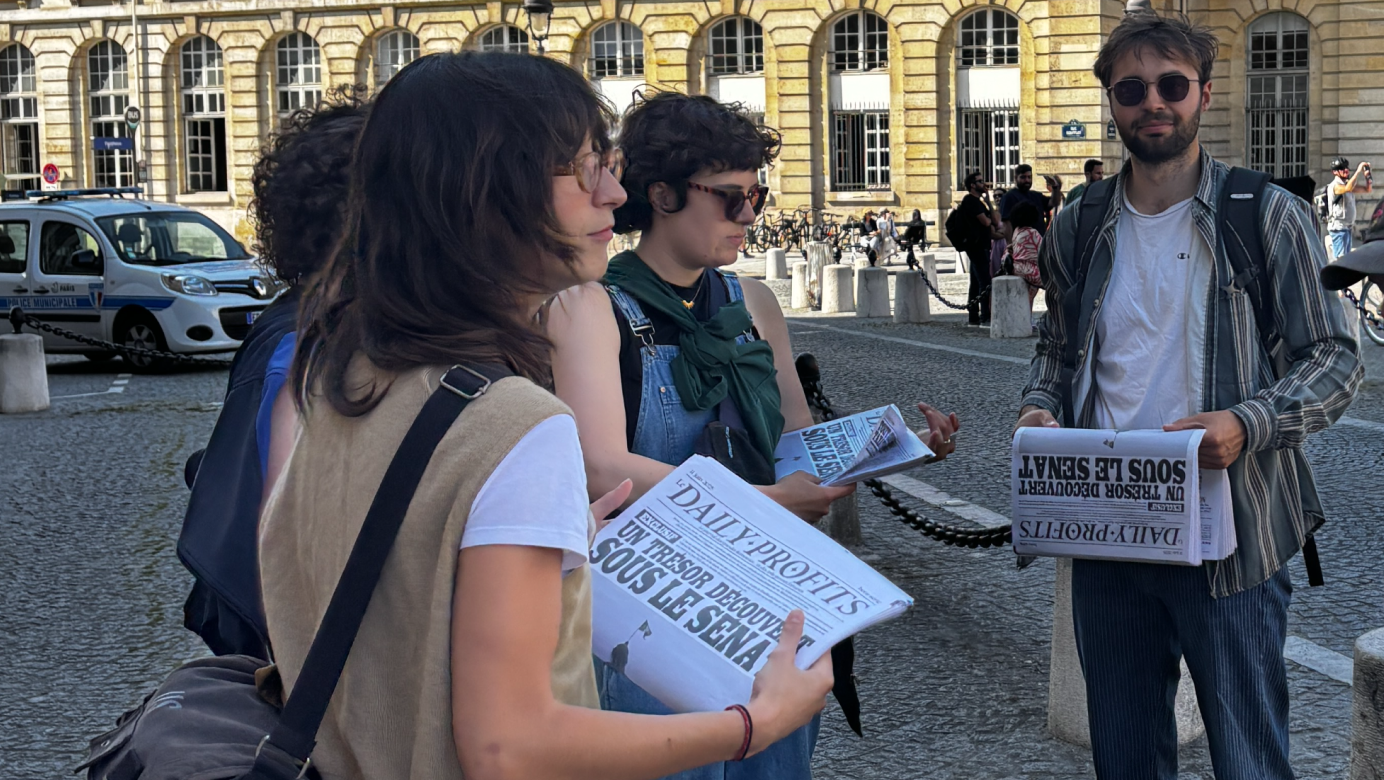
Claire and Gaëtan quickly follow up to reassure everyone:
"If you want to take the time to chat with passersby, please do. Otherwise, handing out the gazette is already great.
— You'll be split into pairs or groups of three: don't stay on your own.
— If you sense any hostility, de-escalate immediately. We don't force anyone to take the gazette. And if needed, we'll stick around to keep an eye on you. »
The brief barely finished, the coordinators lead by example and set off around Place du Panthéon: "Get your newspaper! We found treasure under the Senate: 20 billion for public services! It's free, help yourselves!"

At first intimidated, then amused, the volunteers quickly join in. The atmosphere relaxes, the tone becomes playful and humor becomes a tool for engagement. The qualities of a good town crier? "A smile, a carrying voice, and clear, punchy information to spark interest in a single sentence", according to Gaëtan. Near him, a crier inspired by the moment starts inventing new slogans on the fly: "Madam, I see you don't have a cap on this sunny day. Once you've read it, the gazette also works as a parasol! A true tax shield!"
From the outside, it looks like watching a street theater performance. Public space is a fully integral part of the distribution strategy: "That's where we can make direct contact with people and create meaningful connections," Gaëtan points out. Far from the polarization of platforms or activist meetings that can become insular, the street makes it possible to reach a wider and unexpected audience, and to spark conversations where they don't normally happen. A true way to break down silos.
Where social media favours immediate reaction, paper handed directly from person to person often sparks conversation. The strategy behind Le Bruit qui court rests on the conviction that information circulates better when it's carried by bodies, voices and faces. The newspaper becomes a pretext for creating connection.
"What's interesting is being able to discuss with people. Even when, at first, someone says "Ah no, a tax, that doesn't interest me", sometimes just a few well-chosen words are enough to spark curiosity", he continues. In this logic, the distribution becomes a moment of education and gentle reclamation of attention.
Beyond its original form, the substance remains political. "I'm convinced that the two main areas where we need to fight for ecology and social justice are information and education," he insists. How do we share real, verified, sourced information with people so they can make informed choices?" The answer: by meeting people where they are.
To go further
- Collages or digital campaigns, media are inventing new ways to occupy public space. Here are some examples that could give you ideas.
- Intimacy to build community. By transforming his living room into a professional networking space, food journalist Ezéchiel Zérah builds loyalty with an active audience connected to one another and to him.
- With Marsactu Unlimited, the media outlet offers free access to its content in various locations, including cafés and community centers. By making its offering tangible, it hopes to reach new audiences, sometimes disconnected from news, while reducing its dependence on digital platforms.
- To stay connected with their audience, media outlets are multiplying formats that integrate citizens. Overview from Reporters without Borders, France Inter, Ouest-France and Centre-France.