


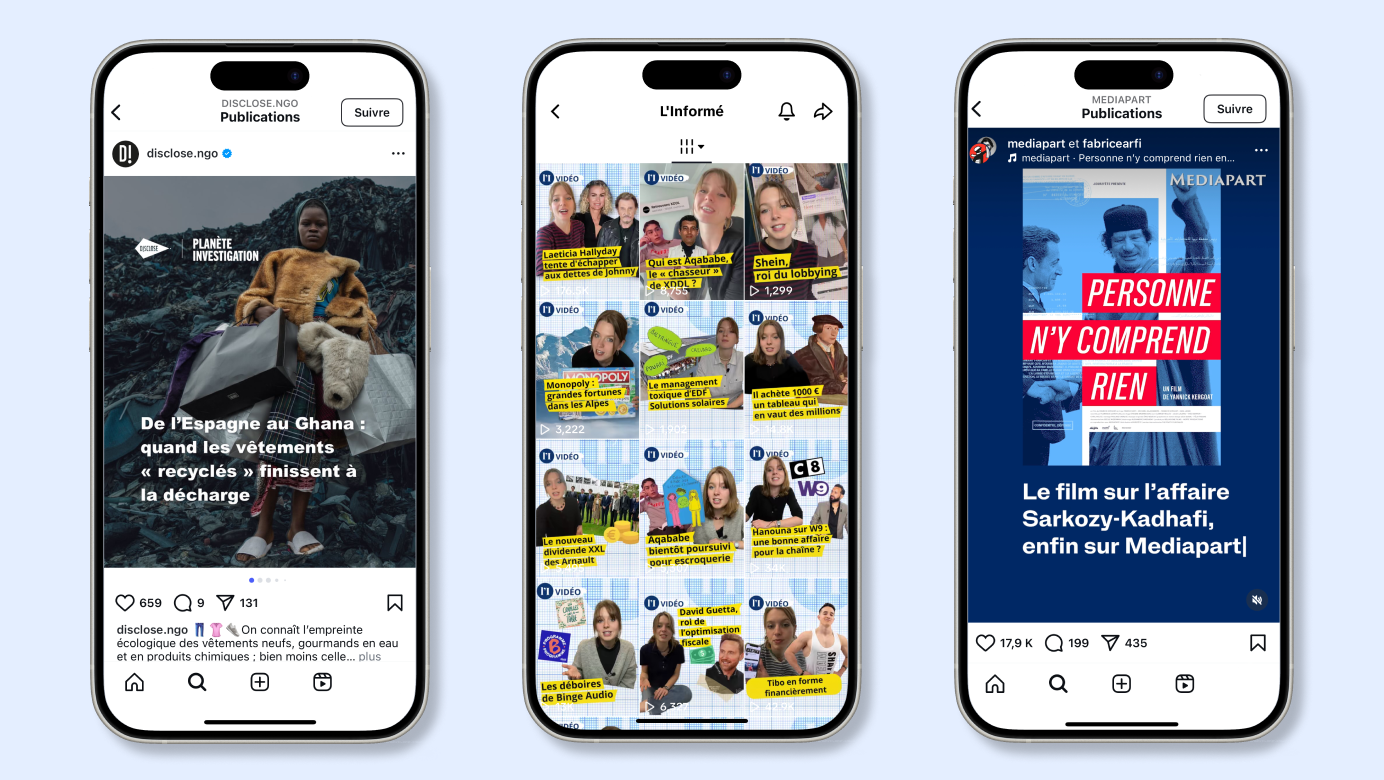
150 dates across France, a tour bus, tens of thousands of tickets sold… What looks like the latest trending artist's tour is nothing other than Mediapart's programme for telling one of its most iconic investigations: ' the Libyan affair', a politico-financial scandal among the most explosive of the Fifth Republic, spanning more than a decade and two continents. 'No one understands any of it', Nicolas Sarkozy, its protagonist, preferred to brush off, with a hint of satisfaction and barely concealed hope that the affair would sink into indifference, smothered by its complexity.
The Mediapart newsroom has taken the opposite gamble: multiplying formats to make the investigation comprehensible and accessible. Adapted for the screen with the film 'Personne n'y comprend rien', distributed in bookstores as a graphic novel, toured through the streets of Paris by bus to visit the emblematic locations of the investigation, and online with podcasts, videos and interactive formats. An all-encompassing distribution strategy, unprecedented in its scope, and emblematic of a broader transformation in journalism: publishing is no longer enough.
New expectations, new uses
To exist in readers' schedules and in the saturated flows of social media, media outlets must redouble their inventiveness and think of distribution as an integral part of journalism. Julie Sockeel, marketing director at Mediapart, notes: "Communication and information methods have changed in 10 years and things are evolving quite rapidly". A change in how readers behave, which the online media observed through its own audience study, available on its website, and which is confirmed by Reuters Institute data whose latest report highlights, for example, the relentless rise of video platforms as preferred sources of information, particularly among young people. "There is a certain 'competition' with other media on one hand, but also with people who become their own publishers or their own media outlets", adds Mathias Destal, co-founder and editor-in-chief of the investigative media outlet Disclose. Competition is no longer just between newsrooms: it also includes influencers and content creators, who are redefining information circuits on the Internet. In this context, where engagement with online information is stagnating or even declining (Reuters Institute), newsrooms are adapting.
Editorial teams becoming their own relay
Given these stakes, newsrooms were encouraged to examine their practices in order to "break the sound barrier" as Mathias Destal puts it. While this doesn't mean abandoning in-depth articles, let alone investigations into long-form journalism, newsrooms now acknowledge the limitations these have in terms of reach against more fleeting attention spans, prompting them to explore information-sharing methods better suited to contemporary usage, particularly on social media.
This shift is reflected in the emergence of new formats and new professions. At L'Informé, a media outlet specializing in political and financial investigations, journalist Zoé Pinet adapts the outlet's investigations into short-form content for TikTok and Instagram. Work that is fully journalistic in nature and respects the same standards and practices as her colleagues who conducted the original investigations: " When I write my script, it's validated by the editors-in-chief, then through back-and-forth exchanges with journalists to verify the accuracy of the information " she explains.

For newsrooms that don't have positions specifically dedicated to social media, this expansion of journalism's scope into territories traditionally associated with communications and marketing has resulted in new forms of collaboration between departments. Mediapart redesigned its organization to foster connections between different teams. "I remain convinced that the services have virtually the same mission," Julie Sockeel assures. " We'll do it with different levers and tools, but ultimately, we all have the same goal: promote content and reach the audience we set out for from the start. That requires working hand in hand ". To facilitate this breaking down of silos, Mediapart undertook an educational effort to overcome resistance, she explains: "Marketing is a word that gets used a lot. Sometimes it can have a slightly negative connotation to its role (…). It still sparks the curiosity of quite a few journalists ".
At Disclose, there's no need to break down silos between departments: there is no marketing team, it's the journalists who handle it. A model that, according to its co-founder, has the advantage of thinking about how to distribute investigations from the moment they're being written: "We've internalized it into the editorial process, it happens very early," confirms the editor-in-chief. Because they're produced by their journalists, content intended for social networks has significant editorial value and is no longer thought of as merely a hook to drive traffic to the original article: "We try to speak to a different audience and create content that stands on its own, independent of the article published on our site. We don't tell ourselves it has to bring readers back to the paper that's 15,000 characters long. If they've read our post, that's already great. They know Disclose and have access to the information. That's what matters." A vision shared by Zoé Pinet, for whom her videos don't necessarily fit into a conversion strategy: "The audience for videos isn't the same as the site's audience. What they want is information, not necessarily the long-form article".
An accessibility search
Instagram carousels, vertical videos on TikTok, cardboard structures, collages… These new journalistic formats have sometimes provoked condescending reactions from certain press veterans, for whom "true" journalism remains inseparable from in-depth investigation, meticulously written in the tradition of long-form reporting. But now, things have changed, observes Julie Sockeel: "I think it's an issue for everyone, for all media outlets, to be more accessible. And perhaps the effort is more significant at Mediapart because we prioritized written content and substance for many years and form came much later". The outlet, which transposed online the traditional architecture of a newspaper with its front page and sections, has thus gradually integrated new tools into its strategy in order to make itself more accessible: broadcasts on Twitch, experiments on TikTok, regular podcast production… Even its articles now offer summaries in boxes titled "Don't have time to read this article?" or an audio version.

For Mathias Destal, editorial interest in developing new formats designed for social media, or even for popularization, in no way constitutes a dilution of journalism. On the contrary, he sees it as a return to the very essence of the profession: explaining and conveying information. "We arrive at the purest information we wanted to bring to public debate," he explains. "As for social media, I don't find it ungrateful, crude or vulgar. Quite the opposite."
With 41,000 followers on Instagram, Disclose relies largely on this network to distribute its investigations. The carousel format is regularly used there to condense and structure the facts of an investigation. A form of popularization that is still sometimes "looked down on" in certain professional circles, even though attitudes have evolved considerably in recent years. Zoé Pinet recalls: "In journalism school, I was in a Video Web major, and concretely we made face-to-camera videos and edited all day (…) Those who were in the Television major would sometimes come into our room and laugh". Today, these "handmade" practices actually allow newsrooms to blend in with content produced by ordinary internet users, maximizing their chances of being seen and consumed by an audience seeking authenticity rather than major institutions or AI.

An evolution that is pushing newsrooms to pay attention to dimensions once considered ancillary, even superficial — such as visual aesthetics. Why? Complex content lands better when images are polished, typefaces are readable, and infographics are clear. In this area, « there is particular care and renewed effort, with an entire design team at Mediapart that didn't exist before », confirms Julie Sockeel.
This increased attention reflects in France the emergence of genuine visual journalism, at the intersection of design, narrative, and information, which has become central to circulating complex stories in saturated digital environments. It also embodies a particular vision of graphic design in media: not merely formatting, but an essential link between the medium and its audience. Form fully serves content, enabling people to see, understand, and retain it.
From Distribution to Customer Loyalty: Finding a New Balance
But this strategy comes at a cost. It involves trade-offs, as evidenced by the campaign led by Mediapart around the Libyan affair: "Redoing all this work for every Mediapart investigation is impossible. […] It was really a very significant investment from the entire team", explains Julie Sockeel.
Organizing events and producing varied formats requires time and teams. Mathias Destal acknowledges this, mentioning a lot of energy that isn't going into investigative reporting. The key, in his view, is to stay focused and prioritize quality over quantity. We're not on Snapchat, we're not on TikTok, because it takes considerable resources every time we go on a network. You have to take it seriously. If we go somewhere, we need to approach it professionally.
A strategic choice made all the more critical by the instability of these platforms. While they make it possible to reach audiences far from traditional channels, they also place media outlets in a position of vulnerability. Their policies can change overnight, as the Canadian case with Meta demonstrated, suddenly depriving newsrooms of these hard-won audiences.
Given this uncertainty, the challenge becomes one of transforming the exhibition into a lasting connection, by converting audiences toward proprietary tools: websites, newsletters, membership areas, or online communities. Channels where the media controls the experience, the relationship, and the data, and can establish a genuine editorial and community bond over time.
To go further
- Form in service of substance: Christelle Perrin, Médianes' art director, discusses the specifics of graphic design for independent media, and shares her tips for creating an effective newsletter.
- The Canadian case: banned from Facebook and Instagram in 2023, independent Canadian media outlets developed new formats and forged collaborations to bounce back. A crisis that sparked reflection on platform dependence.
- Getting into video: embodying the brand, recruiting young people, adapting existing content… Here's how several French and international media outlets are approaching video on social networks.
- Building engaged communities: exclusive content, masterclasses and even social events with editorial teams, media outlets are developing "clubs". A way to strengthen their direct connection with audiences. Chut! and The Bristol Cable share their experience.


