
As every year, we're sharing our favorite picks to read, browse through, or look at—whatever you prefer. Revolutionary narratives, independent publishers, committed authors… Whether you're feeling very much in love or very frustrated, our selection should delight you.
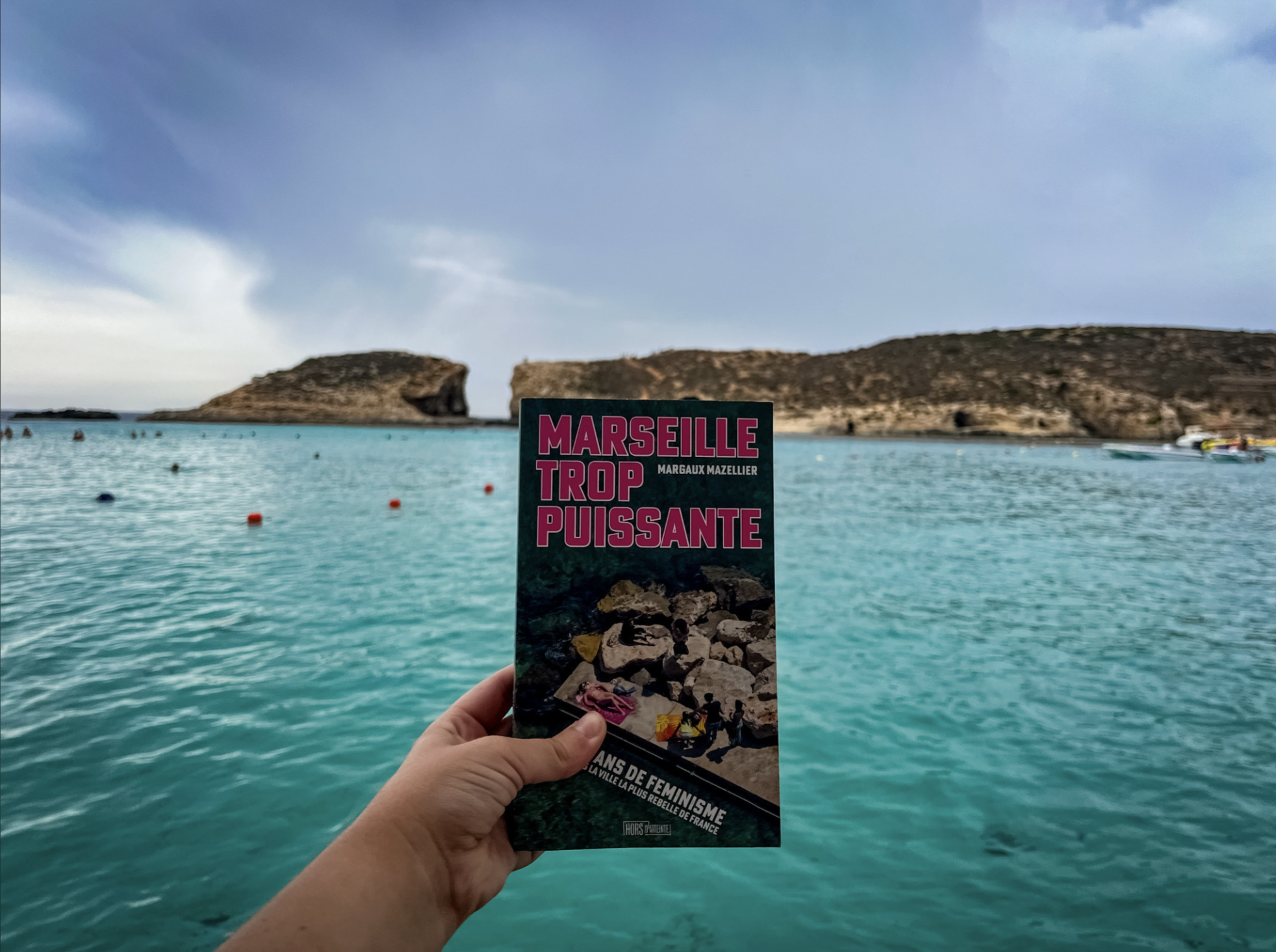
Marseille too powerful, by Margaux Mazellier
Marseille, I've been there a few times, and I never got the impression of being in a feminist city. I saw references to football and Ricard everywhere, I saw guys talking loudly, I saw poorly lit streets where I wouldn't have wanted to find myself alone at night, I saw girls being hit on. So when I saw this book by journalist Margaux Mazellier on my bookstore shelf, it intrigued me. How do girls actually manage to exist in this city? This book, published by the excellent — and Marseille-based — Hors d'Atteinte editions, traces the entire feminist heritage of the city, « from the Mlac to the Drama Queer Football Club, passing through Family Planning and the Cagoles of OM ». Through around twenty intimate interviews with women who have fought (and continue to fight) for their rights in Marseille, Margaux Mazellier tells the story of a deeply committed city. I was moved by all these struggles that echo and evolve across generations, by the ever kind gaze these women have for each other even when they disagree, even when they don't understand one another. If we know today's feminist issues, this book shows the full importance of feminist heritage and the archiving of our struggles. And now, I understand my friends who all want to move to Marseille.
Marine Slavitch, Section Editor
The Dangers of Smoking in Bed, by Marina Enriquez
The Dangers of Smoking in Bed is a collection of twelve horrific tales. Usually, I don't like horror novels that make me sweat under the blankets. Yet I couldn't put the book down until I'd finished it. In these stories, spirits and humans exist side by side in everyday life. The boundary between the two blurs; ghosts don't all look like spirits and they accompany little girls, children, and even elderly women by the hand.
Maëlle Ledu, Graphic Designer
A Lover's Discourse: Fragments, Roland Barthes
A timeless classic among classics. A Lover's Discourse: Fragments by Roland Barthes takes us through 80 states, emotions, postures and objects at the heart of love. We imagine it as singular, solitary. Sometimes we keep silent about it too, out of shame or modesty. We no longer dare to explore it, so great is its power to frighten us, whether we're sixteen or sixty. Faced with it, we're often defenseless — how do you speak of love? Sometimes we attribute it to a gender — feminine. And yet love has something profoundly universal about it.
This essay by Roland Barthes successfully undertakes the perilous exercise of expressing the experience of love, exploring all its states and emotions to echo what dwells deep within us when facing certain beings whom we find graceful. From the most exalting and beautiful to the worst of torments, Roland Barthes captures the intimate and manages to speak of it with poetry and such intelligence. He makes you smile, laugh, reflect, remember, dream with melancholy or passion, hope and perhaps feel again, anew, and with such intensity this complex emotion that sometimes makes us do foolish things. There is as much poetry as realism in these love fragments that lend themselves to the inner wanderings of long summer days.
Pauline Butel, Support and Training Manager
Literature and Revolution, by Joseph Andras and Kaoutar Harchi
« All writers take a stand, so that's not really the question ». I was captivated by this book from the very first line of the summary, after first being drawn in by the pink of its monochrome cover, a hallmark of the brilliant Divergences editions. Taking a stand, yes, but for what? And how? That's the real question here, explored throughout the pages in a dialogue between two authors, Joseph Andras and Kaoutar Harchi, who both place their political commitment—socialist, antiracist, anticapitalist—at the heart of their writing. The book is divided into three parts—Writing, Fighting, Publishing—in which the authors discuss their personal relationship with writing and publishing, but also together offer political reflection on how to organize the struggle through the written word.
As a passionate reader drawn to both the personal and collective resonance of the act of writing, I enjoyed diving into this conversation that views literature as a tool for transforming the world, and raises questions about the material conditions for the existence of books and the practice of writing. In short, a book that invites reflection on our readings, our commitments, and on how we can, by taking up the pen, make the rigid lines of a world sometimes prove flexible.
Mathilde Carlier, Project Manager in charge of communications
Mamie Luger, by Benoît Philippon
A funny and feminist detective story. In the inspector's office, Berthe, 102 years old, refuses to crack… Accused of gunning down a group of cops, she'll tell the story of her life with irreverent wit. A hilarious standoff unfolds as the old woman finally gets everything off her chest. Hour after hour, the toothless elderly woman almost convinces us of the necessity of her murderous acts. Confession, revelation or settling of scores, she has nothing left to lose, nor anything to prove to anyone…
Charlotte Payen, Executive Assistant
Clémence in Anger, by Mirion Malle
Our favorite comic artist recently made her return with a new publication: Clémence in Anger. Published again by La ville brûle — a pluralist publishing house focused on socially engaged topics — Mirion Malle brings closure to what she began with her respective works This Is How I Disappear, released in 2020 (we still have tears in our eyes remembering reading it, truly), and Goodbye Sad Love, released in 2022. This new graphic novel asserts itself both through its vibrant and colorful graphic choices and through its emancipatory and empowering feminist narrative. Far from melancholy, the figure of Clémence reminds us that anger, rage, sometimes destructive, that stirs within us is also an opportunity to better understand ourselves and get to know ourselves. The beauty of community support, love and friendship here answer the gaping wounds of a young woman we feel immediately close to. It's a liberating and comforting read that will make the perfect companion for your summer.
Caroline Fauvel, Web and Marketing Project Manager
Nantes, city in revolt – A counter-visit to the City of Dukes, by Contre Attaque
Do you really know the city of Nantes? While Médianes and current events often take me there, I understood, from the very first pages of Nantes, Rebel City, that I had poor knowledge of the City of Dukes, its history, and its ability to overturn the established order. Led by the Contre-Attaque media team, formerly called Nantes Révoltée, you will visit the city by exploring a series of iconic places, marked by Nantes' rebellions. From post-war insurrectional strikes to May 1968, passing through Notre-Dame-des-Landes, prepare yourself for a true "counter-tour of Nantes off the beaten path, a Proustian madeleine with a tear-gas flavor."
A gem to devour from Divergences publisher, where I also recommend reading You Won't Find Me on Amazon by Laurent Mauduit. The journalist and co-founder of Mediapart explores the dangers that digital giants pose to freedom of information and opinion through an investigation into the world of media and publishing.
Marine Doux, Co-founder, Editorial and Marketing Director
Cultish, by Amanda Montell
The subject isn't exactly summery, I'll grant you that, but the cover is colorful so that makes up for it. Through a series of testimonies, often moving ones, linguist Amanda Montell explains how words, verbs and sentences form the primary arsenal of cults in their indoctrination processes. She offers us a compelling analysis of their strategy and what plunges their victims into a fanaticism that we all too often tend to explain away as mere "brainwashing," without really knowing what that term means and implies. But while the book covers organizations like Scientology, it also invites us to question our relationship with our own everyday gurus. Because these methods aren't limited to cults in the strict sense. They've ended up seeping into our startups, the CrossFit gym down the street, and our social media. Is it ironic that several literary influencers on TikTok ended up convincing me to get this book? Perhaps. Amanda Montell also explains to us—and reassures us somewhat—our contemporary fascination with cults, sustained by Netflix series and podcasts.
Owen Huchon, Community Manager
In Waves, by AJ Dungo
I'm a hopeless romantic, but unlike my colleague Pauline, far from being a surfer. And yet, this essential graphic novel that explores this world moved me deeply; the emotion it stirs is subtle, delicate. Both a tribute and a meditation, In Waves tells the story of love, of grief. It's an ode to the ocean's power to heal, that immensity of blue where sadness can dissolve, and where each wave has the power to carry the promise of rebirth. AJ Dungo plunges us into a canvas intertwining his relationship with Kristen, his muse and his lost love with that of surfing pioneers, Duke Kahanamoku and Tom Blake. A poetic diptych of remarkable precision that takes form in a blue and sepia two-tone palette, minimalist illustrations and words that are never excessive. The pages resist saturation, leaving all the space for the necessary silence that such a story demands.
Juliette Cahen, Editorial Manager
All about love, bell hooks
Here's a book choice that won't shake the walls of your conscience with surprise, but after years of thinking about it, I finally dove into this little red book. Reflecting on love, starting by seeking a definition for it — isn't loving more of an action than a state of being? Might we sometimes confuse love for with investment in a person? What role does sexism and patriarchy play in these reflections, and is it legitimate to ask these questions? An excellent work to take a step back, and perhaps observe differently what we've been taught to believe is instinctive.
Christelle Perrin, Co-founder, Creative Director