
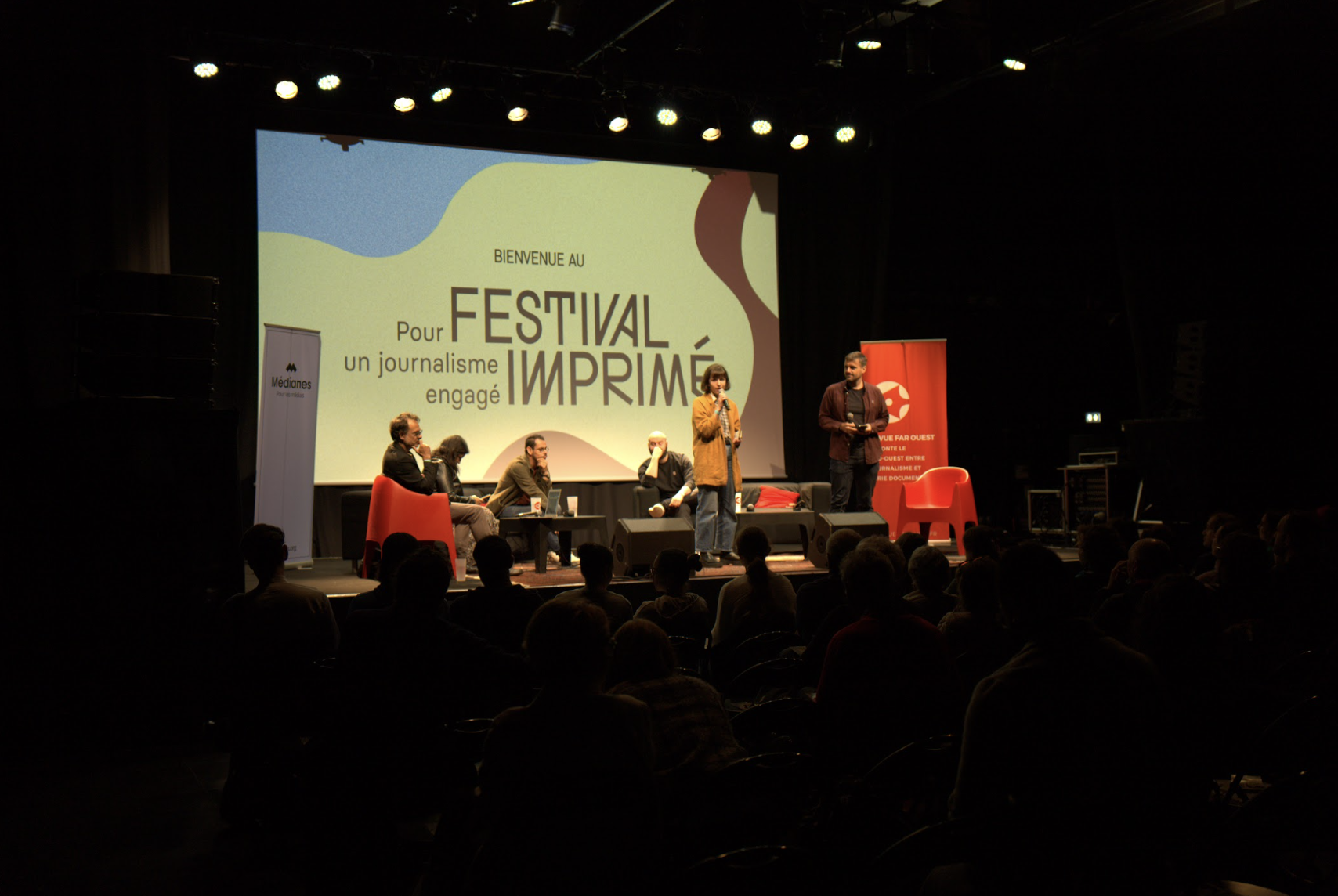
On Saturday, May 4, the third edition of Festival Imprimé took place, which Médianes co-organizes alongside Revue Far Ouest. Far right, sexuality, ecology, protection of sources, the future of journalism… This event was an opportunity to discuss five major themes and collectively find ways to build new, more inclusive and sustainable models of society. Here's a recap.
Media and far-right: after normalization
A roundtable discussion led by Simon Barthélémy, cofounder of Rue89 Bordeaux, with Nassira El Moaddem, journalist at Arrêt sur images, Christophe-Cécil Garnier, deputy editor-in-chief of the investigations team at StreetPress, and Youmni Kezzouf, journalist covering far-right issues at Mediapart.

Theses promoted by the far right appear to be gradually penetrating every aspect of society, starting with the media. What role do the latter play in facilitating the circulation of these discourses?
In recent years, media coverage of the far right has changed significantly. A shift that can be seen in the choice of topics, the angle of reports, and also the use of words. « The term far right is barely used on television anymore » explains Nassira El Moaddem, a journalist at Arrêt sur images. « The National Rally (RN) is no longer a far-right party for some continuous news channels. For CNEWS it's very clear, but this phenomenon is now spreading across the entire French audiovisual landscape. For a long time, BFMTV didn't hesitate to say that the RN was a far-right party. Today, that word is no longer used ».
The normalization of far-right extremism in the media landscape is also accompanied by a surge in violent rhetoric targeting the press and particularly journalists covering its representatives. A shift notably observed by Christophe Cécil-Garnier, journalist at StreetPress: "Groups are much more violent than before. Now that these ideas and rhetoric are omnipresent in our society, these people can come out into the open." A violence expressed openly, particularly on social media. News organizations are therefore taking certain measures to ensure the safety of their journalists, or at least limit their exposure to threats and insults. "I've taken a few hits once or twice," says Youmni Kezzouf, journalist at Mediapart. At the newsroom, we have digital tools that allow us to filter all of that, we have the means to protect ourselves".
This violence, which often expresses itself against a backdrop of racism or sexism, has notably affected Nassira El Moaddem after being targeted by a National Rally MP on the CNEWS set. "It led to a 48-hour cybharassment campaign, with death threats and rape threats. The profession massively supported me," she says.
⟶ To find the complete live-tweet of this conference, visit the Festival Imprimé X account.
Media and sexuality, a real social issue
A roundtable discussion hosted by Marine Slavitch, section editor at Médianes, with Anaïs Carayon, editor-in-chief of URBANIA France and Stéphanie Estournet, independent journalist specializing in sexuality issues and author of the newsletter C'est sextra on the Kessel platform.

If sexuality is commonplace on social media, traditional media remain hesitant about the subject. Are our values, convictions, and activism destined to stop at the bedroom door?
For the press, sexuality remains a taboo subject, relegated to the sidelines or summer magazines: "We're always stuck in sex columns, and that word bothers me," regrets Stéphanie Estournet. "It suggests we're just going to skim the surface of something. It's not very serious." An invisibility that nonetheless concerns a matter of public interest, one that social media and search engines contribute to by viewing such content unfavorably on their platforms. "We see it consistently. The word 'sex' is written with an asterisk replacing the E, which is frankly absurd," explains Anaïs Carayon. "If we share a video about sexuality, we're penalized by Meta." Facing this phenomenon, journalists are trying to create their own spaces where they can speak more freely. This is notably the case with Stéphanie Estournet: "my newsletter is the only place where I'm in control. That's why I created it."
But when media outlets do venture into covering sexuality, the subjects and angles they choose sometimes raise questions. "Media coverage remains deeply sexist, so our relationship with sex is too," observes Anaïs Carayon. A phenomenon partly explained by the lack of resources allocated to these topics, she notes, and one that will impact the quality and seriousness of the coverage: "There's no budget, so we have to cut costs, which means we pick and choose our stories, and sex isn't considered one of them. We handle it in-house, we don't bring in specialists."
Despite these obstacles, Stéphanie Estournet observes a positive trend within French newsrooms: "Discourse is moving toward greater equality, intimate topics are gradually gaining space". A positive and crucial shift for Anaïs Carayon, who urges media outlets to cover sexuality with rigor and professional ethics, particularly for young people who suffer from a lack of information. "I believe that educating young people is hugely important, and I'm not sure they can get reliable information from TikTok accounts, precisely because the platform is quite prudish ".
⟶ To find the full live-tweet of this conference, visit Festival Imprimé's X account.
Covering ecology in the age of backlash
A roundtable discussion hosted by Sylvain Lapoix, journalist at Revue Far Ouest, with Anne-Sophie Novel, journalist specializing in ecological alternatives and media, Louna Wemaere, project manager for the Quota Climat organization, and Léa Gorius, journalist at Reporterre.
As reasons to discuss climate multiply, coverage of these topics runs into reader fatigue and the persistent lens of the old world. How can we understand the phenomenon of media avoidance?
According to Louna Wemaere, the media bear some responsibility for this phenomenon of "information fatigue" regarding environmental news: "In media discourse over the past 20 years, nuclear energy has been discussed twice as much as wind power. 80% of the time, when renewable energies are discussed, it's from the angle of social protests, so in a negative way". However, she believes the public remains concerned about these issues despite media coverage by certain newsrooms: "There are many studies showing there is strong public interest in ecological issues and that this is a political concern".
To reconnect with the public and address these issues more effectively, journalist training then becomes the preferred method for some newsrooms that turn to organizations like Samsa, where Anne-Sophie Novel works, which provides training for press professionals. "There was a turning point in 2022-2023, she recalls. When we published the Charter for Journalism Equal to the Ecological Emergency, it was in September 2022, and Radio France also announced its environmental shift. There was then significant demand for training (…) there was real enthusiasm ".
Yet the editorial treatment of environment-related topics, however serious it may be, is far from immune to a "backlash" often initiated by climate-skeptic circles. When Léa Gorius proposed, for example, doing a story on chemtrails, those white trails created by passing aircraft, the editorial team grew concerned about the negative feedback it might receive. "The journalist who wrote the piece told me 'Are you sure?'" she recalls. Nevertheless, despite a lukewarm reception, media outlets must invest in these platforms in order to reach younger audiences. "On TikTok, it's difficult to fit into people's feed and stand out among videos showing people doing fast fashion hauls, for example," Léa Gorius clarifies.
⟶ To find the full live-tweet of this conference, visit Festival Imprimé's X account.
Source protection: a principle under pressure
A round table hosted by Owen Huchon, journalist at Médianes, with Ariane Lavrilleux, journalist at Disclose and Pauline Delmas, litigation and advocacy officer at Sherpa.

Recent events have repeatedly underscored this point: the protection of sources, so vital to journalism, is under strain. How can we ensure the preservation of this essential principle?
In September 2023, journalist Ariane Lavrilleux's home is searched. "When I got home, the DGSI agents and the investigating judge told me: 'if you show us right away where the documents are, it'll go faster'. The objective was clearly to find my sources," she recounts.
An episode that participates in a narrowing of civic space according to Pauline Delmas, where activists, journalists, and whistleblowers are going to be attacked and yet is entirely legal. My custody was made possible by a law dating from 2010, introduced by Rachida Dati, which was originally supposed to ensure source protection with an exception explains Ariane Lavrilleux. You have the right to obtain a journalist's sources in the name of an overriding public interest requirement, which the courts will decide. Even if you revealed information in the public interest, it doesn't matter, it still constitutes state secrets and you can be prosecuted by the courts with complete legality. It is precisely this vague notion of an overriding public interest requirement that opens the door to arbitrariness according to Pauline Delmas, for whom protecting source confidentiality is not merely a privilege but rather a democratic tool. We must keep this saying in mind: no sources, no information; no information, no democracy.
Especially since these repeated attacks affect major national media just as much as the sustainability of small independent and local newsrooms engaged in investigative work. "To respond to attacks, you need tools, lawyers, and that comes at a cost," warns Ariane Lavrilleux. "We're media outlets under very strong pressure and we don't have millions of euros in financial backing."
To address this, Sherpa notably formulated a number of proposals that it supported as part of the General Assembly on Independent Press. « The first thing to do is to clarify how and under what conditions source confidentiality can be breached, if we consider that it is not absolute. It needs to be better defined and the notion of compelling public interest needs to be better regulated ».
⟶ To find the full live-tweet of this conference, visit Festival Imprimé's X account.
The future of journalism
Recording of a Programme B episode, with Binge Audio and in collaboration with KissKissBankBank.
A discussion hosted by Thomas Rozec, journalist for Programme B on Binge Audio, with Vincent Manilève, independent journalist specializing in web culture, Aude Favre, journalist and founder of WTFake! and Alexandra Colineau, advocacy officer for the Un Bout des Médias association.
Public distrust, the rise of generative AI, the fury of social media, media concentration… How can we reinvent and protect the role of journalists to enable them to continue fulfilling their public interest mission and help us better understand the world in which we live?
According to Vincent Manilève, the profession is affected by job insecurity that weakens the press. " It's difficult not to get caught in a never-ending race. It's the daily reality for many freelancers. A large number of journalists are giving up because of the sector's precariousness. Few will find their place in the long term ".
To address this, independent journalists are exploring various avenues to hope for decent and regular income. Aude Favre, for example, proposed becoming a member on her YouTube channel for 5 euros, 10 euros per month. Vincent Manilève, for his part, opened a Patreon account to receive donations from his community, which allows him to earn 900 euros per month.
Yet convincing readers to provide financial support is no easy task. « Fewer than 10% of people are willing to pay for news » recalls Alexandra Colineau. « Yet we need money to produce quality news. Citizens and readers are also stakeholders, they have a role to play ». But to convince them, journalists must be able to promote themselves, even build a brand around their identity. « As a young journalist, it's important to learn how to self-promote, even though it's not easy or ideal—you might tell yourself you didn't sign up for that. It's not something you learn in journalism school » observes Vincent Manilève.
⟶ To find the complete live-tweet of this conference, visit the Festival Imprimé X account.
To go further
- You can find the detailed event program and list of our partners on the Festival Imprimé website.
- The recordings of all the roundtables are available online.
- Click here to read the report from the second edition of the Imprimé Festival, held on April 1st, 2023 at Rocher de Palmer.