


Creating videos for social media is no trivial matter. Not only is it possible to tackle serious topics on TikTok and Instagram, but producing videos requires considerable technical expertise and an in-depth understanding of these platforms' codes and conventions. More and more newsrooms are betting on opening dedicated positions and departments for producing videos on social platforms. Here are some trends, examples and case studies from French and international media outlets that show how to be more accessible and, in doing so, regain the trust of younger audiences.
Recruit in your target image
According to this study by the American monthly Editor & Publisher, 40% of young people from Generation Z (born between 1997 and 2015) seek the information they need on social media platforms such as TikTok, Snapchat and Instagram. Whether it's a matter of embodying or overseeing video production — filming, editing, distribution — to reach young people, it can be helpful to recruit profiles that match this target audience. Younger generations often have an innate sense of trends and expectations on social platforms. Their knowledge of social media codes and features, combined with their heavy usage, allows them to adapt to the specific format and tone found on each platform.
Beyond recruitment, it's also important to give these journalists enough trust and freedom to leverage their skills and understanding of online culture in content creation. By putting themselves out there and using references familiar to their peers to make complex subjects digestible, younger journalists also help demystify their profession by showing a more accessible side, compared to the highly produced content found on television or YouTube.
This strategy has the advantage of offering an authentic perspective aligned with user expectations and practices. This fresh outlook fosters a deeper connection with the target audience. Making it possible to deliver video content that resonates with the aspirations and concerns of today's youth.
And in practice?
- L'Équipe: an audience rejuvenation challenge
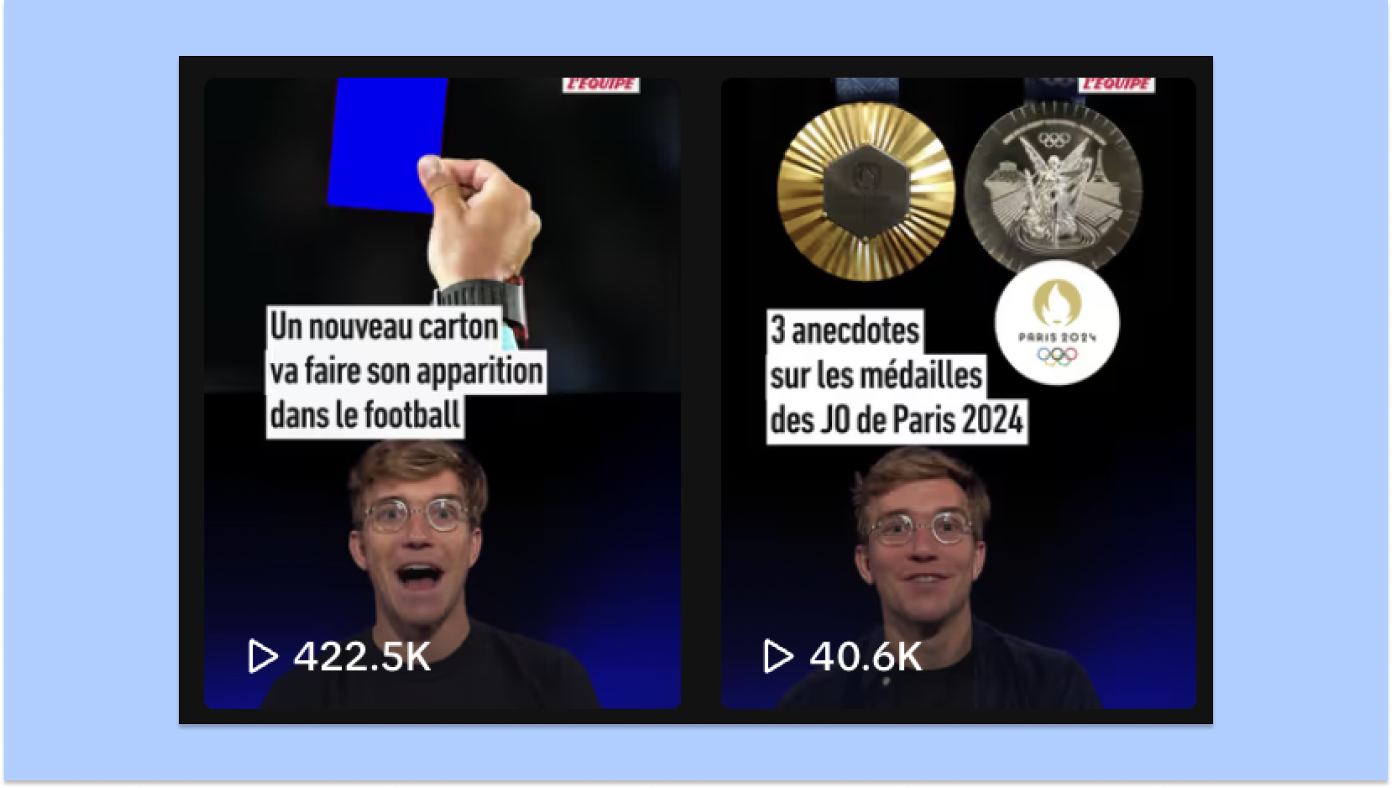
Since last summer and following the recruitment of journalist Paul Bonnaud, who previously worked in the newsroom of the online media outlet HugoDécrypte, the sports magazine L'Équipe has been producing personable videos on TikTok to make sports news more accessible.
Why is this interesting? Until now, L'Équipe's presence on TikTok was managed by a community management team. Following his recruitment, journalist Paul Bonnaud proposed to the editorial leadership to accelerate this strategy by personally creating the TikTok videos for the account. Hiring young journalists in key positions is one way to address mistrust of the media. Indeed, Generation Z expresses greater confidence in journalists who are like them. They understand the needs of their generation and are more inclined to adapt to their practices.
The quote: « There's a desire to rejuvenate the audience and reach people who aren't sports specialists. That's what I appreciate—that I can talk to people who don't follow sports 100%. I adopt that approach: subjects that spark my curiosity can spark others' curiosity too. I'm very independent, I choose my subjects, I write, I film, and I edit everything myself. » — Paul Bonnaud ; La Média'Tech.
- The BBC: a casting call to broaden its horizons
To discover new talent, the BBC launched an incubation program last summer for TikTok users interested in a career in television. Candidates had to meet certain criteria. A follower count above 50,000 or else a "positive creative or innovative impact on social media" was required to hope to secure a place. The 100 selected people benefited from two days of training during which they were able to meet stars from the British audiovisual group and work on their on-screen skills. Four journalists were subsequently hired by the BBC to form a team dedicated to TikTok. Objective? "Developing the BBC News TikTok account to make it the largest and best, both globally and in the United Kingdom, is one of News's main priorities for 2023," according to PressGazette.
Why is this interesting? Until now, the BBC had stayed away from TikTok due to lack of resources to create quality content and reluctance to make lightweight videos. The surge in misinformation following Russia's invasion of Ukraine changed things, meaning there was now a genuine public service mission to be on the platform. The BBC News TikTok account ultimately experienced the fastest growth of all major British and American news brands on TikTok since its launch and now has 2.6 million followers. The videos posted are either repurposed content from the channel, bespoke content created specifically for the platform, or live streams covering major events.
Embodied by the people involved
While young people are better positioned to speak to their peers, the same is true for people from specific communities. Differences in ethnicity, religion, and geographic location create different expectations among audiences regarding information. These differences play a key role in the degree of trust placed in media, with this trust being lower among people from marginalized communities, according to a Reuters Institute study published on April 18th.
• Among people from marginalized communities, many view news media as biased, sensationalist, or depressing.
• Mainstream media outlets are often considered aligned to serve those in power.
• A majority of respondents believe that journalists are out of touch and lack both the experience and knowledge necessary to understand their realities, or even that they hold prejudices.
• Many consider it urgent that media outlets improve diversity within newsrooms and leadership. However, several groups are skeptical of newsrooms that regularly communicate about these efforts.
• For the majority of respondents, local information sources represent their communities and interests more fairly.
• Young people tend to rely more on individuals—often not journalists—whose content is accessible via social media to highlight subjects that matter to them.
One solution is to let those directly affected embody the information. Beyond strengthening or even restoring trust with a specific audience, this strategy will make it possible to explain current events more precisely, sincerely, and in detail, with original perspectives and viewpoints not seen elsewhere.
And in practice?
- Kinky Hair Stories: exploring colonial history through a non-Western-centric lens
On YouTube, the media outlet Histoires Crépues led by artist Seumboy Vrainom explains colonial history using freely accessible web resources: academic articles, dictionary definitions, press archives, and non-Western-centric media. Their video series "Afriques Critiques", produced in partnership with Marie-Yemta Moussanang, founder of the documentary podcast Afrotopiques [supported by Médianes studio, editor's note], offers critical reflection on the concept of development through video conversations with ten African thinkers—whether economists, political activists, researchers, or sociologists.
Why is this interesting? By giving voice to those involved, this series makes it possible to address the subject as closely as possible to on-the-ground realities and concerns, while giving space to voices that are rarely heard. A way of offering perspectives closer to the lived experience of African audiences, and of enabling them to see themselves reflected and feel represented.
- Booska-P: passion first and foremost
Tired of seeing rap treated only through the lens of violence, rap enthusiasts created their own spaces. Initially without economic ambition, rap media (Grünt, Raplume, Booska-P, Yard…) became essential to popular culture. Among them, the giant Booska-P ranks in the top three most-followed media on Instagram and even interviewed Emmanuel Macron during the 2022 presidential election.
Why is it interesting? Because Booska-P owes its success to a culture of proximity that its journalists maintain with both artists and audiences. Most of them did not follow the traditional curriculum of major institutions and were recruited on the basis of passion. A way to break free from the social insularity of traditional newsrooms and, as a result, build a bond of trust with their young audience. All issues we also addressed at the second edition of the Festival Imprimé for engaged journalism, alongside Lise Lacombe (co-founder of the rap magazine Mosaïque), Mekolo Biligui (independent journalist and columnist for the rap show La Récré) and Emmanuelle Carinos Vasquez (doctoral researcher in social sciences, specialist in French rap and journalist for L'Abcdr du son).
Adapt existing content
It can be worthwhile to adapt content already published or broadcast by your media outlet to share on social networks. While this strategy works well for television programs, it can also apply to written formats, especially when they already contain illustrations such as maps or data visualizations. This approach typically requires minimal production constraints, yet can have the same impact as a highly produced and personalized video in terms of engagement and reach.
It's also a very effective way to capture the attention of users who aren't in the habit of consulting traditional media. In practical terms, for existing broadcasts, it's possible to extract key moments and integrate them into dynamic edits. Generally speaking, it can be useful to add subtitles to videos, caption them properly to improve their discoverability, and provide a link to the original content in the comments section, for example. An effective way to potentially direct new audiences to a media outlet while enabling more direct interaction with your audience.
And in practice?
- INA: archives to shed light on current events
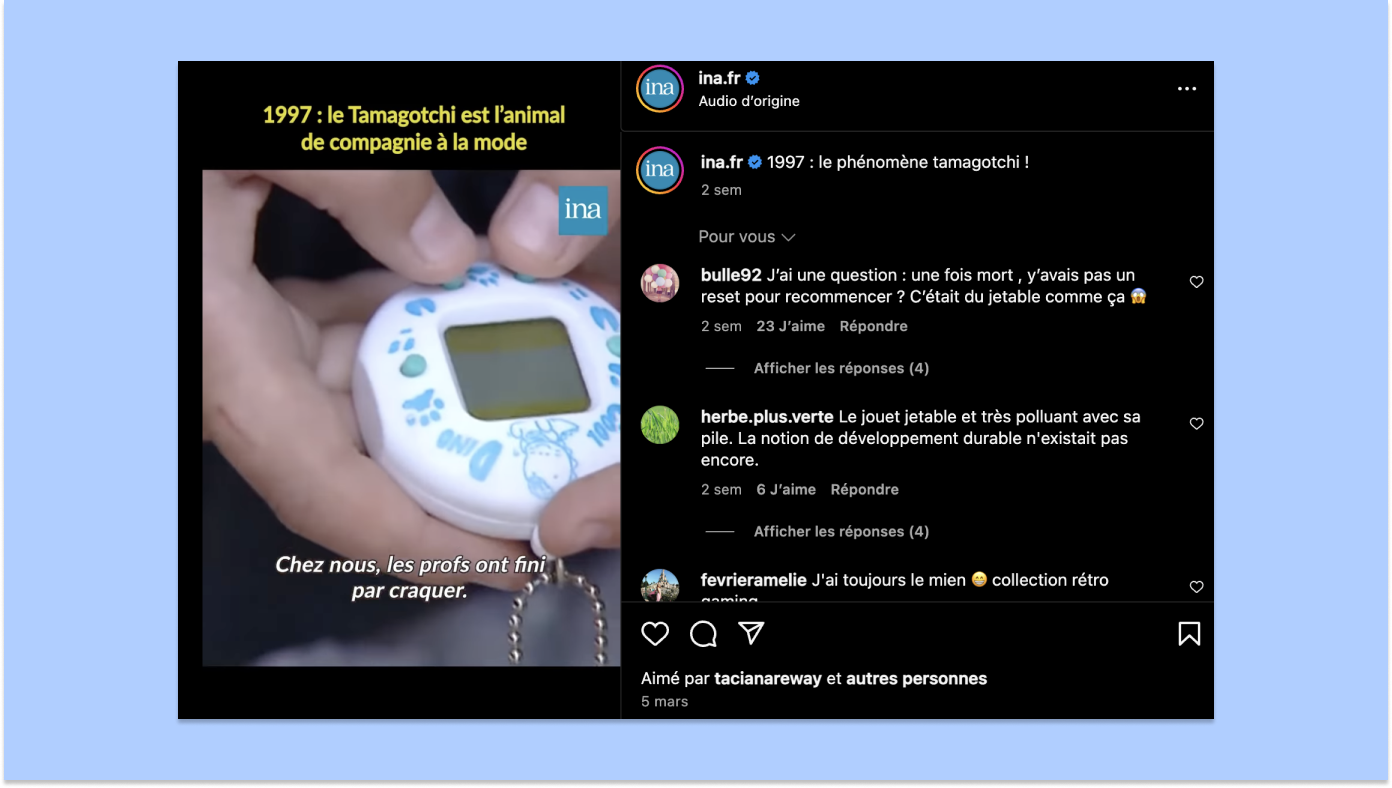
With nearly 425,000 subscribers on the platform and videos that in some cases reach 4 million views, the INA "has transformed into a cool media outlet that appeals to under-30s, thanks to its amazing and funny archives", Le Monde reports.
Why is it interesting? The Institute's strategy is to play with the nostalgic aesthetic of TV archives that social networks love, by publishing videos that resonate with current events: a way to maximize their visibility and engagement rates. A sign of recognition, their formats are widely imitated and repurposed. On Instagram, the humorous and parody account Miskin Télé (9,000 followers) regularly offers games in its stories where you have to guess the professions of people interviewed based on archives published by the INA on TikTok.
The quote: « Our operation then becomes that of a traditional media outlet, with an editorial meeting every day to determine how archives can shed light on current events: finding lines of rupture, of continuity, reminding [ourselves] that an event taking place may not be so unprecedented. […] we apply an internal rule when producing content, a little gimmick called the 3 Es: astounding, enlightening, moving. Our content must meet at least one of these three Es. » — Antoine Bayet, Editorial Director of INA; La Réclame.
- The Informed: making long economic investigations sexy
From its launch, the economic investigation media L'Informé, despite being recent and potentially unknown to the general public, accumulated more than two million views for just four videos published on TikTok. The media now has 21,500 followers on the platform and publishes an average of one video per week, almost systematically presented by video journalist Emeline Mauro.
Why is it interesting? The site publishes lengthy investigations on complex subjects. Nobody expected it on TikTok, so it's quite a surprise. Its goal is to help the public better understand the newsroom's revelations by summarizing and illustrating them. While not trivial, the topics are chosen based on what works on the platform: revelations about reality TV contestants, YouTubers, hosts, or celebrities well-known to the general public. A winning formula for showcasing existing content while making it accessible.
Multiply accounts
This strategy can be interesting for media organizations looking to offer content tailored to each audience segment rather than grouping videos with different formats and themes (investigation summaries, reports, recipes, games) on a single account. This segmentation makes it possible to reach specific audiences and build engaged communities around particular topics. Furthermore, it offers users a personalized experience based on their preferences, thereby strengthening loyalty and engagement.
It may therefore be wise to identify the most popular sections, topics, or journalists so as to create dedicated accounts for them on video platforms. Creating multiple accounts also allows each one to have its own editorial line, its own editing style, and its own way of engaging with the community, without being constrained by uniform visual and narrative standards.
And in practice?
- The New York Times: one account per section
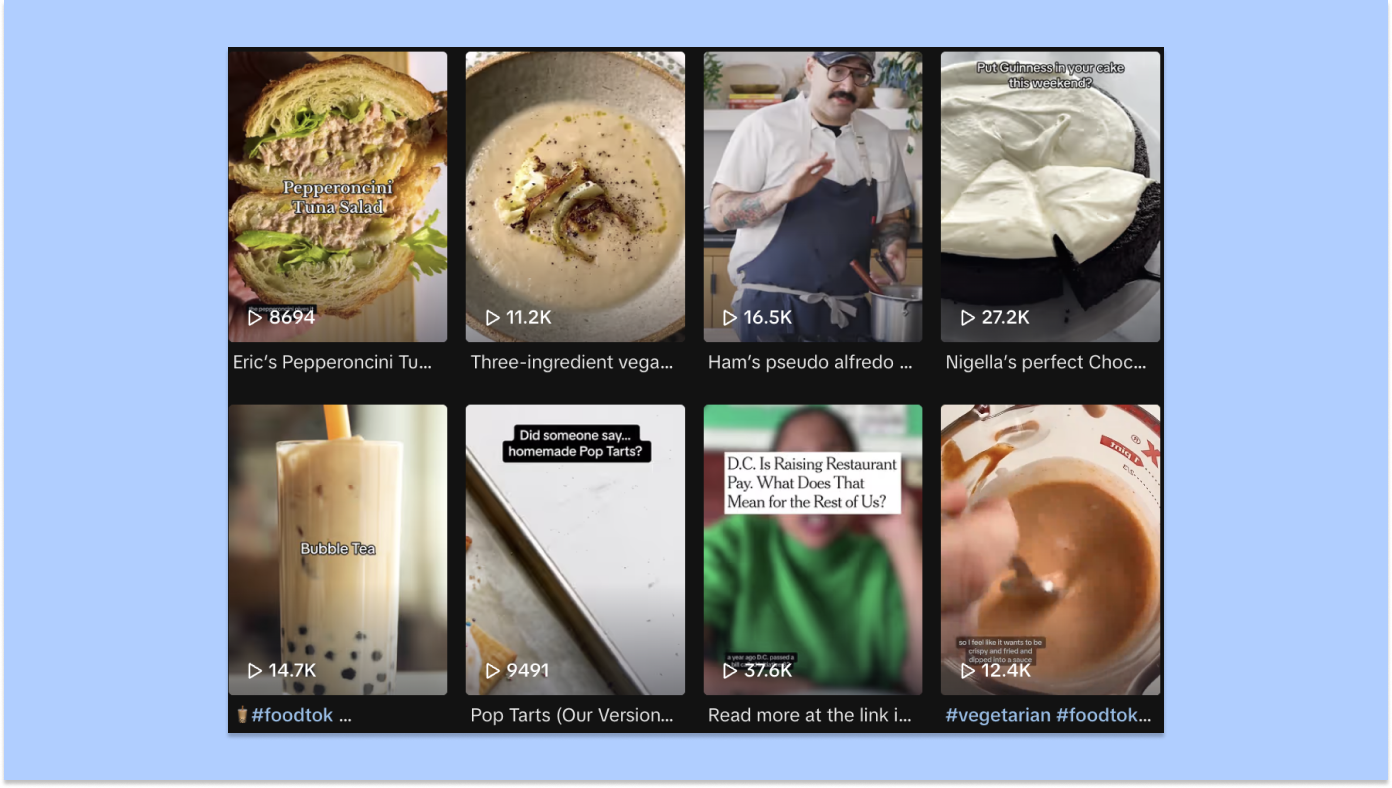
Totally absent from TikTok barely a year ago, the New York Times decided to employ an ambitious strategy and now offers a wide range of accounts on the platform. Its main account, @nytimes, has 590,000 followers, plus the 360,000 followers of the account linked to its "NYT Cooking" section, the 91,500 followers of the account linked to its "Wirecutter" section and the 25,000 followers of the account dedicated to its "Opinion" section. More recently, the New York Times also decided to spotlight its subscribers by creating a new account for them: @mynytimes. The publication shares behind-the-scenes content and highlights feedback and comments from its readers, such as their New Year's resolutions or their opinions on published recipes. Accounts have also been created for their podcasts, including "Hard Fork", their show dedicated to new technologies.
Why is this interesting? All these TikTok accounts make it possible to build different communities around specific topics, formats, or products, and to engage with the various audiences of a general-interest media outlet. Reaching a broad audience doesn't exempt you from having a strategy to target each of your segments. It's also a good way to attract younger audiences and make the publication more accessible and less impersonal through authentic content.
- France Télévisions: one account per presenter
Élise Lucet, a journalist at France Télévisions, has been running a TikTok account entirely dedicated to her since last November, where she answers questions from the public and shares behind-the-scenes stories from her investigations. Beyond discussing important topics like source protection and anti-SLAPP lawsuits, the presenter reveals some anecdotes about her work. On the platform, her videos have garnered hundreds of thousands of views, and the account now has 38,400 followers. Seeing this success, several other France Télévisions presenters now have their own accounts on the platform: this is the case for Caroline Roux, host of the show C dans l'air, and also Laurent Delahousse, presenter of the weekend editions of France 2's 8pm news.
Why is it interesting? These TikTok accounts complement France Télévisions' broadcasts. Following an episode about identity theft, Élise Lucet offered for example 3 tips to avoid falling victim to it. The accounts don't just post episode excerpts: all are tailored to the specific expectations of TikTok users, who are looking for a certain authenticity and dialogue with personalities on the platform. The group uses this to build trust and closeness with its star figures, particularly through behind-the-scenes content.
Have fun and give creativity room to flourish
In the end, that's perhaps what matters most. TikTok and Instagram offer a unique space of freedom to explore subjects in an unconventional and creative way. This approach not only captures audience attention, but also makes complex topics more accessible and memorable. For example, using everyday objects to illustrate concepts allows people to identify with the material easily and connect emotionally and directly with the subject at hand. Through their concrete and interactive nature, these playful methods also foster better understanding of the information delivered by journalists.
And in practice?
- Alternatives Économiques: Playmobils explaining the news
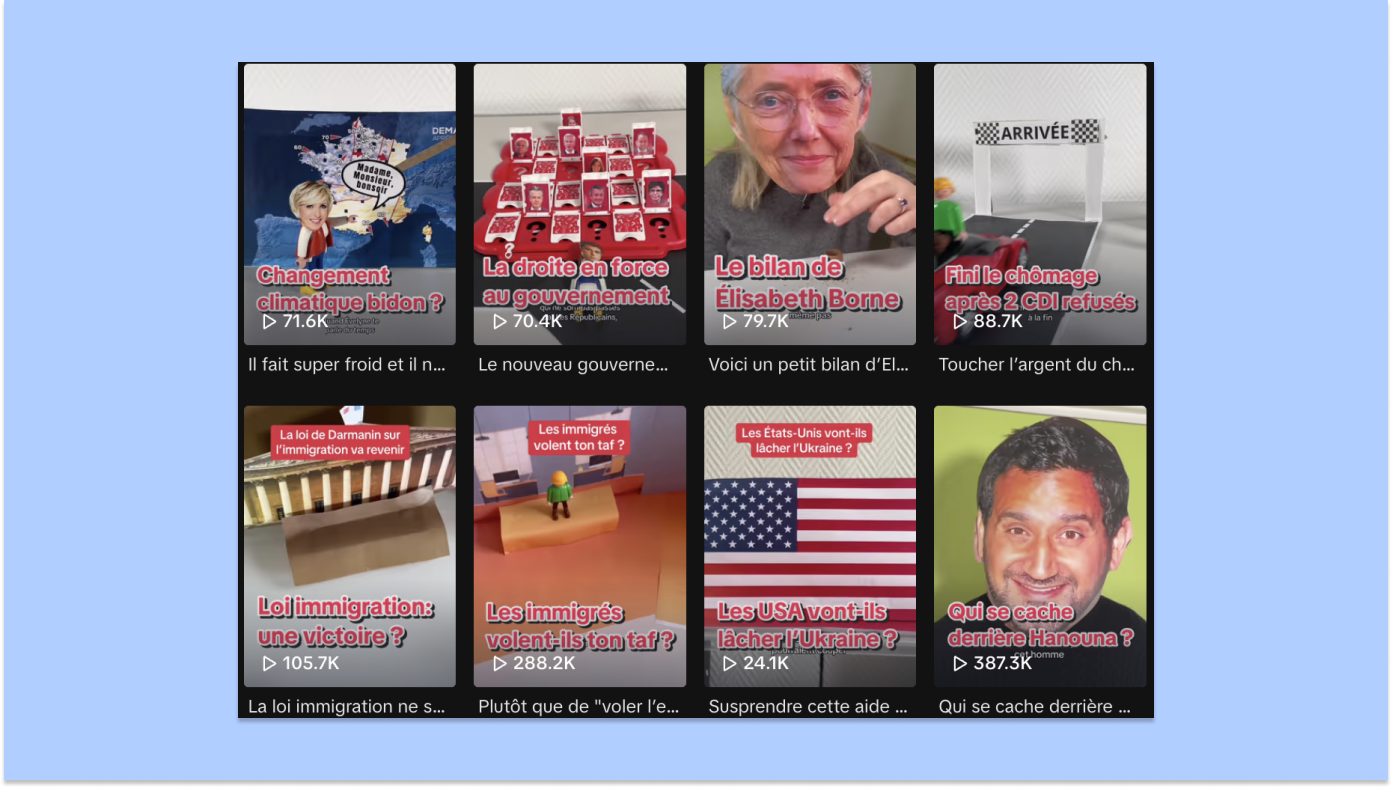
Noting a decline in its high school audience, Alternatives Économiques made the decision two years ago to hire journalist Rudy Pupin to manage its TikTok account. The project was immediately integrated into the media's marketing department as part of its strategy to boost brand awareness and image. The magazine specializing in economic and social issues now has nearly 120,000 followers on the platform, and its videos regularly exceed hundreds of thousands of views.
Why it's compelling? The recipe for success lies notably in the creativity in how subjects are illustrated: Rudy Pupin regularly uses Playmobils, modeling clay, fake sand, or rice to explain his topics. All everyday objects and DIY materials that allow the audience to engage with subjects and learn without even realizing it. Especially since even the most complex topics, like inheritance law or soil rights in Mayotte, attract large audiences. Enough to challenge the stereotypes that would suggest TikTok is only an appropriate platform for light subjects.
The quote: " I spend a lot of time choosing the right accessories and doing edits to make sure I'm speaking to everyone while maintaining journalistic rigor. "— Rudy Pupin; La Revue des médias.
- The Parisian: using comedic devices
In 2021, the daily newspaper Le Parisien called on Mathieu Hennequin, a journalist then twenty-five years old, to create and produce video content for the TikTok platform. The account now has nearly one million followers. Unusual reports, street interviews, explainer formats with voiceover… Like a news website that publishes breaking news briefs and long-form articles, the outlet adapts its formats to each subject, never forgetting the "TikTok touch" and its references to pop culture and current trends.
Why is this interesting? From its launch, the account stood out for its ability to engage audiences by using comedic devices like jokes, self-deprecation, and references to Internet trends. The whole balancing act consists of finding the right mix to avoid wearing out viewers.
The quote: " At first, my bosses thought I was too cautious. They'd tell me "loosen up, it needs to be funny" », says the 25-year-old video creator. Encouraged by positive feedback on his videos, the young man has even recently launched into stand-up comedy. " They're two different roles, he explains. At Le Parisien, I always ask myself how much a particular joke serves the account and fits with the newspaper's interests. If I perform a character, it's not out of ego. » — Mathieu Hennequin ; La Revue des médias.
Engage multiple services
Before diving headfirst into video, it can be helpful to take time to organize internally and gather insights from the people you work with who build your media daily. Certain departments or specialized journalists at your media outlet might surface ideas you wouldn't have thought of at first, whether it's tools, marketing challenges, or formats.
And in practice?
- Le Monde: betting on open source information techniques
Once the exclusive domain of written journalism, investigative reporting is increasingly taking shape through video formats. The daily newspaper Le Monde has just strengthened its open source video investigation unit (OSINT) by equipping itself with new image analysis tools to better cover international stories, with Ukraine leading the way.
Why is this interesting? Because beyond helping journalists embody their subjects and thus strengthening the trust bond with audiences, the tools enabled by video — visualization of scale, reconstructions, tracking — allow greater transparency in the investigation process, and therefore better audience engagement.
The quote: « Russia's invasion of Ukraine has brought home a fundamental truth: while the Internet is awash in misinformation, manipulation attempts and lies, it is also an extraordinary repository of original documents, verifiable public data and irreplaceable firsthand accounts, posted closest to reality. In short, an endless investigative landscape for uncovering new information. » — Le Monde.
- Les Échos: leveraging the expertise of different teams
While the business daily has no difficulty retaining its subscribers, with a renewal rate close to 100% in the B2B segment, Les Échos struggles to reach young people: its audience's average age is currently 50 years old. This challenge is all the more critical as it concerns the future of the daily newspaper in terms of readership and subscriptions. Based on this observation, the daily conducted several audience and market studies to define their target profile and information consumption habits. Once the data was collected, the team shifted into project mode by setting up several multidisciplinary working groups: editorial, audience, product, distribution, data…
Why is this interesting? To develop a new digital project, the key to success lies in mobilizing a range of skills. Facing the need to reach a new audience, the Les Échos team followed a structured project management methodology that enabled them to get up and running efficiently by leveraging all the expertise within their newsroom. Les Échos now produce engaging and accessible news video formats around ten minutes long distributed on their YouTube channel. In three months, the first four videos garnered 750,000 views, with a completion rate [An indicator that helps quickly identify content that resonates with audiences. The higher the rate, the more engaged users are, and the more likely they are to return and consume more content, Editor's note.] of 50% on YouTube and an average age between 25 and 35 years old. These videos are also distributed on social media in a trailer format lasting a few seconds. The audience is particularly receptive on LinkedIn, where there is already a highly engaged community of young active thirty-somethings.
To go further
- On TikTok, Kelsey Russell shares her passion: reading the print edition of the New York Times. Through her videos, she aims to reconcile the younger generation with print media. An initiative that hasn't gone unnoticed, particularly among media outlets.
- You too probably check out what other people are saying before deciding to buy a product? Your audience might have the same instinct with your comment section before reading an article or playing a video. Which is why it's worth making a vibrant, accessible and welcoming space.
- Media outlets are entrepreneurial projects that sometimes struggle to communicate about themselves. Yet it's a matter of public interest and an important marketing lever. Booska‑P, Les Jours, and Gimlet reveal their behind-the-scenes operations, and this formula works.
- The democratization of artificial intelligence, through the use of tools like ChatGPT, has prompted the press to react. How can we adopt this new array of tools without compromising information quality? Formats, approaches, debates, tools: an overview of uses.
- Violence, misinformation… the very nature of war calls on media to adopt differentiated coverage—whether to better serve their audiences or to ensure the wellbeing of their teams. Format, approach, tone, working conditions, tools: an overview of best practices.


